Last updated on November 6th, 2026 at 11:39 am
Why does a weekly shop that cost eighty dollars three years ago now cost a hundred and ten — and nobody in the supply chain seems to be losing money? The answer is not a single villain. It is a system, and it was built over decades. The best books about why groceries cost more do not offer quick fixes or dietary advice.
They follow the money: from subsidised commodity crops and consolidated meatpackers, through logistics networks and slotting fees, to the retail chains that now control what gets stocked, at what price, in what neighbourhood. These fifteen books map that system in full.
Table of Contents
Why Grocery Prices Are a Good Reading Hook
There is almost no better gateway into political economy than the grocery bill. It is one of the few data points where macroeconomics becomes inseparable from the personal.
When the price of eggs doubles in a year, or when a modest weekly shop quietly climbs past what felt possible two years ago, the abstract machinery of commodity markets, labour suppression, and retail consolidation becomes uncomfortably real.
Most of us, confronted with that reality, look for a single explanation.
Supply-chain disruption. Corporate greed. Pandemic aftershocks. Climate. Each of these is part of the story — but none of them, alone, is the story. The books about why groceries cost more that accumulate the most intellectual power are the ones that refuse to settle for a single villain.
They trace the entire system: how commodity agriculture created radical price distortions; how a small number of meatpackers, seed corporations, and retail chains consolidated power over decades; how nutritional science was captured by the very industry it was meant to regulate; and how the consumer — at the end of a chain stretching from seed to shelf — absorbs costs that have been manufactured, not found.
Food writing has a long history of operating at this intersection of the personal and the structural.
Eric Schlosser’s exposure of the fast food industry’s grip on American meatpacking in 2001 was not just an act of journalism — it reframed how a generation of readers understood price tags. Michael Pollan made commodity corn a philosophical problem. Marion Nestle turned food lobbying into a scholarly archive.
What has followed, especially in the post-2020 era of visible grocery inflation, is a body of work that is more urgent, more financially literate, and more internationally scoped than anything the genre has produced before.
The fifteen books assembled here span that entire tradition — from foundational texts to the most current analysis. Together, they constitute a full education in why food costs what it does: which is to say, why it costs far more than it should, for most of the people involved in producing it, and far less than it should, for the planet that absorbs its consequences.
“The books about why groceries cost more that accumulate the most intellectual power are the ones that refuse to settle for a single villain. They trace the entire system.”
— Sopranu Editorial
Visual: The Farm-to-Shelf Supply Chain
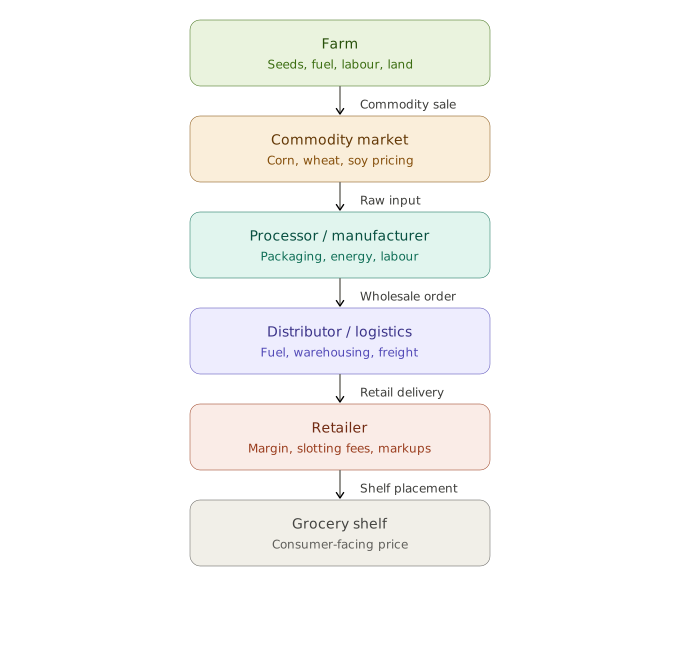
15 books about why groceries cost more
These titles are organised thematically — but every one addresses the core question of what food costs, who bears those costs, and why the system is built to keep it that way. This is the essential library for anyone serious about books about why groceries cost more.
1: Farming & Agricultural Power
01. The Omnivore’s Dilemma by Michael Pollan
Published in 2006
The Omnivore’s Dilemma is the book that mainstreamed food systems thinking. Pollan follows four meals — industrial, organic, pastoral, and wild — through their respective supply chains, revealing how commodity pricing, particularly around corn, distorts every price signal at the grocery store.
The chapter on industrial corn alone reshaped public understanding of how a single subsidised crop could quietly colonise the entire American diet. Canonical and consistently readable, this remains the standard entry point for food systems literacy.
02. Perilous Bounty by Tom Philpott
Published in 2020
Philpott explores and exposes the small handful of seed and pesticide corporations, investment funds, and magnates who benefit from the trends that imperil American farming.
A New York Times Book Review Editors’ Choice, praised by Eric Schlosser and Bill McKibben.
This is the book for understanding how agricultural fragility — the brittleness that feeds directly into grocery prices — was structurally engineered over decades of deregulation and consolidation in seed, chemical, and land markets.
03. Animal, Vegetable, Junk: A History of Food, from Sustainable to Suicidal by Mark Bittman
Published in 2021
A passionate, informed sweep from the earliest hunter-gatherer diets to the current industrialised food system — named a New York Times Book Review Editors’ Choice.
Bittman provides the historical arc that makes today’s pricing crisis legible: not a series of emergencies, but the accumulated consequence of choices made over centuries of turning food into an extractive industry.
The most historically grounded entry on the list, and essential for understanding why none of this is accidental.
2: Supply Chain & Logistics
04. Fast Food Nation: The Dark Side of the All-American Meal by Eric Schlosser
Published in 2001
Fast Food Nation is the foundational text of modern food systems journalism. Schlosser traced how fast food chains restructured meatpacking, supply chains, and labour — directly showing how industrial consolidation drives what consumers pay.
Written a quarter-century ago, its analysis of how a handful of chains reshaped the entire agricultural supply chain remains the starting point for the genre.
Its core insight — that cheap food for consumers requires suppressed wages and consolidated corporate power — has only become more relevant.
05. Raw Deal: Hidden Corruption, Corporate Greed, and the Fight for the Future of Meat by Chloe Sorvino
Published in 2022
Written by Forbes’ food and agriculture editor, this is the definitive account of meat pricing.
Sorvino argues the problem goes back nearly 50 years: USDA subsidies in the 1970s and a consolidation wave beginning in the 1980s resulted in a handful of companies controlling most of the beef, poultry, and pork industries.
The result: suppressed farm-gate prices, elevated retail prices, and a system where the companies in between capture most of the value. Essential reading for understanding meat price hikes specifically.
3: Retail Power & Supermarket Economics
06. The Secret Life of Groceries by Benjamin Lorr
Published in 2020
The most directly relevant title to grocery pricing specifically. The product of five years of research and hundreds of interviews across every level of the supermarket industry — from shrimping boats in Thailand to truck drivers to Trader Joe’s buyers — it is the only major book to take the supermarket itself as its primary subject.
Lorr delivers powerful social commentary on the American quest for more, and offers compassionate insight into the lives that provide it. Indispensable for any reader focused on supply chain books about food prices at the retail end.
07. Barons: Money, Power, and the Corruption of America’s Food Industry by Austin Frerick
Published in 2024
The most current and urgent entry on the list.
Frerick examines how retail consolidation concentrates power in the hands of a few companies while simultaneously driving down prices paid to farmers and restricting consumer access to healthy food.
Published in 2024, this is the book most directly calibrated to explain the post-2020 grocery price surge, tracing how the same consolidation dynamics that produced cheap food for decades have now flipped into a mechanism for sustained price inflation. Required reading for anyone asking why groceries cost more right now.
08. Food Politics: How the Food Industry Influences Nutrition and Health by Marion Nestle
Published in 2002
Nestle’s Food Politics is the field’s most authoritative academic voice, as far as I know.
With rigorous scholarly evidence, this book documents how food corporations capture regulatory bodies, distort nutritional guidance, and use lobbying to protect pricing power and market access.
Understanding food politics means understanding why the companies that sell you food face so little regulatory constraint on how they price it.
Essential scholarly backbone for any serious engagement with food systems, and the book that made Nestle the pre-eminent critic of the industry.
4: Inflation, Global Systems & Political Economy
09. Salt Sugar Fat: How the Food Giants Hooked Us by Michael Moss
Published in 2013
A Pulitzer Prize–winning journalist’s forensic account of how Kraft, Nestlé, General Mills, and their peers engineer products for addiction and market dominance. One of the highest-rated food nonfiction titles on Goodreads.
The pricing implication is direct: once a manufacturer engineers a product for maximum craveability, consumers become captive purchasers, and the company can price accordingly.
This is the book that explains why processed food companies wield such extraordinary pricing power — not despite making inferior products, but because of how those products are designed.
10. Ultra-Processed People by Chris van Tulleken
Published in 2023
A medical doctor’s forensic, science-led investigation into how ultra-processed food — cheap to produce, expensive to resist — has colonised global diets.
Van Tulleken’s central argument is that solutions must be rooted not in individual choices but in the global systems that have made ultra-processed food so prevalent and so apparently affordable.
A rigorous complement to Moss’s journalism: where Moss exposes the corporate engineering, van Tulleken documents the biological capture. Together they explain why so much of the grocery aisle is designed to cost you more than you intended to spend.
11. Stuffed and Starved by Raj Patel
Published in 2007 (revised)
Patel examines the paradox of simultaneous global hunger and obesity as twin products of the same concentrated food market. Globally scoped, analytically rigorous, and widely assigned in university food systems courses.
The key insight — that the same supply chain structures that produce obesity in wealthy nations produce hunger in poorer ones — is among the most important frameworks in the food systems literature.
Essential for readers who want to move beyond the American context to understand how food pricing works as a global political problem.
12. The Way We Eat Now by Bee Wilson
Published in 2019
Wilson presents a remarkable array of data — often in unusual and striking visual forms — and delivers numerous surprises about how eating patterns have shifted globally.
Praised across the political spectrum by the New York Times and The Times (UK). Particularly strong on how food systems intersect with social inequality and the affordability crisis: why it is that the wealthiest countries, with the most food, also have the worst access to genuinely nourishing eating for their poorest citizens.
Among the most globally scoped and accessible titles on the list.
13. In Defense of Food: An Eater’s Manifesto by Michael Pollan
Published in 2008
Pollan’s accessible follow-up to The Omnivore’s Dilemma argues that nutritional science and industrial processing have together displaced real food — and explains why processed substitutes are cheap while genuinely nutritious food has become expensive.
Widely read and briskly written, it is the best entry point for food systems books for beginners, particularly those approaching the topic from a health angle who want to understand the economic architecture behind what they are being sold.
A short book that repays its reading time many times over.
14. A History of the World in Seven Cheap Things by Raj Patel & Jason W. Moore
Published in 2017
The most theoretically sophisticated entry on this list.
Patel and Moore argue that capitalism has historically maintained itself by making nature, money, work, care, food, energy, and lives artificially cheap — offloading true costs onto the environment and onto labour.
\Their analysis explains why grocery prices appear low yet the actual costs are borne by ecosystems, by farmworkers, and by communities downstream of industrial agriculture.
Challenging but genuinely rewarding; the only title here that explains the grocery bill as a philosophical and civilisational problem.
15. What to Eat Now by Marion Nestle
Published in 2025
An update to her 2005 What to Eat, this 720-page volume is the most current comprehensive reference on the list.
Nestle critiques the contemporary food system driven by business interests that prioritise the marketing of profitable, highly processed food over public health, arguing that this system creates disparities in food access and contributes to global nutritional failures.
From the field’s most authoritative academic voice, this is the book to reach for when you want everything: history, policy, science, and retail economics, synthesised by the person who has spent a career mapping the territory.
Glossary of the key terms that appear across these books
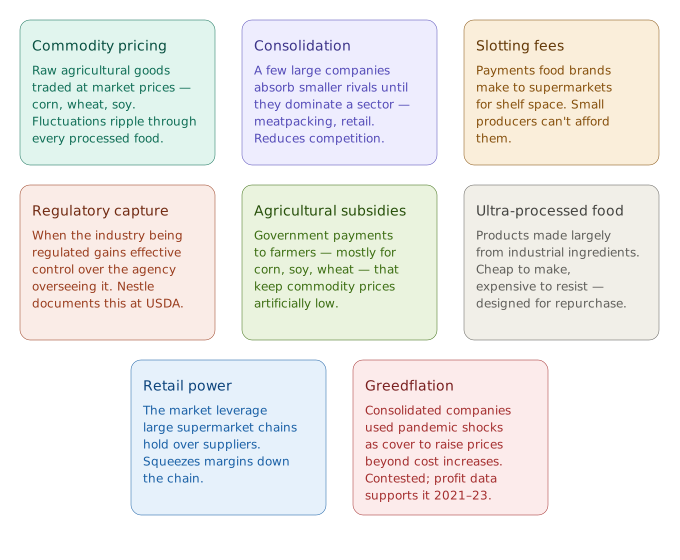
At a Glance: Books by Theme and Reader Type
If you are looking for books about grocery inflation through a specific lens — whether that is supply chain, farming, science, or global systems — this table maps the list to your need.
| Book | Primary Focus | Best For | Difficulty |
|---|---|---|---|
| Fast Food Nation by Schlosser | Supply chain / labour | First-time food systems readers | Accessible |
| The Omnivore’s Dilemma by Pollan | Industrial vs. alternative farming | Narrative readers, students | Accessible |
| Salt Sugar Fat by Moss | Corporate food engineering | Consumer advocacy readers | Accessible |
| Food Politics by Nestle | Regulatory capture / lobbying | Policy and academic readers | Moderate |
| Stuffed and Starved by Patel | Global food inequality | International development readers | Moderate |
| The Secret Life of Groceries by Lorr | Supermarket economics | Anyone buying groceries | Accessible |
| Barons by Frerick | Post-2020 price surge | Current-affairs readers | Accessible |
| Ultra-Processed People by van Tulleken | Food science / biology | Health-focused readers | Moderate |
| Raw Deal by Sorvino | Meat industry consolidation | Financial journalism readers | Accessible |
| Animal, Vegetable, Junk by Bittman | Historical sweep | Big-picture history readers | Accessible |
| In Defense of Food by Pollan | Nutritional science & food cost | Beginners: food systems books for beginners | Accessible |
| Perilous Bounty by Philpott | Agricultural fragility | Farming-system readers | Moderate |
| The Way We Eat Now by Wilson | Global dietary shift | Data-driven general readers | Accessible |
| Seven Cheap Things by Patel & Moore | Political economy | Theoretical / academic readers | Advanced |
| What to Eat Now by Nestle | Comprehensive reference | Scholars, serious general readers | Moderate–Advanced |
Who This List Is For — and Who Should Look Elsewhere
Best For:
- Readers frustrated by rising grocery bills who want structural explanations
- Students in food policy, public health, or economics courses
- Anyone interested in supply chain books about food prices
- Journalists, researchers, and writers covering food systems
- Readers who have finished one food book and want to go deeper
Not Ideal For:
- Readers seeking recipes or practical cooking guidance
- Those wanting a single, quick explanation for rising prices
- Readers who prefer fiction-style narrative above analysis
- Those only interested in personal nutrition, not systems
10 Honourable Mentions
These are all verified, credible titles that are strong on one or two of the selection criteria but were displaced from the main fifteen for reasons of scope, specificity, or overlap. Any of them would be a worthy addition to a reading list built from the books above.
1. Eating Animals by Jonathan Safran Foer · 2009
Powerful on factory farming ethics and costs, but primarily moral in framing rather than economic.
2. The Third Plate by Dan Barber · 2014
A chef’s visionary argument for sustainable American cuisine. Prescriptive rather than diagnostic; targets food professionals more than general readers.
3. Tomatoland by Barry Estabrook · 2011
Masterful single-commodity deep dive into how industrial monoculture and labour exploitation shape supermarket prices. Narrower scope than the main 15.
4. Grocery by Michael Ruhlman · 2017
Engrossing tour of grocery aisles, but focuses largely on a single upscale Midwestern chain and does not represent the full breadth of food retail.
5. The Fate of Food by Amanda Little · 2019
Rigorously reported on climate and future food production. More forward-looking than explanatory of current price dynamics.
6. Regenesis by George Monbiot · 2022
Radical argument for replacing industrial agriculture with lab-grown alternatives. Important, but more polemical than analytical.
7. The End of Food by Paul Roberts · 2008
A rigorous economic and systems analysis of global food supply fragility. Slightly dated but prescient; more technical than accessible.
8. Eating Tomorrow by Timothy A. Wise · 2019
Deeply researched on how trade regimes harm smallholder farmers and raise food prices in developing nations. Narrower audience than the main 15.
9. Diet for a Small Planet by Frances Moore Lappé · 1971 (revised)
The grandmother of food systems writing. Dated in some specifics, but historically foundational — essential context for understanding how this conversation began.
10. Bet the Farm by Beth Hoffman · 2021
Accessible memoir-journalism on what it actually costs to run a small American farm — explaining from the farmer’s side why grocery prices are too high for consumers yet too low for producers.
Editorial Verdict
If you read one: The Secret Life of Groceries (Lorr) or Barons (Frerick) — depending on whether you want the fullest human portrait of the system, or the sharpest current analysis of why prices are where they are. If you read two: add The Omnivore’s Dilemma for the agricultural foundation. If you read five: add Food Politics and Salt Sugar Fat, and you will have covered every layer of the chain. These are, collectively, the books about why groceries cost more that the conversation needs.
FAQs
1. What are the best books about why groceries cost more for a complete beginner?
Start with In Defense of Food by Michael Pollan — short, accessible, and explains the economic logic of why processed food is cheap while real food is expensive.
Follow it with The Secret Life of Groceries by Benjamin Lorr, which takes you through the entire supermarket supply chain at a readable pace. Between them, they cover the industrial logic and the retail mechanics without requiring any prior knowledge of food policy or economics.
2. Are there supply chain books specifically focused on food prices, not just food culture?
Yes. Raw Deal by Chloe Sorvino is written from a financial journalism perspective and focuses directly on how meatpacking consolidation drives retail prices. Barons by Austin Frerick examines supermarket consolidation and its pricing consequences. The Secret Life of Groceries traces the entire logistics chain.
All three are solidly grounded in the economic mechanics of supply chain books about food prices rather than cultural or ethical framing.
3. Which books focus specifically on books about grocery inflation in the post-2020 context?
Barons (Frerick, 2024) is the most directly calibrated to the post-pandemic price surge, analysing how existing consolidation dynamics produced and then extended grocery inflation.
What to Eat Now (Nestle, 2025) provides the most current comprehensive overview. Ultra-Processed People (van Tulleken, 2023) and Raw Deal (Sorvino, 2022) both address the structural conditions behind recent price rises in specific categories.
4. Why do grocery prices keep rising even after supply chains stabilised post-pandemic?
The books on this list point to several structural answers that outlast any single disruption. Retail consolidation — a small number of chains controlling most of the market — allows companies to sustain higher prices without competitive pressure to reduce them.
Corporate processing power in meat and grain means farmers receive less while consumers pay more. And what economists have called “greedflation” — the use of genuine inflation as cover for additional margin expansion — was documented across the food industry in 2021–23. Barons, Raw Deal, and Food Politics address this most directly.
5. Is there a single book that covers the entire food system — farming, processing, retail, and health?
What to Eat Now by Marion Nestle (2025) is the closest to a comprehensive single reference, at 720 pages. For a more readable synthesis at shorter length, Animal, Vegetable, Junk by Mark Bittman provides a historical sweep that covers all phases.
The Omnivore’s Dilemma covers farm-to-table for four different food chains in rich detail. Realistically, the full picture emerges from reading two or three titles across the categories — which is precisely why this list is organised thematically.
6. Are these food systems books for beginners, or do they require specialist knowledge?
The majority are written for a general educated readership. Schlosser, Pollan, Lorr, Moss, Bittman, Sorvino, and Wilson all write as journalists or narrative nonfiction authors — no prior knowledge is assumed.
The academic end of the list — Nestle’s Food Politics, Patel and Moore’s Seven Cheap Things — is more demanding, but rewarding for readers who want the theoretical underpinning. The comparison table above rates each book’s difficulty and can help you sequence your reading.