
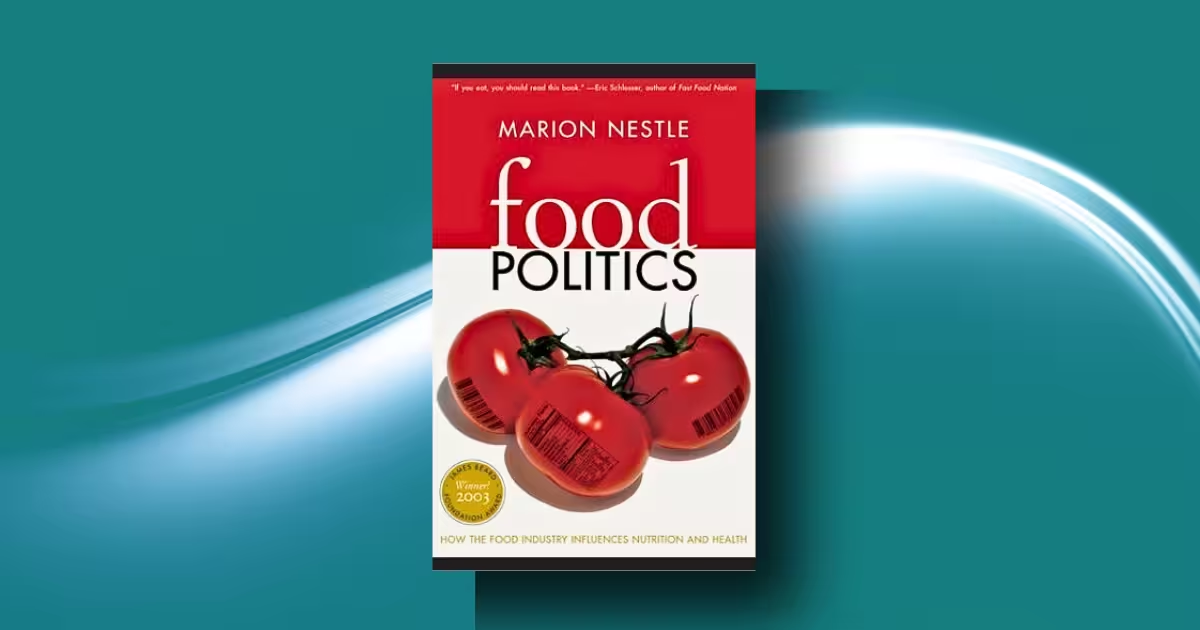
Why does trying to eat healthy often feel like swimming against a powerful current? What if the food industry’s relentless pursuit of profit is the primary reason nutrition advice seems confusing, and the deck is deliberately stacked against your personal willpower? Marion Nestle investigates the reasons through her Food Politics.
Food Politics is best for consumers tired of feeling manipulated, parents navigating school lunch politics, health professionals seeking the real story behind dietary guidelines, activists ready to challenge corporate power, and anyone who has ever wondered why common sense about food never seems to win.
Not for readers looking for a quick-fix diet book, industry apologists, or those who prefer to believe that food choices are solely a matter of personal responsibility.
Table of Contents
Introduction: A Book That Dare to Name the Enemy
Published by the University of California Press, Food Politics: How the Food Industry Influences Nutrition and Health by Marion Nestle (no relation to the corporation) is a groundbreaking exposé that first appeared in 2002, with revised editions following in 2007 and 2013.
Nestle, a professor of nutrition, food studies, and public health at New York University, brings rare authority to this work. She previously served as a nutrition policy advisor to the U.S. Department of Health and Human Services and managed the editorial production of the 1988 Surgeon General’s Report on Nutrition and Health.
The book’s central thesis is as simple as it is provocative: food is political.
Nestle argues that the primary mission of food companies is to sell products, not to promote health. Consequently, the industry systematically works to influence government dietary advice, co-opt nutrition professionals, market aggressively to children, deregulate products like dietary supplements, and create “techno-foods” that appear healthy but perpetuate overconsumption.
According to the introduction, Food Politics is about “how the food industry influences what we eat and therefore influences our health”. It is, as Julia Child famously declared, “a courageous and masterful exposé”. The book laid the groundwork for today’s food revolution and changed how we respond to food industry marketing practices.
Background: The Paradox of Plenty
To understand the book’s argument, you must first grasp a shocking statistic: the U.S. food supply provides close to 3,900 calories per person per day, an amount roughly twice the average need. This overabundance, or what historian Harvey Levenstein termed the “paradox of plenty,” creates a fierce competitive environment where companies must convince people to eat more of their products, not less.
As Nestle states bluntly, “eating less—a principal strategy for managing weight—is very bad for business”.
Traditionally, we believe we choose foods for personal taste, convenience, and cost. Nestle argues that this belief ignores the billions of dollars spent to manipulate those choices. She makes an uncomfortable comparison: “Food companies will make and market any product that sells, regardless of its nutritional value or its effect on health. In this regard, food companies hardly differ from cigarette companies”.
This central analogy infuriates critics but is undeniable when you examine the tactics.
Food Politics Summary: What You Will Learn
Nestle does not just state her thesis; she proves it through meticulous research and case studies. Here is what I learned from the book, broken down by its thematic sections.
Part 1: Undermining Dietary Advice
Nestle begins by revealing that basic dietary advice has remained consistent for over fifty years: eat more fruits and vegetables and avoid overweight. Yet public confusion is rampant. She argues this confusion is a deliberate outcome.
The chapter traces the shift from “eat more” to “eat less” advice. In 1977, the McGovern committee issued Dietary Goals for the United States, recommending reduced consumption of meat, eggs, and dairy. The backlash was immediate. Nestle quotes Senator Robert Dole negotiating with a cattleman: “SENATOR DOLE: I wonder if you could amend No. 2 and say ‘increase consumption of lean meat’? Would that taste better to you? MR. FINNEY: Decrease is a bad word, Senator”.
This leads to the infamous 1991 Food Guide Pyramid case study. The USDA’s original pyramid design placed meat and dairy at the narrow “eat less” tip. Under pressure from the National Cattlemen’s Association and the National Milk Producers Federation, the Bush administration killed the graphic.
Nestle reveals the inside story: “The secretary had ‘also learned of the Pyramid for the first time in Saturday’s paper. ‘I bet a lot of you were surprised,’ he said to the ranchers… ‘I’m the Secretary of Agriculture, and I was surprised too’… The cattlemen complained that the Pyramid would cause people to eat less meat”.
After a costly $855,000 research project, the USDA released a revised pyramid with the serving numbers moved outside the design, increasing the recommended allowance for meat. This, Nestle argues, is politics masquerading as science.
Part 2: Working the System
This section exposes how the food industry buys influence. Nestle documents the “revolving door” between government and industry, citing the former president of the National Cattlemen’s Association appointed as chief of the USDA’s Food Marketing and Inspection Division.
She also reveals the power of soft-money campaign contributions, noting that “agribusiness contributions go preferentially to members of House and Senate Agriculture Committees”.
Perhaps most damning is her analysis of how food companies co-opt nutrition professionals. She cites the American Dietetic Association (ADA), which accepted sponsorship from McDonald’s for “Happy Meals” and allowed corporate funding for its educational fact sheets. One internal explanation noted that “the first draft of the fact sheet may be submitted by the funder or PR agency staff”.
Nestle’s conclusion is unavoidable: when professional organizations depend on industry funding, their ability to offer unbiased advice is severely compromised.
Part 3: Exploiting Kids, Corrupting Schools
This section is the most emotionally resonant. Nestle details how food companies view children as “underage consumers” and systematically market to them. She cites a marketing executive who justifies advertising to children as “nothing less than primary education in commercial life”.
The chapter on “pouring rights” is particularly shocking. Nestle explains how school districts, starved for funding, sign exclusive contracts with soft drink companies like Coca-Cola and Pepsi. In return for millions of dollars, schools grant the companies the right to sell only their products on campus. One Colorado district administrator, signing himself “The Coke Dude,” announced payments to principals with a memo stating: “If 35,439 staff and students buy one Coke product every other day for a school year, we will double the required quota”.
As a result, school vending machines directly compete with federally subsidized meal programs. Nestle notes that “soft drinks have replaced milk in the diets of many American children”, and researchers calculate that “for each additional soda consumed, the risk of obesity increases 1.6 times”.
Part 4: Deregulating Dietary Supplements
Nestle turns her attention to the supplement industry, which achieved a stunning political victory with the Dietary Supplement Health and Education Act (DSHEA) of 1994. This law fundamentally shifted the burden of proof from the manufacturer to the FDA.
Under DSHEA, “manufacturers did not need to demonstrate that their products were safe before selling them.” Instead, “Congress required the FDA to prove that products were unsafe before the agency could order them removed from the market”.
This deregulation, Nestle argues, has created a marketplace where consumers are unprotected. The law allows “structure/function” claims—such as “supports immune health”—without requiring scientific evidence of efficacy.
The result is a multi-billion dollar industry built on marketing, not medicine.
Part 5: Inventing Techno-Foods
The final section critiques “functional foods” or “techno-foods”—processed items fortified with vitamins, fiber, or herbal supplements to appear healthy. Nestle uses the case of olestra, Procter & Gamble’s zero-calorie fat substitute, to illustrate the absurdity. The FDA approved olestra after a 30-year struggle, but required a warning label: “Olestra may cause abdominal cramping and loose stools”.
Nestle argues that these foods are a “techno-fix” that distracts from the real solution: eating a balanced, plant-based diet. She quotes her colleague Joan Gussow: “eating healthfully is neither complicated, nor time-consuming, nor punishing. And we don’t need any more new products to do it”.
Conclusion: The Politics of Food Choice
Nestle concludes by listing the industry’s standard talking points: “the keys to healthful diets are balance, variety, and moderation… there is no such thing as a good or a bad food”.
She urges readers to reject this framework. The solution, she argues, is not just personal willpower but political action: reforming campaign finance laws, banning commercials for junk food aimed at children, taxing soft drinks, and demanding that schools serve real food.
Food Politics Analysis
Food Politics is an unsettling masterpiece. It is not a breezy read; it is dense, meticulously referenced, and often infuriating. Yet its power lies in its methodical demolition of the myth of personal responsibility. Nestle’s writing is clear and impassioned, but she never relies on emotion. She lets the documents speak for themselves.
The book is also a testament to the power of a single voice. Nestle was criticized as a “food nanny” and a “dictator” by industry shills, but she persevered. Her work has directly inspired the modern food movement, from Michelle Obama’s “Let’s Move” campaign to the growing demand for GMO labeling.
Nevertheless, the book has a significant weakness: it is almost too depressing. The sheer scale of corporate influence can leave the reader feeling hopeless.
Additionally, the 2013 edition is already a decade old, and while the fundamental analysis remains sound, some of the data on lobbying expenditures and specific industry tactics have evolved.
Strengths and Weaknesses
Strengths:
Unmatched Documentation: Nestle provides hundreds of pages of notes and citations. You cannot argue with her facts.
Clear Explanation of Complex Policy: She makes arcane subjects like “pouring rights” and “DSHEA” accessible and dramatic.
Courageous Stance: She names names and criticizes powerful institutions without apology.
Weaknesses:
Dense Prose: Some sections read like a government report, which can be dry.
Lack of Solutions: The conclusion is relatively brief compared to the exhaustive analysis of the problem. The reader is left asking, “So what do I do tomorrow?”
Dated Examples: While the principles hold, references to specific legislation from the 1990s can feel remote to a younger reader.
Comparison with Similar Works
Food Politics is frequently compared to Eric Schlosser’s Fast Food Nation (2001). While Schlosser focuses on the supply chain and labor practices of the fast-food industry, Nestle focuses on the regulatory and political capture of nutrition science.
Michael Pollan’s The Omnivore’s Dilemma (2006) is a more philosophical and journalistic exploration of the food chain, whereas Nestle’s work is a surgical dissection of policy. For a more recent complement, read Michael Moss’s Salt, Sugar, Fat (2013), which details the food engineering behind addiction.
Conclusion: A Final Recommendation
Food Politics is not a diet book. It will not tell you to eat kale or quinoa. Instead, it will fundamentally rewire your perception of every grocery store aisle and every commercial break. If you have ever felt guilty for being confused about nutrition, this book will liberate you by showing you that the confusion is manufactured.
Who will benefit from reading this book?
General audiences who want to understand why they are overweight and confused.
Parents who want to fight for better school lunches.
Health professionals who need to understand the source of their own funding.
Activists looking for a blueprint for change.
Policy students seeking a case study in regulatory capture.
Do not read this book if you are looking for a quick fix. But if you are ready to understand the true nature of the American food system, Marion Nestle has provided the definitive guide.
As Michael Pollan writes in the foreword, “The book you hold is one of the founding documents of the movement to reform the American food system”.







