
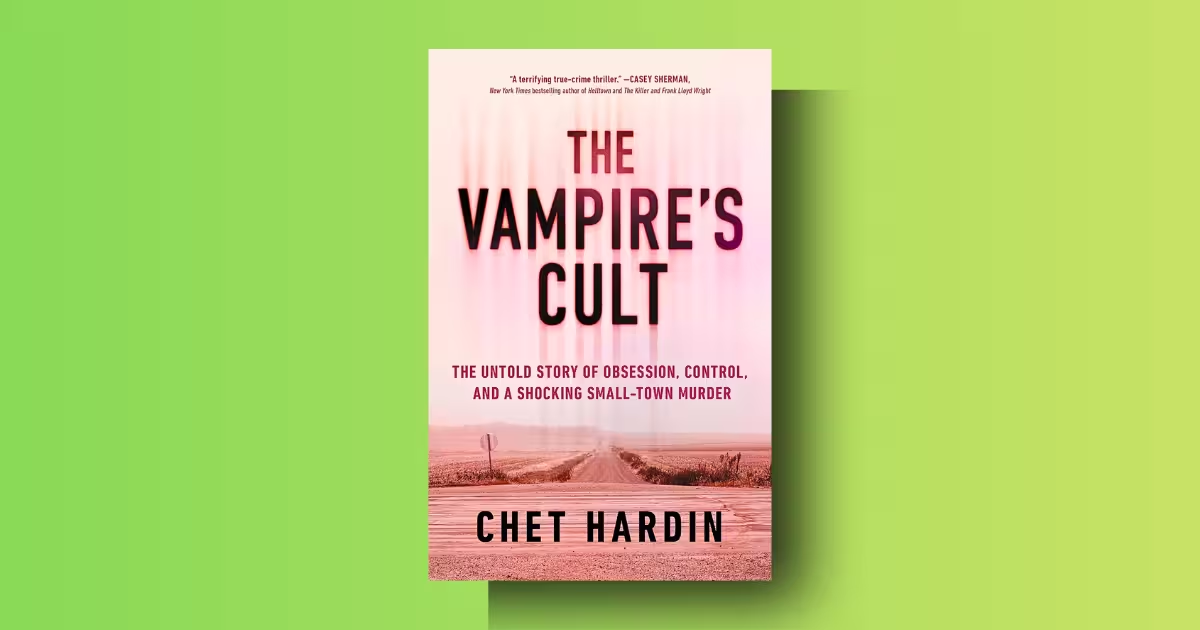
Why does a charming con artist convince intelligent young women to believe in vampires, witchcraft, and murder, and what does this say about the dark side of human nature? Chet Hardin’s The Vampire’s Cult reveals the reasons behind the chilling crimes.
Overview
Chet Hardin’s The Vampire’s Cult is a meticulously researched true crime narrative that unravels the horrifying story of Aubrey Trail, a fifty-two-year-old felon and self-proclaimed vampire, and his young accomplice Bailey Boswell.
Published by Sourcebooks in 2026, this book documents the 2017 murder of twenty-four-year-old Sydney Loofe, a small-town Nebraska woman who was lured through Tinder to a gruesome death, dismembered, and scattered across farmland.
What sets this book apart from typical true crime fare is Hardin’s deep exploration of psychological manipulation, coercive control, and the disturbing allure of magical thinking.
Through extensive interviews with the convicted killers, their victims, law enforcement, and family members, Hardin constructs a narrative that is both deeply unsettling and profoundly educational.
The book’s central thesis argues that Aubrey Trail was not merely a murderer but a master manipulator who weaponized fantasy, fear, and false promises to control vulnerable young women.
His “coven of witches”—entirely fabricated, served as both a carrot and a stick, offering belonging and power while threatening supernatural punishment. The book forces readers to confront uncomfortable questions about vulnerability, trust, and the human capacity for self-deception.
Key Figures:
- Sydney Loofe: 24-year-old murder victim, dismembered into 14 pieces
- Aubrey Trail: 52-year-old convicted murderer, sentenced to death
- Bailey Boswell: 23-year-old accomplice, sentenced to life without parole
- Trial Timeline: June 2019, lasted three weeks with fifty witnesses
- Body Discovery: December 4, 2017, nineteen days after disappearance
- Sentence: Trail received death penalty (June 2021); Boswell received life plus 52 years (November 2021)
Reader recommendation
The Vampire’s Cult is best for:
- True crime enthusiasts seeking a deeply psychological exploration of cult dynamics
- Readers interested in understanding coercive control and manipulation tactics
- Those who appreciate meticulously researched investigative journalism
- Psychology and sociology students studying criminal behavior and victimology
- Fans of books like Helter Skelter or I’ll Be Gone in the Dark
The Vampire’s Cult cannot be suggested to:
- Readers sensitive to graphic descriptions of violence and dismemberment
- Those seeking a quick, light read—this is an intense, emotionally heavy narrative
- Individuals who prefer straightforward whodunits without psychological depth
- Readers uncomfortable with explicit discussions of sexual manipulation and abuse
- Those looking for a definitive answer about Bailey Boswell’s level of culpability
Table of Contents
Introduction
The Vampire’s Cult: The Untold Story of Obsession, Control, and a Shocking Small-Town Murder was published by Sourcebooks in 2026.
The author, Chet Hardin, is a journalist specializing in reporting on “bad ideas and worse people.” His background includes years in the newspaper industry, construction, politics, technology, and coffee—an eclectic mix that suggests a writer who understands people from all walks of life.
Hardin’s approach to journalism, which he describes as “crate digging” in reference to old-school rap DJs, involved spending years exploring every facet of the story.
Context of The Vampire’s Cult
At its core, The Vampire’s Cult is a true crime narrative that documents the murder of Sydney Loofe and the subsequent investigation, trial, and conviction of Aubrey Trail and Bailey Boswell.
However, the book transcends the typical true crime genre by examining the psychological mechanisms that allowed Trail to manipulate vulnerable young women into believing in his fabricated world of witches, vampires, and supernatural powers.
The murder itself captured public fascination across Nebraska and beyond. According to the book, Sydney was “a pretty young woman, twenty-four years old, a small-town girl from a good family who had been catfished on Tinder and lured to a gruesome death.” Her body was dismembered and scattered in ditch rows and farmland outside Wilber, Nebraska. The case made national headlines, with media outlets comparing Trail to Charles Manson and speculating about blood-drinking rituals.
Purpose of The Vampire’s Cult
Hardin’s stated purpose appears to be multiple-fold: to honor Sydney Loofe’s memory, to document the full scope of Trail and Boswell’s crimes, and to understand how ordinary people can be drawn into extraordinary evil.
As Hardin writes in the conversation with the author section, “At first, what drew me to the story was Aubrey Trail. I’d never heard of someone cutting their throat in a courtroom before, and I figured anyone who would do that had to be quite a character.”
More significantly, Hardin notes that “over the years as I wrote the book, what kept me interested were the stories of the women involved. It fascinated me what they were willing to do and willing to believe, just for a little bit of money and attention.” This focus on the psychology of manipulation and belief forms the book’s central contribution to the true crime genre.
Background
The Setting: Wilber, Nebraska
Wilber is described as a tidy, quaint town “home to two bars and twice as many churches, with a downtown that stretched from the flashing red light to the family-owned grocery, and was best known for its annual Czech festival, a weekend celebration of polka music and kolaches.”
This setting is crucial to understanding the crime—the contrast between the town’s wholesome exterior and the horrors occurring in a windowless basement apartment creates an almost gothic atmosphere.
The apartment itself was “in the basement of a one-story home on a quiet street near the edge of town. It had a private entrance off the driveway and was hidden from prying eyes by a row of trees.” Notably, “there were no windows. Not a single one.” This physical isolation mirrors the psychological isolation Trail imposed on his victims.
The Key Players
Aubrey Trail emerged from a troubled background. Born Aubrey Clifton Perry on September 7, 1966, in Tennessee, he was abandoned by his father and raised primarily by grandparents after his mother left. His criminal career began early—at seventeen, he was sentenced to ten years for armed robbery. By the time he met Bailey Boswell, he had spent decades cycling in and out of prison for forgery and bad checks.
Bailey Boswell’s background is equally complex. Her biological father, Alfred Pinegar, was murdered execution-style when she was only eighteen months old. Her mother remarried, but Bailey always felt a sense of distance from her family. As she told investigators, “I was having mental issues, but I didn’t want to tell anyone. I was just angry. I was just upset. I was mean.”
Sydney Loofe was described by her mother as a tomboy who loved the outdoors. Born on August 21, 1993, in Broken Bow, Nebraska, she struggled with depression and scoliosis. At the time of her death, she was working as a cashier at Menards in Lincoln and had recently told her manager she was “thinking about checking herself into a hospital for depression.”
The Vampire’s Cult Summary
Part One: The Making of a Monster
Hardin begins by tracing Aubrey Trail’s childhood and criminal development. The narrative reveals a pattern of early trauma and institutionalization that shaped his worldview.
Early Life and Abandonment
Trail’s mother, Joyce, was just fourteen when she became pregnant with him. His father abandoned the family when Aubrey was three. Joyce later left her two young sons with their grandparents and disappeared for five years.
Trail’s cousin described the grandparents’ home as a place of love despite poverty: “It didn’t matter if there was no food sometimes at Granny Ree and Pa Toddy’s. There was so much love that it filled you.” However, when his grandmother died, Trail was left devastated. As he recalled, “Everybody says it’s the turning point of my life. Everybody says that’s when I went bad.”
The Reform School Years
Trail was sent to Taft Youth Center, Tennessee’s maximum-security juvenile facility. According to the book, “members of the school staff had used extreme measures to discipline unruly inmates. Some of these punishments included shackling students by their wrists to overhead steam pipes, hogtying them on the floor where they would be left for hours, or chaining them naked to their beds.”
This institutional violence likely reinforced Trail’s belief that the world was divided into predators and prey. His time in adult prisons further hardened him. He witnessed a fellow inmate stabbed to death and later bragged, “You know, there’s just some people in prison you don’t fuck with.”
The Pattern of Manipulation
Trail’s ability to manipulate women was evident long before he met Bailey Boswell. In 1995, while in an Iowa jail, he charmed a middle-aged divorcee and part-time jailer named Mickey. After his release, she let him move into her house and married him. Throughout their brief marriage, “Aubrey would disappear for days and weeks at a time, sometimes with a girlfriend. When he did come home, it was just to steal from his wife.”
This pattern—charming vulnerable women, extracting resources, then moving on—would become the template for his relationship with Bailey and his manipulation of other young women.
Part Two: The Recruitment
Hardin’s narrative shifts to the summer of 2016, when Bailey Boswell was working as a waitress in Princeton, Missouri. She had dropped out of college after multiple alleged sexual assaults and had fled an abusive relationship. Her life was spiraling when she met Aubrey Trail.
The First Meeting
Bailey was working as a sex worker on Backpage when she met Trail, who introduced himself as Alan Gambino. She later recalled thinking, “I can’t steal this guy’s money. He’ll kill me.” Despite his intimidating appearance—”six feet tall and well on his way to three hundred pounds” with “two front teeth [that] were rotted stubs”—Bailey found herself confiding in him.
Trail’s response was calculated. He didn’t demand sex; instead, he offered her an escape. “One day,” he told her, “you’re gonna be mine.” He gave her four hundred dollars and a promise of protection.
The Witches and the Fantasy
Trail constructed an elaborate fantasy world to control Bailey. He told her about a coven of thirteen witches who communicated with her through a special flip phone “that the police couldn’t track.” Each witch had special powers:
“Arianna could hold full conversations with animals. Emily could put a person to sleep at the snap of her fingers. Ami had the strength of a dozen men. Michelle could heal you with her thoughts. Kathy had the gift of second sight.”
Bailey kept a list of these witches and their powers in her purse, where the FBI would later find it. According to Hardin’s research, “There were twelve witches in all, and each had their own special power.”
The Rules and Punishments
Trail established strict rules that Bailey had to follow:
- She had to ask permission before doing anything, “whether it was smoking a cigarette, calling her daughter, getting a drink of water, or using the bathroom.”
- She was “expected to be submissive to him at all times.”
- When she disobeyed, she was punished with beatings.
Bailey later described one such punishment: “When Aubrey spanked her, it was usually with a belt and sometimes so hard that he drew blood.”
The Astral Projection and Demonic Possession
One of the most disturbing aspects of Trail’s manipulation was his claim that witches could possess his body. According to Bailey:
“I always knew when a witch’s arrival was imminent. Aubrey would make a funny noise. It could happen at any time. They might be driving down the interstate or lying in bed, and he would take in a deep, sharp breath, the sound of sucking in the air. ‘Hhhhhwooooooop!’ And then he was gone. When he exhaled, it was no longer Aubrey.”
Bailey claimed to have had sex with these possessing entities, particularly Michelle. “It was still Aubrey’s body, of course, but in Bailey’s mind, she was making love to a woman.”
Part Three: The Crime Spree
With Bailey fully under his control, Trail embarked on a six-month crime spree across the Midwest and beyond. The Vampire’s Cult documents their thefts, cons, and increasingly dangerous behavior.
The Shoplifting and Cons
Trail taught Bailey the tricks of his trade: “At the larger antique malls, where there were never enough employees to watch over all the aisles, they pulled more brazen heists, like using miniature bolt cutters to empty a display case of its jewelry or using spray paint to cover up the distinctive markings on a set of rare stoneware crocks.”
One Pennsylvania state trooper estimated their total thefts “between three hundred and five hundred thousand dollars.” Trail himself boasted, “The money was rolling in. There were times we could have made ten thousand dollars, but we just didn’t feel like getting out of bed.”
The Coiled Hair Stella Scam
Trail’s most elaborate con involved a counterfeit coin known as a coiled hair Stella. According to the book, “No one knew for certain how many of these coins were left in the world when Aubrey claimed to have found one; most estimates placed the number around a dozen or so. A pristine Stella, Ashley was told, was easily worth a million dollars.”
The reality was far different: “Of course, Aubrey’s coin was a counterfeit. He had bought it on eBay for a few hundred bucks.” Yet he convinced an elderly antique dealer to fund the “appraisal process,” ultimately defrauding the couple out of “four hundred thousand dollars, their entire life savings.”
Recruiting Other Women
Trail and Bailey began recruiting other young women, using Tinder and other dating apps. Ashley Hills was one such recruit. According to her testimony:
“Ashley was given a weekly allowance of two hundred dollars, and in return, she was required to spend two days a week at the apartment, with at least one overnight stay. While she was there, she had chores to do, like washing the dishes or vacuuming the floors.”
The rules for these women were similar to those imposed on Bailey: they had to be naked at all times, call Trail “Daddy,” and ask permission before doing anything.
Part Four: The Murder of Sydney Loofe
The Vampire’s Cult‘s most harrowing section details the final days of Sydney Loofe’s life and the events surrounding her murder.
The Tinder Connection
Sydney Loofe and “Audrey” (Bailey’s Tinder alias) matched on November 11, 2017. Their flirtation was quick and intense. On November 13, Sydney texted a friend, “She’s gorgeous. Brunette, tattoos, nice body, good kisser. ugh, she’s perf.”
Sydney’s vulnerability is palpable in her texts. She told a friend, “Things are finally looking up” and “I didn’t feel like crying. I wasn’t anxious or anything.” She was desperately seeking connection and hope.
The Second Date
On November 15, Bailey picked up Sydney at 6:54 PM. According to cell phone data, they drove south toward Wilber. Sydney’s phone was turned off at 8:32 PM.
What happened next is described in Bailey’s later confession. As she told Hardin:
“In the apartment, Bailey made the introductions. Aubrey, she said, was her daddy, which Sydney didn’t seem to question. There were a few minutes of awkward small talk, the TV playing quietly in the background, before Aubrey suggested to Bailey that she show her guest the weed they brought back from Colorado. And taking her cue, Bailey led Sydney into the bedroom.”
Then Trail attacked:
“Only a minute or two later, Aubrey followed behind them. And as they were distracted, he slipped behind Sydney, lacing an extension cord around her neck. He pulled it tight and said, ‘You need to get better friends.'”
The Killing
Bailey described the murder in chilling detail:
“Sydney was tied on the bed, struggling against her bindings, when Bailey crawled on top of her, put the extension cord around her neck, and pulled at the ends. It was harder to strangle someone than Bailey had imagined. Sydney got one of her hands free and was flailing, trying to get her fingers under the cord.”
When Bailey couldn’t finish the job, Trail took over. “Bailey grabbed Sydney’s loose hand and pinned it to the mattress. And as Aubrey tightened the extension cord, the oddest feeling came over her. It was guilt. Not for what they were doing to Sydney, Bailey said. It was the guilt of not being strong enough to do it on her own.”
The Dismemberment
The next morning, Trail sent Bailey out for supplies. According to her account:
“When she got back, he had the kitchen already prepared. The floor and the walls were covered with plastic tarps and pieces of cardboard. The table was shoved off to the side. In the bedroom, Sydney was on her stomach, her legs still bound and bent up behind her.”
Trail dismembered Sydney’s body into fourteen pieces. According to the forensic pathologist, Dr. Michelle Elieff, “there was a larger amount of tissue gone than would be anticipated just from predation.” Sydney had been drained of all her blood.
Part Five: The Investigation and Trial
The Manhunt
The investigation moved quickly. Police traced Sydney’s phone to the Wilber area. A search of Trail and Boswell’s apartment revealed “a patch of circular swipes on the wall, as though someone had scrubbed hard.” The smell of bleach was overpowering.
Lincoln Police Investigator Lacey Reha traced Bailey’s phone to a hotel and discovered her identity. Meanwhile, Deputy Dillon Semrad used an innovative technique to track the Tinder account’s phone number.
The Discovery of Sydney’s Body
On December 4, 2017, searchers found Sydney’s remains. According to the book:
“A black trash bag had been gnawed open by wild animals. Human remains were scavenged and dragged into the dirt. Lying in the tangle of dead weeds was a handless arm. Along the inside of the bicep was a tattoo that read ‘Everything will be wonderful someday.'”
The Trial
The trial began in June 2019. The prosecution called fifty witnesses before Trail took the stand. During the trial, Trail made a dramatic suicide attempt, slashing his throat with a razor blade in the courtroom.
According to The Vampire’s Cult:
“Aubrey Trail shouted, ‘Bailey is innocent, and I curse you all!’ and slashed at his throat with a contraband razor blade.”
The wound required eighty-eight stitches to close. Trail later used a photo of his scar for a Christmas card.
The Verdict
The jury took less than three hours to reach a verdict. Trail was convicted of first-degree murder and sentenced to death. In his victim impact statement, Sydney’s father wrote:
“This person/persons not only took my daughter’s life, he planned it by purchasing tools and material to clean up after he dismembered her. He cut my daughter up into fourteen pieces. The part that I cannot get out of my mind and haunts me to this day is the fact that he cut off her head.”
Bailey Boswell was convicted in a separate trial and sentenced to life in prison without parole, plus fifty-two years.
The Vampire’s Cult Analysis
The Power of Coercive Control
One of the book’s most significant contributions is its detailed examination of coercive control—a pattern of behavior designed to dominate and manipulate another person through fear, isolation, and psychological abuse.
Trail’s control over Bailey was comprehensive. He isolated her from her family, monitored her communications, and punished her for disobedience. As her mother observed, “Whenever he called, Bailey jumped.
No matter what they were doing. Whether she had been at home for a day or for an hour, even if she had just pulled into the driveway, if he told her to leave in the middle of family dinner or in the middle of the night, she wouldn’t even argue. She just left.”
The Vampire’s Cult demonstrates how control operates not just through fear but through the manipulation of hope and belonging. Trail offered Bailey a fantasy of power and importance, she was going to be a “queen” of his coven. This promise of significance was particularly potent for someone who felt worthless and unloved.
The Role of Magical Thinking
Trail’s elaborate fantasy about witches, vampires, and astral projection served multiple psychological functions. First, it provided an explanation for his erratic behavior and cruelty—he wasn’t abusing Bailey; he was being possessed by supernatural entities. Second, it created a shared secret that bonded his victims to him and isolated them from outsiders. Third, it made his power seem absolute and inescapable.
As one of the young women he recruited, Ashley Hills, testified:
“Growing up, you always want to think there is something else out there bigger than you, and then it was there. He was very convincing, and there were times that it was almost like a hypnosis when he would speak to me.”
The Vampire’s Cult raises important questions about why intelligent people believe in obvious falsehoods. As Hardin writes in the author’s note, “I believe that everyone is susceptible to the perils of misplaced trust and magical thinking. Everyone is vulnerable when the right con man comes along.”
The Question of Bailey’s Culpability
One of the most contested aspects of the case is Bailey Boswell’s level of responsibility. Sheriff Alan Moore believed “she was the actual mastermind behind the crime, that she was the one who wanted to kill someone, anyone, and that Aubrey was just her patsy.”
Other evidence suggests she was a victim of Trail’s manipulation who became complicit in his crimes. Her attorney argued that “she was just a slave to Aubrey’s perverted will, that she was beaten down and terrified, unable to get away.”
The Vampire’s Cult doesn’t provide a definitive answer, but it does present compelling evidence of Bailey’s agency. She actively participated in recruiting other women, described torture fantasies with “joy,” and was present during Sydney’s murder and dismemberment.
Yet it also shows how Trail systematically broke down her will. As Bailey herself reflected:
“You know it’s not right to kill, but he makes it sound so glorious. After you hear that shit for so long, like your whole mind frame starts to change, and you start to understand what he’s saying. It’s almost like, I feel like I treated Aubrey like he was my god.”
The Failure of Institutions
The book documents several institutional failures that might have prevented the murder. Ashley Hills’ friends reported her situation to police in July 2017—four months before Sydney’s murder. According to the police report, “Three college-aged girls, stone-cold sober on Monday night… told a Lincoln city police investigator that their friend had fallen under the thrall of a cult leader who lived in Wilber.”
Yet no action was taken. Similarly, Bailey’s mother contacted the National Human Trafficking Hotline on September 22, 2017, nearly eight weeks before Sydney’s murder. Again, no effective intervention occurred.
These failures highlight the difficulty of intervening in cases of coercive control, where victims often protect their abusers and deny that anything is wrong.
The True Cost of the Crime
The Vampire’s Cult powerfully conveys the ripple effects of Trail and Boswell’s crimes. Sydney’s family was devastated. Her mother wrote in her victim impact statement:
“I can’t tell you how many times I’ve picked up my cell phone to call her, only to realize she’s no longer there. Or how many times I see something and think, Wow, Sydney would love this. I miss her laugh, which always ended in her coughing uncontrollably.”
The young women who were recruited but escaped also suffered lasting trauma. Katie Brandle, who had been manipulated into agreeing to help murder someone, told an FBI agent:
“I’m already ashamed of what I was going to do. Thinking that it was possible that I buried a body or I took someone’s life?… I don’t wanna know that.”
Strengths and Weaknesses
Strengths
Meticulous Research
Hardin’s reporting is exhaustive. He conducted extensive interviews with the key players, including both Aubrey Trail and Bailey Boswell. He had access to thousands of pages of discovery documents, including police reports, court transcripts, and FBI interviews. This depth of research gives the book an authority that many true crime narratives lack.
Psychological Depth
Unlike many true crime books that focus primarily on the gruesome details of the crime, The Vampire’s Cult delves deeply into the psychology of manipulation and control. Hardin shows how Trail systematically broke down his victims’ will, creating a world where murder seemed like a reasonable option.
Humanization of Victims
Hardin gives voice to Sydney Loofe and the other young women who fell under Trail’s influence. Sydney is not just a victim but a fully realized person—someone who loved animals, struggled with depression, and was desperately seeking connection. This humanization makes the tragedy more profound.
Balanced Perspective
The Vampire’s Cult presents multiple perspectives on the case. While clearly sympathizing with the victims, Hardin doesn’t shy away from the complexity of Bailey Boswell’s situation. He presents evidence of her culpability while also showing how she was manipulated.
Weaknesses
Potential for Sensationalism
The book’s title, The Vampire’s Cult, and its marketing may overemphasize the supernatural elements of the story. While Trail did claim to be a vampire and did create a fantasy world of witches, the book’s framing might attract readers expecting a more sensational narrative than what’s delivered.
Lack of Definitive Answers
The Vampire’s Cult raises important questions about Bailey Boswell’s culpability and the extent of Trail’s other crimes but doesn’t provide definitive answers. While this uncertainty reflects the reality of the case, some readers may find it frustrating.
Graphic Content
The book includes detailed descriptions of Sydney Loofe’s dismemberment and the sexual abuse she suffered. While these details are necessary to convey the horror of the crime, they may be too disturbing for some readers.
Comparison with Similar Works
Helter Skelter by Vincent Bugliosi
Like “Helter Skelter,” The Vampire’s Cult examines how a charismatic leader can manipulate followers into committing horrific crimes. Both books explore the psychology of cult dynamics and the power of fantasy to override moral judgment.
However, The Vampire’s Cult is more focused on the experience of the victims and the mechanisms of coercive control, while “Helter Skelter” is more of a procedural account of the investigation.
I’ll Be Gone in the Dark by Michelle McNamara
Both books are examples of deeply researched true crime that honors the victims while exploring the psychology of the perpetrators. However, McNamara’s book focuses on the investigation of an unsolved case, while Hardin’s book examines a case that was solved relatively quickly.
The Gift of Fear by Gavin de Becker
While not a true crime narrative, de Becker’s book on intuition and violence prevention shares themes with “The Vampire’s Cult.” Both works explore how predators manipulate their victims and why people ignore their instincts when something feels wrong.
Conclusion
Overall Assessment
The Vampire’s Cult is a groundbreaking work of true crime journalism that transcends the genre’s limitations. Chet Hardin has produced a meticulously researched, psychologically astute, and deeply humane account of one of Nebraska’s most shocking murders.
The book succeeds in multiple dimensions: as a true crime narrative, it’s gripping and well-paced; as a work of journalism, it’s thorough and balanced; as a psychological study, it offers important insights into the nature of coercive control and the power of magical thinking.
Hardin’s central argument—that Aubrey Trail was a master manipulator who weaponized fantasy and fear to control vulnerable young women—is convincingly supported by the evidence. The book shows how Trail systematically isolated his victims, broke down their will, and made them complicit in his crimes.
Recommendation
The Vampire’s Cult is essential reading for anyone interested in true crime, cult dynamics, or the psychology of manipulation. It’s particularly valuable for:
- True crime enthusiasts seeking a deeply researched, psychologically complex narrative
- Students of psychology and sociology studying coercive control and victimology
- Law enforcement professionals wanting to understand the dynamics of cult-like manipulation
- General readers interested in how ordinary people can be drawn into extraordinary evil
However, readers should be prepared for graphic content and emotional intensity. This is not a book for casual reading—it demands engagement and will likely disturb even seasoned true crime readers.
Final Thoughts
What makes The Vampire’s Cult particularly valuable is its refusal to provide easy answers. Hardin doesn’t simply condemn Trail as a monster or portray Bailey as a pure victim. Instead, he shows the complexity of human psychology—how people can be both victims and perpetrators, how fantasy can override reality, and how the need for belonging can lead to the darkest places.
The book also serves as a memorial to Sydney Loofe. By telling her story in such detail, Hardin ensures that she is remembered not just as a victim but as a person—someone who loved animals, struggled with depression, and was seeking connection when she encountered evil.
In the end, The Vampire’s Cult is a cautionary tale about the dangers of misplaced trust and the power of manipulation. It reminds us that evil doesn’t always look evil, sometimes it looks like a charming older man offering money and belonging to vulnerable young women.
And it reminds us that all of us, in our moments of vulnerability, are susceptible to the right con man.







