
Last updated on August 5th, 2026 at 12:56 pm
Did Michelle McNamara’s relentless pursuit of the Golden State Killer finally bring him to justice, or did her obsession cost her everything?
Overview
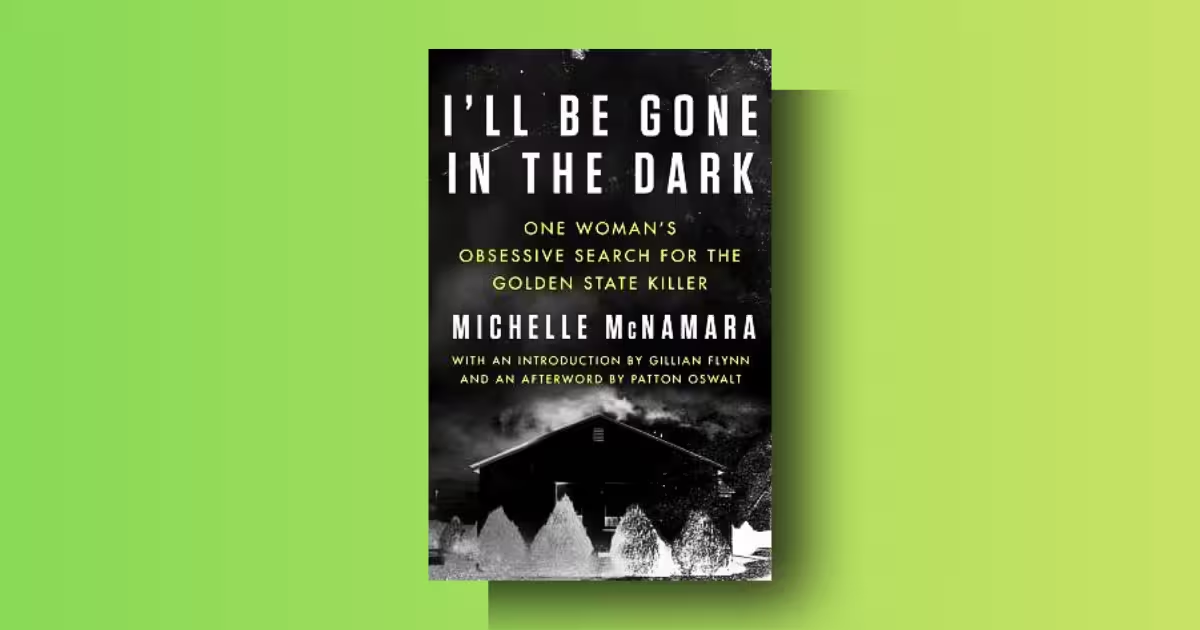
I’ll Be Gone in the Dark: One Woman’s Obsessive Search for the Golden State Killer is a true crime book by Michelle McNamara, published posthumously on February 27, 2018, that investigates the case of the Golden State Killer, a serial rapist and murderer who terrorized California from 1976 to 1986, committing at least 50 sexual assaults and 10 murders.
McNamara, who died unexpectedly on April 21, 2016, at age 46, spent the last years of her life obsessively researching the case. The book is part true crime investigation, part memoir, documenting not just the killer’s crimes but McNamara’s own psychological journey into darkness.
What makes this book extraordinary is its prescience: McNamara’s work helped revive public interest in the case, and just two months after its release, on April 25, 2018, authorities arrested Joseph James DeAngelo, a 72-year-old former police officer, using DNA evidence from genealogy websites.
DeAngelo later pleaded guilty to 13 murders and received multiple life sentences. The book’s title comes from a chilling threat DeAngelo made to a 15-year-old victim in 1976: “You’ll be silent forever, and I’ll be gone in the dark”.
Table of Contents
Introduction
I’ll Be Gone in the Dark: One Woman’s Obsessive Search for the Golden State Killer was written by Michelle McNamara (April 14, 1970 – April 21, 2016), an American true crime author and the founder of the blog True Crime Diary.
The book was published on February 27, 2018, nearly two years after her death. It features an introduction by bestselling author Gillian Flynn (Gone Girl) and an afterword by McNamara’s husband, comedian Patton Oswalt. The book reached #1 on the New York Times bestseller list.
Context
The book chronicles McNamara’s investigation into the Golden State Killer, a predator who operated across California for a decade. Before McNamara coined the name, he was known by various monikers: the East Area Rapist (EAR) in Northern California, the Original Night Stalker (ONS) in the South, and the Visalia Ransacker.
McNamara felt the existing names were inadequate—they fragmented the killer’s identity across jurisdictions and failed to capture the full scope of his terror. She gave him a unified name that reflected his statewide reign of violence.
McNamara’s credentials were rooted in genuine passion rather than formal training. She held an MFA in fiction writing from the University of Minnesota and had sold television pilots to ABC and Fox. Her blog, True Crime Diary, launched in 2006, became a respected platform where she chronicled hundreds of unsolved crimes. Her work caught the attention of Dateline NBC, who hired her as a consultant.
Purpose
The book’s central thesis is twofold. First, McNamara argues that the Golden State Killer could be identified through rigorous research, geographic profiling, and the power of modern technology, she believed his name was buried somewhere in the mountains of police reports, just waiting to be uncovered.
Second, and more personally, the book explores the devastating toll that obsessive investigation can take on the investigator.
As McNamara writes: “There’s a scream permanently lodged in my throat now”. The book is both a hunt for a killer and an unflinching self-examination of what that hunt costs.
Background
The Golden State Killer’s crimes began on June 18, 1976, in Rancho Cordova, a suburb of Sacramento, when a 23-year-old woman was raped in her bed by a masked intruder. Over the next decade, he evolved from a serial rapist to a murderer, attacking couples in their homes, binding them, and terrorizing them for hours before killing his victims.
What made him so difficult to catch was his methodical approach. He conducted extensive reconnaissance, studying victims’ routines, disabling lights, and leaving multiple escape routes. He wore masks, spoke in a forced whisper, and left few clues. Jurisdictional fragmentation compounded the problem—different police departments across California investigated different attacks without realizing they were hunting the same man.
By the time DNA technology emerged in the late 1990s, the case had gone cold. In 2001, DNA evidence finally linked the Northern California rapes to the Southern California murders, confirming they were the work of one man. But the killer’s identity remained unknown.
McNamara entered the picture in 2011, after reading retired detective Larry Crompton’s self-published book Sudden Terror about the East Area Rapist. She became consumed by the case, diving into police reports, online forums, and geographic profiling.
She coined the name “Golden State Killer” in 2013 in a Los Angeles magazine article. That article, and the book that followed, would prove pivotal in keeping the case alive.
I’ll Be Gone in the Dark Summary
Part One: The Crimes
McNamara opens with a chilling epigraph from Weldon Kees’s poem “Crime Club,” setting the tone for a book about unsolved evil lurking beneath suburban normalcy. She then plunges readers into the world of the Golden State Killer, beginning with his first known attack on June 18, 1976, in Rancho Cordova.
The narrative moves geographically and chronologically through the killer’s spree:
Sacramento, 1976-1977: The East Area Rapist strikes repeatedly, targeting women and girls in their bedrooms. His methods are distinctive—he ties victims with shoelaces, forces them to masturbate him, and speaks in a guttural whisper. The community descends into panic.
As McNamara notes: “By May 16, a surge of newly installed floodlights lit up the east side like a Christmas tree. Nearly three thousand guns were sold in Sacramento County between January and May”.
Visalia: McNamara explores the possible connection between the East Area Rapist and the Visalia Ransacker, a burglar who terrorized the Central Valley from 1974 to 1975. The Ransacker’s methods—stealing personal items, ransacking homes, leaving behind valuables—bore striking similarities to the EAR’s behavior.
The Original Night Stalker Murders: The book details the Southern California murders, beginning with the Goleta attacks in 1979 and 1981, the Ventura murders of Lyman and Charlene Smith in 1980, the Dana Point murders of Keith and Patrice Harrington in 1980, the Irvine murder of Manuela Witthuhn in 1981, and the final murder of Janelle Cruz in Irvine in 1986.
McNamara describes each crime with a journalist’s precision and a humanist’s empathy, never losing sight of the people behind the statistics.
McNamara brings the victims to life through details: Manuela Witthuhn, who kept a list of co-workers’ mistakes written in German; Cheri Domingo, whose final argument with her teenage daughter Debbi ended with “Why don’t you just get the hell out of my life!”; Janelle Cruz, a troubled young woman who had been raped as a teenager and was trying to rebuild her life.
These portraits are not gratuitous; they make the reader understand what was stolen.
Part Two: The Investigation
The middle section of the book follows McNamara’s own investigation and her interactions with the detectives who had spent decades on the case. She profiles key figures:
- Richard Shelby, the Sacramento detective who worked the case from the beginning, a gruff, plainspoken man who “lacked finesse” but never gave up
- Carol Daly, the female detective whose empathy made her invaluable in interviewing traumatized victims
- Larry Crompton, the Contra Costa detective who carried the case like a personal failure
- Paul Holes, the criminalist who used DNA to connect the Northern and Southern California crimes
McNamara also introduces the online community of amateur sleuths who gathered on message boards to share theories and clues. She describes her relationship with “the Kid” (Paul Haynes), a young researcher who compiled a 118-page “Master List” of potential suspects. She writes: “I was convinced one of the Mittys was probably going to solve this thing”.
The investigation’s emotional toll becomes increasingly apparent. McNamara describes working late into the night in her daughter’s playroom, surrounded by stuffed animals and legal pads, scouring digitized police reports. She writes: “My faith was in human error. He made a mistake somewhere along the line, I reasoned”.
She also documents the case’s many near-misses and false leads. In one memorable episode, she tracks down a pair of monogrammed cuff links stolen during a 1977 Stockton attack, paying $40 for overnight delivery from an Oregon vintage store. She excitedly shows them to her husband, convinced she’s found the killer. But the cuff links turned out not to belong to him.
Part Three: The Completion
This section, written by Paul Haynes and Billy Jensen after McNamara’s death, provides closure that McNamara never lived to see.
It details how investigators finally caught DeAngelo using DNA from genealogy websites. On April 18, 2018, investigators followed DeAngelo to a Hobby Lobby store, wiped the door handle of his car, and obtained a DNA sample that matched crime-scene evidence.
They also collected a piece of tissue from his trash. Two days later, on April 25, he was arrested at his Citrus Heights home.
The section also includes McNamara’s prescient “Letter to an Old Man,” written to the killer himself. She predicts his capture with uncanny accuracy: “One day soon, you’ll hear a car pull up to your curb, an engine cut out. You’ll hear footsteps coming up your front walk… The doorbell rings… This is how it ends for you”.
I’ll Be Gone in the Dark Analysis
What I Learned from This Book
Reading I’ll Be Gone in the Dark was unlike any true crime experience I’ve had. The book is not just about a killer—it’s about what happens when a person’s search for justice becomes all-consuming. McNamara’s writing is so intimate that you feel her exhaustion, her frustration, and her desperate hope.
What struck me most was her empathy. In lesser hands, true crime can feel exploitative, turning victims into plot points. McNamara never lets that happen. She writes about the victims with such care that you remember them as people, not just case numbers.
The Globe and Mail noted: “She kept her work free of salaciousness and sensationalism. Someone else’s tragedy never felt like entertainment”.
The book also made me rethink the value of citizen investigation. McNamara was not a trained detective or forensic scientist. She was a writer with a laptop and an obsession. Yet her work helped keep the case alive, and she coined the name, Golden State Killer, that finally unified the case in the public consciousness.
As Paul Holes said: “There’s no question that Michelle’s role, even outside of the book, is significant”.
But the book is also a cautionary tale. McNamara’s obsession came at a cost. She lost sleep, neglected relationships, and ultimately, her health suffered.
The New York Times reported that she had an undiagnosed heart condition and had taken a mix of prescription drugs, including Adderall, fentanyl, and Xanax. Her death at 46 was a stark reminder that obsession, even righteous obsession, can be deadly.
McNamara effectively supports her arguments with meticulous research. She drew on thousands of pages of police reports, interviews with detectives, and her own investigative work. The book is richly detailed, sometimes overwhelmingly so. McNamara’s attention to minutiae, a pair of cuff links, a yearbook photo, a specific shoe impression—creates a vivid picture of the investigation’s painstaking nature.
The book fulfills its stated purpose in an unusual way. It doesn’t solve the case; McNamara died before DeAngelo’s arrest, but it contributed to the case’s resolution by keeping it in the public eye. As Sacramento County Sheriff Scott Jones acknowledged, her work “kept interest and tips coming in”.
Where the book falls short is in its unfinished state. McNamara only completed about half the manuscript. The sections pieced together by Haynes and Jensen, while necessary, lack her distinctive voice. The Los Angeles Review of Books noted that the book is “a literary patchwork quilt, stitched together from notes, transcriptions, and articles”. Some readers may find the transitions jarring.
Strengths and Weaknesses
Strengths
1. Unflinching Humanity
McNamara treats victims, survivors, and detectives with profound respect. She doesn’t sensationalize; she humanizes. As the Los Angeles Review of Books observed, this is “a new kind of true crime book, dripping with a deep empathy and an emotional honesty that is rare in any genre”.
2. Meticulous Research
The book is a testament to McNamara’s investigative rigor. She left behind “3,500 files” on the case, including dozens of notebooks, legal pads, and thousands of digitized police reports. Her attention to detail is staggering.
3. A Unique Blend of Genres
The book is simultaneously a true crime investigation, a memoir, and a meditation on obsession. This hybrid approach makes it more compelling than a straightforward crime narrative.
4. Prescience
McNamara’s “Letter to an Old Man” is eerily accurate. She predicted the killer’s capture with almost prophetic clarity.
Weaknesses
1. Unfinished Nature
The book’s incomplete state is its most significant flaw. The editorial transitions are sometimes jarring, and some threads are left dangling. As one Goodreads reviewer noted: “The writing felt disjointed in places”.
2. Overwhelming Detail
McNamara’s thoroughness can occasionally become exhausting. The sheer volume of names, dates, and locations can be difficult to track, especially for casual readers.
3. The Author’s Absence
While McNamara’s voice is powerful in the sections she completed, her death leaves a void. The book ends not with her conclusions but with others’ efforts to finish her work.
4. Unresolved Questions
McNamara left behind a “StillToDo” list with unanswered questions. Readers looking for a tidy resolution may be frustrated.
Comparison with Similar Works
I’ll Be Gone in the Dark stands alongside Truman Capote’s In Cold Blood as a landmark in true crime literature. Like Capote, McNamara brings literary artistry to the genre, elevating crime reporting to something more profound. But there are key differences: Capote maintained an authorial distance, while McNamara inserts herself into the narrative, making her own obsession a central theme.
The book also invites comparison to Mindhunter by John E. Douglas, which explores criminal profiling. But where Douglas focuses on the psychology of the offender, McNamara focuses on the psychology of the pursuer.
More recently, I’ll Be Gone in the Dark has been compared to The Stranger Beside Me by Ann Rule, another true crime classic in which the author had a personal connection to the killer. But McNamara’s connection was not personal—it was obsessional, born of a childhood trauma that never healed.
Conclusion
I’ll Be Gone in the Dark is a masterpiece, though an imperfect one. It is haunting, deeply human, and at times devastating. McNamara’s writing is so vivid that you feel the terror of the victims, the frustration of the detectives, and her own desperate hope.
The book’s unfinished nature is a reminder of what was lost when McNamara died—not just a book, but a voice that could have continued to speak for the voiceless.
Recommendation
I recommend this book to anyone who loves true crime, but with a warning: it will unsettle you. It will make you think about obsession, justice, and the cost of searching for monsters in the dark.
For general audiences, the book is accessible but demanding. The graphic descriptions of violence may be triggering for some readers. But for those who can handle the darkness, I’ll Be Gone in the Dark offers something rare: a true crime book that is as much about the investigator as the investigated, and one that played a genuine role in bringing a killer to justice.
As McNamara herself wrote: “One day soon, you’ll hear a car pull up to your curb, an engine cut out. You’ll hear footsteps coming up your front walk… This is how it ends for you.” She was right. And in a strange way, she helped make it happen.







