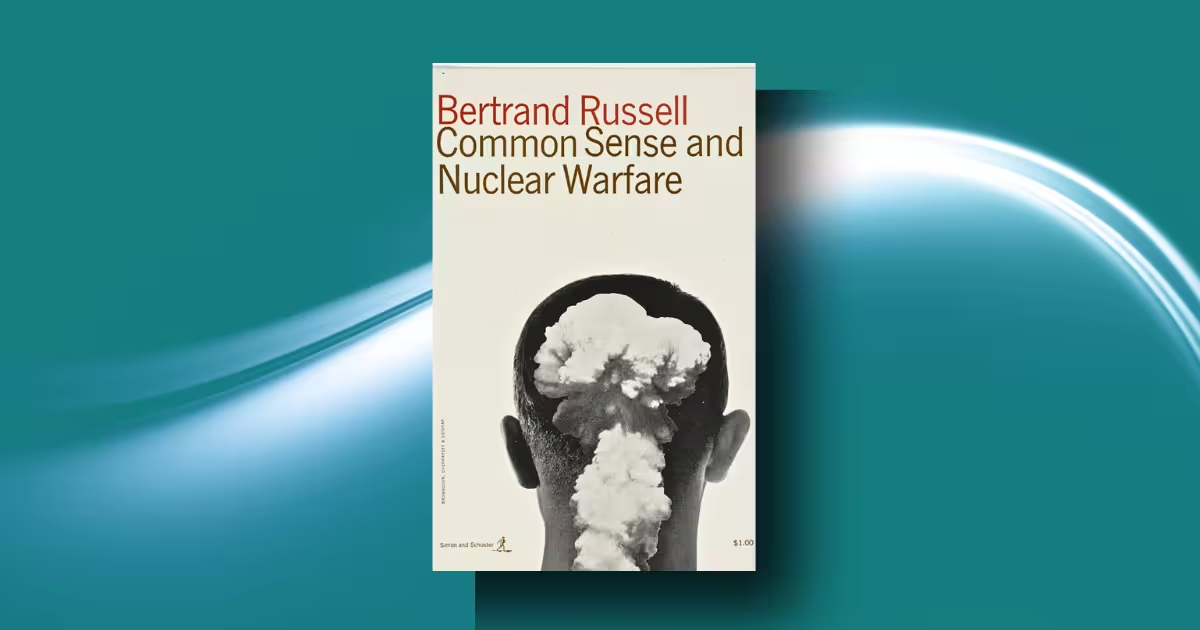

Do you ever lie awake at night wondering if the human species is actually smart enough to survive its own inventions? Common Sense and Nuclear Warfare by Bertrand Russell won’t give you a good night’s sleep, but it might just give you the clearest, most terrifyingly rational framework for understanding why we’re still here—and how long that might last.
Overview
In 93 pages, Bertrand Russell—Nobel Prize-winning philosopher, mathematician, and co-author of the 1955 Russell-Einstein Manifesto—delivers a razor-sharp argument that nuclear weapons have fundamentally changed the rules of human conflict.
Written at the height of the Cold War in 1959, this book argues that disarmament alone isn’t enough; the only way to prevent nuclear annihilation is to abolish war itself.
Russell introduces the unforgettable metaphor of “Chicken!” to describe the suicidal game being played by superpowers, outlines the devastating human cost of even a “successful” nuclear strike, and proposes a step-by-step roadmap toward international conciliation and eventual world government.
Ken Coates’ 2001 Foreword updates the analysis through the post-Cold War era, arguing that Russell’s warnings remain tragically relevant.
Suggested readers
Common Sense and Nuclear Warfare is suggested for
- Students of political science, international relations, and philosophy
- Anyone seeking to understand the origins of nuclear deterrence theory
- Readers interested in Cold War history and the Campaign for Nuclear Disarmament
- Those who appreciate clear, logical, emotionally restrained arguments about existential threats
Not for:
- Readers looking for a cheerful, optimistic take on humanity’s future
- Those who prefer dense academic jargon over accessible common sense
- Anyone who believes technological solutions alone can save us
- Readers who want detailed policy prescriptions (Russell offers principles, not blueprints)
Table of Contents
1. Introduction
Common Sense and Nuclear Warfare by Bertrand Russell was first published in 1959 by George Allen & Unwin in London and simultaneously by Simon and Schuster in New York.
The edition I’m reviewing is the 2001 Routledge reissue, which includes a substantial Foreword by Ken Coates, then Chair of the Bertrand Russell Peace Foundation. The book runs a compact 93 pages in its original form—a testament to Russell’s ability to say more in fewer words than almost any other philosopher of the twentieth century.
Bertrand Arthur William Russell (1872–1970) needs little introduction. He was one of the founders of analytic philosophy, a Nobel Laureate in Literature (1950), and arguably the most influential public intellectual of his era.
But what makes Common Sense and Nuclear Warfare particularly significant is that it represents Russell not as an abstract philosopher but as a passionate, engaged campaigner. By 1959, Russell had already co-authored the Russell-Einstein Manifesto in 1955—a document that called on scientists to “remember your humanity, and forget the rest”.
He had become the founding president of the Campaign for Nuclear Disarmament (CND) in 1958. This book was his attempt to translate philosophical clarity into practical political action.
Context of Common Sense and Nuclear Warfare
The book was written at what we now recognize as the peak of Cold War paranoia. The Soviet Union had detonated its first atomic bomb in 1949—far earlier than American intelligence had predicted. The first hydrogen bomb test (Ivy Mike) occurred in 1952, followed by the Soviet test in 1953. By 1959, both superpowers possessed thermonuclear weapons with yields thousands of times greater than the bombs that destroyed Hiroshima and Nagasaki.
The doctrine of “massive retaliation” had been formalized under US Secretary of State John Foster Dulles. The world was playing what Russell would memorably call “brinkmanship”—a policy adapted from a game played by “youthful degenerates” where two cars race toward each other and the first to swerve loses face. The Cuban Missile Crisis was still three years away.
The Partial Nuclear Test Ban Treaty was four years away. The Non-Proliferation Treaty was nine years away. In other words, humanity was living through the most dangerous period in its history, and almost nobody in power was talking about it with the clarity Russell demanded.
Purpose of Common Sense and Nuclear Warfare
The book’s central thesis is deceptively simple and devastatingly radical: “The only way to end the threat of nuclear war is to end war itself.”
Russell argues this through three logical steps:
1️⃣ A large-scale nuclear war would be an utter disaster, not only to the belligerents but to mankind.
2️⃣ When a small war occurs, there is a considerable risk that it may turn into a great war; over time, this risk becomes a certainty.
3️⃣ If all existing nuclear weapons were destroyed and there were an agreement that no new ones should be manufactured, any serious war would nevertheless become a nuclear war as soon as the belligerents had time to manufacture the forbidden weapons.
From these three premises, Russell concludes that disarmament alone is insufficient. You cannot simply ban the weapons and hope for the best.
You must eliminate the conditions that make war possible in the first place. This means creating mechanisms for peaceful dispute resolution, building international institutions with real enforcement power, and—most challengingly—changing the human psychology that makes nationalism and ideological fanaticism so dangerously appealing.
2. Background
To fully appreciate Common Sense and Nuclear Warfare, you need to understand where Russell was coming from—both intellectually and personally.
Russell had not always been a committed anti-nuclear campaigner. In fact, in the late 1940s, he had supported the Baruch Plan, an American proposal to internationalize all atomic energy under UN control. When Stalin rejected the plan, Russell went further: he suggested that it might be worth threatening war to force Soviet compliance with atomic internationalization.
As he acknowledges in Appendix II, “I thought, at that time, that it would be worth while to bring pressure to bear upon Russia and even, if necessary, to go so far as to threaten war on the sole issue of the internationalizing of atomic weapons”.
This earlier stance has led some critics to accuse Russell of inconsistency.
His response is characteristically blunt: “If a man gets into a train with a view to reaching a certain destination and on the way the train breaks down, you will not consider the man guilty of an inconsistency if he gets out of the train and employs other means of reaching his destination”.
What changed? The circumstances changed. When America alone possessed nuclear weapons, internationalization was a viable path. Once both superpowers had them, the calculation shifted entirely. A war fought to force compliance would now be a war in which both sides could annihilate each other.
This evolution in Russell’s thinking is crucial because it demonstrates that he wasn’t a naive pacifist. He had supported the fight against Nazi Germany. He understood that some wars had been justified. What made the nuclear age different was its existential finality. “I have never been a complete pacifist,” he writes, “and have at no time maintained that all who wage war are to be condemned.
I have held the view, which I should have thought was that of common sense, that some wars have been justified and others not. What makes the peculiarity of the present situation is that, if a great war should break out, the belligerents on either side and the neutrals would be all, equally, defeated”.
This is the key that unlocks the entire book. Russell isn’t asking anyone to become a saint. He’s asking them to become rational. And rationality, in the nuclear age, dictates that war is no longer a viable instrument of policy for anyone.
3. Common Sense and Nuclear Warfare Summary
Chapter I: If Brinkmanship Continues
Russell opens by examining the likely trajectory of the Cold War if it continues without actual nuclear conflict. He draws heavily on a 1958 report from America’s National Planning Association titled 1970 Without Arms Control. The report’s conclusion is chilling: “not only does the danger of war remain a possibility, but the probability totalled over time increases, becoming a certainty if sufficient time elapses without succeeding in finding alternatives”.
The arms race, Russell argues, will inevitably escalate in both cost and danger. The United States was already spending $45 billion annually on military preparation—about 10% of its gross national product. The Soviet Union was spending an estimated 15% of its GNP.
Between 1959 and 1970, the world would spend an estimated $1.5 to $2 trillion on armaments—and Russell notes that this would “certainly prove to be an underestimate, since new inventions will necessitate increasingly expensive weapons”.
What kind of new inventions? Russell anticipates:
- Bacteriological warfare: “It should be possible to poison the Mississippi and the Volga”.
- Weather control: Making enemy regions suffer drought or flood, or “that its temperature should be lowered to a point where it would no longer produce useful crops”.
- Melting the polar ice: Submerging coastal regions.
- Satellite-based weapons: “By means of electronic computers, they can be timed to rain death upon enemy regions, while suspending this useful activity during their passage over friendly territory”.
- Lunar missile bases: Russell quotes General Putt, who testified to Congress that the moon “might provide a retaliation base of considerable advantage over earthbound nations”.
Russell’s response to these plans is one of the book’s most quotable passages: “When I read of plans to defile the heavens by the petty squabbles of the animated lumps that disgrace a certain planet, I cannot but feel that the men who make these plans are guilty of a kind of impiety”.
Chapter II: If Nuclear War Comes
This chapter is where Russell deploys the hard data. He quotes General James Gavin, who testified before the Symington Senate Committee that “current planning estimates run on the order of several hundred million deaths” in a nuclear exchange. Gavin noted that the death toll would depend on which way the wind blew—radiation from bombs dropped on Russia would drift southeast into Japan and the Philippines, or the other way into Western Europe.
Russell then cites the Federal Civil Defence Administration’s estimate of what would happen if 2,500 megatons of nuclear weapons were dropped on the United States. Using the 1950 population of 151 million, they calculated:
- First day: 36 million dead, 57 million injured
- By the sixtieth day: 72 million dead, 21 million injured, leaving only 58 million uninjured
Russell notes that these figures must be increased proportionally for the current (1959) population. But the numbers alone don’t capture the horror:
“In the first place, many of those listed as uninjured would, inevitably, suffer from fallout in moving from place to place. In the second place, there could be no adequate medical care of the injured since most medical supplies and hospitals would be destroyed and a very large number of medical men and nurses would be dead. In the third place, since communications and water supplies would almost certainly be disrupted, it would be almost impossible to feed the surviving populations of large cities. In the fourth place, since drains and sewers would be largely destroyed, there would probably be severe epidemics.”
Beyond the immediate casualties, Russell discusses the long-term genetic damage from radioactive fallout—Strontium 90, Caesium 137, and Carbon 14 (which has a half-life of 8,070 years). He cites Dr. Linus Pauling’s estimate that if tests continued at the then-current rate, each year would cause 230,000 seriously defective children and 420,000 embryonic and neonatal deaths.
Russell’s conclusion is devastatingly clear: “Our present courses lead inevitably, sooner or later, to the extinction of the human species. We are not doomed to persist in the race towards disaster. Human volitions have caused it, and human volitions can arrest it”.
Chapter III: Methods of Settling Disputes in the Nuclear Age
Here Russell introduces his most famous metaphor: the game of “Chicken!”
“This is a policy adapted from a sport which, I am told, is practised by some youthful degenerates. This sport is called ‘Chicken!’ It is played by choosing a long straight road with a white line down the middle and starting two very fast cars towards each other from opposite ends. Each car is expected to keep the wheels of one side on the white line.
As they approach each other, mutual destruction becomes more and more imminent. If one of them swerves from the white line before the other, the other, as he passes, shouts ‘Chicken!’, and the one who has swerved becomes an object of contempt.”
The tragedy, Russell observes, is that when statesmen play this game, they risk not just their own lives but “those of many hundreds of millions of human beings”. And yet both sides consider their own statesmen wise and the other side’s reckless. “Both are to blame for playing such an incredibly dangerous game”. Eventually, “the moment will come when neither side can face the derisive cry of ‘Chicken!’ from the other side. When that moment is come, the statesmen of both sides will plunge the world into destruction”.
Russell acknowledges the practical politician’s counter-argument: if one side is willing to risk global war and the other isn’t, the side willing to run the risk will win all negotiations. But Russell insists this is a false dichotomy.
The alternative isn’t surrender—it’s a fundamental change in the rules of the game. Both sides have a common interest in survival that outweighs any ideological conflict.
Chapter IV: Programme of Steps towards Peace
Russell outlines a gradual approach to peace, recognizing that “the problem is not merely to discover measures which, if adopted, would prevent war, but to discover measures which, in addition to this merit, are also such as Governments and public opinion, both in the East and in the West, can be induced to support”.
Step One: Abolition of nuclear tests. Russell sees this as the low-hanging fruit—scientists agree that tests can’t be concealed under proper inspection. A test ban would stop the spread of radioactive poisons, prevent new powers from joining the “Nuclear Club,” and prove that East-West agreement is possible.
Step Two: A joint declaration by the US and USSR that they will seek to settle differences otherwise than by war or the threat of war. This should be followed by the appointment of a permanent joint body to study disputes.
Russell emphasizes that these steps must preserve the existing balance of power. Neither side should be asked to accept a net disadvantage.
Chapter V: New Outlook Needed before Negotiations
This chapter tackles the psychological obstacles to peace. Russell argues that statesmen must recognize a fundamental truth: “A statesman who aims at making his own country safe and prosperous can now only achieve his aim by making all powerful countries safe and prosperous”.
The old model of pursuing national welfare at the expense of other nations is obsolete. “What is quite certain is that the world which would emerge from a nuclear war would not be such as is desired by either Moscow or Washington”.
On the most optimistic plausible scenario, the post-war world would consist of “destitute populations, maddened by hunger, debilitated by disease, deprived of the support of modern industry and means of transport, incapable of supporting educational institutions, and rapidly sinking to the level of ignorant savages”.
Russell suggests that mutual suspicion could be reduced by concrete confidence-building measures. “Perhaps the first and most convincing proof of sincerity that could be given would be the abandonment of secrecy by both sides”.
Another measure would be agreeing to invite neutrals as arbitrators in disputes.
Chapter VI: Disarmament
Russell offers a surprising position: he does not consider disarmament the most important problem. “I see, however, two objections to treating this as the central and primary problem: First, as the experience of the last thirteen years has shown, disarmament conferences cannot reach agreements until the relations of East and West become less strained than they have been; second, the long-run problem of saving mankind from nuclear extinction will only be postponed, not solved, by agreements to renounce nuclear weapons”.
In other words, disarmament is a palliative, not a solution. If war breaks out, neither side will honour disarmament agreements.
However, disarmament still has immense value:
- Proof that East-West negotiation can bear fruit
- Reduction of the risk of unintended war—Russell warns that a mechanical failure in radar, a nervous breakdown in a commander, or a small country’s nuclear attack could trigger a major war
- Economic relief from the crushing burden of the arms race
- Demonstrating the necessity of arbitration over war
On inspection, Russell cites Seymour Melman’s book Inspection for Disarmament (1958), which concluded that inspection could prevent the manufacture of new nuclear weapons but probably couldn’t prevent concealment of existing stocks.
Chapter VII: Steps towards Conciliation
Russell proposes a small Conciliation Committee: two Americans, two Russians, one West European, one Chinese, and two neutrals (an Indian and a Swede).
The committee would:
- Deliberate confidentially—nothing published without unanimous consent
- Seek agreement, not diplomatic victory
- Ensure that conciliatory measures give no net advantage to either side
- Diminish friction in difficult regions
- Respect the wishes of inhabitants where possible
Russell acknowledges this sounds utopian but points to historical precedent: Britain and Russia, after fifty years of mutual suspicion following the Crimean War, concluded an entente in 1907 because they feared Germany more than each other.
The fear of nuclear warfare is even more rational.
Chapter VIII: Territorial Adjustments
Russell tackles the three most contentious regions:
Europe: Russell proposes that “no sovereign State, whether in Eastern or Western Europe, should have any alien armed forces on its territory”. This would require both America and Russia to withdraw troops. Russia would lose its satellite states;
America would lose its forward bases for H-bomb attacks on Russia. The goal is to neutralize all Central Europe from the Rhine to the Vistula. Germany must be reunited, but with agreed limitations on its armaments.
The Middle East: Russell identifies two intractable problems—oil and Israel. On oil, he argues that Western Europe must come to terms with Arab nationalism and make economic concessions. On Israel, he suggests fixing unalterable geographical frontiers and having Russia and the West jointly prevent aggression by or against Israel.
The Far East: Russell argues that “no reasonable man can expect the Communists to lose control of China except in a universal cataclysm”.
The West must give Communist China its seat in the UN and abandon support for Chiang Kai-shek. On Formosa (Taiwan), Russell suggests Chiang should be allowed to remain for his lifetime on condition that at his death the island rejoins the mainland.
Chapter IX: Approach to an International Authority
Russell argues that the ultimate solution is a World Authority with power to enforce its decisions. He acknowledges this is utopian but insists it’s a logical necessity.
He proposes a reformed UN with:
- Membership for all states, including Communist China
- A two-chamber system similar to the US Congress, where small states have equal representation in one chamber and proportional representation in the other
- Abolition of the veto—Russell compares it to Poland’s liberum veto, which made that country impotent
- An International Armed Force with personnel from many nations, so that mutiny in any national interest would be impossible
Russell acknowledges that “the world is faced with a race between reason and death”.
Chapter X: Some Necessary Changes in Outlook
Russell concludes by addressing the psychological obstacles to peace:
Fanaticism: He condemns those who believe “that the extermination of the human race would be preferable to the victory of the ideology that they dislike”. He points out that “the great majority of mankind, even in politically educated countries, are occupied throughout the greater part of their time with quite unpolitical matters”.
Nationalism: Russell distinguishes between cultural nationalism (which he values) and the kind that leads to armed strife. He notes the absurdity of collective self-glorification: “What should we think of an individual who said, ‘I am morally and intellectually superior to all other individuals, and, because of this superiority, I have a right to ignore all interests except my own’?”
Education: Russell argues that history teaching must change—he even suggests, half-jokingly, that every country should teach its history from books written by foreigners. Education should emphasize man’s contest with nature, not with other men.
4. Common Sense and Nuclear Warfare Analysis
What Makes Common Sense and Nuclear Warfare Exceptional
Common Sense and Nuclear Warfare is one of those rare works that manages to be both urgently of its time and eerily timeless.
Reading it in 2026—sixty-seven years after its publication—is a disorienting experience. So much has changed: the Soviet Union no longer exists, the Cold War is over, and we’ve survived decades without nuclear Armageddon. And yet Russell’s analysis feels more relevant than ever.
The clarity of his logic is breathtaking. Russell doesn’t waste words on moral posturing. He doesn’t appeal to your better nature. He appeals to your self-interest. “It would be necessary only to appeal to motives of national self-interest,” he writes in the Introduction.
This is what makes the book so powerful. Russell isn’t asking anyone to be a saint. He’s asking them to be rational. And rationality, in the nuclear age, dictates that war is no longer a viable instrument of policy.
The “Chicken!” metaphor is genius. It captures the insanity of nuclear deterrence in an image that anyone can understand. Two cars racing toward each other, the first to swerve loses face. But when statesmen play this game, they risk not just their own lives but billions of others.
As Ken Coates notes in his Foreword, the game of Chicken has only become more complex with the proliferation of nuclear weapons to more players.
Russell’s foresight is remarkable. He anticipated the weaponization of space, the dangers of nuclear proliferation to smaller states, the genetic damage from radioactive fallout, and the psychological toll of living under constant threat of annihilation.
He saw that the arms race was not just expensive but self-defeating—each side’s “security” made the other side more insecure, leading to an endless spiral.
The book’s structure is masterful. Russell moves from diagnosis to prescription, from the immediate (test bans) to the long-term (world government), from the concrete (territorial adjustments) to the psychological (changing education). Each step is logically connected to the next. You can disagree with his proposals, but you can’t accuse him of not thinking them through.
Where the Book Falls Short
No book is perfect, and Common Sense and Nuclear Warfare has its limitations.
It’s too optimistic about human rationality. Russell assumes that if you present the facts clearly enough, people will make the rational choice. But as the past sixty-seven years have shown, humans are not purely rational creatures.
We are driven by identity, ideology, pride, and fear. Russell acknowledges this—he writes extensively about fanaticism and nationalism—but he never fully grapples with the possibility that people might prefer glorious death to a compromised life.
It underestimates the power of vested interests. The military-industrial complex wasn’t yet a widely discussed concept in 1959, but Russell does touch on the economic forces driving the arms race. He notes that “new inventions will necessitate increasingly expensive weapons” and that “every increase in productivity will release more labour for warlike purposes”.
But he doesn’t fully explore how defence contractors, military bureaucracies, and political careers depend on the continuation of the arms race.
The territorial proposals are naive. Russell’s suggestion that Communist China should be given Taiwan at Chiang Kai-shek’s death, or that Russia and America should jointly guarantee Israel’s borders, seems wildly optimistic even by 1959 standards.
The 2001 Foreword by Ken Coates implicitly acknowledges this—Coates traces the complex history of nuclear proliferation in China, India, Pakistan, and Israel, showing that Russell’s neat territorial solutions were never going to be simple.
It’s too short. At 93 pages, the book feels more like a long essay than a comprehensive treatment. Russell himself acknowledges that he’s sketching principles rather than detailed blueprints. Some readers will want more depth on the economics of disarmament, the mechanics of inspection, or the psychology of nationalism.
The Book’s long-lasting Value
Despite these limitations, Common Sense and Nuclear Warfare remains essential reading for anyone who wants to understand the nuclear predicament. Its core argument—that the only way to end the threat of nuclear war is to end war itself—has only become more urgent with the proliferation of nuclear weapons to more states and the emergence of new technologies like cyberwarfare and artificial intelligence.
Russell’s insistence that survival is a common interest that transcends ideology is a message that needs to be heard today more than ever. In an era of resurgent nationalism, great-power competition, and climate change, we are once again being asked to choose between our tribal identities and our shared humanity. Russell’s answer is clear: choose humanity, or choose extinction.
As Noam Chomsky writes in his endorsement: “Bertrand Russell’s eloquent and lucid analyses and warnings…should find a prominent place in the thinking of those who hope to reverse the seemingly inexorable drive towards self-destruction”.
5. Strengths and Weaknesses
Strengths
Uncompromising clarity: Russell writes with the precision of a logician and the passion of a man who knows time is running out. Every sentence serves the argument. There’s no filler, no jargon, no intellectual showing-off.
Moral seriousness without moralizing: Russell doesn’t lecture. He doesn’t tell you to be good. He tells you to be smart. And being smart, in the nuclear age, means recognizing that war is no longer a viable option for anyone.
Historical foresight: Russell anticipated developments that seemed like science fiction in 1959—space-based weapons, nuclear proliferation, the genetic effects of radiation—and treated them with the seriousness they deserved.
Practical proposals: Russell doesn’t just wring his hands. He offers a step-by-step programme for moving from brinkmanship to peace, from test bans to world government. Whether you agree with his proposals or not, you have to respect the ambition.
Weaknesses
Over-reliance on rationality: Russell assumes that if you present the facts clearly, people will make the right choice. History suggests otherwise. Humans are emotional, tribal, and often irrational. Russell acknowledges this but doesn’t fully account for it in his proposals.
Naive optimism about institutions: Russell’s proposed Conciliation Committee, with its perfectly balanced membership and commitment to “agreement rather than diplomatic victory,” seems charmingly naive. International politics doesn’t work that way, and Russell should have known it.
Underestimating the military-industrial complex: Russell touches on the economic drivers of the arms race but doesn’t fully explore how defence spending creates constituencies that benefit from continued conflict.
Too short: The book is a sketch, not a comprehensive treatment. Some topics—the economics of disarmament, the mechanics of inspection, the psychology of nationalism—deserve more depth.
6. Common Sense and Nuclear Warfare Key Quotes
“The appeal is to human beings, as such, and is made equally to all who hope for human survival.”
“It must be viewed, as some new epidemic would be viewed, as a common peril to be met by concerted action.”
“Since the nuclear stalemate became apparent, the Governments of East and West have adopted the policy which Mr. Dulles calls ‘brinkmanship’. This is a policy adapted from a sport which, I am told, is practised by some youthful degenerates. This sport is called ‘Chicken!'”
“When I read of plans to defile the heavens by the petty squabbles of the animated lumps that disgrace a certain planet, I cannot but feel that the men who make these plans are guilty of a kind of impiety.”
“Our present courses lead inevitably, sooner or later, to the extinction of the human species. We are not doomed to persist in the race towards disaster. Human volitions have caused it, and human volitions can arrest it.”
“What is quite certain is that the world which would emerge from a nuclear war would not be such as is desired by either Moscow or Washington.”
“The world is faced with a race between reason and death.”
“I have never been a complete pacifist and have at no time maintained that all who wage war are to be condemned. I have held the view, which I should have thought was that of common sense, that some wars have been justified and others not. What makes the peculiarity of the present situation is that, if a great war should break out, the belligerents on either side and the neutrals would be all, equally, defeated.”
7. Comparison with Similar Works
The Atomic Bomb and the End of World War II by Herbert Feis (1966)
Feis provides a detailed historical account of the decision to use atomic weapons against Japan. Russell’s book is less concerned with history and more with the future. Where Feis looks backward, Russell looks forward—and his forward-looking analysis is more urgent and more prescient.
Nuclear Weapons and Foreign Policy by Henry Kissinger (1957)
Kissinger’s book, published two years before Russell’s, is a sophisticated defence of nuclear deterrence. Kissinger argued that limited nuclear war was possible and that the US needed a flexible nuclear strategy. Russell would have none of it.
For Russell, any nuclear war—limited or not—risked escalation to Armageddon. The contrast between the two books captures the fundamental divide in Cold War thinking: the strategist who believed nuclear weapons could be managed, and the philosopher who believed they couldn’t.
The Strategy of Conflict by Thomas Schelling (1960)
Schelling’s game-theoretic analysis of nuclear deterrence is the intellectual foundation of “rational” nuclear strategy.
Russell’s “Chicken!” metaphor is essentially a game-theoretic insight, but where Schelling saw a tragic but manageable logic, Russell saw madness. Schelling’s analysis is more sophisticated; Russell’s is more urgent.
Fail-Safe by Eugene Burdick and Harvey Wheeler (1962)
This novel, about an accidental nuclear war triggered by a mechanical failure, dramatizes exactly the kind of unintended war Russell warned about. Russell’s book is the non-fiction counterpart to Burdick and Wheeler’s nightmare scenario.
The Fate of the Earth by Jonathan Schell (1982)
Schell’s book, published at the height of the second Cold War, picks up where Russell left off. It’s longer, more detailed, and more despairing. But Schell acknowledges his debt to Russell and the early anti-nuclear movement. Russell’s book is the seed from which Schell’s tree grew.
8. Conclusion
Common Sense and Nuclear Warfare is not a comfortable book. It will not reassure you. It will not tell you that everything will be okay. What it will do is give you the clearest possible picture of the nuclear predicament and a rational framework for thinking about it.
Russell’s central argument—that the only way to end the threat of nuclear war is to end war itself—is as valid today as it was in 1959. The Cold War may be over, but nuclear weapons remain. Nine states now possess them. New technologies—cyberwarfare, artificial intelligence, hypersonic missiles—are creating new risks of accidental or miscalculated war.
The game of Chicken has more players, faster cars, and narrower roads.
Russell’s proposed solutions—test bans, conciliation committees, territorial adjustments, world government—may seem naive or impossible. But they point in the right direction. The alternative is the continuation of the arms race, the proliferation of nuclear weapons, and the ever-present risk of annihilation.
Who should read this book? Anyone who wants to understand why we’re still here and how long that might last. Students of international relations, political science, and philosophy will find it essential. Activists and campaigners will find it inspiring. Ordinary citizens will find it terrifying—and that’s the point. Russell wanted to scare us into sanity.
Why read it now? Because the issues Russell raised haven’t gone away.
Because the logic of nuclear deterrence hasn’t changed. Because the human psychology he diagnosed—nationalism, fanaticism, pride, fear—is still with us. Because we need common sense now more than ever.
As Russell writes in his Preface: “What is needed is not an appeal to this or that -ism, but only to common sense”. That’s what this book offers: common sense about the most uncommon threat humanity has ever faced. Read it. Share it. Act on it. The race between reason and death is still running, and we don’t know which will win.