
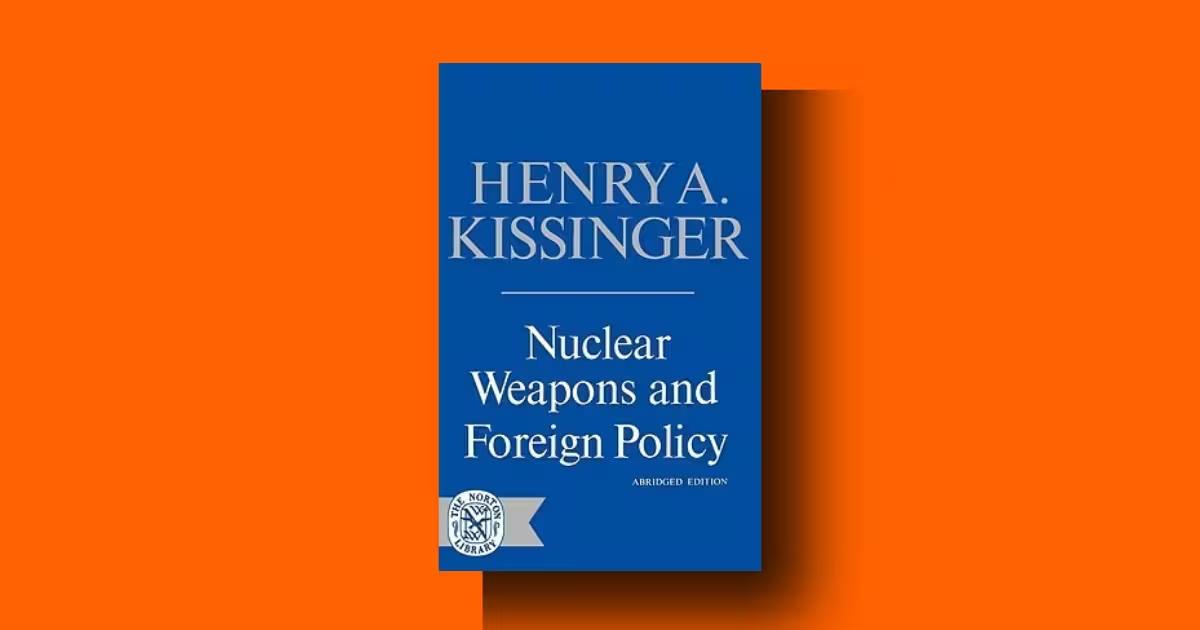
Do you ever wonder why, despite possessing enough nuclear firepower to destroy the world many times over, the United States has found itself unable to translate that terrifying strength into political advantage? Why did a nation with an atomic monopoly watch helplessly as the Soviet Union expanded its grip across Eastern Europe and China fell to communism? Henry Kissinger’s Nuclear Weapons and Foreign Policy forces you to confront these uncomfortable questions head-on—and the answers he provides in this 1957 masterpiece remain disturbingly relevant more than six decades later.
Table of Contents
Overview
Nuclear Weapons and Foreign Policy is a landmark work of strategic thought that argues America’s reliance on “massive retaliation” and all-out nuclear war as its primary deterrent has created a paralyzing gap between military power and political purpose.
Kissinger contends that the United States must develop a flexible doctrine of limited war—including limited nuclear war—to counter the Soviet strategy of ambiguity, which seeks to overturn the global balance through incremental aggression rather than a single catastrophic blow.
The book’s central thesis is that the nuclear age demands not just more powerful weapons but a fundamental rethinking of how force relates to diplomacy, how deterrence actually works, and how democracies can find the moral courage to act in an era of existential risk.
Suitable readers
Nuclear Weapons and Foreign Policy is suitable for students of international relations, military strategists, policymakers, historians of the Cold War, political science enthusiasts, and anyone seeking to understand why the United States has struggled for decades to align its military capabilities with its foreign policy objectives.
The book is essential reading for those who want to grasp the intellectual foundations of American strategic thinking in the nuclear age.
Nuclear Weapons and Foreign Policy is not suitable for readers seeking a lightweight introduction to nuclear policy or those uncomfortable with dense, theoretical arguments. This is not a casual read—it demands careful attention and some familiarity with Cold War history. Casual readers may find the doctrinal debates and strategic abstractions overwhelming.
Introduction
Book Title: Nuclear Weapons and Foreign Policy
Author: Henry A. Kissinger
Publication Details: Originally published in 1957 by the Council on Foreign Relations (Harper & Row); abridged edition published in 1969 by W. W. Norton & Company.
Author’s Credentials: At the time of writing, Kissinger was a Harvard University professor of Government, Director of the National Security Studies program, and a member of the Center for International Affairs. He had previously served as a consultant to the Department of State, the U.S. Arms Control and Disarmament Agency, and the National Security Council.
By the time of the abridged edition’s publication in 1969, Kissinger had become Assistant to President Nixon for National Security Affairs—a position from which he would profoundly shape American foreign policy.
Context of Nuclear Weapons and Foreign Policy: The book emerged from a study conducted by the Council on Foreign Relations, which brought together a panel of experts from government, diplomacy, science, engineering, the military services, and weapons production.
This collaborative effort gave Kissinger access to an extraordinary range of expertise, lending the work an authority that pure academic speculation could never achieve.
Purpose of Nuclear Weapons and Foreign Policy: Kissinger’s central argument is that the United States has failed to integrate nuclear weapons into a coherent strategic doctrine.
The book seeks to bridge the gap between American military power—unprecedented in human history—and the political objectives that power is meant to serve. As Kissinger writes in the preface to the 1969 edition: “at a time when technology has put in our grasp a command over nature never before imagined, the value of power depends above all on the purpose for which it is to be used.”
Background
To appreciate the book’s significance, we must understand the historical moment in which it was written.
The mid-1950s represented a watershed in nuclear history. The Soviet Union had successfully tested its first atomic bomb in 1949—far earlier than American intelligence had predicted—and by 1953 had detonated a thermonuclear device.
The United States had lost its atomic monopoly, and the nuclear stalemate that Kissinger describes was beginning to take shape. Yet American strategic thinking had barely evolved beyond the World War II paradigm of total victory through overwhelming force.
The Korean War (1950-1953) had exposed the bankruptcy of this approach. A conflict that fit no category of American strategic thought—neither a surprise attack on the United States nor a direct threat to Europe—had forced the nation to improvise a response. As Kissinger observes: “It has been remarked more than once that, had the Korean War not actually taken place, we would never have believed that it could have.”
The doctrine of “massive retaliation,” formally articulated by Secretary of State John Foster Dulles in 1954, had become the cornerstone of American strategy. This approach held that the United States would respond to any aggression—whether large or small—with the full weight of its nuclear arsenal. But Kissinger recognized the fundamental flaw in this reasoning: a threat that is too terrible to use ceases to be credible.
“The more total the sanctions of our weapons technology have become,” he writes, “the more absolute we have imagined the provocation that would alone justify unleashing it.”
This is the dilemma that Nuclear Weapons and Foreign Policy seeks to resolve: how can a nation maintain a credible deterrent without painting itself into a corner where the only response to any provocation is national suicide?
Nuclear Weapons and Foreign Policy Summary
Part I: The Challenge of the Nuclear Age
Kissinger opens with a striking observation about the paradox of modern power. Throughout history, humanity has suffered from a shortage of power, concentrating immense effort on developing new sources of it.
But now, “it would have seemed unbelievable even fifty years ago that there could ever be an excess of power, that everything would depend on the ability to use it subtly and with discrimination.”
This is the defining challenge of the nuclear age: “the enormity of modern weapons makes the thought of war repugnant, but the refusal to run any risks would amount to giving the Soviet rulers a blank check.”
Kissinger argues that American strategic thought has been crippled by its own historical success. Having won two world wars by outproducing opponents, the United States developed what he calls a “strategy of attrition unencumbered by political considerations.” This approach worked against Germany and Japan, but it proved woefully inadequate against a revolutionary power that understood the subtle relationship between force and policy.
The Soviet Union, by contrast, had developed what Kissinger terms a “strategy of ambiguity”—a method of advancing by small, calculated increments that never quite present a clear casus belli.
As he explains: “Because we have considered the advantage of peace so self-evident, we have been tempted to treat each act of Soviet intransigence as if it were caused by a misunderstanding of our intentions.”
Part II: The Dilemma of American Security
Kissinger traces the evolution of American strategic doctrine from World War II through the Korean War, exposing the deep flaws in how the military services organized themselves for the nuclear age.
The Problem of Interservice Rivalry: The traditional division of functions—Army for land warfare, Navy for sea control, Air Force for air superiority—had become obsolete in an era of long-range bombers, ballistic missiles, and weapons of unprecedented destructiveness. Yet the services continued to fight for control of overlapping weapons systems rather than develop a coherent national strategy.
“The division of functions which worked relatively smoothly for a century and a half has become a source of bitter rivalry in the nuclear age.” Kissinger observes that each service was developing its own 1,500-mile missile, treating doctrinal disputes as battles for budget appropriations rather than opportunities for strategic clarity.
The Korean War as a Case Study: Korea exposed the gap between American military planning and the actual challenges facing the nation.
A war that fit no category of strategic thought forced improvisation under pressure. “We kept it limited,” Kissinger writes, “not because we believed in limited war but because we were reluctant to engage in all-out war over the issues which were at stake in Korea.”
The result was a frustrating stalemate that demonstrated the bankruptcy of an all-or-nothing strategic doctrine. “Our insistence on divorcing force from diplomacy caused our power to lack purpose and our negotiations to lack force.”
Part III: The Strategy of Ambiguity—Sino-Soviet Strategic Thought
Perhaps the most distinctive contribution of Nuclear Weapons and Foreign Policy is Kissinger’s analysis of Communist strategic thinking. Drawing on Lenin, Stalin, and Mao Tse-tung, he constructs a portrait of a revolutionary power that understands the relationship between force and policy with extraordinary sophistication.
The Revolutionary vs. Legitimate Order: Kissinger distinguishes between a “legitimate” international order—where all major powers accept the basic arrangements—and a “revolutionary” order, where one or more powers seek to overthrow the existing system. “A legitimate order does not make conflicts impossible; it limits their scope. Wars may arise, but they will be fought in the name of the existing system.”
The Soviet Union and Communist China represent revolutionary powers that reject the existing order.
This gives them a profound psychological advantage over status quo powers like the United States. “A long period of peace leads to the temptation to trust appearances and to seek to escape the element of conjecture in policy by interpreting the motives of other powers in the most favorable and familiar manner.”
Mao’s Theory of Protracted War: Kissinger devotes particular attention to Mao’s writings on military strategy, which he considers the most sophisticated theoretical statement of Communist military thought. “Mao’s theory of war, therefore, rejects the notion of a quick, decisive war conducted on the basis of purely military considerations, which underlies so much of American strategic thought.”
Mao’s strategy of “protracted limited war” involves a series of transformations, none decisive in themselves, the cumulative effect of which changes the balance of power. His famous sixteen-word formula—“Enemy advances, we retreat; enemy halts, we harass; enemy tires, we attack; enemy retreats, we pursue” —captures the essence of this approach.
The Continuity of Soviet Doctrine: Kissinger warns against the temptation to believe that Soviet leadership has fundamentally changed its goals. “What is permanent in Soviet theory is the insistence upon the continuing struggle, not the form it takes at any given moment.” He points to the historical pattern of “peaceful coexistence” offensives followed by renewed aggression, arguing that these tactical shifts reflect strategic calculation rather than genuine change.
Part IV: The Soviet Union and the Atom
Kissinger analyzes how the Soviet leadership responded to the American atomic monopoly and the subsequent development of its own nuclear arsenal.
Minimizing the Atomic Threat: During the period of American atomic monopoly, Soviet strategy combined three themes: nuclear weapons were not decisive; they were uniquely horrible and should be banned; and the Soviet Union was the champion of peace.
As Kissinger observes: “With a cold-blooded effrontery, as if no other version of reality than its own were even conceivable, through all the media and organizations at its disposal, through diplomacy and propaganda, the Kremlin advanced these related themes.”
Stalin himself set the tone in 1946: “I do not consider the atomic bomb as such a serious force as several political groups incline to think it. Atomic bombs are intended to frighten people with weak nerves, but they cannot decide the outcome of a war since for this atomic bombs are completely insufficient.”
The Shift in Soviet Doctrine: As the Soviet nuclear stockpile grew, the Kremlin gradually modified its position.
By 1955, Soviet doctrine had evolved to acknowledge that nuclear weapons were a vital part of military power—while maintaining that the Soviet Union was less vulnerable than its capitalist opponents. “Only political adventurers can think that they will succeed with the help of atomic weapons in canceling the progressive development of mankind.”
The Continuing Advantage: Kissinger argues that the Soviet Union has maintained a psychological advantage throughout the nuclear age. “In every crisis, the non-Soviet world protests the horror of nuclear war and thereby reduces the strength of its negotiating position. By contrast, the Soviets do not seem so inhibited.”
Part V: The Esoteric Strategy—Principles of All-Out War
Kissinger examines the nature of all-out nuclear war and concludes that it has ceased to be a meaningful instrument of policy.
The Futility of Total Victory: “A war which starts as an all-out war is the least likely contingency, although it is the only one for which we have an adequate doctrine.” The destructiveness of modern weapons means that even the victor would suffer catastrophic losses, making victory pyrrhic at best.
The Changing Nature of Deterrence: “Henceforth the only outcome of an all-out war will be that both contenders must lose.” When both sides possess the ability to inflict unacceptable damage, numerical superiority in weapons becomes increasingly meaningless.
The Limits of Retaliatory Power: Kissinger warns that relying on all-out war as the primary deterrent creates a dangerous psychological gap. “The greater the horror of our destructive capabilities, the less certain has it become that they will in fact be used.”
Part VI: What Price Deterrence? The Problems of Limited War
This section contains Kissinger’s most practical and controversial arguments.
The Necessity of Limited War: Kissinger contends that the United States must develop the capability to fight wars that stop short of all-out nuclear conflict. “Given the power of modern weapons, a nation that relies on all-out war as its chief deterrent imposes a fearful psychological handicap on itself.”
The Purpose of Limited War: “The purpose of limited war is to inflict losses or to pose risks for the enemy out of proportion to the objectives under dispute.” It is not a substitute for massive retaliation but a way of making deterrence credible across the full spectrum of possible conflicts.
The Requirements for Limited War: Kissinger argues that limited war requires forces specifically designed for that purpose—not simply obsolescent weapons handed down from the Strategic Air Command. “A weapons system for limited war is therefore basically different from a retaliatory force. Limited wars require units of high mobility and considerable firepower which can be quickly moved to trouble spots.”
The Psychological Dimension: “A limited war among major powers can be kept limited only by the conscious choice of the protagonists.” This requires both sides to understand the rules of engagement and to have an incentive to observe them. “Success in limited war requires, therefore, that the opponent be persuaded that national survival is not at stake and that a settlement is possible on reasonable terms.”
Part VII: The Problems of Limited Nuclear War
Kissinger confronts the most controversial question of all: can nuclear weapons be used in a limited war without triggering all-out conflict?
The Case Against Limited Nuclear War: Critics argue that any use of nuclear weapons would inevitably escalate to all-out war. “In the absence of a natural cutoff point, it is argued, the employment of any nuclear weapon may start a cycle of gradually expanding commitments ending in all-out war.”
Kissinger’s Response: He contends that proper tactics and clear communication can make limited nuclear war possible. “With proper tactics, nuclear war need not be as destructive as it appears when we think of it in terms of traditional warfare.” The key is to develop small, highly mobile, self-contained units that can operate without the cumbersome supply lines that would make them vulnerable to nuclear attack.
The Tactical Revolution: “The proper analogy to limited nuclear war is not traditional land warfare, but naval strategy, in which self-contained units with great firepower gradually gain the upper hand by destroying their enemy counterparts without physically occupying territory or establishing a front line.”
The Advantage of Nuclear Superiority: Kissinger argues that the United States is better positioned than the Soviet Union to fight limited nuclear wars. “When manpower can no longer be substituted for materiel, the strategic significance of Communist China may be much reduced.” The complexity of modern nuclear weapons favors nations with superior industrial capacity and technical expertise.
Part VIII: Diplomacy, Disarmament, and the Limitation of War
Kissinger addresses the role of diplomacy in managing nuclear conflict.
The Limits of Disarmament: He is skeptical of grand disarmament schemes, arguing that they address the symptoms rather than the causes of international tension. “The notion that armaments are the cause rather than the reflection of conflict is not new. It has been the basis of schemes of disarmament throughout history.”
The Problem of Inspection: Kissinger contends that inspection systems cannot effectively prevent surprise attack in the missile age. “When wars can be fought by the forces-in-being and when striking forces are designed to be able to attack with no overt preparation, warning can be attained under optimum conditions only for the time the delivery vehicles, whether planes or missiles, are in transit.”
The Alternative: Limiting War: Rather than seeking to eliminate war entirely—a utopian goal—Kissinger proposes that diplomacy should focus on mitigating its horrors. “A more productive, less absolute, solution might be an endeavor to mitigate the horrors of war.”
Practical Proposals: Kissinger suggests specific limitations that could be established in advance: no attacks on cities, no use of weapons above 500 kilotons, and inspection systems that would operate even during hostilities. “We could announce that Soviet aggression would be resisted with nuclear weapons if necessary; that in resisting we would use weapons of not more than 500 kilotons explosive power unless the enemy used them first.”
Part IX: The Impact of Strategy on Our Allies and the Uncommitted
Kissinger examines how American strategic doctrine affects relations with allies and neutral nations.
The Problem of Alliances: “An alliance is effective, however, only to the extent that it reflects a common purpose and represents an accretion of strength to its members.”
The American reliance on all-out war has undermined NATO and other alliances by making allies feel that their military contributions are irrelevant and that they have no control over their own security.
The Case of NATO: “Almost a decade after its creation NATO is still without a force sufficient to prevent its members from being overrun by the Soviet Army.” The alliance has been torn between a strategy of minimum risk and the desire for economy, between the wish for protection against Soviet occupation and the reluctance to face harsh realities.
The Uncommitted Nations: Kissinger offers a nuanced analysis of anti-colonial nationalism, arguing that neutralism is often a psychological necessity for newly independent states. “Neutralism and anti-colonialism are not so much a policy as a spiritual necessity.” The leaders of these nations need to demonstrate their independence from the West precisely because they are culturally closest to it.
The Challenge of Leadership: “The price of our power is leadership. For what else is leadership except the willingness to stand alone if the situation requires?” Kissinger argues that the United States must not subordinate its strategic interests to the demands of allies or the preferences of neutral nations.
Part X: The Need for Doctrine
The concluding chapter argues for a fundamental rethinking of American strategic thought.
The Importance of Doctrine: “Strategic doctrine is the mode of survival of a society, relating seemingly disparate experiences into a meaningful pattern.” Without a clear doctrine, each crisis will seem novel, and energies will be absorbed in analysis rather than action.
The Failure of Organization: Kissinger criticizes the structure of American defense decision-making, where interservice rivalry and budgetary pressures prevent the development of coherent strategy. “The absence of an agreed strategic doctrine, each service will give its own reply.”
Proposals for Reform: He suggests reorganizing the military into Strategic and Tactical Forces, extending the defense budget cycle to two years, and creating a Strategic Advisory Council that would integrate civilian and military perspectives.
The Deeper Challenge: Kissinger concludes by addressing the cultural and psychological obstacles to effective American strategy. “A society can survive only by the genius that made it great. But we should be able to leaven our empiricism with a sense of urgency.”
Nuclear Weapons and Foreign Policy Analysis
The Visionary Insights
Nuclear Weapons and Foreign Policy was a groundbreaking work that fundamentally reshaped American strategic thinking. Its influence can be seen in the subsequent development of flexible response doctrine, the emphasis on limited war capabilities, and the recognition that nuclear weapons are instruments of policy rather than ends in themselves.
The Concept of Limited War: Kissinger’s insistence that the United States must develop capabilities for conflicts short of all-out nuclear war was revolutionary in 1957.
As one contemporary observer noted: “Dr. Kissinger has produced what in my opinion is the most profound and constructive study that has yet been made of one of the toughest problems facing our country.”
The Analysis of Soviet Strategy: Kissinger’s reading of Communist strategic thought demonstrated an extraordinary sophistication. He understood that Soviet leaders were not simply aggressors but practitioners of a form of political warfare that exploited the psychological vulnerabilities of democratic societies. “The great advance of communism over the past generation has many causes, but chief among them is a spiritual crisis among its opponents.”
The Limits of Nuclear Deterrence: Kissinger recognized early that nuclear weapons could not solve all strategic problems. “Our capacity for massive retaliation did not avert the Korean War, the loss of northern Indochina, the Soviet-Egyptian arms deal, or the Suez crisis.”
The Controversial Positions
Not all of Kissinger’s arguments have aged equally well.
The Feasibility of Limited Nuclear War: Many strategists have questioned whether nuclear weapons can ever be used without escalating to all-out conflict. The argument that “with proper tactics, nuclear war need not be as destructive as it appears” seems optimistic in light of subsequent experience.
The problem of command and control, the difficulty of communicating intentions during conflict, and the risk of miscalculation make limited nuclear war a highly dangerous proposition.
The Soviet Threat: Kissinger’s analysis of Soviet intentions has been criticized for being overly alarmist. While he was right that the Soviet Union was a revolutionary power, his assumption that its fundamental goals were unchanging proved too rigid.
The Sino-Soviet split, the evolution of Soviet foreign policy under Khrushchev and Brezhnev, and ultimately the collapse of the Soviet Union itself all suggest a more complex reality than Kissinger’s framework allows.
The Moral Dimension: Kissinger’s emphasis on strategic calculation sometimes seems to neglect the moral dimensions of nuclear policy. His willingness to contemplate the use of nuclear weapons in limited wars, and his emphasis on the importance of being willing to run risks, can appear cold-blooded in retrospect.
Contemporary Relevance
Despite these criticisms, Nuclear Weapons and Foreign Policy remains essential reading for anyone seeking to understand the strategic challenges of the nuclear age.
The Return of Great Power Competition: With the resurgence of tensions between the United States, China, and Russia, the questions Kissinger raised about the relationship between force and diplomacy have become newly relevant.
The Problem of Ambiguity: The concept of a “strategy of ambiguity” remains a powerful analytical tool for understanding how revolutionary powers exploit the hesitations of status quo states.
The Limits of Military Power: Kissinger’s insight that “power which is not clearly related to the objectives for which it is to be employed may merely paralyze the will” speaks directly to contemporary challenges, from the wars in Afghanistan and Iraq to the ongoing struggle against terrorism.
Strengths and Weaknesses
Strengths
1. Intellectual Rigor: Kissinger’s analysis is grounded in a deep reading of history, strategic theory, and Communist doctrine. His arguments are carefully constructed and supported by evidence.
2. Practical Prescriptions: Unlike many works of strategic theory, Nuclear Weapons and Foreign Policy offers concrete proposals for policy, from military reorganization to diplomatic initiatives.
3. Historical Insight: Kissinger’s understanding of the relationship between revolutionary and legitimate orders provides a valuable framework for analyzing international conflict.
4. Psychological Sophistication: He recognizes that deterrence depends not just on physical capabilities but on perceptions, intentions, and the willingness to run risks.
Weaknesses
1. Cold War Bias: The book is very much a product of its time, with assumptions about the Soviet threat that later proved too simplistic.
2. Optimism About Limited Nuclear War: Kissinger’s confidence in the possibility of fighting limited nuclear wars seems misplaced in light of subsequent experience.
3. Neglect of Domestic Politics: The book focuses almost exclusively on international relations, paying relatively little attention to the domestic political constraints that shape American foreign policy.
4. Dense Prose: The book is not an easy read, and its arguments can be difficult to follow for readers without a background in strategic studies.
Comparison with Similar Works
Thomas Schelling’s The Strategy of Conflict (1960): Schelling’s work focuses on the bargaining aspects of nuclear strategy, emphasizing how the threat of force can be used as a tool of coercion. Kissinger is more concerned with the actual conduct of limited war.
Bernard Brodie’s Strategy in the Missile Age (1959): Brodie, like Kissinger, argued that nuclear weapons had fundamentally changed the nature of warfare. However, Brodie was more skeptical about the possibility of limited nuclear war than Kissinger.
Herman Kahn’s On Thermonuclear War (1960): Kahn’s work is more technical and less diplomatic than Kissinger’s, focusing on the mechanics of nuclear war rather than its relationship to foreign policy.
The Report of the Gaither Committee (1957): This secret government report, which became public knowledge shortly after Kissinger’s book, reached similar conclusions about the vulnerability of American strategic forces and the need for civil defense.
However, Kissinger’s work is more comprehensive and more focused on political implications.
Conclusion: The Enduring Relevance of Kissinger’s Vision
Nuclear Weapons and Foreign Policy stands as a landmark in the literature of international relations. Its combination of historical insight, strategic sophistication, and practical prescription makes it essential reading for anyone seeking to understand the challenges of the nuclear age.
The book’s central insight—that the United States must develop a flexible doctrine that relates force to policy across the full spectrum of conflict—remains as relevant today as it was in 1957.
As Kissinger himself observed in the preface to the 1969 edition: “These events have altered the international climate. But they have intensified, rather than lessened, the need to seek a clarification of doctrine and a new international order.”
In an era of renewed great power competition, when the risk of nuclear conflict—whether through miscalculation or design—has once again become a central concern of international politics, Kissinger’s warnings about the dangers of rigid doctrine and the importance of strategic flexibility deserve careful attention.
The book is not without its flaws. Its Cold War assumptions, its optimism about limited nuclear war, and its sometimes dense prose make it a challenging read. But for those willing to engage with its arguments, Nuclear Weapons and Foreign Policy offers an unparalleled education in the strategic challenges of the nuclear age—and in the difficult choices that democracies must make to survive in a dangerous world.
As Kissinger writes in his concluding chapter: “At a time when technology has put in our grasp a command over nature never before imagined, power must be related to the purpose for which it is to be used.” This is the central challenge of our time, and Kissinger’s book remains one of the most important guides to meeting it.







