
Do you ever lie awake at night wondering what would actually happen if someone pushed that button? Not the vague, abstract “nuclear war would be bad” kind of wondering—but the kind where you can actually picture millions of people burning, cities turning to glass, and the entire human story coming to a sudden, silent end?
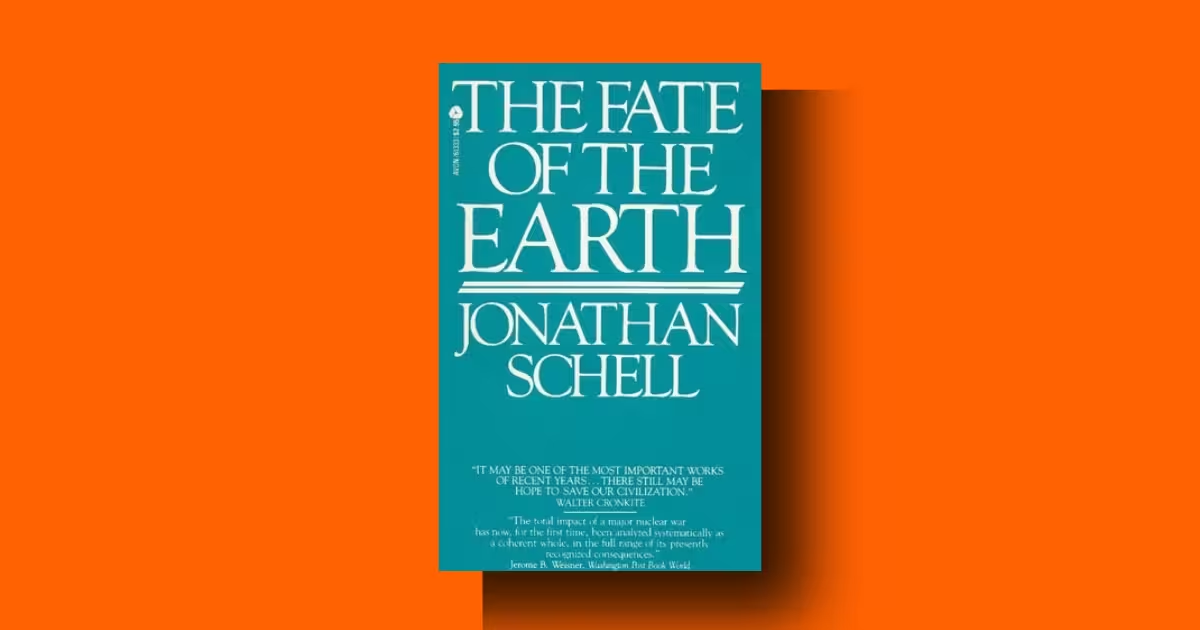
Jonathan Schell’s The Fate of the Earth doesn’t just ask that question. It answers it with a level of detail that will haunt you long after you close the book. Published in 1982 during the height of Cold War tensions, this work emerged from a three-part series in The New Yorker and quickly became one of the most influential anti-nuclear books ever written.
It won the Los Angeles Times Book Prize and was named one of the 100 greatest pieces of journalism of the 20th century.
But here’s the thing: thirty years after the Cold War ended, with the Soviet Union long gone and new nuclear threats emerging from places like North Korea, Pakistan, and potentially rogue states, Schell’s work feels less like a historical artifact and more like a prophecy we’re still ignoring.
Overview
The Fate of the Earth is a three-part existential warning that does precisely what its title promises: it forces you to confront the literal end of humanity.
Part one details the physical destruction a full-scale nuclear war would cause—not in abstract terms but with horrifying specificity, walking you through what would happen to New York City, to the ecosystem, to every living thing.
Part two shifts to philosophy, exploring what it would mean for humanity to simply stop existing—what Schell calls “the second death.”
Part three argues that our current system of nation-states and nuclear deterrence is fundamentally incapable of saving us, and that we must choose between national sovereignty and survival itself.
The Fate of the Earth doesn’t offer easy answers. What it does is make the unthinkable thinkable—and in doing so, makes you realize that the world has been living on borrowed time since 1945.
Preferred readers
Best for: Anyone who wants to understand nuclear danger at a visceral, gut level. Activists, policymakers, students of international relations, and ordinary citizens who feel like they should be worried about nuclear weapons but don’t quite know why.
Environmentalists concerned about existential threats. Readers of John Hersey’s Hiroshima or Rachel Carson’s Silent Spring will find a kindred spirit here.
Not for: Readers looking for practical policy solutions—Schell is stronger on diagnosis than prescription. Those who prefer their nonfiction dry and academic will find the philosophical sections challenging. And if you’re prone to anxiety or existential dread, honestly? This book might break you a little. It’s not exactly a light beach read.
Table of Contents
Introduction
Book: The Fate of the Earth
Author: Jonathan Schell (1943–2014)
Publication: 1982, Alfred A. Knopf
Pages: 244
Genre: Nonfiction / Journalism / Philosophy / Politics
Jonathan Schell wasn’t just a writer sitting in an ivory tower contemplating theoretical dangers. He was a journalist who had witnessed the brutality of war firsthand.
As a young reporter for The New Yorker, he embedded with American troops in Vietnam and wrote searing accounts of the destruction he saw—including the now-classic “The Village of Ben Suc,” which detailed the forced evacuation and destruction of a Vietnamese village.
That experience shaped his lifelong hatred of war and his conviction that violence, once unleashed, spirals far beyond anything its perpetrators intend.
Schell came from a family of journalists and activists; his brother Orville Schell is also a renowned journalist and former dean of the journalism school at UC Berkeley. He wrote for The New Yorker, The Nation, and Newsday, and taught at Princeton, Wesleyan, and Yale. His body of work spans from Vietnam to the nuclear crisis to the Iraq War, always asking the same fundamental question: How do we stop killing ourselves?
Context: What This Book Is About
The Fate of the Earth is about exactly what its title suggests: the possibility that human beings, through their own ingenuity and their own hands, might render the planet uninhabitable for their own species. It’s not a work of science fiction.
It’s a work of science fact—or at least, the best available science as of 1982, combined with rigorous philosophical reflection.
The book grew out of a simple but devastating premise: nuclear weapons have changed everything, and our thinking hasn’t caught up. As Einstein famously put it, “The unleashed power of the atom has changed everything save our modes of thinking, and thus we drift toward unparalleled catastrophe”.
Schell took that warning and built an entire book around it, walking readers step by step through exactly what a nuclear holocaust would look like, what it would mean, and why we seem incapable of stopping it.
Purpose: The Book’s Primary Argument
Schell’s point is stark and uncompromising. He argues that:
A full-scale nuclear war would not merely kill millions or even billions of people—it would likely extinguish the human species entirely.
The extinction of humanity is qualitatively different from any other disaster. It’s not just the death of everyone alive; it’s the cancellation of all future generations—what Schell calls “the second death”.
Our current system of nuclear deterrence, which relies on the threat of mutual assured destruction, is morally bankrupt and practically unsustainable. It forces us to live as potential mass murderers while pretending everything is normal.
The only way out is to abolish nuclear weapons entirely—and to do so, we may need to rethink the entire system of nation-states that makes war possible in the first place.
This is not a comfortable argument. It’s not meant to be.
Background
To understand The Fate of the Earth, you have to understand the moment in which it was written. The year was 1982. The Cold War was at one of its iciest points.
Ronald Reagan had been elected president on a platform of military buildup and had famously called the Soviet Union an “evil empire.” The Soviet Union, meanwhile, was led by a series of aging, sclerotic leaders who seemed to view détente with suspicion.
Nuclear arsenals had grown to grotesque proportions. By Schell’s reckoning, the United States and the Soviet Union together possessed around 50,000 nuclear warheads—enough to destroy the world many times over.
The doctrine of “mutually assured destruction” (MAD) held that neither side would attack because the other would retaliate, ensuring both were destroyed.
But this logic, Schell argued, was insane. It required each side to threaten the annihilation of the other’s civilian population—hundreds of millions of innocent people—in order to prevent war.
Moreover, the risk of accidental war was terrifyingly real. In 1979, a technician at NORAD mistakenly loaded a training tape into the system, causing the United States to believe a massive Soviet attack was underway.
In 1983, a year after Schell’s book was published, a Soviet lieutenant colonel named Stanislav Petrov correctly identified a similar false alarm and prevented a likely nuclear response. Schell’s book captured this hair-trigger reality with chilling precision: “That so much should be balanced on so fine a point—that the fruit of four and a half billion years can be undone in a careless moment—is a fact against which belief rebels”.
The anti-nuclear movement was gaining steam. The Nuclear Freeze campaign, which called for a bilateral halt to the testing, production, and deployment of nuclear weapons, was drawing millions of Americans into activism. Schell’s book became a kind of intellectual manifesto for that movement—a way of saying, “Here’s why this matters, in terms that can’t be ignored.”
The Fate of the Earth Book Summary
Part One: “A Republic of Insects and Grass”
The first section of The Fate of the Earth is, without exaggeration, one of the most harrowing pieces of nonfiction ever written.
Schell begins by taking readers step by step through the effects of a nuclear explosion. He doesn’t start with a twenty-megaton warhead—he starts with Hiroshima, the twelve-and-a-half-kiloton bomb that killed 130,000 people.
He describes the thermal pulse that charred human beings where they stood, the blast wave that flattened an entire city in seconds, the firestorm that turned survivors into living torches, and the “black rain” of radioactive fallout that fell on the western parts of the city.
But Hiroshima, Schell emphasizes, was a small bomb by modern standards. Today’s arsenals contain weapons eighty times more powerful—and in some cases, 1,600 times more powerful.
To make this concrete, Schell takes us on a tour of what would happen if a one-megaton bomb were detonated over New York City. He describes:
- The fireball, more than a mile wide, that would broil the city below for ten seconds.
- The thermal pulse that would ignite flammable materials within a nine-and-a-half-mile radius—an area of more than 280 square miles.
- The blast wave, with winds reaching 400 miles per hour near ground zero, that would flatten virtually every building between Battery Park and 125th Street.
- The mass fires that would coalesce into either a conflagration or a firestorm, consuming all oxygen and turning shelters into ovens.
Then he scales up. A twenty-megaton bomb—of which the Soviet Union had more than a hundred—would flatten an area with a twelve-mile radius and cause third-degree burns twenty-three miles away. The mushroom cloud would be seventy miles in diameter.
But Schell doesn’t stop at cities. He examines what would happen to the natural environment. He draws on scientific studies showing that a full-scale nuclear exchange would produce enough radioactive fallout to kill most mammals, birds, and fish. Trees would die, especially conifers. Insects, with their higher radiation tolerance, would survive disproportionately—hence the title “A Republic of Insects and Grass”.
And then there are the global effects: the potential depletion of the ozone layer, the injection of nitrogen oxides into the atmosphere, the possible “nuclear winter” that would block out sunlight and cause global temperatures to plummet. Schell is careful not to overstate what was known in 1982, but he makes clear that the risks are catastrophic.
The cumulative effect of this section is overwhelming. By the time you finish it, you understand—not intellectually but viscerally—what nuclear war would mean. It’s not a matter of “winning” or “losing.” It’s a matter of ending.
Part Two: “The Second Death”
The second section shifts from science to philosophy. Having established what nuclear war would do, Schell asks: What would it mean?
His answer is that extinction is qualitatively different from any other catastrophe. The death of every person on earth is one thing—unimaginably huge, but still a multiplication of individual deaths. But the cancellation of all future generations is something else entirely. Schell calls this “the second death”: not just the end of life, but the end of birth.
He draws on the work of political philosopher Hannah Arendt, who distinguished between the “private realm” of individual existence and the “common world” shared by all generations. The common world, Arendt argued, is what gives human life meaning—the institutions, the art, the knowledge, the relationships that outlast any individual.
Nuclear extinction would destroy not just individual lives but the entire common world—past, present, and future.
Schell writes: “The world is made a common one by what Arendt calls ‘publicity,’ which insures that ‘everything that appears in public can be seen and heard by everybody.’ … It is the publicity of the public realm which can absorb and make shine through the centuries whatever men may want to save from the natural ruin of time.”
But the nuclear peril threatens something more basic than any particular achievement. It threatens the possibility of achievement itself. If there is no future, there is no point. If there are no children, there is no legacy. If there is no mankind, there is no meaning.
Schell explores the implications of this for love, for marriage, for politics, for art. He suggests that the nuclear peril has already begun to corrupt these institutions—that our inability to face extinction has led to a kind of spiritual sickness, a denial of reality that infects everything we do.
He also tackles the philosophical puzzle at the heart of extinction: If no one is left to mourn it, is it really a tragedy? His answer is that extinction matters not because the unborn will miss it—they won’t exist to miss anything—but because we, the living, are already diminished by the threat of it. The anticipation of extinction corrupts life in the present, making us numb, indifferent, and morally compromised.
Part Three: “The Choice”
The final section of the book is the most controversial—and, for many readers, the most frustrating.
Schell argues that the nuclear predicament is ultimately a political problem, not a technical one. We cannot “uninvent” nuclear weapons; the knowledge of how to build them will exist as long as civilization does. But we can choose to abolish them. The question is whether we have the will.
He examines the doctrine of deterrence and finds it fundamentally flawed. Deterrence requires each side to threaten the annihilation of the other’s civilian population—an act that is morally indefensible under any circumstances. Moreover, it’s unstable.
Accidents happen. Miscalculations happen. Leaders go mad. The hair-trigger alert status of nuclear forces means that the world is always one mistake away from annihilation.
Schell’s conclusion is stark: we must choose between national sovereignty and survival. The nation-state system, which reserves the right of each country to wage war, is incompatible with the existence of nuclear weapons. Either we find a way to transcend that system—through world government, or some equivalent—or we will eventually destroy ourselves.
Critics have pointed out that Schell offers no practical roadmap for achieving this. He tells us what we must do but not how to do it.
In The Abolition, published two years later, he would try to fill that gap, arguing that nuclear weapons could be eliminated while retaining the capacity to rebuild them—a kind of “weaponless deterrence”. But even then, his proposals were more conceptual than concrete.
Still, Schell’s purpose in The Fate of the Earth was not to offer a detailed policy prescription. It was to make us see—to break through the denial that allows us to live with nuclear weapons as if they were just another piece of military hardware. In that, he succeeded brilliantly.
The Fate of the Earth Analysis
What Makes This Book So Powerful?
Reading The Fate of the Earth is not a pleasant experience. It’s not meant to be. Schell’s prose is clear, almost clinical in its precision, but the content is devastating. He doesn’t sensationalize; he doesn’t need to. The facts speak for themselves.
What sets this book apart from other anti-nuclear works is its refusal to look away. Schell forces us to confront the full horror of nuclear war—not as an abstraction, but as something that could happen today, right now. He makes us feel the heat of the fireball, see the flash of the blast, imagine the screams of the dying. He makes us understand that the people who would die in a nuclear holocaust are not statistics—they are us.
The book’s philosophical sections are equally powerful. Schell’s exploration of extinction is genuinely original. He doesn’t just say “extinction would be bad”—he unpacks why it would be bad, in terms that anyone can understand.
He makes us feel our connection to future generations, and he makes us understand what we would lose if those generations never came to be.
The Intellectual Framework
Schell draws on a wide range of sources: scientific studies, philosophical works, poetry, and political theory. His engagement with Hannah Arendt is particularly fruitful. Arendt’s concept of the “common world”—the shared space of human achievement that transcends individual lives—gives Schell a way to talk about extinction that avoids the trap of individualistic thinking.
He also draws on the work of Edmund Burke, who described society as a “partnership” between the living, the dead, and the unborn. This framework allows Schell to argue that extinction is not just a crime against the living but a betrayal of the dead and an act of violence against the unborn.
The Critique of Deterrence
Schell’s critique of deterrence is one of the book’s strongest sections. He points out that deterrence requires each side to threaten the annihilation of the other’s civilian population—an act that is morally indefensible. He also notes that deterrence is unstable: it relies on the rationality of leaders, the reliability of technology, and the absence of accidents. Given the stakes, even a tiny probability of failure is unacceptable.
He writes: “The machinery of destruction is complete, poised on a hair trigger, waiting for the ‘button’ to be ‘pushed’ by some misguided or deranged human being or for some faulty computer chip to send out the instruction to fire”.
This is not alarmism. This is a sober description of the world we actually live in.
Strengths and Weaknesses
Strengths
1. Unflinching honesty. Schell doesn’t sugarcoat anything. He tells you exactly what nuclear war would mean, and he doesn’t let you look away. This is the book’s greatest strength. It breaks through the denial that allows us to live with nuclear weapons.
2. Intellectual depth. The philosophical sections are genuinely thought-provoking. Schell’s exploration of extinction, the common world, and the debt to future generations adds a dimension that most anti-nuclear works lack.
3. Moral clarity. Schell makes clear that nuclear weapons are not just a technical problem—they are a moral crisis. He forces us to ask: What kind of people are we, that we would threaten the annihilation of millions of innocent people?
4. Prophetic power. Written during the Cold War, the book anticipated many of the nuclear dangers we face today: proliferation, terrorism, the risk of accidental war. Its warnings remain as urgent as ever.
5. Literary quality. Schell was a gifted writer. His prose is clear, elegant, and powerful. The book is a pleasure to read—if “pleasure” is the right word for something so harrowing.
Weaknesses
1. Lack of practical solutions. Schell tells us what we must do but not how to do it. His call for a transcendence of the nation-state system is inspiring but vague. Critics have pointed out that he offers no realistic alternative to deterrence.
2. Philosophical abstraction. Some readers will find the philosophical sections difficult or overly abstract. Schell’s engagement with Arendt and Burke may feel remote from the immediate practical concerns of nuclear policy.
3. Overstatement. Some critics have accused Schell of exaggerating the likelihood of extinction. They argue that even a full-scale nuclear war would not necessarily wipe out humanity, especially in the Global South. Schell’s response—that even a risk of extinction is unacceptable—is philosophically sound, but the empirical question remains debated.
4. Dated in some respects. The book was written before the end of the Cold War, before the discovery of “nuclear winter,” before the rise of non-state terrorist threats. Some of the specific details are outdated, though the overall argument remains relevant.
5. The “abolition” solution is controversial. Schell’s proposal for nuclear abolition has been criticized by proponents of deterrence, who argue that it would create new dangers—including the risk of cheating and the temptation for rogue states to acquire weapons. Schell addressed these criticisms in The Abolition, but the debate continues.
Comparison with Similar Works
John Hersey, Hiroshima (1946)
Hersey’s classic account of the atomic bombing of Hiroshima is the most direct precursor to Schell’s work. Both writers use detailed, visceral descriptions to make the horrors of nuclear war real. But where Hersey focuses on the immediate aftermath of a single bomb, Schell zooms out to consider the global consequences of a full-scale nuclear war.
Rachel Carson, Silent Spring (1962)
Carson’s book about the dangers of pesticides shares with Schell’s work a concern for the health of the natural world and the vulnerability of ecosystems. Both writers argue that human technology has outrun human wisdom, and both call for a fundamental rethinking of our relationship to the environment.
Herman Kahn, On Thermonuclear War (1960)
Kahn was a leading nuclear strategist who argued that nuclear war was “thinkable” and that the United States could survive and even “win” a nuclear exchange. Schell’s book can be read as a direct rebuttal to Kahn’s cold-blooded rationalism. Where Kahn saw a problem to be managed, Schell saw a moral abyss.
Daniel Ellsberg, The Doomsday Machine (2017)
Ellsberg’s posthumous book, based on his experiences as a Pentagon insider, makes many of the same arguments as Schell: that nuclear weapons are dangerously unstable, that the risk of accidental war is terrifyingly high, and that abolition is the only sane goal. Ellsberg’s work is more focused on the inside story of American nuclear policy, while Schell’s is more philosophical.
Annie Jacobsen, Nuclear War: A Scenario (2024)
Jacobsen’s recent book imagines a minute-by-minute account of a nuclear war, drawing on interviews with military officials and experts. It’s a more journalistic and procedural take on the same subject, but it shares Schell’s commitment to making the unthinkable thinkable.
Conclusion
The Fate of the Earth is not a book you read and forget. It stays with you. It haunts you. It changes the way you see the world.
Schell’s achievement is to have made the unthinkable thinkable. He forces us to confront the reality that we have been living with for seventy-five years: that the human species now has the power to end its own existence, and that we have done remarkably little to stop it.
The book has its weaknesses. Schell is stronger on diagnosis than prescription. His philosophical sections may try the patience of some readers. His call for nuclear abolition, while morally compelling, has been criticized as impractical.
But these are quibbles. The Fate of the Earth is one of the most important books of the twentieth century. It compels us—and “compel” is the right word—to confront the nuclear peril in which we all find ourselves. It is, as one reviewer wrote, “a work of enormous force. There are moments when it seems to hurtle, almost out of control, across an extraordinary range of fact and thought. But in the end, it accomplishes what no other work has managed to do”.
Who Should Read This Book?
Everyone. I’m serious. If you live on this planet, you have a stake in the question Schell raises. You don’t need to be a policy expert or a philosophy major to understand this book. Schell writes with remarkable clarity, and his argument is accessible to anyone willing to engage with it.
That said, the book is not for the faint of heart. It is deeply disturbing. It will make you anxious. It will make you angry. It will make you wonder how we have allowed ourselves to come to this point.
But that’s precisely why you should read it. Because the alternative—ignoring the problem, hoping it goes away—is not an option. The weapons are still there. The risk is still there. And as long as they exist, we are all living on borrowed time.
A Final Thought
Schell ends the book with a call to action—not a specific policy proposal, but an appeal to our common humanity. He writes that we must choose between “national sovereignty” and “survival”. This is not hyperbole. It is a statement of fact.
The nation-state system, which reserves the right of each country to wage war, is incompatible with the existence of nuclear weapons. Either we find a way to transcend that system—or the system will destroy us.
The choice is ours. But we don’t have forever to make it. The weapons are there, ready to be used, at any moment. The question is not whether they will be used, but when. And when they are, there may be no one left to remember what we had.
That is the fate of the earth. And it is in our hands.
Tags
Nonfiction, Nuclear Weapons, Nuclear War, Politics, Philosophy, Environmentalism, Cold War, Journalism, Existential Risk, Peace Studies, International Relations,
Keywords
The Fate of the Earth summary, Jonathan Schell, nuclear war, nuclear weapons, nuclear holocaust, extinction, human extinction, nuclear disarmament, nuclear abolition, Cold War, mutually assured destruction, MAD, Hiroshima, Nagasaki, nuclear proliferation, nuclear winter, anti-nuclear movement, nuclear freeze, arms control, deterrence, existential risk, Hannah Arendt, common world, future generations, nuclear policy, New Yorker, book review, nuclear danger, nuclear threat, peace movement, environmental catastrophe, nuclear testing, nuclear strategy, nuclear ethics, nuclear history







