
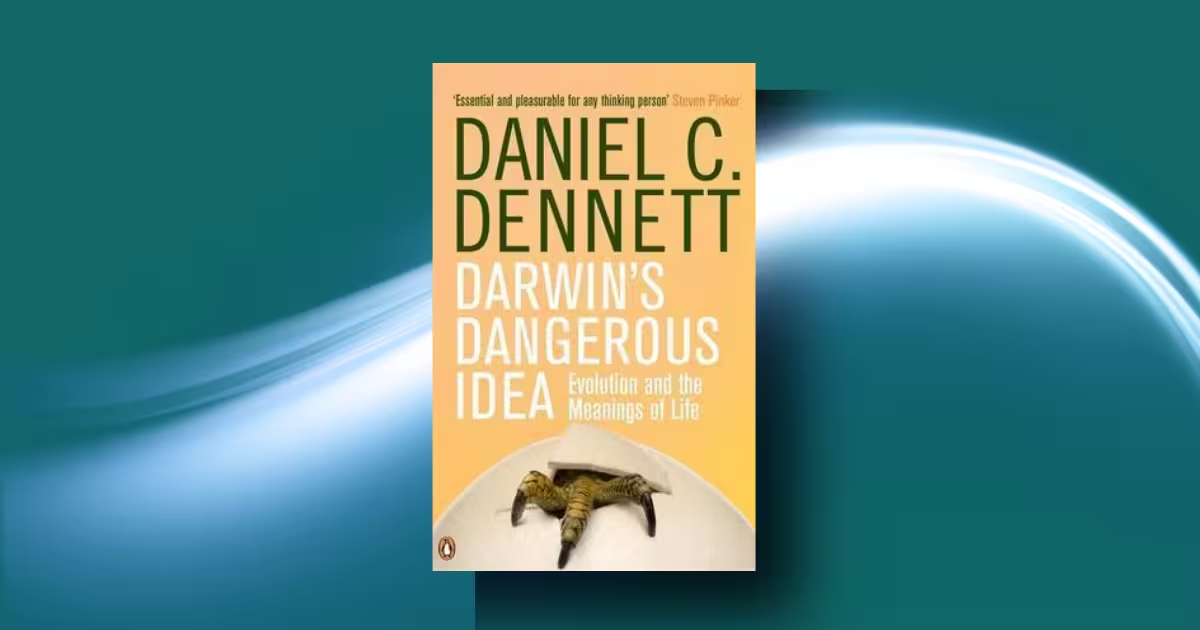
Does a single idea really have the power to dissolve religion, rewrite morality, and explain the human mind — all at once? If Daniel C. Dennett is to be believed, yes. And the idea in question has been sitting in plain sight since 1859. Darwin’s Dangerous Idea: Evolution and the Meanings of Life, first published in 1995, is not merely a book about evolution.
It is an assault on every comfortable philosophical fence humanity has ever built to keep Darwin at bay. I came to it expecting a science book. I finished it with the unsettling sensation that the ground beneath my most cherished beliefs had shifted — perhaps permanently.
Darwin’s Dangerous Idea is best for Readers who want to understand why evolution is philosophically explosive, not just biologically true. Philosophy students, scientists curious about the mind-body problem, atheists, agnostics, curious theists, and anyone who has ever seriously asked “Why is there something rather than nothing?” Dennett is a guide for all of them — demanding, but rewarding.
Not for readers seeking comfort in their existing worldview, those who want a simple popular-science read, or those unwilling to wade through dense philosophical argument. This is a 586-page intellectual marathon, and Dennett will not slow down for the fainthearted.
Table of Contents
1. Introduction
Darwin’s Dangerous Idea: Evolution and the Meanings of Life was written by Daniel C. Dennett (March 28, 1942 – April 19, 2024), Distinguished Professor of Arts and Sciences and Director of the Center for Cognitive Studies at Tufts University, Massachusetts.
He was also the author of Content and Consciousness (1969), Brainstorms (1978), Elbow Room (1984), The Intentional Stance (1987), and Consciousness Explained (1992), among others.
When Darwin’s Dangerous Idea appeared in 1995, it arrived as both a celebration of Darwinian theory and a philosophical declaration of war — war against the idea that the human mind, human meaning, and human morality require anything beyond a blind, mindless, algorithmic process to exist.
The book is part evolutionary biology, part philosophy of mind, part cultural criticism. Dennett’s credentials are in philosophy, not biology, and he is refreshingly upfront about that.
But what he brings to the table that professional biologists rarely do is the willingness to follow the logic of natural selection wherever it leads — past the cellular wall, past the brain, and into the most sacred corners of human self-understanding: consciousness, language, morality, and meaning itself.
Darwin’s Dangerous Idea is published in three parts.
Part I situates Darwin’s idea in the history of philosophy and shows why it constitutes a genuine revolution — not merely a scientific advance, but a complete inversion of the traditional “mind-first” worldview. Part II examines challenges to Darwinism from within evolutionary biology, finding them all wanting.
Part III applies Darwinian thinking to the human species — to our minds, our languages, our meanings, and our moral codes — with thrilling and sometimes disturbing results.
Dennett’s central thesis can be stated with remarkable economy: natural selection is an algorithmic process — mindless, purposeless, substrate-neutral — and this single fact is sufficient to explain the origin of all design in the universe, including the design of the human brain and everything it produces.
In Dennett’s own formulation, “Darwin’s dangerous idea is that Design can emerge from mere Order via an algorithmic process that makes no use of pre-existing Mind.”
This idea, he argues, is not merely a biological hypothesis. It is a universal acid — a corrosive that, once loosed upon the traditional picture of the world, eats through every layer: Plato’s eternal Forms, Locke’s proof that mind must precede matter, Hume’s frustrated search for an alternative to divine design, Chomsky’s mysterious “language organ,” Gould’s spandrels, Penrose’s quantum consciousness.
Nothing survives the acid in its original form. Everything must be rebuilt on a new foundation — or abandoned.
2. Background: Before Darwin, the World Was Mind-First
To appreciate why Dennett considers Darwin’s idea truly dangerous, you have to first understand the philosophical world into which it erupted.
Before 1859, the dominant view across Western philosophy was what Dennett calls the “Mind-first” view: the universe was fundamentally ordered by intelligence. John Locke, writing in 1690, argued from pure logic that “incogitative Matter” could never produce a “thinking intelligent Being.”
Therefore, something with Mind must have existed first. This was not mere religious dogma — it was presented as philosophical necessity, as obvious and undeniable as a mathematical theorem.
Even David Hume, the most devastating skeptic of his era, could not escape this conclusion.
In his Dialogues Concerning Natural Religion (1779), Hume’s character Philo systematically dismantled every version of the Argument from Design — the theistic claim that the order and complexity of nature implies a designing intelligence.
Hume showed the argument was logically flawed. But then, at the end of the Dialogues, Philo concedes the point anyway. Why? As Dennett explains: “Hume could not see how the ‘curious adapting of means to ends, throughout all nature’ could be due to chance — and if not chance, what?”
Hume was trapped. He could see that the traditional answer — a divine Designer — was philosophically indefensible. But he could not imagine any alternative. Darwin, 83 years later, provided one.
Natural selection gave the world a way of generating design without a designer, purpose without a purposer, order without a mind to impose it. This is why Dennett calls it “the single best idea anyone has ever had” — ahead of Newton and Einstein — because it resolved a puzzle that had baffled every major thinker in Western history.
3. Darwin’s Dangerous Idea Summary
Part I: Starting in the Middle — The Philosophical Revolution
Darwin’s Dangerous Idea opens with a childhood memory: Dennett recalls singing around a campfire, a song called “Tell Me Why,” which explained the stars, the ivy, and the sky through God’s handiwork. Then, he writes, “along comes Darwin and spoils the picnic. Or does he? That is the topic of this book.”
Chapter 2: The Algorithm at the Heart of Everything
The central conceptual innovation Dennett brings is the framing of natural selection as an algorithm — a formal, step-by-step process that, given the right inputs and enough time, is guaranteed to produce output.
Three features of algorithms are critical: substrate neutrality (it doesn’t matter what the algorithm runs on — carbon, silicon, or something else entirely), underlying mindlessness (no step in the process requires intelligence or intention), and guaranteed results (the process always produces its output, reliably, without error).
Dennett argues that natural selection satisfies all three conditions exactly, and this is what makes it so powerful and so disturbing.
Darwin himself could not fully articulate the algorithmic nature of his own idea — the concept of algorithm as we understand it is a twentieth-century invention, formalized by Alan Turing.
But Darwin sensed it. His summary in Origin of Species lays out the logic with austere precision: if organisms vary, if offspring inherit those variations, and if there is a struggle for resources, then advantageous variations will accumulate over time, producing adaptation. “This principle of preservation, I have called, for the sake of brevity, Natural Selection.”
The crucial point Dennett drives home is that you don’t need to understand why something is advantageous for it to be selected. Natural selection is blind. It doesn’t aim; it filters. And this is what Locke and Hume could not imagine: design without a designer, function without intention.
Chapter 3: Universal Acid — Skyhooks vs. Cranes
This is perhaps the most conceptually fertile chapter in Darwin’s Dangerous Idea, and it introduces two of Dennett’s most famous metaphors. A skyhook is a miraculous, top-down source of design — something that lifts order into existence from above without itself needing explanation. God is the ultimate skyhook.
The soul is a skyhook. Noam Chomsky’s mysterious “language organ,” which appeared suddenly in human evolution without any selective explanation, is a skyhook.
A crane, by contrast, is a legitimate lifting device — something that enhances and accelerates the design process but is itself the product of the same bottom-up, algorithmic process.
Sexual selection is a crane. The Baldwin Effect — the way individual learning can temporarily mimic genetic adaptation and thereby guide genetic evolution — is a crane. Language itself, once evolved, becomes a crane that massively amplifies human cognitive power.
The difference between good Darwinians and bad ones, Dennett argues, is that good Darwinians look for cranes; bad ones (or closet Darwin-doubters) keep hoping for skyhooks.
The concept of “universal acid” captures what happens when Darwinian thinking is taken seriously across all domains.
Dennett writes that the idea “eats through just about every traditional concept, and leaves in its wake a revolutionized world-view.” Platonic essences dissolve: species are not eternal types but contingent populations. Aristotelian teleology dissolves: purpose is not built into nature from above but emerges from below through selection.
The argument from design dissolves: what looks like the work of a divine craftsman is the cumulative product of billions of years of mindless filtering.
Chapters 4 & 5: The Tree of Life and the Library of Mendel
Dennett provides a vivid visualization of the Tree of Life — the actual historical branching pattern of all organisms that have ever lived, extending back approximately 3.5 billion years to the first single-celled life forms.
He walks through some of the most important conceptual puzzles in evolutionary biology: what a species actually is (no essence, just a branch in the tree), how speciation occurs invisibly in real time but can only be recognized retrospectively, and what it means for Mitochondrial Eve — the most recent common female ancestor of all humans alive today — to have existed.
Mitochondrial Eve, Dennett notes, can only be retrospectively crowned; nothing in her biology or behavior identified her as special at the time.
To understand the space of possible organisms, Dennett introduces the “Library of Mendel” — a thought experiment borrowed from Jorge Luis Borges’s “Library of Babel.”
The Library of Mendel contains every possible DNA sequence. Most of these sequences produce nothing viable — they are, as Richard Dawkins puts it, “ways of being dead rather than alive.”
The actual organisms that have ever existed occupy Vanishingly narrow threads through this incomprehensible space, and the path the Tree of Life has taken through it was not predetermined. Contingency is real. History matters.
Part II: Darwinian Thinking in Biology — Defending the Core
Part II of Darwin’s Dangerous Idea is largely a sustained engagement with the internal critics of Darwinian orthodoxy, principally Stephen Jay Gould. Dennett’s treatment of Gould is respectful but unsparing, and it has proven controversial.
Adaptationism and the Spandrels Debate
Gould and Richard Lewontin’s famous 1979 paper, “The Spandrels of San Marco and the Panglossian Paradigm,” argued that adaptationists — biologists who explain every feature of an organism as an adaptation — were guilty of the same naive optimism as Voltaire’s Dr. Pangloss, who insisted that everything is for the best in the best of all possible worlds. Gould and Lewontin proposed that many biological features are “spandrels” — architectural by-products of structural constraints that have no direct adaptive function.
Dennett takes Gould and Lewontin apart with careful and occasionally devastating precision. He argues that adaptationism is not a mistake but the irreplaceable core of evolutionary biology.
Without the presumption that features have functions, you cannot do reverse engineering — you cannot look at a biological structure and ask “What is this for?” He quotes the evolutionary biologist Colin Pittendrigh: “The study of adaptation is not an optional preoccupation with fascinating fragments of natural history; it is the core of biological study.”
More pointedly, Dennett accuses Gould of a persistent pattern: announcing revolutionary challenges to Darwinian orthodoxy that, on close inspection, turn out to be minor corrections or just plain errors.
Punctuated equilibrium — Gould’s most celebrated contribution, the claim that evolution proceeds not gradually but in fits and starts punctuated by long periods of stasis — turns out, Dennett argues, to be either false (the claimed pattern of sudden bursts followed by stasis is not universal) or compatible with orthodox neo-Darwinism (if it is a real pattern, Darwinian mechanisms can explain it).
In either case, it is no revolution.
This critique of Gould generated enormous controversy when Darwin’s Dangerous Idea was published, and it still does. Dennett is accused of caricature and of academic score-settling. But even critics who find his tone too harsh generally concede that his arguments are substantially correct.
Stuart Kauffman and Self-Organization
One of the most interesting chapters in Part II deals with the theoretical biologist Stuart Kauffman, who had proposed that “self-organization” — spontaneous ordering processes that emerge from the laws of physics and chemistry — could supplement or even partially replace natural selection as a source of biological order.
Kauffman’s work on complex systems and “the edge of chaos” suggested that certain patterns in biology — the conservation of early embryonic development across very different species, for instance — might reflect not selection pressures but intrinsic mathematical regularities.
Dennett’s verdict is nuanced. He argues that Kauffman’s discoveries are genuine and important, but that they deepen rather than overthrow Darwinism. Kauffman’s “self-organization” is itself a crane — a set of conditions that makes evolution more efficient and more powerful.
The principles Kauffman uncovers are not competitors to natural selection; they are the constraints within which natural selection operates, and natural selection, given time, will reliably discover and exploit them.
Kauffman himself ultimately agrees, describing his work as an attempt to “include Darwinism in a broader context.”
Part III: Mind, Meaning, Mathematics, and Morality
This is the most ambitious and most controversial part of Darwin’s Dangerous Idea, and it is where Dennett’s argument becomes genuinely alarming to many readers.
Chapter 12: The Cranes of Culture — Memes
Dennett introduces and defends Richard Dawkins’s concept of the meme — a unit of cultural transmission, analogous to a gene. Just as genes propagate by moving from body to body through biological reproduction, memes propagate by moving from brain to brain through communication, imitation, and teaching.
Words, ideas, musical phrases, architectural styles, religious beliefs, and scientific theories are all memes. They replicate, vary, and compete for mental real estate.
The most persuasive, memorable, or emotionally resonant memes spread; others die out.
Dennett takes the meme concept further than Dawkins, arguing that our very selves — our identities, our values, our personalities — are constituted by the memes that have successfully colonized our brains.
The human brain did not evolve to have the specific beliefs and values that any individual human holds; it evolved to be colonizable by memes, and the memes did the rest.
This is a deeply unsettling picture of selfhood, and Dennett knows it: “If I am nothing over and above some complex system of interactions between my body and the memes that infest it, what happens to personal responsibility?”
His answer is that autonomy is not destroyed by this picture; it is redefined. You are still the agent of your decisions — the meme complex that constitutes your identity is the genuine author of your actions, not a mere puppet of your genes. But the Cartesian illusion of a sovereign, unified self standing apart from both genes and culture is indeed dissolved.
Chapter 13: Losing Our Minds to Darwin — Language and Intelligence
Dennett constructs what he calls the “Tower of Generate-and-Test” — a hierarchy of increasingly powerful types of minds, each capable of exploring more of the space of possible actions before acting:
- Darwinian creatures — organisms whose “decisions” are made entirely by natural selection over generations; they explore behaviorally what their ancestors explored genetically.
- Skinnerian creatures — organisms capable of operant conditioning; they can learn from their individual experience.
- Popperian creatures — organisms capable of using an inner model of the world to preselect better actions; “our hypotheses die in our stead,” as Karl Popper said.
- Gregorian creatures — organisms that import “mind-tools” from their cultural environment, especially language, to construct increasingly sophisticated inner worlds. Only humans.
Language is the master crane. It allows human minds to accumulate and share the cognitive labor of billions of individuals across thousands of years. A single contemporary human is, in terms of cognitive power, the beneficiary of more design work than has been done by all natural selection operating on all other species combined.
This section contains Dennett’s lengthy and impassioned critique of Noam Chomsky, who had argued that the human language faculty was not a Darwinian adaptation but something closer to a physical law — something that “appeared” rather than evolved.
Chomsky’s position was supported by Gould, who shared his suspicion of adaptationist explanations of language. Dennett’s demolition of this position is one of the most intellectually satisfying sequences in the book, culminating in the observation that Chomsky and Gould, by dismissing the evolutionary explanation of language, had effectively endorsed a skyhook — a miraculous gift that no naturalistic explanation could account for.
Chapter 14: The Evolution of Meanings
Can meaning itself be naturalized — given an evolutionary explanation? The philosophical opponents of this project are formidable: Jerry Fodor, Hilary Putnam, John Searle, Saul Kripke, and others have all argued, in various ways, that there is a kind of “original” or “intrinsic” intentionality — the property of being about something — that cannot be derived from any purely physical or functional process.
Only minds have real meaning; machines merely simulate it.
Dennett attacks this view through an extended thought experiment about a “two-bitser” — a vending machine designed to accept U.S. quarters. If the machine is moved to Panama, where quarter-balboas are physically indistinguishable from U.S. quarters, does the machine now “mean” quarter-balboa when it accepts a coin?
And what does this tell us about the meaning of the frog’s visual system when it detects a fly — or a small dark object that happens to pass?
Dennett argues that meaning, like function, is not an intrinsic property but emerges from history, environment, and selection. There is no “original” intentionality; all intentionality is derived, and this is not a deficiency — it is the only kind there is.
Chapters 16 & 17: The Origin and Redesign of Morality
The final philosophical frontier: can Darwinian thinking illuminate the origin and nature of morality? Dennett argues yes, but carefully. He traces the evolutionary scaffolding of ethical behavior from parental investment through kin selection, reciprocal altruism, and the game-theoretic mathematics of cooperation.
Robert Axelrod’s famous Prisoner’s Dilemma tournaments, which showed that the strategy “Tit for Tat” — cooperate until defected against, then retaliate — is robustly stable in iterated games, provide a mathematical underpinning for the emergence of trust and fairness in social animals.
But Dennett is explicit that evolutionary origins do not justify current moral practices.
The naturalistic fallacy — the inference from “is” to “ought” — is never licensed by Darwinian thinking. What Darwinian thinking can do is illuminate the constraints under which ethical reasoning must operate: we are finite, time-pressured, heuristic reasoners, not ideal rational agents.
The result is what Dennett calls “The Moral First Aid Manual” — not a set of eternal commandments, but a set of practical, revisable, imperfect rules that function as “conversation-stoppers” in the endless debate over right and wrong. “But that would be murder.” “But that would violate a person’s rights.”
These are not logically airtight principles; they are design features of a cognitive architecture that must decide without full information.
Chapter 18: The Future of an Idea
Darwin’s Dangerous Idea‘s final chapter confronts the obvious objection: if Darwin’s idea is truly a universal acid, doesn’t it dissolve everything we care about? Doesn’t it reduce love, beauty, conscience, and meaning to mere adaptive strategies — or worse, to the self-replicating agendas of memes that have infested us?
Dennett’s answer is a resounding no. The acid does corrode — it destroys the naive, pre-Darwinian versions of our cherished values. But what emerges from the acid bath is not nothing; it is something stronger and more honest.
Love is no less real for being an adaptation; beauty is no less beautiful for having an evolutionary history; conscience is no less binding for being a product of cultural selection. “There is no future in a sacred myth,” Dennett insists. But there is a future in a truth that can withstand examination.
Darwin’s Dangerous Idea ends with an appeal to biodiversity — not just biological diversity, but the diversity of human cultures, ideas, and values. Dennett argues that the Darwinian perspective should make us more committed to preserving this diversity, not less, because in a world of uncertainty and change, variation is the only hedge against extinction.
4. Darwin’s Dangerous Idea Analysis
Darwin’s Dangerous Idea is a genuinely groundbreaking work — one of those rare books that actually changes how you think, rather than merely adding to what you know. It is maddening and magnificent in equal measure.
The maddening parts come from Dennett’s rhetorical habits: he can be too confident, too dismissive of opponents who have a point, and occasionally too willing to punch below the belt (his treatment of Gould is the most notorious instance).
The magnificent parts — and they are genuinely magnificent — are the passages where the argument clicks into place with crystalline clarity, where you suddenly see that an entire domain of seemingly irreducible mystery has been illuminated by the simple, terrible logic of selection.
Darwin’s Dangerous Idea effectively proves its central philosophical claim: that the traditional “Mind-first” picture of the universe is no longer tenable.
Whatever one thinks of Dennett’s specific applications of Darwinian thinking to language, consciousness, and morality, his demonstration that natural selection can in principle generate the appearance of design without any pre-existing Mind is a philosophical achievement of the first order. Hume saw the problem; Darwin solved it; Dennett explains both, with erudition and verve.
Does the author effectively support his arguments with evidence and logical reasoning? Mostly, yes.
The biological sections are well-researched, and Dennett is careful to distinguish his own philosophical positions from the scientific consensus. The philosophical sections are sharp and often devastating.
The weakest sections are those dealing with memes and cultural evolution, where the analogies between genetic and cultural transmission strain under scrutiny, and where Dennett’s confidence somewhat outstrips the available evidence.
5. Strengths and Weaknesses
Strengths
Conceptual clarity and richness. Dennett is a master of the philosophical thought experiment. The Library of Mendel, the skyhook vs. crane distinction, the Tower of Generate-and-Test — these are genuinely illuminating devices that make genuinely difficult ideas accessible without dumbing them down.
Intellectual courage. Dennett goes where other philosophers fear to tread. He takes on the evolution of consciousness, of language, of morality, and of meaning — domains where most philosophers are content to plant a flag marked “Here be mysteries” and back away. His willingness to speculate boldly, while acknowledging the speculative nature of what he is doing, is admirable.
Range and erudition. Darwin’s Dangerous Idea draws on biology, philosophy of mind, cognitive science, game theory, linguistics, and the history of science. Few authors can synthesize across so many fields without losing the thread; Dennett manages it more often than not.
The Gould critique. Whatever its tone problems, Dennett’s critique of Stephen Jay Gould is substantially correct and importantly necessary. Gould was, as Dennett documents, systematically misleading general audiences about the state of Darwinian science, and the correction was overdue.
Weaknesses
The treatment of Gould. The criticism is often accurate, but the delivery is sometimes contemptuous in a way that undermines the argument. A charitable reader of Gould comes away feeling that Dennett has sometimes chosen a caricature over a careful reconstruction.
Meme science is underdeveloped. The meme concept is evocative and philosophically suggestive, but Dennett himself acknowledges that a rigorous science of memetics may be impossible. This limits the weight the argument can bear in Part III.
Length and repetition. Darwin’s Dangerous Idea is 586 pages and could be 450. Dennett has a tendency to re-explain his key distinctions (skyhooks vs. cranes, good reductionism vs. greedy reductionism) more times than is strictly necessary.
Atheism assumed, not argued. Darwin’s Dangerous Idea assumes a secular, naturalistic framework and does not seriously engage with sophisticated theological responses to Darwinism. Readers looking for a fair-minded survey of the science-religion interface will need to look elsewhere.
6. Comparison with Similar Works
Darwin’s Dangerous Idea occupies a specific and important niche in the literature of evolutionary philosophy. Several comparisons are illuminating:
Richard Dawkins, The Selfish Gene (1976) and The Blind Watchmaker (1986). Dennett draws heavily on Dawkins and credits him explicitly throughout. Dawkins is the more vivid science writer; Dennett is the more rigorous philosopher.
The Blind Watchmaker is probably the better introduction to the argument against design; Darwin’s Dangerous Idea is the more comprehensive philosophical treatment.
Dennett also introduces the meme concept (Dawkins invented it) in far greater philosophical detail than Dawkins himself ever did.
Stephen Jay Gould, Wonderful Life (1989) and The Structure of Evolutionary Theory (2002). Gould and Dennett are the great antagonists of late-twentieth-century evolutionary philosophy. Gould writes with more literary elegance; Dennett argues with more philosophical rigor. Readers who want to understand the debate should read both, but should be aware that Dennett’s critique of Gould’s science has largely been vindicated by subsequent evolutionary biology.
Steven Pinker, The Language Instinct (1994). Published a year before Dennett’s book, Pinker’s work on language is one of the key sources for Dennett’s critique of Chomsky.
Pinker makes the detailed scientific case for language as a Darwinian adaptation; Dennett makes the broader philosophical argument for why this matters.
E.O. Wilson, Consilience (1998). Wilson’s effort to unify human knowledge under a naturalistic framework is similar in ambition to Dennett’s project, but more optimistic about the prospects for a single science of humanity. Dennett is more cautious about reductionism (distinguishing “good” from “greedy” reductionism) and more careful about the limits of adaptationist explanation in the social sciences.
Peter Singer, A Darwinian Left (1999). Where Dennett explores the philosophical implications of Darwinism for morality, Singer is more concerned with the political implications. The two books complement each other well.
7. Conclusion
Darwin’s Dangerous Idea is, thirty years after its first publication, more relevant than ever.
The debates it engages — over the evolution of consciousness, the Darwinian origins of morality, the relationship between evolution and religion, the nature of intentionality, and the prospects for a purely naturalistic worldview — are, if anything, more urgent now than in 1995. The rise of large language models has given Dennett’s arguments about the algorithmic nature of mind an eerie contemporary resonance: can an algorithm produce genuine understanding?
Dennett would say the question is based on a false premise — there is no understanding, in humans or machines, that is not algorithmic all the way down.
Philosopher Daniel Dennett died on April 19, 2024, at the age of 82, leaving behind a body of work that permanently altered the philosophical landscape. With his passing, his intellectual legacy — including this book — assumes even greater importance as a record of what it looked like to take Darwinian thinking with complete philosophical seriousness.
Darwin’s dangerous idea has not lost its danger. It still threatens to dissolve every sacred cow it touches.
But Dennett’s achievement, in this book, is to show that what survives the dissolution — honest understanding, genuine compassion, earned meaning — is worth more than what was lost. “There is no future in a sacred myth,” he tells us. And on the evidence of this book, the truth he offers instead is, if not comfortable, at least magnificently alive.
Who should read this book? Anyone who wants to understand why Darwinian evolution is philosophically, and not just scientifically, the most important idea in the history of human thought.
Scientists, philosophers, curious non-specialists, students of cognitive science, and anyone willing to have their deepest assumptions challenged by one of the keenest minds of the twentieth century.








I’ve been exploring for a little bit for any high-quality articles or blog posts
in this sort of house . Exploring in Yahoo I at last stumbled
upon this web site. Reading this information So i am satisfied to convey that I have a very excellent uncanny feeling
I discovered exactly what I needed. I such a lot indisputably will make certain to don?t omit this
website and give it a glance regularly.