
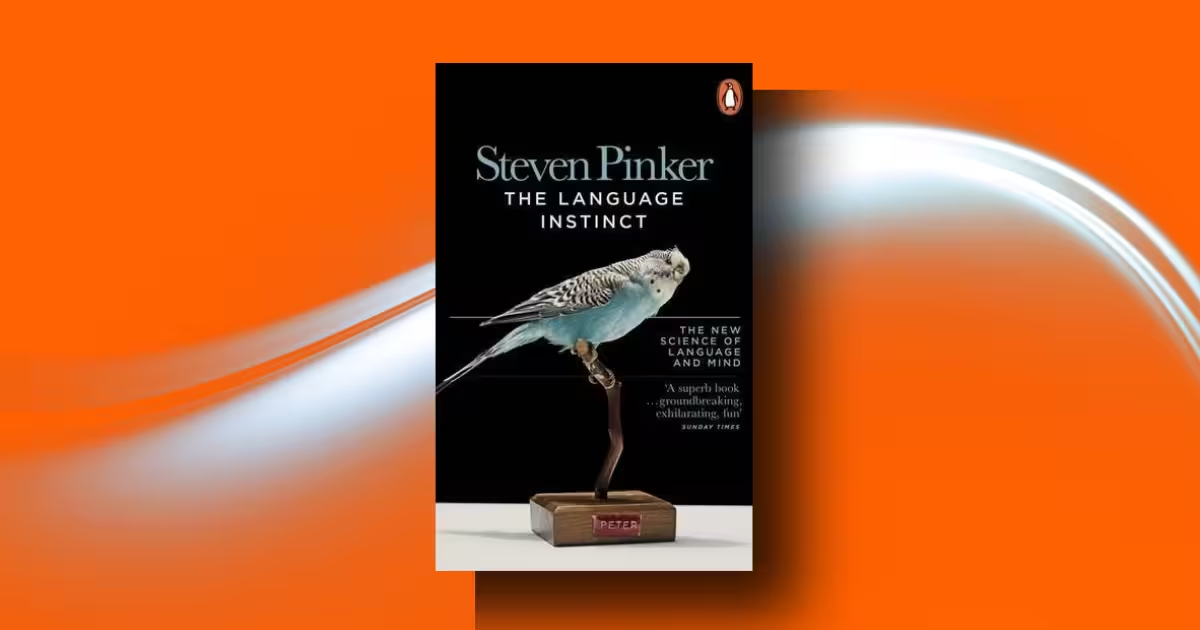
Did you know that a three-year-old child — who cannot tie her shoelaces, cannot add two numbers, and does not yet know right from left — is already one of the most sophisticated grammatical geniuses on the planet? The Language Instinct: How the Mind Creates Language by Steven Pinker will show you exactly why that is, and the answer is far stranger, far more beautiful, and far more profound than anything your English teacher ever told you.
The Language Instinct is best for readers who are curious about how the human mind works; students of linguistics, psychology, biology, or cognitive science; anyone who has ever wondered why children learn language so effortlessly while adults struggle; people fascinated by how evolution shapes the brain; readers of popular science who enjoy a bold, witty, evidence-packed argument.
Not for those looking for a style guide or a grammar handbook; readers who want only light, casual reading with no intellectual demand; those seeking a book that celebrates linguistic relativism or the Sapir-Whorf hypothesis — Pinker systematically and, at times, mercilessly dismantles it.
Table of Contents
1. Introduction
The Language Instinct: How the Mind Creates Language is a landmark work in popular cognitive science, first published in 1994 by William Morrow and later reissued in an updated edition in 2007 by Harper Perennial Modern Classics.
The author, Steven Pinker, was at the time of writing a professor in the Department of Brain and Cognitive Sciences at the Massachusetts Institute of Technology (MIT) and Director of the McDonnell-Pew Center for Cognitive Neuroscience.
He is now the Johnstone Family Professor of Psychology at Harvard University. Pinker is widely regarded, as Time magazine once named him, as one of the “100 Most Influential People in the World.”
The book received the William James Book Prize from the American Psychological Association and the Public Interest Award from the Linguistics Society of America — two of the most distinguished honours in its field.
Context
The Language Instinct belongs to the genre of narrative popular science, sitting at the intersection of linguistics, evolutionary biology, cognitive psychology, and neuroscience.
It is Pinker’s attempt to bring decades of academic research — much of it locked away in specialist journals — to a general readership.
Pinker draws on his own laboratory work on language acquisition in children, the theories of Noam Chomsky, the evolutionary frameworks of Charles Darwin and Richard Dawkins, and a dizzying range of evidence from brain-damaged patients, sign language, creoles and pidgins, computer science, and animal communication research.
The result is a book that, in just over 500 pages, manages to be both encyclopaedic in scope and electric in pace.
Purpose
Pinker’s central thesis is breathtakingly direct: language is not a cultural invention, but a biological instinct.
He writes plainly in Chapter 1: “Language is a complex, specialized skill, which develops in the child spontaneously, without conscious effort or formal instruction, is deployed without awareness of its underlying logic, is qualitatively the same in every individual, and is distinct from more general abilities to process information or behave intelligently.”
This single claim overturns practically everything most educated people believe they know about language — that it is taught, that it is culturally variable at its deepest level, that it is deteriorating, that it determines thought, or that animals can acquire it.
The book’s mission is to demolish each of those assumptions with evidence, and to replace them with something far richer.
2. Background
By the early 1990s, cognitive science had made explosive advances in understanding language.
The field had transformed since Noam Chomsky’s revolutionary work in the late 1950s, which proposed that all human languages share a deep “universal grammar” wired into the brain.
Yet, as Pinker notes in his preface, “Language is beginning to submit to that uniquely satisfying kind of understanding that we call science, but the news has been kept a secret.”
The popular understanding of language was — and to a great extent remains — riddled with misconceptions.
People believed that language was a cultural artefact like money or the calendar, that children needed to be explicitly taught grammar, that language shaped and limited thought (the so-called Sapir-Whorf hypothesis), and that chimps could be taught to speak in the same way humans do.
Against this backdrop of widespread misunderstanding, Pinker set out to write the book that would change all of it.
3. Summary: Everything You Need to Know About The Language Instinct
Core thesis
Main takeaway: Pinker argues that language is not mainly a cultural invention, school-taught skill, or general-purpose habit.
It is a specialized biological capacity of the human mind: an “instinct” for acquiring and using grammar.
Children do not merely copy adults; they actively construct grammar from limited input.
The book’s central claim is that human brains contain language-specific machinery that lets us convert thoughts into structured speech and recover structured thoughts from speech.
The argument
Human language looks effortless, but it is an extremely complex system. Every normal human society has language, and so-called “primitive” societies do not have primitive grammars.
Children acquire grammatical systems rapidly, often without explicit instruction, and even create new grammar in creoles and sign languages when the input around them is incomplete.
Thought itself is not identical to English, Chinese, or any other spoken language; Pinker argues for an abstract “mentalese” beneath speech.
Grammar then acts as a translation system between thought and sound. The book uses evidence from children, deaf signers, aphasia, specific language impairment, speech perception, language change, and evolution to argue that language is an evolved, specialized component of human nature.
Chapter-by-chapter takeaways
| Chapter | Highlighted takeaway |
|---|---|
| 1. An Instinct to Acquire an Art | Language is treated as a biological capacity, not a learned cultural trick. Pinker compares language to spider web-spinning: not because language is rigid, but because humans are naturally equipped to acquire it. He draws on Darwin and Chomsky to frame language as a mental organ or computational module. |
| 2. Chatterboxes | Complex language is universal across human groups. There are “Stone Age” technologies, but Pinker argues there are no “Stone Age languages.” Nonstandard dialects are not broken versions of standard language; they are rule-governed systems. Children, creoles, and sign languages show that grammar is actively generated, not passively imitated. |
| 3. Mentalese | We do not literally think in our native language. Pinker attacks strong versions of the Sapir-Whorf hypothesis and argues that thought exists in a more abstract representational system, “mentalese.” Words express thought; they do not fully constitute it. |
| 4. How Language Works | Grammar is a combinatorial system. A finite number of words and rules can generate an unlimited number of sentences. Syntax is not just word order; it encodes who did what to whom through phrases, heads, arguments, movement, dependencies, and structure. |
| 5. Words, Words, Words | Words are not simple labels pasted onto things. A word bundles sound, meaning, syntax, morphology, and conceptual relations. Children must solve a hard problem: mapping words to meanings in context. Pinker later connects this chapter to his work on regular and irregular forms in Words and Rules. |
| 6. The Sounds of Silence | Speech is not a string of crisp sounds. It is a continuous acoustic stream that listeners mentally segment into phonemes. Human language has “duality of patterning”: meaningless sounds combine into meaningful units, which then combine into phrases and sentences. |
| 7. Talking Heads | Understanding language is computationally hard. Sentences are full of local ambiguities, but humans resolve them quickly using grammar, memory, context, and pragmatics. Pinker uses artificial intelligence and speech recognition failures to show how impressive ordinary comprehension really is. |
| 8. The Tower of Babel | Languages differ dramatically on the surface, but Pinker argues that they share deep design principles. Language diversity comes from innovation, learning, and separation among speech communities. Language change is not decay; it is constant reanalysis and recombination by human minds. |
| 9. Baby Born Talking—Describes Heaven | Babies are not born speaking, but they are born prepared for language. Infants can discriminate speech sounds early; children pass through babbling, first words, word combinations, and a grammar explosion. T he chapter emphasizes a critical period: language acquisition is easiest in childhood and harder later. |
| 10. Language Organs and Grammar Genes | Language depends on brain systems and genetic development, but Pinker rejects the simplistic idea of a single “grammar gene.” Brain damage can selectively impair language, and inherited language disorders suggest genetically guided language circuitry. Later notes in the edition discuss FOXP2 and clarify that it is not a single grammar gene. |
| 11. The Big Bang | Pinker argues that language is best understood as an evolutionary adaptation shaped by natural selection. Its many interacting parts—syntax, morphology, lexicon, speech perception, vocal tract, parsing, and learning mechanisms—show adaptive complexity. |
| 12. The Language Mavens | Pinker criticizes prescriptive grammar authorities who mistake prestige conventions for logic. He does not reject good style or standard grammar; his point is that many “rules” are arbitrary, historically confused, or socially motivated. Nonstandard dialects can be grammatically sophisticated. |
| 13. Mind Design | Language becomes a model for understanding the rest of the mind. Pinker argues that learning is not the opposite of innateness; learning requires innate machinery. He uses language to support a broader evolutionary-psychology view of the mind as a set of specialized systems, not a blank slate. |
4. The book’s strongest ideas to remember
1. Language is an instinct, but not a reflex
Pinker does not mean that children are born speaking English, Bengali, or Japanese.
He means they are born with a species-specific capacity to acquire whatever human language surrounds them.
Environment determines which language a child learns; biology explains why children can learn any human language so quickly and deeply.
2. Children are grammar builders, not tape recorders
A major piece of evidence is that children say things they could not simply have copied, such as over-regularized forms and novel sentence structures.
Creoles and emerging sign languages are even stronger evidence: when children receive incomplete linguistic input, they can impose systematic grammar on it.
3. No human language is “primitive”
Pinker rejects the idea that technologically simple societies speak simple languages. He uses examples from Kivunjo, Cherokee, sign languages, and nonstandard English dialects to argue that grammatical complexity is a human universal, not a mark of education or civilization.
4. Thought is deeper than words
Against strong linguistic determinism, Pinker argues that people do not think in their native language.
Language influences communication and can guide attention, but the book rejects the stronger claim that language makes certain thoughts impossible.
The “mentalese” idea explains how translation, word invention, infant thought, animal cognition, and nonverbal reasoning are possible.
5. Grammar is a hidden engineering system
Ordinary speakers unconsciously handle phrase structure, agreement, case, tense, recursion, ambiguity, and dependency.
The fact that we do this without noticing it is the reason language seems simple. Pinker’s repeated move is to make ordinary speech look strange again, so the reader can appreciate its machinery.
6. Speech perception is astonishing
Spoken language is not cleanly separated into individual sounds. Coarticulation smears sounds together, accents vary, speakers differ, and phonemes change depending on context.
Human listeners still decode speech rapidly, which explains why machine speech recognition was such a hard engineering problem in the book’s era.
7. Language changes, but it does not simply decay
Pinker treats language change as normal, creative, and systematic. Mishearings, reanalysis, social separation, borrowing, and children’s reconstruction of grammar all drive change. This is why languages diversify over time without becoming worse.
8. Standard grammar is socially useful, not cognitively superior
The book distinguishes descriptive grammar from prescriptive grammar.
Standard English matters because it is socially powerful and useful in formal contexts, but that does not mean nonstandard dialects are illogical or ungrammatical.
Pinker’s target is not clarity or style; it is false authority about what makes language “correct.”
9. Genes matter, but “one grammar gene” is a myth
The book discusses inherited language disorders and brain localization to support biological specialization.
But Pinker is careful that a single defective gene disrupting grammar does not mean one gene “controls grammar.” Later material in the file reinforces that language is genetically complex.
10. Language is a window into human nature
The final chapter generalizes the lesson: humans are not blank slates, and learning is not magic.
A mind must already be structured in order to learn. Language shows how nature and nurture cooperate: biology supplies the learning machinery; culture supplies the particular language.
5. Key concepts in plain terms
Mental grammar: The unconscious rule system in a speaker’s mind. It is not a school grammar book.
Universal Grammar: The proposed shared design constraints that make all human languages learnable by children.
Mentalese: The abstract language of thought beneath spoken or signed language.
Poverty of the stimulus: Children acquire grammatical knowledge that seems richer than the explicit evidence available to them.
Discrete combinatorial system: A system where finite units combine into unlimited expressions: sounds into words, words into sentences.
Duality of patterning: Human language combines meaningless sound units into meaningful units, then meaningful units into larger structures.
Creole: A full language that develops when children transform a pidgin or incomplete input into a systematic native language.
Critical period: The childhood window during which language acquisition is especially easy and complete.
Prescriptive grammar: Rules about how people are told they should speak or write.
Descriptive grammar: Rules that actually govern how speakers of a language or dialect speak.
6. Practical takeaways for readers
For parents: Children need exposure to language, but they do not need formal grammar instruction to acquire their first language.
For language learners: Adult difficulty with second languages is not a moral failure or lack of intelligence; it reflects a biological shift after childhood.
For educators: Teaching reading and writing is different from children acquiring speech. Spoken or signed language is instinctive; literacy is a cultural technology that usually needs instruction.
For writers: Standard usage is useful, but many “rules” are conventions, not laws of logic. Good style should serve clarity, audience, and purpose.
For anyone judging dialects: Nonstandard does not mean ungrammatical. Dialects have rules; they just differ from prestige standards.
For thinking about AI: Human language understanding is hard because it requires grammar, meaning, context, inference, and social understanding—not just word matching.
The book’s big message is that language is one of the clearest windows into the design of the human mind.
We are not blank slates absorbing speech by imitation, nor are we merely taught grammar by parents and schools.
We are a species whose brains are built to acquire language, translate thought into structured expression, and understand new sentences we have never heard before.
That capacity is biological, computational, social, and evolutionary all at once.
7. The Language Instinct Analysis
The Language Instinct is one of the most important and genuinely thrilling works of popular science written in the twentieth century.
Reading it for the first time, I remember feeling the peculiar pleasure of watching a vast, tangled subject suddenly reorganize itself around a single powerful idea.
is what great science writing does — not just transmit information, but change the way you see.
What Pinker achieves here is rare: a synthesis that manages to be simultaneously rigorous and entertaining, technically ambitious and accessible to a non-specialist reader.
The prose has what the Atlantic Monthly rightly called “acid verve” — a combination of precision and wit that makes even the most technical passages a pleasure to read.
His use of examples from popular culture, from soap operas to Lewis Carroll to George Bernard Shaw, is not mere decoration; it is the pedagogical strategy of a gifted teacher who understands that the abstract must always be anchored in the concrete.
On the question of whether Pinker effectively supports his central thesis, the answer is an unqualified yes.
The argument for language as a biological instinct is assembled from so many independent lines of evidence — neurological, genetic, developmental, evolutionary, anthropological, computational — that no single piece of counter-evidence could dislodge it.
This is what a mature scientific thesis looks like. It does not rest on one clever experiment; it is a coherent picture that makes sense of an enormous and otherwise bewildering diversity of facts.
Does the book fulfil its stated purpose? Overwhelmingly.
By the final page, you understand why language is universal, why children acquire it without instruction, why it is independent of thought, how it is structured, where it came from, and why ordinary speech is far more sophisticated than any grammar maven has ever acknowledged.
8. Strengths and Weaknesses
Strengths
The greatest strength of The Language Instinct is the sheer audacity and coherence of its central thesis.
In an intellectual climate that was still, in 1994, heavily influenced by the social constructivist view of language, Pinker’s insistence on the biological reality of a language instinct was genuinely provocative — and he backs it up completely.
A second great strength is the range and quality of the evidence.
Pinker is not cherry-picking; he is genuinely attempting to make sense of the full diversity of the field, from Williams syndrome to Nicaraguan Sign Language to the Loebner Prize competition to the evolution of the vocal tract. Each piece of evidence is explained clearly and located within the larger argument.
The chapter on the language mavens is a particular delight — funny, rigorous, and refreshingly honest about the gap between prescriptive fantasy and descriptive reality.
And then there is the writing itself. Pinker is, to put it simply, one of the best science writers alive. The book never condescends, never glosses, and never becomes tedious.
Weaknesses
The book’s most significant weakness is also a consequence of its greatest strength: its argument is so sweeping and so confident that it occasionally oversimplifies the genuine complexity and ongoing debate in the field.
Pinker’s treatment of the Sapir-Whorf hypothesis, for instance, is more dismissive than it perhaps deserves.
The strong version of the hypothesis — that language determines thought — is indeed discredited.
But the weak version — that language influences certain aspects of cognition in modest ways — has found more empirical support in the decades since the book was published, particularly in research on colour perception, spatial reasoning, and number representation.
Pinker’s polemical style serves clarity but can sometimes sacrifice nuance.
Similarly, his treatment of Chomsky is respectful but selective. Pinker endorses Chomsky’s universal grammar enthusiastically while disagreeing with his scepticism about evolutionary explanations — and this disagreement is argued with characteristic force.
But Chomsky’s scepticism about adaptationist narratives is not simply obstinacy; it reflects genuine uncertainties about the limits of evolutionary reasoning that Pinker does not always give full weight.
The book is also, inevitably, dated in some technical areas.
It was published in 1994, well before the discovery of the FOXP2 gene in 1998, before the detailed neuroimaging work of the 2000s and 2010s that has significantly complicated the simple Broca’s/Wernicke’s picture, and before the explosion of computational linguistics enabled by deep learning.
The 2007 updated edition includes a new afterword addressing some of these developments, but the main text remains a product of its time.
9. Comparison with Similar Works
Readers who have loved The Language Instinct will find natural companions in several other works. Pinker’s own subsequent books — Words and Rules (1999), which develops the argument about regular and irregular morphology, The Stuff of Thought (2007), which explores what language reveals about human conceptual structure, and How the Mind Works (1997), which extends the instinct framework to the whole of the mind — form a natural sequence.
For the evolutionary biology underlying Pinker’s argument, Richard Dawkins’ The Blind Watchmaker (1986) and The Selfish Gene (1976) are essential reading; Pinker draws on both extensively.
Daniel Dennett’s Darwin’s Dangerous Idea (1995), published shortly after The Language Instinct, provides a powerful philosophical complement.
Those interested in the neuroscience of language will find Oliver Sacks’ The Man Who Mistook His Wife for a Hat (1985) a humane and illuminating companion — Sacks’ case studies of neurological patients illuminate the fragility and specificity of language functions in ways that complement Pinker’s more theoretical account.
For a direct challenge to Pinker’s nativist position, Geoffrey Sampson’s The Language Instinct Debate (2005) offers the most sustained and intellectually serious critique, arguing that there is no compelling evidence for an innate language organ.
Reading Pinker alongside Sampson gives a fuller picture of the genuine controversies in the field.
For those drawn to the philosophical dimensions of the language and thought relationship that Pinker addresses in his chapter on mentalese, Ludwig Wittgenstein’s Philosophical Investigations (1953) and Jerry Fodor’s The Language of Thought (1975) — the latter essentially the foundational text for Pinker’s concept of mentalese — are rewarding further reading.
10. Conclusion
The Language Instinct is a remarkable, groundbreaking, and enduring book. It is the kind of work that genuinely changes how you experience your own mind — after reading it, you cannot listen to a child learning to speak, or catch yourself reaching for the right word, or marvel at a piece of great prose, without a new layer of understanding.
Who should read it?
Almost everyone. It is indispensable for students of linguistics, cognitive science, psychology, biology, and philosophy of mind.
But it is also a book for the curious general reader — anyone who has ever wondered why language feels so effortless, so natural, so much a part of being human.
Because the answer, it turns out, is that it is a part of being human: as deep in our biology as our upright posture and our forward-facing eyes.
Is it suitable for specialists? Yes, as a synthesis and a provocation, though specialists will find much to dispute in its more sweeping claims. Is it suitable for general audiences?
Absolutely — Pinker writes with a lucidity and wit that make even the most technical passages readable. The ideal reader is anyone who has ever taken language for granted and wants, for the first time, to appreciate what a staggering miracle it is.
As Pinker writes in that electrifying opening: “Simply by making noises with our mouths, we can reliably cause precise new combinations of ideas to arise in each other’s minds.”
After reading this book, you will never think of that quite so simply again.







