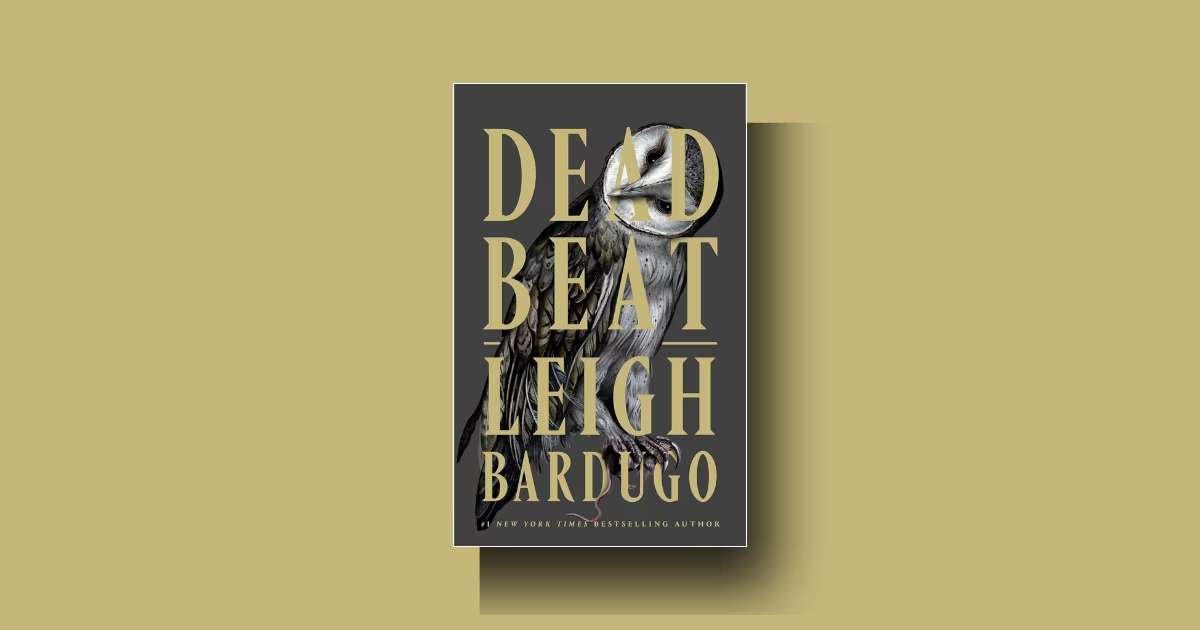

Dead Beat ending explained: Leigh Bardugo’s final Ninth House novel brings Alex Stern’s dark Yale saga to its long-awaited conclusion, but the ending leaves plenty to unpack. From Alex and Darlington’s fate to the demons, Lethe House, and the secrets surrounding Alex’s past, here’s what the Dead Beat ending means and how it closes the Ninth House trilogy.
Table of Contents
Snapshot
Dead Beat is the third and final book in Leigh Bardugo’s Ninth House trilogy, published by Flatiron Books in 2026. The novel picks up months after the events of Hell Bent, with Alex Stern, Darlington, Dawes, and Turner hunting demons that have been slipping through the open door to hell.
The plot involves a false quest for a golem that turns out to be armor for a soldier, a final confrontation with the demon prince Golgarot at Harkness Tower, and Alex’s transformation from a self-described abomination into a queen who forges her own crown.
The book kills off Tripp Helmuth, reveals that Darlington’s family home Black Elm is possessed by his great-grandfather’s demon, and ends with Alex closing all seven nexuses of Yale’s secret societies and murdering Alban Reed, the president of the Lethe board.
Reader Recommendation: This book is for readers who finished Hell Bent and need closure. If you loved the dark academia atmosphere of Ninth House, the heist-like pacing of Hell Bent, and the found family dynamic between Alex, Dawes, Turner, and Darlington, you will find the payoff here.
If you are looking for a gentle ending where everyone survives and nothing hurts, this is not that book. Dead Beat earns its title.
Introduction
Leigh Bardugo’s Dead Beat arrived in 2026 and I read it in three days, which is fast for me. I have been following Alex Stern since Ninth House dropped in 2019, and I needed to know how this story ended. Bardugo is best known for the Grishaverse, but the Ninth House series is her darkest work. It is about power, trauma, and the question of whether someone who has been broken can ever be whole again.
The book is published by Flatiron Books. Bardugo is also an associate fellow of Pauli Murray College at Yale University, which explains why the campus details feel so precise.
Background
The Ninth House series began with Ninth House in 2019. That book introduced Galaxy “Alex” Stern, a high school dropout from Los Angeles who could see ghosts.
She was recruited to Yale after a mysterious encounter with a man named Dean Sandow and given a position in Lethe, the Ninth House, which is supposed to monitor the eight other secret societies at Yale. Lethe’s mission is to protect the university and the city of New Haven from the magical fallout of the societies’ rituals.
Hell Bent, the second book, came out in 2023. It followed Alex’s quest to rescue Darlington from hell after he was dragged there by a demon. The book ended with Alex and her friends escaping hell, but leaving the door open behind them. Demons began slipping through into New Haven.
Dead Beat is the third and final installment. It deals with the consequences of that open door.
Dead Beat Summary
Part I: Inserviam Tibi (I Will Serve You)
The book opens in early spring, months after the events of Hell Bent. Alex, Darlington, Turner, and Dawes have been hunting demons that have come through the open door to hell. The demons feed on human emotions, sometimes taking over their hosts completely. They trap the demons in a puzzle box called the Voynich Coffin, but the box is losing its structural integrity because they have crammed twenty-two demons into it.
Alex is struggling. She is exhausted, skinny, and running on determination and delusions about her own limits. Darlington is also struggling. He is part demon now, and he worries constantly about losing control. He is haunted by his time in hell, where he was forced to become one of Golgarot’s torturers.
The first major demon hunt involves a demon that has taken the form of a baby. It is feeding on a woman named Janie Keep, draining her blood and her joy. Alex traps it in the Voynich Coffin. After the hunt, Turner tells the group that they cannot keep going like this. He is working two jobs and not sleeping.
The group discusses Kittscher’s Daemonologie, a text written by one of the original pilgrims who walked the Gauntlet in 1933. Darlington has come to believe that Kittscher was right about something: all magic is demonic. He thinks the reason the St. Elmo’s ritual went wrong is that he is a portable nexus, and his demonic nature disrupts magic.
Dawes reveals that she has been researching the original pilgrims. She has found documents in the Yale Club library in New York. These documents include a photograph of the four original pilgrims and a version of Kittscher’s Daemonologie with additional pages. The pilgrims used code names: Doubting Thomas, Prince Henry, Good Ol’ Hec, and Nick Zanca.
The group travels to New York to meet with the Lethe board. At the Yale Club, Alban Reed, the board president, tells them he wants a new nexus. He pressures Alex to help him create one. Alex lies and says she does not know how. Reed threatens her, saying he can protect her from “others” who would want to use her gifts.
Dawes stays behind in the library and steals documents. She finds that the four pilgrims were Rudolph Kittscher (the scholar), Lionel Reiter (the priest), Hector Nygard (the soldier), and Daniel Arlington II (the prince, Darlington’s great-grandfather).
The group tracks down Rudolph Kittscher. He is living under the name Thomas Neumann in Rhode Island. When they arrive, they find he is not a vampire but a “nachtzehrer,” a creature that feeds on members of its own household. He has been draining a young caregiver named Theo Alonto for two years. Alex captures Kittscher’s demon and puts it in the Voynich Coffin.
Theo is barely alive. He cannot speak, but he communicates by blinking. He asks Alex to kill him, to give him oblivion. Alex consumes his soul, which gives her a piece of his memories. She experiences his childhood, his first kiss, his love for his mother.
Part II: Usque ad Finem Temporum (Until the End of Time)
The group searches for the golem artifacts. They find pages from an old Lethe Armory Catalogue that list four items: Heart of Gold, Hand of God, Feet of Clay, and Head of the Dragon. They believe these are pieces of a golem, but they are wrong.
Alex discovers the truth by Wheelwalking into Hector’s memories. The artifacts are not for a golem. They are armor for a soldier. The original pilgrims were supposed to bring a demon back from hell and cage it using this armor. Hector was supposed to be the soldier who would don the armor and drag the demon back if something went wrong. But Hector killed himself before he could fulfill his duty.
Darlington realizes that his great-grandfather, Daniel Arlington II, was the “prince” of the pilgrims. He did not defeat his demon. He fed it his descendants. Black Elm, the Arlington family home, is possessed by the demon. It has been feeding on every Daniel Arlington who lived there.
Alex’s father, Luis Huilca, appears. He is part of a secret order of priests that hunts Wheelwalkers. He tries to kill Alex. Alex stabs him back and orders Dawes to wipe his memory.
The group acquires all four artifacts. They prepare to climb Harkness Tower. The plan is for Alex to ascend the tower, which is a mirror of the Gauntlet, and face Golgarot in a final confrontation.
The Final Battle
Alex climbs Harkness Tower, which has 284 steps. Along the way, she faces three trials, each designed to break her. The first is a tattoo parlor where she must name a tarot card to save Hellie. The second is a burning building where she must identify the true culprit. The third is a library where she must find the most valuable item.
She solves each trial, but they take a toll on her.
At the top, she faces Golgarot in a stadium. He forces her to relive the worst moment of her life: her assault in a public bathroom when she was a teenager. She is unable to save her younger self, but she realizes that she does not have to. The dead come to her aid, including Hellie, her grandmother Estrea, and the Bridegroom. They help her see that she cannot change the past, but she can still choose her future.
Golgarot calls Darlington as his second, and Darlington, bound by his oath to hell, attacks Alex. He breaks her ribs, tears open her chest, and leaves her dying on the ground.
But Alex does not give up. She reaches out through the Wheel and feeds on the resentment of every soul in New Haven. She heals herself and forges Golgarot’s yoke into a crown. She puts the crown on her head and commands Darlington to serve her instead of hell.
Together, Alex and Darlington defeat Golgarot. Alex closes all seven nexuses of Yale’s secret societies. She sends Golgarot and all the demons back to hell. The Voynich Coffin is sent through the gate as well, sealing the demons inside.
The Aftermath
The group returns to Il Bastone. Tripp Helmuth, who was possessed by a demon but had retained his humanity, died fighting Reiter. He was stabbed through the heart with a salt sword. Dawes is devastated.
Turner plants evidence that exposes Linus Reiter’s murders. The police find at least seven bodies buried on Reiter’s estate. Turner is promoted.
Alex decides not to finish the semester. She plans to leave Yale and travel with Darlington to Italy to investigate a haunted monastery.
Alban Reed and Charlie Girard confront Alex and Darlington at Black Elm. Alex kills Reed by consuming his soul. Darlington captures Girard. They wipe Girard’s memory and leave him in New Jersey with Reed’s body.
The book ends with Alex, Darlington, Dawes, and Turner performing an exorcism at Black Elm to drive out the demon that has possessed the house for a century.
Dead Beat Analysis and Criticism
Dead Beat Characters
Alex Stern is the heart of this series. She is a survivor of sexual assault, poverty, and addiction. She is not a good person in the traditional sense. She has killed people. She has consumed souls. But she is loyal to the people she loves, and she refuses to give up even when everything is stacked against her. In Dead Beat, she finally accepts that she does not have to be “good” to be worthy of love.
Daniel Arlington (Darlington) is a tragic figure. He was raised in a haunted house by a grandfather who was feeding him to a demon. He went to hell and became a torturer to survive. He is part demon now. He struggles with his nature, but he chooses to serve Alex, not because he is forced to, but because he loves her.
Pamela Dawes is the Oculus of Lethe. She is a grad student who has spent six years maintaining the Lethe archives and armory. She is shy and anxious, but she is also brave. She fights Reiter and kills him with hellfire. She loses Tripp, and his death breaks her.
Abel Turner is a detective with the New Haven Police Department. He is a man of faith who struggles to reconcile his belief in God with the reality of demons. He becomes a key ally to Alex and the others. He uses his position to expose Reiter’s crimes and protect the group.
Tripp Helmuth was a rich frat boy who was consumed by a demon. The demon retained Tripp’s personality and his desire to be good. Tripp dies a hero, saving Dawes from Reiter. His last words are “One of the good guys.”
Golgarot is the demon prince. He is ancient, cruel, and manipulative. He wants to open the door to hell and use Alex’s blood to keep it open forever. He is defeated when Alex forges his yoke into a crown and claims his power for herself.
Dead Beat Themes and Symbolism
Power and Corruption: The societies at Yale are built on a foundation of exploitation and murder. The original pilgrims killed innocent people to walk the Gauntlet. The Bonesmen killed Kylie Sanz in a botched ritual.
The donors who funded Harkness Tower wanted to capture a demon to use as a source of power. The book argues that institutions of power will always protect themselves, even if it means sacrificing the vulnerable.
Trauma and Recovery: Alex is a survivor of sexual assault. She has PTSD. She has nightmares. She has used drugs and alcohol to cope. But she does not let her trauma define her. She fights back. She builds a new family. She learns to trust again. The book does not suggest that trauma is easily overcome, but it does suggest that healing is possible.
The Meaning of Family: Alex’s biological father tried to kill her. Darlington’s family fed him to a demon. But Alex finds a chosen family in Darlington, Dawes, Turner, and Tripp. The book argues that family is not about blood. It is about who shows up for you.
Sacrifice and Redemption: Tripp sacrifices himself to save Dawes. Alex sacrifices her place at Yale to close the nexuses. Darlington sacrifices his humanity to become a demon. The book asks whether sacrifice can redeem a person, and whether some people are beyond redemption.
Symbolism: The four artifacts (Heart, Hand, Feet, Head) represent the four pilgrims. The Harkness Tower is a mirror of the Gauntlet. The owls represent Alex’s father’s order, which has been watching her. The Crown represents Alex’s transformation from victim to queen.
Strengths
The character development is excellent. Alex, Darlington, Dawes, and Turner all grow over the course of the series. The pacing is tight. The plot is full of twists. The themes are relevant and thought-provoking.
Weaknesses
Some readers might find the ending too dark. The book kills off a beloved character. The pacing in the middle section drags slightly. The villain, Alban Reed, is not as compelling as the demons.
Comparison with Similar Works
Dead Beat is similar to The Secret History by Donna Tartt, but with more magic and more diversity. It is similar to Catherine House by Elisabeth Thomas, but with a faster pace. It is similar to Bunny by Mona Awad, but with more heart.
Personal Insight with Contemporary Educational Relevance
One of the most important themes in Dead Beat is the question of institutional accountability. The societies at Yale have been getting away with murder for over a century. They have killed innocent people, covered up their crimes, and used their power to protect themselves. This is not just a fantasy element. It is a reflection of real-world scandals involving elite institutions.
In 2023, the Yale Daily News reported that the university had failed to adequately address sexual misconduct complaints for years. In 2024, the New York Times published an investigation into fraternity hazing deaths at universities across the country. These stories show that institutions of power often prioritize their own reputations over the safety of the people they are supposed to protect.
Dead Beat argues that accountability is possible, but only if people are willing to fight for it. Alex, Dawes, and Turner do not wait for the system to fix itself. They expose the crimes, they punish the guilty, and they build a new system that puts the safety of students and the community first.
This is a lesson that applies to the real world. If you see something wrong, say something. If the system fails, build a better one. Do not wait for permission.
Dead Beat Quotes
“We don’t do this alone. That’s how we lose.” (Turner to Alex, Chapter 3)
“I will serve you ’til the end of days.” (Darlington to Alex, Chapter 38)
“The last word is always stars.” (Darlington to Alex, Chapter 52)
“One of the good guys.” (Tripp’s last words, Chapter 62)
“I prefer to play to my strengths.” (Alex to Darlington, Chapter 63)
“All that time and you never learned no one gets what they deserve.” (Alex to Golgarot, Chapter 63)
“Go home, lick your wounds, yell about how you were robbed. But this gate is closed to you.” (Alex to Golgarot, Chapter 63)
Conclusion
Dead Beat is an outstanding conclusion to the Ninth House trilogy. It is dark, emotional, and ultimately hopeful. It does not give readers a perfect ending. It gives them something better: a chance for the characters to heal, to grow, and to build a future on their own terms.
I recommend this book to fans of dark academia, urban fantasy, and stories about found family. If you loved Ninth House and Hell Bent, you will not be disappointed. If you have not started this series yet, now is the time.
This series is significant because it takes the tropes of dark academia and uses them to tell a story about trauma, recovery, and the power of chosen family. It is a story about a girl who was told she was a mistake and who proved everyone wrong.