


Last updated on October 8th, 2026 at 08:23 am
Is Drishyam 3 worth watching? Yes, if you have followed Vijay Salgaonkar this far. Drishyam: The Conclusion or Drishyam 3 is a gripping, crowd-pleasing finale with strong turns from Ajay Devgn, Jaideep Ahlawat and Prakash Raj, and it ties off every loose thread. It stumbles in a slow opening and a convenient pre-finale, and its twists lack the shock of “Drishyam 2.”
Drishyam 3 Review at a Glance
Verdict: A satisfying, well-acted conclusion that works best as a battle of wits and only flirts with its sharper political ideas.
Best performance: Ajay Devgn’s restrained Vijay, with Jaideep Ahlawat owning the first half.
Biggest weakness: A sluggish start and a predictable stretch before the climax.
Remake or original? Original. It is not a remake of the Malayalam “Drishyam 3.”
Box office: About Rs 66.75 crore net in India on day one, per Sacnilk.
Table of Contents
Drishyam 3: Quick Facts
| Detail | Information |
|---|---|
| Title | Drishyam: The Conclusion (Drishyam 3) |
| Release date | October 2, 2026 (Gandhi Jayanti) |
| Director | Abhishek Pathak |
| Writers | Abhishek Pathak, Aamil Keeyan Khan, Parveez Shaikh |
| Cast | Ajay Devgn, Jaideep Ahlawat, Prakash Raj, Tabu, Shriya Saran, Rajat Kapoor, Ishita Dutta, Mrunal Jadhav, Kamlesh Sawant |
| Language | Hindi |
| Running time | 2 hours 30 minutes |
| Cinematography | Sudhir K. Chaudhary |
| Background score | Amar Mohile |
| Franchise position | Third and final Hindi film |
Audience Recommendation
| Best for | Not for |
|---|---|
| Fans of the first two Hindi “Drishyam” films | Newcomers who have not seen Parts 1 and 2 |
| Viewers who enjoy courtroom drama and slow-burn cat-and-mouse thrillers | Viewers expecting a twist as shocking as “Drishyam 2” |
| Audiences who were let down by the Malayalam “Drishyam 3” | Anyone who dislikes loud background scores |
| Readers interested in films about misinformation and public opinion | Those looking for the family warmth of the earlier films |
Drishyam 3 Review: A Hero for the Post-Truth Age
Every good con needs an audience, and Vijay Salgaonkar has always known his. Across three films, the small-town cable operator played by Ajay Devgn has picked up everything he needs to know about police work from the Hindi movies he watches every night, and then turned that education against the police.
In “Drishyam: The Conclusion,” the last installment of the Hindi series, he finally states his philosophy out loud: “Kahani ka sach hona zaruri nahi, sach lagna zaroori hai.” A story doesn’t have to be true. It only has to seem true.
That line works as the film’s thesis, and as a fair summary of what this franchise has been selling since 2015: an ordinary family man who stays one move ahead of everyone, the audience included.
Is Drishyam 3 a remake of the Malayalam film?
No. The first two Hindi films were remakes of Jeethu Joseph’s Malayalam originals starring Mohanlal. This one, directed by Abhishek Pathak, who also made the 2022 “Drishyam 2,” tells its own story. It is not a remake of the Malayalam “Drishyam 3,” and it parts ways with that film from the opening scenes, not just in the final reel.
At the trailer launch, Devgn described it as a completely different script, and said he wanted Mohanlal and Joseph to watch it and give their approval.
What is Drishyam 3 about?
The setup will be familiar to anyone who has kept up. Years ago, Vijay’s wife, Nandini (Shriya Saran), and elder daughter, Anju (Ishita Dutta), killed Sameer Deshmukh, the son of the senior police officer Meera Deshmukh (Tabu), in what amounted to self-defense. Vijay, convinced that a family like his would never get a fair hearing against a family like hers, hid the crime and has been defending the lie ever since.
Fresh evidence now reopens the case, and this time the authorities seem certain he is concealing something. The easy domestic moments that gave the earlier films their warmth are mostly gone. The movie heads straight into the investigation and stays there.
Jaideep Ahlawat and Prakash Raj: the new adversaries
The new opponent is Superintendent Rajveer Singh Tomar, played by Jaideep Ahlawat, and the first half largely belongs to him. Ahlawat lands every line with precision, and his scenes opposite Devgn build steadily toward an intermission face-off in which Vijay, for once, lets his anger show. It is the best stretch of the film, and it suggests a two-hander the movie never quite delivers.
That is because the second half shifts to the courtroom, where Prakash Raj, as the public prosecutor Indrajith Shetty, takes over the interrogations. Raj is excellent and commanding, but his arrival pushes Ahlawat to the sidelines just when the duel between cop and suspect should be tightening.
Viewers who remember Akshaye Khanna’s sharply written investigator in “Drishyam 2” may feel the absence of a single, sustained opponent.
How good is Ajay Devgn in Drishyam 3?
Devgn plays Vijay almost entirely through restraint. He does a great deal with his eyes and the slight tilt of his head, and he is generous with his scene partners, letting Ahlawat, Raj and Kamlesh Sawant (as Inspector Gaitonde, the franchise’s reliably exasperating comic foil) have their moments. Saran makes the most of a key turn as the drama unfolds.
Tabu and Rajat Kapoor, as Meera and her husband, Mahesh, are given little to do, which is a shame: the grieving, vengeful mother was once the engine of this story, and she deserved a fuller farewell.
The film underneath the thriller
The more interesting film is the one running underneath the procedural. As The Hindu’s Shreyas Pande observed, “The Conclusion” quietly flips the usual underdog story. Here the power sits with the dead boy’s family, and it is the common man who borrows the state’s methods.
Vijay spreads a carefully built narrative through WhatsApp, stirs up resentment of the authorities among local churchgoers and steers the anger of a crowd toward his own ends.
In one pointed scene, two police officers, a lawyer and a businessman recite the elite universities they attended, only to be outmaneuvered by a man with little formal schooling.
The movie enjoys these reversals as payback, and audiences will too.
But it rarely pauses to notice that its hero’s greatest weapon is the very thing that makes the present moment so unnerving: the manufactured consensus, the lie repeated until it hardens into fact. (We have looked at that same anxiety from another angle in our piece on deepfakes and the future of truth online.)
The film was released on Oct. 2, Gandhi Jayanti, which sits ironically beside a hero whose relationship with truth is anything but Gandhian. Vijay is no apostle of truth. He is calm, calculating and entirely persuasive, which makes him less a hero for the post-truth age than its mascot.
Pathak sketches that idea without committing to it, and the result is a crowd-pleaser with a cautionary tale buried inside it, unexamined.
Where Drishyam 3 falls short
The craft is mostly sturdy, though the film is not without bumps. An early sequence of staged playacting runs long, and the recap of the first two films, rushed through the opening titles, will leave newcomers scrambling; this is not a movie that rewards a missed detail.
The second half moves quickly, sometimes breathlessly, but the stretch before the finale leans on convenience, and seasoned viewers may see a couple of the final turns coming. None of the twists land with the jolt of the earlier films.
Final verdict
What “The Conclusion” does deliver is closure. Its screenplay, by Pathak, Aamil Keeyan Khan and Parveez Shaikh, ties off the loose threads rather than leaving the door open for another sequel, a choice that sets it apart from its Malayalam counterpart.
Drishyam 3 knows exactly what its audience came for: the pleasure of watching a quiet man make fools of powerful people. Only in its closing moments does it let the other side state its case, and only briefly. Whether we should be cheering quite so loudly is the question it leaves us to take home.
Drishyam 3 Ending Explained
How does the case reopen?
The story picks up after “Drishyam 2.” Meera Deshmukh has never stopped pursuing justice for her son, Sameer, who died years earlier at the hands of Nandini and Anju after he secretly recorded Anju and tried to blackmail her. Vijay’s cover-up has survived two investigations, and every attempt to prove the family’s guilt has failed.
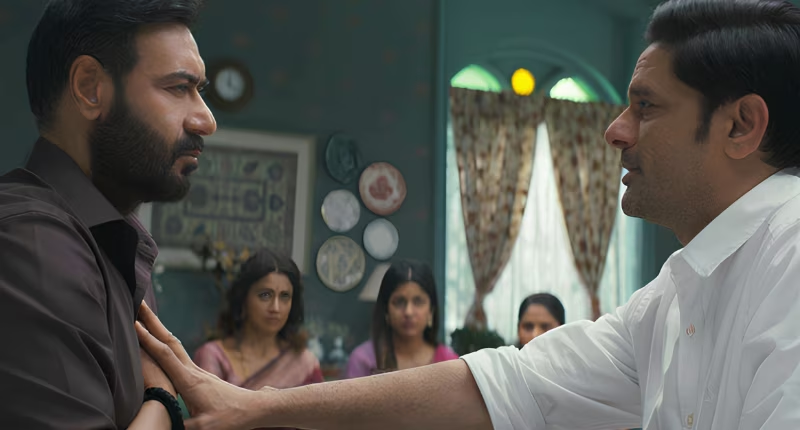
This time the case passes to SP Rajveer Singh Tomar, who changes tactics. Instead of searching for the remains, he goes after the people and logistics behind Vijay’s original plan and tracks down witnesses connected to the old cover-up. The pressure on the Salgaonkars builds through the first half and peaks in a tense pre-interval face-off between Tomar and
Vijay.
What happens in the courtroom?
The second half moves into court. Public prosecutor Indrajith Shetty starts taking apart the timeline Vijay built years ago, and the testimonies tied to the cover-up seem to hand the state its missing pieces. Outside the courtroom, Vijay works on public opinion, spreading his version of events through WhatsApp and turning local churchgoers’ distrust of the authorities to his advantage.
Does Vijay Salgaonkar go to jail in Drishyam 3?
No. The twist is that Vijay has been letting the prosecution build its strongest case on purpose. His apparent weakness is a performance. When that case collapses in court for lack of solid proof, the family is acquitted, and, as post-release explainers describe it, the principle of double jeopardy means they cannot be tried again for the same crime. The case is closed for good.
What does Meera Deshmukh say at the end?
The final word goes to Meera, who sums up the franchise’s moral knot in one line: “Wo galat hokar bhi hero hai aur hum sahi hokar bhi villain.” He is the hero despite being wrong; we are the villains despite being right.
Drishyam 3 Pros and Cons
| Pros | Cons |
|---|---|
| An original story that frees the Hindi series from the Malayalam template | An overlong stretch of staged playacting early on |
| Ajay Devgn’s restrained, eyes-first performance | A rushed recap of the first two films that leaves newcomers behind |
| Jaideep Ahlawat’s commanding first half and the pre-interval face-off | Ahlawat is sidelined once the courtroom drama begins |
| Prakash Raj’s forceful courtroom interrogations | Tabu and Rajat Kapoor have little to do |
| A fast, gripping second half | A convenient pre-finale and a few predictable twists |
| Genuine closure, with every loose end tied off | The twists lack the shock value of “Drishyam 2” |
| A timely subtext about misinformation and crowd anger | A background score that can feel excessive |
| Kamlesh Sawant’s Gaitonde adds welcome comic relief | The political subtext is raised but never examined |
Drishyam 3 Themes
Perception over truth. The film’s central idea is that what people believe matters more than what happened. Vijay wins not by proving his innocence but by controlling what everyone sees and hears, which is the franchise’s title made literal: drishyam means “visual” or “sight.”
Family before law. Vijay is no crusader for the common good. Everything he does serves a single purpose, protecting his wife and daughters, and the film asks how far that loyalty can stretch before it becomes something darker. Park Chan-wook’s No Other Choice makes an interesting companion piece on how far a family man will go.
The reversal of power. Usually the underdog faces down the system. Here the dead boy’s family holds the badge and the influence, while an ordinary cable operator borrows the state’s own tools of narrative control to beat it.
Misinformation and the crowd. Vijay’s use of WhatsApp messaging and community resentment mirrors the way real-world falsehoods spread and harden, a parallel the film makes visible without fully confronting. For a classic take on manipulation and control, see our review of The Manchurian Candidate (1962).
Moral ambiguity. Meera’s closing line turns the franchise inside out. The grieving mother who is right about the crime ends up cast as the villain, and the man who hid it walks away a hero.
Cinema as education. From the first film onward, Vijay has learned his craft from the movies he watches every night. The final chapter keeps that joke alive: the same popular cinema that taught audiences what justice looks like has taught its hero how to fake it.
Indian cinema’s uneasy relationship with fact and fiction is something we have written about before in Controversial Films and Fiction Versus Facts.
Drishyam 3 vs Drishyam 2 vs Malayalam Drishyam 3
| Drishyam 2 (Hindi, 2022) | Drishyam 3 (Malayalam) | Drishyam: The Conclusion (Hindi, 2026) | |
|---|---|---|---|
| Story source | Remake of Jeethu Joseph’s Malayalam film | Original Malayalam story | Original Hindi story |
| Director | Abhishek Pathak | Jeethu Joseph | Abhishek Pathak |
| Lead | Ajay Devgn | Mohanlal | Ajay Devgn |
| Main investigator | Akshaye Khanna | Not covered in this review | Jaideep Ahlawat |
| Release | 2022 | May 21, 2026 | October 2, 2026 |
| Ending | Open to a sequel | Post-credits scene sets up “Drishyam 4” | Closes the case for good |
| India day 1 net | Rs 15.38 crore | Not covered in this review | Rs 66.75 crore |
Drishyam 3 Box Office Collection
Figures as of October 3, 2026. All numbers are trade-tracker estimates, not official producer figures.
“Drishyam: The Conclusion” opened on Gandhi Jayanti, a national holiday, and audiences turned up in force. According to the trade tracker Sacnilk, the film earned about Rs 66.75 crore net in India on its first day across 15,759 shows, with overall occupancy of roughly 60 percent. That is more than four times the Rs 15.38 crore net opening of “Drishyam 2” in 2022.
Sacnilk ranks it as the second-biggest opening day for a Hindi film, behind only “Dhurandhar: The Revenge” and just ahead of “Jawan.”
ETV Bharat and Pinkvilla likewise place it second among 2026 releases, after “Dhurandhar: The Revenge.” Pinkvilla also noted that the result is unusual for a thriller, a genre that has not traditionally drawn blockbuster openings.
Overseas markets added about Rs 15 crore gross, taking the worldwide first-day total to roughly Rs 95.10 crore gross. Momentum looks set to carry into the weekend: by midday Friday, advance bookings for Saturday had already passed Rs 12 crore gross, according to Koimoi.
The Free Press Journal cites an unofficial production budget of about Rs 110 crore, which means the first day alone recovered more than half of that figure, though distribution and marketing costs still have to be earned back.
| Metric | Figure |
|---|---|
| Day 1 India net | Rs 66.75 crore |
| Day 1 India gross | Rs 80.10 crore |
| Day 1 overseas gross | Rs 15 crore (approx.) |
| Day 1 worldwide gross | Rs 95.10 crore |
| Day 1 occupancy | 60.1% |
| “Drishyam 2” Day 1 India net (2022) | Rs 15.38 crore |
| Reported budget (unofficial) | Rs 110 crore |
Drishyam 3 FAQs
Is Drishyam 3 a remake of the Malayalam Drishyam 3?
No. Unlike the first two Hindi films, “Drishyam: The Conclusion” has an original story and is not narratively connected to the Malayalam “Drishyam 3” starring Mohanlal. It continues from the Hindi “Drishyam 2” and goes in a different direction from start to finish.
Is Drishyam 3 the last Drishyam film?
Yes, for the Hindi series. “Drishyam: The Conclusion” is billed as the third and final Hindi installment, and Ajay Devgn has said it ends the franchise. The Malayalam series is continuing separately: producer Antony Perumbavoor confirmed in August 2026 that a “Drishyam 4” will be made.
Who plays the new police officer in Drishyam 3?
Jaideep Ahlawat plays SP Rajveer Singh Tomar, the officer who reopens the investigation into the Salgaonkar family. Prakash Raj joins as public prosecutor Indrajith Shetty, who leads the case in court.
Does Vijay Salgaonkar go to jail in Drishyam 3?
No. The prosecution fails to prove its case, the court closes it, and Vijay and his family walk free. Post-release explainers note that double jeopardy prevents the family from being tried again for the same crime.
What is the running time of Drishyam 3?
“Drishyam: The Conclusion” runs about 2 hours 30 minutes (150 minutes).
How much did Drishyam 3 earn on day one?
According to Sacnilk, the film earned about Rs 66.75 crore net in India and around Rs 95.10 crore gross worldwide on its opening day, October 2, 2026.
Do I need to watch Drishyam 1 and 2 before Drishyam 3?
It helps. The film rushes through its recap of the earlier parts during the opening titles, and the plot depends on details from both previous films. Rewatching “Drishyam” (2015) and “Drishyam 2” (2022) first will make the twists easier to follow.
Who directed Drishyam 3?
Abhishek Pathak directed “Drishyam: The Conclusion.” He also directed the 2022 Hindi “Drishyam 2” and co-wrote the new film with Aamil Keeyan Khan and Parveez Shaikh.
Conclusion: Should You Watch Drishyam 3?
“Drishyam: The Conclusion” gives Vijay Salgaonkar the send-off fans wanted: a clean ending, a strong ensemble and one last demonstration that the man who watches movies all night understands stories better than the people hunting him.
It is weaker than “Drishyam 2” on surprise and stronger than the Malayalam “Drishyam 3” on closure, according to many early viewers.
Watch it in a theater, ideally after a rewatch of the first two films, and pay attention to how easily you find yourself rooting for the lie. For more films worth your time, browse our list of 101 best films you need to see.
Drishyam 3

Director: Abhishek Pathak
Date Created: 2026-10-14 01:30
4
Pros
- Ajay Devgn delivers a strong performance as Vijay Salgaonkar.
- Jaideep Ahlawat is a standout as SP Rajveer Singh Tomar.
- Prakash Raj adds weight as public prosecutor Indrajith Shetty.
- The film is an original story, not a remake of Malayalam Drishyam 3.
- Gripping, tense finale to the Hindi Drishyam franchise.
- Smart courtroom drama and cat-and-mouse investigation.
Cons
- Runtime of about 2 hours 30 minutes may feel long.
- Opening recap of Drishyam 1 and *2* is rushed.
- New viewers may be lost without watching the previous films.
- Some twists may feel convenient or reliant on legal technicalities.
- Not connected to the Malayalam Drishyam 3, which may disappoint fans.
