
Last updated on October 8th, 2026 at 09:20 am
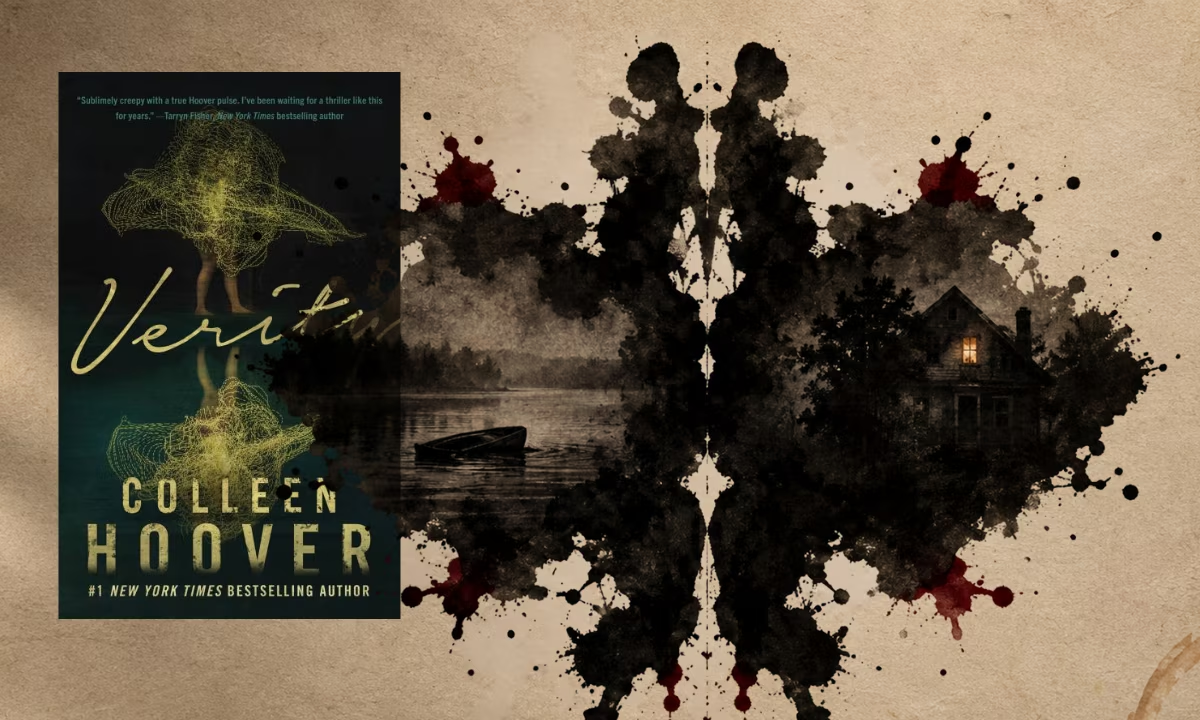
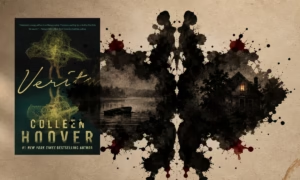
Verity Manuscript vs Letter. What do you do when two documents written by the same woman, in the same house, tell you two opposite stories about the same night?
That is the question millions of readers have carried away from Colleen Hoover’s Verity. The novel was self-published in December 2018, picked up by Grand Central Publishing in 2021 after a BookTok surge, and sold more than two million print copies in 2022 alone, according to sales figures reported by FanBolt.
Most popular thrillers end with a solution. Verity ends with a choice, and readers have spent years arguing over it in comment sections, book clubs, and group chats.
The argument usually comes down to one line: Team Manuscript or Team Letter?
That divide matters more than it seems.
In 2016, Oxford Dictionaries named “post-truth” its Word of the Year, defining it as a condition in which objective facts shape public opinion less than emotion and personal belief do. Verity is that condition shrunk down to a single family. You get two persuasive accounts, no neutral witness, and a narrator with every reason to pick one side. Whatever you decide on the final page says as much about you as it does about the book.
With the film adaptation starring Anne Hathaway and Dakota Johnson opening in theaters on October 2, 2026, the debate has a fresh audience. Here is what the argument is about, why it refuses to die, and what the movie does to it.
Table of Contents
Verity Plot Summary
Lowen Ashleigh is a little-known writer in Manhattan. Her mother, whom she cared for alone, has just died, she is about to be evicted, and she has barely left her apartment in weeks. On her way to a meeting at Pantem Press, she sees a pedestrian killed by a truck right in front of her. A stranger helps her clean up and lends her his shirt. He turns out to be Jeremy Crawford, the husband of bestselling thriller writer Verity Crawford.
The meeting is a job offer. Verity was badly hurt in a car crash and can no longer write, so Pantem wants someone to finish the last three books in her series. Jeremy offers $75,000 per book. Lowen takes the job under a pen name, Laura Chase, and travels to the Crawfords’ house in Vermont to go through Verity’s notes.
The house is full of grief. Verity and Jeremy’s twin daughters have both died: Chastin from a peanut allergy at a sleepover, and Harper six months later, when a canoe tipped over on a lake near their home. Verity, now unable to speak or walk, is cared for by a nurse named April. Their five-year-old son, Crew, is the only child left.
While sorting through Verity’s office, Lowen finds a hidden manuscript called So Be It, Verity’s private account of her marriage and motherhood. It grows darker chapter by chapter, from Verity’s jealousy of her own children to attempts to harm them, and finally to the claim that she drowned Harper on purpose. Lowen keeps it secret from Jeremy, even as the two of them fall into an affair.
Strange things start to happen. Lowen’s bedroom door locks from the inside, Crew is cut by a knife found on the floor of Verity’s room, and one night Lowen sees Verity standing at the top of the stairs. Jeremy tells her Verity cannot walk. Then Crew lets slip that his mother talks to him. Lowen sets up a baby monitor, catches Verity moving on camera, and finally gives Jeremy the manuscript. Jeremy confronts his wife. Verity opens her eyes and speaks, and Jeremy, with Lowen’s help, kills her and makes it look like she died in her sleep.
Seven months later, Lowen and Jeremy are building a new life in North Carolina, and Lowen is pregnant. While they clear out the old house, she finds a letter Verity hid under her bedroom floor. It tells a completely different story, and Lowen destroys it before Jeremy can see it. That letter is the reason readers are still arguing.
What Is the “Verity Manuscript vs Letter” Debate?
The short answer: The debate centers on two conflicting documents found by the narrator, Lowen Ashleigh, a struggling writer hired to finish a bestselling thriller series for its injured author, Verity Crawford.
The first document is the manuscript. While working in Verity’s office, Lowen finds a hidden autobiography titled So Be It. Written in Verity’s voice, it confesses to monstrous things: trying to end her own pregnancy with a wire hanger, choking her infant daughter Harper with her fingers, becoming convinced that Harper caused the death of her twin sister, Chastin, and finally tipping a canoe on purpose so that Harper would drown. Its last lines suggest Verity might drive her car into a tree.
The second document is the letter. Seven months after Verity’s death, a pregnant Lowen finds a handwritten letter to Jeremy, Verity’s husband, hidden under the floorboards of Verity’s old room. In it, Verity claims the manuscript was “antagonistic journaling,” a writing exercise in which an author retells real events through a villain’s darker inner voice.
She says Harper’s death was an accident, that Jeremy read the manuscript, believed it, strangled her, and then staged the car crash that injured her. She admits to faking the severity of her injuries, but only, she says, to survive long enough to escape with their son, Crew.
The core question: The novel never confirms which document is true. Lowen tears the letter apart, flushes some of it, and swallows the pieces with Jeremy’s name on them so he will never read it.
The book’s final line asks which truth Verity was manipulating. So the reader is left holding the question nobody in the story will ever answer: did Lowen and Jeremy kill a manipulative child-murderer, or did they kill a grieving mother whose only crime was writing fiction too well?
Why Verity Is the Perfect Story for a Post-Truth World
The short answer: Verity connects with modern readers because it recreates the experience of living among competing narratives. Like a news feed full of conflicting accounts, the novel hands you two persuasive stories from one biased source and forces you to decide based on incomplete, filtered information.
The comparison is not just a metaphor. Look at how the evidence works inside the book. Every fact Lowen learns reaches her through someone with a motive. The manuscript is written by a novelist famous for telling her stories from the villain’s point of view. The letter is written by the same novelist, at a moment when she has every reason to look innocent.
Jeremy’s version of events reaches Lowen through grief and anger. And Lowen’s own version reaches us through a narrator who is falling in love with the man whose wife stands in her way.
That is the post-truth problem in miniature. You cannot step outside the stories to check them. You can only weigh one storyteller against another.
The Unreliable Narrator as a Feature, Not a Bug
Hoover stacks the deck so that no one is trustworthy, starting with the woman telling the story.
Lowen opens the novel days after her mother’s death, facing eviction, and so isolated she has barely left her apartment in weeks. She also has a long history of sleepwalking, serious enough that her own mother feared what she might do at night. In the Crawford house she hears noises, sees things on monitors, and repeatedly doubts her own perceptions.
Verity is, by every reading, a liar. Both documents agree that she faked the extent of her injuries. The only dispute is why.
Jeremy is either a grieving father pushed past his limit or a man who has now tried to kill his wife twice. Even his simplest reaction is unclear. When Lowen hands him the manuscript, he asks where she found it. Only after reading the letter does Lowen realize that question never actually denied he had seen it before.
This is why a “just read it carefully” approach fails. Careful reading does not settle the case. It only shows you how many places the case could break.
The Reader as Detective (and Judge)
The sharpest detail in Verity is how the two documents feed each other.
In the manuscript, Verity describes trying to kill infant Harper by forcing her fingers down the baby’s throat, reasoning that choking on vomit would be hard to prove as murder.
Months later, when Jeremy has his hands around Verity’s throat, it is Lowen who suggests how to finish the job: make her vomit and cover her nose and mouth so it looks like she aspirated in her sleep. Jeremy does exactly that.
The manuscript also mentions crashing a car into a tree with an unbuckled child and the passenger airbag switched off. The letter then claims that this same line gave Jeremy his plan for staging Verity’s crash.
In other words, each document contains the seed of the other’s story.
If the manuscript is true, Lowen has absorbed a killer’s logic so completely that she reuses it without noticing. If the letter is true, the manuscript became a script that two other people followed to commit real crimes. Either way, words on a page end up killing someone.
That is why your verdict reveals your worldview. Do you trust a private confession because it seems too ugly to invent? Or do you trust a final plea because it was written by a woman with nothing left to lose? Notice, too, what Lowen does. By her own account, she chooses the version that lets her keep her new home, her partner, and her unborn daughter.
She even admits that she fell for Jeremy partly through Verity’s descriptions of him. Then she destroys the only evidence that could change his mind. That is not a detective’s conclusion. It is a believer protecting what she has.
The “Manuscript vs. Letter” Showdown: A Rorschach Test for Readers
| Feature | The Manuscript (Verity’s Confession) | The Letter (Verity’s Retraction) |
|---|---|---|
| Content | A first-person “autobiography” describing Verity’s resentment of her daughters, an attempted self-induced abortion, an attempt on infant Harper’s life, and the deliberate drowning of Harper. | A claim that the manuscript was an “antagonistic journaling” exercise, that Harper’s death was an accident, and that Jeremy strangled Verity and staged her car crash. |
| Implication | Verity is a psychopathic villain. Jeremy and Lowen’s killing of her is, at least in their minds, justified. | Verity is a victim. Jeremy tried to kill his wife twice before finally succeeding, and Lowen is an active accomplice who suggested the method. |
| Reader’s Bias | Favors a “just-world” story in which a monster gets what she deserves. | Favors a story of a woman who is not believed, judged by her worst words instead of her life. |
| Evidence in Text | Hidden and written in Verity’s private voice. Matches her habit of writing her novels from the antagonist’s view, and its account of the canoe fits Jeremy’s own suspicion that Verity told Crew to hold his breath. | Found after her death, a classic final-reveal device. Explains why she faked her injuries and why Jeremy turned on her. But it was written by a proven liar with every reason to seem innocent. |
| What Both Agree On | Verity faked her condition. Harper drowned on Verity’s watch. She told Crew to hold his breath. She secretly talks to Crew. | Same facts, opposite meaning. |
That last row is the real trap. The two documents rarely disagree about what happened. They disagree about what it meant. That is exactly how many real-world arguments work: the footage is the same, the interpretation is not.
How the Movie Adaptation (2026) Reshapes the Debate
The short answer: The 2026 film, directed by Michael Showalter from a screenplay by Nick Antosca and released by Amazon MGM Studios on October 2, 2026, keeps the ambiguous ending. It stars Anne Hathaway as Verity, Dakota Johnson as Lowen, and Josh Hartnett as Jeremy. But it makes several changes that shift how the debate feels.
Cutting a Child
The film removes Chastin entirely. In the book, Verity and Jeremy have twin daughters, Chastin and Harper, plus a younger son, Crew.
According to Pedestrian.tv’s breakdown, the movie makes Harper and Crew twins instead and drops Chastin’s death from a peanut allergy. Slate notes that the film also drops the wire-hanger abortion attempt and Lowen’s sleepwalking.
The effect is subtle but real. In the novel, the manuscript accuses Verity of decades of hostility toward her daughters, and it suggests one twin killed the other. Without Chastin, the film’s version of Verity carries fewer horrors. Her possible villainy is still dark, but it is smaller, which makes the letter a little easier to believe.
Cutting the sleepwalking also changes Lowen. In the book, her night wanderings give readers a reason to doubt her own perception. On screen, that doubt is gone.
The film also adds something the book skips. In the novel, Jeremy tells police Verity died in her sleep, and the story jumps seven months ahead.
According to Pedestrian.tv and Mamamia, the film instead has Jeremy and Lowen put Verity’s body in the lake where Harper drowned, followed by a scene of the couple speaking to police after it is recovered.
Focus Group Changes
According to Variety‘s reporting, as summarized by Thought Catalog, Showalter originally shot a darker ending. Lowen puts on sunglasses in a car and relaxes, hinting that she was in control all along, before the film cuts to Verity opening her eyes underwater. Test audiences, both fans of the book and newcomers, rejected it.
Showalter’s explanation was that “the audience is Lowen,” and viewers were not ready to share her guilt.
That detail is revealing. The filmmakers found that audiences wanted to keep the question open rather than have it answered for them. Hoover backed the decision, saying viewers should leave the film feeling what they felt after the book. She also wanted the film to stop at the original ending, which means the bonus chapter added to a later edition of the novel was left out.
Hoover’s Changing View
Hoover has long sided with the manuscript. On the Open Book with Jenna podcast, as reported by The Tab, she said plainly: “I’m Team Manuscript.”
The film shook that a little. In an interview with E! News, she said the adaptation gave her food for thought and that she found herself feeling sorry for the character she had considered the more evil one. Mamamia‘s coverage reports that this was Verity.
The cast is split too. Hathaway has said that, as Verity, she is on the letter’s side, while Johnson has said that she personally sides with the letter despite playing a character who believes the manuscript.
When the author herself starts to drift, readers lose the last outside authority they might have leaned on. The question goes back to where Hoover left it: with you.
FAQ: The Verity Ending, Explained
Is Lowen an unreliable narrator?
Yes. Lowen’s judgment is clouded by grief over her mother’s recent death, the threat of eviction, a history of sleepwalking, and her growing attraction to Jeremy. She admits she began falling for him partly because of how the manuscript described him. She also benefits from believing the manuscript, because the letter would make her an accomplice to murder.
Did Jeremy really kill Verity?
Yes, in both the book and the film. In the novel, after reading the manuscript and confronting Verity, Jeremy begins to strangle her. Lowen stops him from leaving marks, then suggests making it look like Verity choked on her own vomit in her sleep.
Jeremy forces his fingers down her throat and covers her mouth and nose until she dies, then tells police she died in her sleep. The body-in-the-lake sequence appears only in the 2026 film. The open question is not whether he killed her, but whether he was right about her.
Who wrote the letter, and why does Lowen destroy it?
Verity wrote it while she was still alive, addressed to Jeremy, and hid it under her bedroom floor with a knife and a photo of her daughters. Lowen finds it seven months after Verity’s death, while clearing out the house. She destroys it because, if it is true, Jeremy killed an innocent woman, and she decides he could not survive knowing that. Jeremy never reads it.
What is the point of the ambiguous ending?
The ending is designed to start an argument about truth and storytelling. It forces readers to notice their own biases and accept an uncomfortable idea: sometimes the evidence cannot settle the matter, and what we believe depends on which storyteller we choose to trust.
Does the movie end the same way as the book?
Mostly. The film keeps the twist and the ambiguity, and Lowen still finds the letter while pregnant. It differs in the details: Chastin is cut, Verity’s body ends up in the lake, and the abortion attempt and sleepwalking are dropped.
Conclusion
Verity is more than a bestseller with a shock ending. It holds up a mirror to how we decide what is real when every source has an angle.
The reason it is still argued over nearly eight years after its quiet self-published release, and the reason it has now become a major studio film, is that its central mystery cannot be solved by design. Hoover gives you two texts by one author, a narrator who destroys half the evidence, and a husband who never learns the alternative. Then she leaves you alone with it.
That is a useful kind of discomfort. Deciding what to believe when every witness is compromised is a skill we need more than ever, whether the subject is a family tragedy in Vermont or the morning’s headlines. The book teaches it by refusing to do the work for you.
In the end, the real story of Verity is not the one on the manuscript pages or in the letter. It is the one each reader writes in their own head, and then defends.
If you like stories that turn the reader into the judge, read our analysis of The Silent Patient, our Sharp Objects review, our breakdown of My Husband’s Wife‘s ending, and our look at why American Psycho still disturbs readers.
Verity
Verity Manuscript vs Letter. What do you do when two documents written by the same woman, in the same house, tell you two opposite stories about the same night?
URL: https://www.sopranu.com/verity-manuscript-vs-letter-ending-explained/
Author: Colleen Hoover
4.5
Pros
- An ending built around two contradictory documents, the manuscript and the letter, that deliberately can't be settled
- A cast of unreliable narrators where every source has a motive, including Lowen herself
- Clever mirroring: each document contains the seed of the other's story, such as the vomit method and the car-crash detail
- Lasting discussion value, with readers still split into Team Manuscript and Team Letter years later
Cons
- Very disturbing content, including violence against children and an attempted self-induced abortion
- No resolution by design, which may frustrate readers who want a definitive answer
- The letter relies on a "classic final-reveal device," as your comparison table puts it