
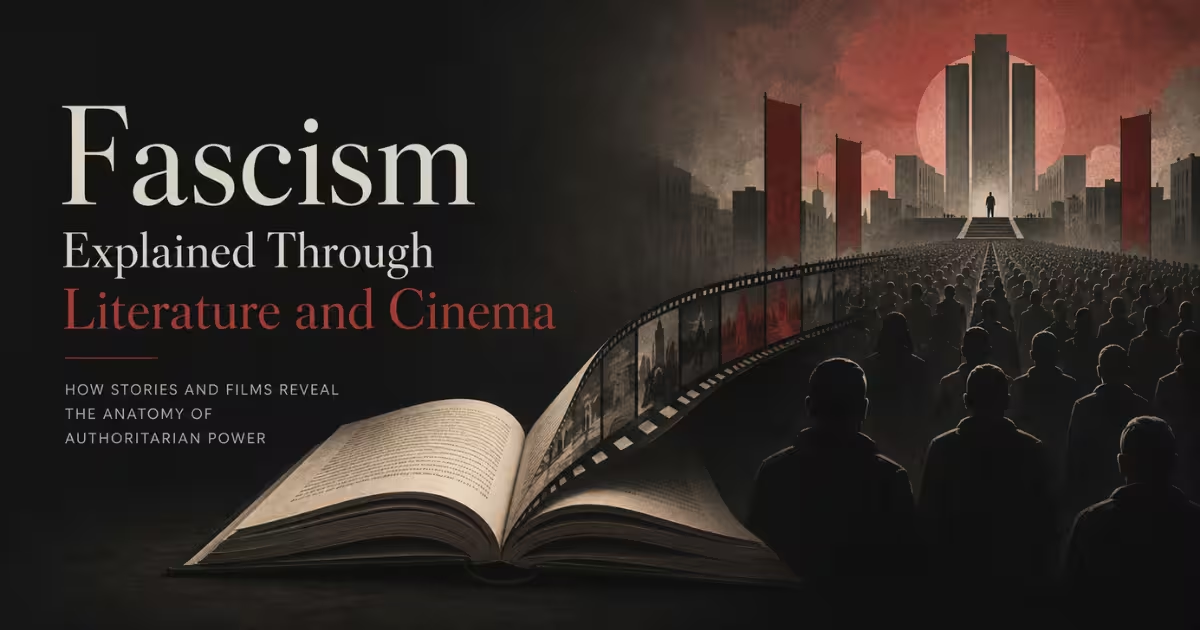
Fascism is often defined through politics, but literature and cinema reveal how it truly works: through fear, spectacle, conformity, propaganda, and the slow surrender of moral judgment.
From dystopian novels like George Orwell’s Nineteen Eighty-Four to films such as The Conformist, Cabaret, and Bicycle Thieves, stories help us understand fascism not only as an ideology, but as a lived atmosphere.
This article explains fascism through literature and cinema, showing how books and films expose the psychology of authoritarian power, the seduction of mass movements, and the fragile line between ordinary obedience and political complicity.
Table of Contents
Introduction
Fascism is often introduced as a political term, but it is felt first as an atmosphere: fear in public life, obedience disguised as patriotism, language emptied of truth, violence given a moral costume, and ordinary people learning when to stay silent.
The United States Holocaust Memorial Museum defines fascism as an ultranationalist, authoritarian political philosophy combining nationalism, militarism, economic self-sufficiency, and totalitarianism; it opposes pluralism, individual rights, equality, and democratic government.
Britannica similarly describes fascist movements as marked by extreme militaristic nationalism, contempt for electoral democracy, hostility to political and cultural liberalism, hierarchy, and the subordination of individual interests to the nation.
Those definitions are necessary.
But literature and cinema show something definitions cannot fully capture: how fascism seduces, humiliates, organizes, beautifies, and normalizes itself.
Novels and films reveal the small transactions by which people surrender conscience: the joke not challenged, the neighbor not defended, the lie repeated because it is safer than truth, the spectacle admired because it feels stronger than reality.
To understand fascism through literature and cinema is not merely to study dictators. It is to study crowds, families, bureaucrats, artists, cowards, opportunists, and spectators.
It is to ask why people fall in love with power even when power is clearly preparing to consume them.
What Fascism Looks Like in Stories
In political theory, fascism is ideology. In fiction, it becomes behavior.
It appears when public life becomes theatrical and every citizen is expected to play a role. It appears when the leader becomes a symbol above criticism.
It appears when complexity is mocked as weakness, minorities are treated as contamination, masculinity is militarized, and the nation is imagined as a wounded body that must be purified.
This is why fascism is such a recurring subject in literature and cinema. Books can enter the frightened mind. Films can show the choreography of crowds, uniforms, architecture, music, and spectacle. Together, they reveal fascism as both system and performance.
The Holocaust Museum notes that Nazi propaganda relied on slogans, symbols, contemporary technology, censorship, and control of media including radio, film, newspapers, and theater to demonize Jews and turn German society against them.
That point matters: fascism does not merely use culture after seizing power. It turns culture into a weapon before, during, and after the seizure of power.
Orwell: Language as a Battlefield
No discussion of authoritarianism in literature can avoid George Orwell. Animal Farm, first published in 1945, and Nineteen Eighty-Four, published in 1949, remain central texts for understanding how political language becomes an instrument of domination.
Although Orwell was writing about totalitarianism more broadly, his work helps explain fascism because fascist politics depends on the destruction of shared reality.
If words can be made to mean their opposite, cruelty can be called discipline, censorship can be called protection, war can be called destiny, and obedience can be called freedom.
In Animal Farm, revolution is betrayed not only by force but by revision. The past is constantly rewritten. Memory becomes unstable. The powerful do not simply command; they edit reality. That is one of literature’s clearest lessons about authoritarian politics: tyranny survives when people lose confidence in their own recollection.
Nineteen Eighty-Four goes further.
It imagines a society where surveillance, propaganda, and linguistic control combine to make independent thought almost impossible. Fascism similarly treats private judgment as treasonous.
The individual is not allowed to stand apart from the nation, the party, the leader, or the crowd.
The terrifying lesson is not just that power lies. It is that power wants citizens to participate in the lie.
Kafka: Bureaucracy Without a Face
Franz Kafka is not usually labeled a “fascist novelist,” but his fictional worlds help us understand the emotional machinery of authoritarian rule.
In Kafka, power is impersonal, procedural, and absurd. The accused often does not know the charge. The citizen cannot find the center of authority. Rules exist, but they are not explainable.
That matters because fascism often combines theatrical passion with bureaucratic coldness. It shouts in public and files paperwork in private. It stages rallies, but it also depends on permits, lists, classifications, denunciations, identity documents, police files, and institutional obedience.
Kafka teaches that authoritarianism is not always a boot smashing a door. Sometimes it is a clerk, a corridor, a form, a summons, a silence.
This is one reason literature remains so powerful as a political instrument. It does not only show what regimes declare. It shows what regimes feel like to the person trapped inside them.
The Conformist: Fascism as the Desire to Belong
Bernardo Bertolucci’s The Conformist is one of cinema’s most important studies of fascist psychology.
The British Film Institute describes the film as starring Jean-Louis Trintignant as a repressed bureaucrat in Mussolini’s Italy who is assigned to kill his former professor.
Britannica notes that the protagonist tries to deal with his own inadequacies through conformity to the prevailing social order in Fascist Italy under Mussolini.
That is the key: fascism does not recruit only sadists. It recruits the insecure, the frightened, the ambitious, the lonely, and the socially anxious. It offers them a costume of certainty. It says: you do not need to become morally whole; you only need to belong.
In The Conformist, fascism is not presented merely as a doctrine. It is a psychological bargain. The protagonist wants normality so badly that he accepts moral deformity. He wants to disappear into the state, to let ideology cover his inner emptiness.
The film’s visual style makes this argument through architecture, shadow, symmetry, and movement. Fascism is shown as beautiful and deadening at once. Its spaces are grand but airless. Its order is not peace; it is paralysis.
Triumph of the Will (1995): Cinema as Propaganda
Leni Riefenstahl’s Triumph of the Will is impossible to discuss casually.
It is not just a film about fascism; it is a fascist film. Britannica describes it as a documentary study of the 1934 Nazi Party convention at Nuremberg that emphasized party unity, introduced Nazi leaders to the German people, and exhibited Nazi power to the world.
The Documentation Center Nazi Party Rally Grounds in Nuremberg describes the film as a perfectly executed propaganda film, premiered in Berlin on March 28, 1935, and then shown across German cities, including for political education.
Its importance lies in how it transforms politics into religious spectacle. The leader descends like a savior.
The crowd becomes a single body. Individual faces disappear into mass choreography. Architecture, music, flags, camera angles, and editing all work toward one emotional result: surrender.
This is cinema’s danger. Film can humanize the oppressed, but it can also glorify oppression. It can expose propaganda, but it can also become propaganda. Triumph of the Will reminds us that aesthetic brilliance is not moral innocence.
A beautiful image can be an ugly act.
Cabaret (1972): Fascism Arrives While People Are Distracted
Bob Fosse’s Cabaret remains one of the sharpest cinematic depictions of fascism’s social arrival. It does not begin with tanks. It begins with jokes, songs, clubs, flirtations, gossip, and denial.
The horror of Cabaret is that many characters do not immediately understand the scale of what is coming. Some think the Nazis are vulgar but manageable. Some assume politics will remain outside the nightclub.
Some are too absorbed in private desire to see public catastrophe forming around them.
That is how fascism often advances in art: not as a sudden thunderclap but as background noise that gradually becomes the main melody. By the time the characters notice, the room has changed.
A JSTOR Daily essay on Cabaret argues that the film shows how easily satire, indifference, and complicity can slide into one another when fascist aesthetics enter entertainment spaces. (JSTOR Daily) That is exactly why the film still matters. It understands that fascism is not only enforced by believers. It is also enabled by people who think they are merely watching.
Italian Neorealism: After Fascism, Reality Returns
After fascism and war, Italian neorealism turned cinema toward ordinary suffering.
Vittorio De Sica’s Bicycle Thieves is often discussed as one of the defining films of this movement. The film’s postwar Italian setting, its focus on poverty, and its use of neorealist style to depict the struggle for survival among working-class people.
This matters because fascism thrives on myth: heroic nation, purified people, glorious destiny. Neorealism answers with faces, streets, hunger, unemployment, shame, and children watching adults fail.
If fascist cinema elevates the leader and the crowd, neorealism restores the individual and the ordinary. It says history is not only made by generals and parties; it is endured by fathers, mothers, workers, and children.
The political power of neorealism lies in its refusal of grand illusion. It does not shout “anti-fascism” in every frame. It does something more devastating: it shows the human wreckage left after the slogans collapse.
Satantango and The Melancholy of Resistance: The Crowd Waiting for a Savior
László Krasznahorkai’s fiction, and Béla Tarr’s cinematic adaptations, offer another route into authoritarian psychology.
These works are not simple fascism allegories, but they are profound studies of collapse, rumor, charisma, and the hunger for order.
Satantango shows that villagers “desperate for order” mistake choreography for deliverance, and describes Irimiás as a salesman-prophet whose power lies in timing, atmosphere, and the manipulation of guilt.
That is a remarkably useful way to think about authoritarian movements. Before people accept tyranny, they often accept performance as rescue.
Likewise, in my review of The Melancholy of Resistance, I call the novel a “barometer” measuring how rumor, rhetoric, and spectacle thicken until people cannot breathe, recommending it to anyone who senses that “order” can be a costume.
That phrase—order as costume—cuts to the heart of fascism. Fascism promises order, but its order is often staged. It creates chaos, identifies enemies, then offers itself as the only cure.
Literature helps us notice that pattern before it hardens into law.
Fascism, Spectacle, and the Body
One of fascism’s most disturbing features is its obsession with bodies: strong bodies, pure bodies, obedient bodies, reproductive bodies, military bodies, punished bodies. It turns politics into a physical fantasy.
The nation is imagined as a body under threat. The enemy is described as disease. Violence becomes surgery.
Cinema is especially useful for studying this because cinema is itself an art of bodies in space. Uniforms, marches, salutes, mass rallies, and choreographed movement all create a visual language of submission. Fascist aesthetics often transform the individual body into a unit within a larger design.
That is why films about fascism frequently focus on spectatorship. Who is looking? Who is being looked at? Who is turned into an object? Who benefits from beauty? Who pays for it?
Olivia Laing’s The Silver Book is relevant here because it connects fascism, homophobia, spectacle, cruelty, and 1970s Italian cinema. The novel asks how one can live and make art freely when fascism, homophobia, and spectacle close in at once.
That formulation captures a central problem in political art: beauty is never automatically innocent. Under authoritarian pressure, even art can become a bargain with power.
Why Fascism Needs Myths
Fascism rarely says, “We want domination.” It says, “We want rebirth.” It tells a story of national humiliation, betrayal, decadence, contamination, and future glory. Its emotional structure is mythic.
There was once greatness. That greatness was stolen. Enemies are everywhere. Only discipline, purity, violence, and loyalty can restore destiny.
Literature is uniquely suited to exposing this myth because literature understands narrative temptation. It knows that humans live by stories. A political myth can be more powerful than an argument because it gives people roles: hero, traitor, victim, redeemer, invader, martyr.
Fascist myth simplifies the world. Great literature complicates it.
That is why authoritarian movements often fear writers, teachers, journalists, filmmakers, librarians, and historians. They preserve ambiguity. They keep records. They remember names. They refuse the false cleanliness of propaganda.
How to Recognize Fascism Through Books and Films
Literature and cinema teach us to recognize fascism not only by its symbols but by its habits.
Watch for the leader who claims to embody the people. Watch for the crowd that becomes more real than the person. Watch for language that turns human beings into pests, stains, parasites, or threats. Watch for nostalgia weaponized into rage. Watch for art that makes domination look glamorous. Watch for the citizen who says, “I am not political,” while adapting perfectly to political cruelty.
In novels, fascism often appears as corrupted language, manipulated memory, bureaucratic absurdity, social conformity, and moral cowardice. In cinema, it appears as spectacle, architecture, rhythm, mass movement, costume, and the seduction of belonging.
The greatest anti-fascist works do not merely say, “Fascism is evil.” They ask: What part of ordinary life makes fascism possible? What weakness does it exploit? What beauty does it counterfeit? What fear does it flatter?
Those questions are harder than slogans, and more useful.
Conclusion: Art as a Warning System
Fascism explained through literature and cinema becomes more than a chapter in political history. It becomes a pattern of perception.
Orwell teaches us to distrust corrupted language.
Kafka teaches us to fear faceless authority. Bertolucci teaches us that conformity can become complicity. Riefenstahl teaches us that beauty can serve evil. Cabaret teaches us that fascism can enter while people are laughing. Italian neorealism teaches us to look at ordinary lives after political myths collapse. Krasznahorkai and Tarr teach us that communities in despair may mistake performance for salvation.
The purpose of reading and watching these works is not to feel superior to the past. It is to become more alert in the present.
Fascism does not always arrive wearing the same uniform. Sometimes it arrives as entertainment, nostalgia, order, wounded pride, moral panic, or the promise that someone else’s freedom is the price of your safety.
Literature and cinema keep asking us to look again. That is their democratic power. They return the face to the crowd, the name to the victim, the doubt to the slogan, and the conscience to the spectator.
FAQs
What is fascism in simple terms?
Fascism is an authoritarian, ultranationalist political ideology that places the nation or national community above individual rights, rejects liberal democracy and pluralism, and often glorifies violence, hierarchy, discipline, and a powerful leader.
Why study fascism through literature and cinema?
Because fascism is not only a system of government. It is also a culture of obedience, spectacle, fear, myth, and conformity. Literature shows its inner psychology; cinema shows its visual and emotional power.
What are the best books for understanding fascism and authoritarianism?
Start with George Orwell’s Animal Farm and Nineteen Eighty-Four, Kafka’s The Trial, Alberto Moravia’s The Conformist, and László Krasznahorkai’s Satantango or The Melancholy of Resistance.
What are the best films about fascism?
Important films include The Conformist, Cabaret, The Great Dictator, Bicycle Thieves, Rome, Open City, Satantango, and, as a dangerous propaganda object to study critically, Triumph of the Will.
Is all authoritarianism fascism?
No. Fascism is a specific form of authoritarian politics with ultranationalist, anti-democratic, exclusionary, hierarchical, and often militaristic features. Not every dictatorship is fascist, though many authoritarian systems share overlapping methods.
“







