
Have you ever woken up at 3 AM wondering if your best professional years are already behind you? I have. And according to Arthur C. Brooks, if you’re in your late thirties to early fifties and feeling that creeping dread, you’re not imagining things, you’re experiencing a biological reality that most successful people refuse to acknowledge.
Overview
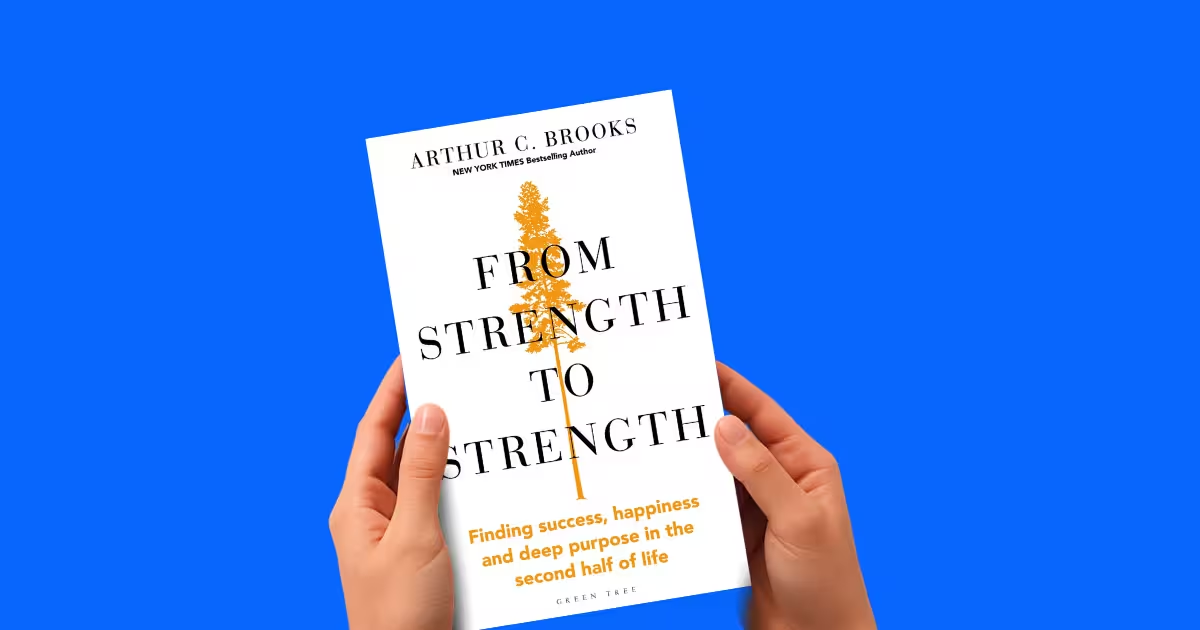
From Strength to Strength: Finding Success, Happiness, and Deep Purpose in the Second Half of Life by Arthur C. Brooks (Portfolio/Penguin, 2022) is a #1 New York Times bestseller that delivers a blunt, research-backed wake-up call to high achievers.
The book argues that professional decline sets in much earlier than most people think, typically between the late thirties and early fifties, and that the strategies that made you successful in the first half of life will actively work against you in the second.
Brooks, a Harvard professor and The Atlantic’s happiness columnist, offers a practical roadmap for escaping what he calls the “striver’s curse” by transitioning from fluid intelligence (fast problem-solving) to crystallized intelligence (wisdom, teaching, and synthesis).
Who will actually love this book: Anyone over forty who has built a successful career and is starting to feel the weight of their own decline, or fears it. This includes executives, entrepreneurs, lawyers, doctors, academics, artists, and anyone whose identity is wrapped up in their professional achievements.
If you’ve ever secretly wondered whether your best work is behind you, this book will speak directly to that fear.
Who might bounce off it: People under thirty-five who haven’t yet experienced professional decline (though I’d argue it’s worth reading early).
Also, readers who are uncomfortable with Brooks’s open embrace of spirituality and religion in the later chapters, several critics note the book “goes off the rails” when he advises readers to find religion.
And if you’re in a mid-level or labor-intensive job rather than a high-powered professional career, some of the advice may feel less applicable.
Table of Contents
1. Introduction
Book: From Strength to Strength: Finding Success, Happiness, and Deep Purpose in the Second Half of Life
Author: Arthur C. Brooks
Publication: Portfolio/Penguin, 2022
Pages: 272
Awards: #1 New York Times Bestseller, endorsed by the Dalai Lama
Context of From Strength to Strength
Arthur C. Brooks is not your typical self-help author. He is the Parker Gilbert Montgomery Professor of the Practice of Public Leadership at Harvard Kennedy School and Professor of Management Practice at Harvard Business School.
Before academia, he spent twelve years as a professional classical French hornist, a career that crashed and burned in his early thirties when his abilities inexplicably declined. He then became president of the American Enterprise Institute for a decade before stepping down voluntarily to apply the very principles he writes about in this book.
He writes The Atlantic’s popular “How to Build a Life” column and hosts the podcast “Office Hours with Arthur Brooks”.
In other words, Brooks isn’t some detached academic lecturing from an ivory tower. He’s a recovering striver who lived the burnout, hit the wall, and found his way out. This personal experience gives the book an authenticity that purely theoretical works lack.
Purpose of From Strength to Strength
The book’s central thesis is deceptively simple but devastating in its implications: the formula for success that works in the first half of life, focus single-mindedly, work tirelessly, sacrifice personally, and climb relentlessly, stops working in the second half.
As Brooks writes in the introduction, he came to call this the “striver’s curse”: “people who strive to be excellent at what they do often wind up finding their inevitable decline terrifying, their successes increasingly unsatisfying, and their relationships lacking”.
The book aims to show readers how to beat this curse by accepting decline, shedding attachments to worldly rewards, and transitioning to a life of wisdom, teaching, and service.
2. Background
Brooks’s motivation for writing this book came from a moment of accidental eavesdropping on an overnight flight from Los Angeles to Washington, DC.
He overheard an elderly woman telling her husband, a man Brooks recognized as a universally beloved public figure, to stop saying “it would be better if you were dead.”
That moment crystallized something Brooks had been feeling himself. At forty-eight, he had achieved all the professional goals he’d set at forty. He was president of a prominent think tank, a bestselling author, and a New York Times columnist. Yet he wasn’t happy. And worse, he could see the decline coming.
The book is the result of nine years of research across social science, brain science, philosophy, theology, and history. Brooks interviewed hundreds of leaders and dug into the biographies of history’s most successful people to understand why so many of them ended their lives in disappointment, frustration, or bitterness.
3. From Strength to Strength Summary
The Professional Decline Nobody Talks About
Here’s the uncomfortable truth Brooks delivers in Chapter 1: your professional decline is coming much sooner than you think.
According to the research Brooks cites, peak performance in practically every high-skill profession occurs between the late thirties and early fifties. Scientists make their most prizewinning discoveries in their late thirties. Financial professionals peak between thirty-six and forty. Doctors over sixty-five are 50 percent more likely to be found at fault for malpractice than younger doctors. Poets hit their half-life after 15.4 years from the start of their careers; novelists after 20.4 years; mathematicians after 21.7 years.
Brooks uses Charles Darwin as a case study. Darwin published On the Origin of Species at age fifty and changed science forever. But after that, he hit a wall. He couldn’t make new breakthroughs.
Gregor Mendel’s work on genetics, exactly what Darwin needed, was published in an obscure journal that Darwin never saw, and Darwin lacked the mathematical skills to understand it anyway.
In his last years, despite being buried as a national hero in Westminster Abbey, Darwin confessed to a friend: “I have not the heart or strength at my age to begin any investigations lasting years, which is the only thing which I enjoy. I have everything to make me happy and contented, but life has become very wearisome to me.”
The pattern isn’t limited to knowledge workers. Athletes peak in their twenties. Air-traffic controllers have such a sharp age-related decline that mandatory retirement is age fifty-six. The more accomplished you are at your peak, the more pronounced the decline feels when it sets in.
The Two Types of Intelligence
This is where the book gets interesting. Brooks draws on the work of British psychologist Raymond Cattell, who in 1971 posited that humans possess two distinct types of intelligence.
Fluid intelligence is the ability to reason, think flexibly, and solve novel problems. It’s what we commonly think of as raw smarts, the kind of intelligence that lets you innovate, analyze quickly, and come up with new ideas. Fluid intelligence peaks in early adulthood and begins declining in one’s thirties and forties.
This is why tech entrepreneurs, theoretical mathematicians, and innovators tend to peak and decline early.
Crystallized intelligence is the ability to use a stock of knowledge learned in the past. It’s wisdom, pattern recognition, teaching ability, and the capacity to synthesize complex ideas.
Crystallized intelligence tends to increase with age through one’s forties, fifties, and sixties, and doesn’t diminish until quite late in life, if at all.
Brooks uses a memorable metaphor: think of your brain as a vast library. Fluid intelligence is the speed of your research librarian, how fast he can retrieve information. Crystallized intelligence is the size of the library itself and the librarian’s knowledge of where to find things, even if it takes him a while.
The key insight is that most high-achieving professionals build their careers entirely on fluid intelligence.
When it declines, they panic and double down on the strategies that made them successful, working harder, longer hours, trying to outrun the decline. This is exactly the wrong response.
The Second Curve
The solution, according to Brooks, is to jump from the fluid intelligence curve to the crystallized intelligence curve. He calls this the “second curve”.
Careers that rely on crystallized intelligence, teaching, mentoring, counseling, synthesizing, and sharing wisdom, peak much later in life.
Historians, for example, peak 39.7 years after career inception, meaning a historian who finishes their PhD at thirty-two still has half their work to go at seventy-two. College professors get their best teaching evaluations in their sixties and seventies.
Brooks’s favorite example of someone who successfully made this transition is Johann Sebastian Bach. In his early career, Bach was considered the finest composer in the high baroque style.
But his career was overtaken by a newfangled “classical” style championed by his own son, C. P. E. Bach. Rather than rage against his decline, Bach jumped onto his second curve. He stopped trying to be the greatest innovator and became the greatest teacher.
He wrote The Art of Fugue to show future generations exactly how to build a fugue or canon. He died beloved, fulfilled, and happy.
Brooks contrasts Bach with Darwin, who hit his wall, became despondent, and never found his second curve. The difference wasn’t talent, it was the courage to change.
The Success Addiction
Chapters 3 and 4 tackle what Brooks calls “success addiction”, the unhealthy attachment to money, power, pleasure, and prestige that keeps strivers chained to their declining fluid intelligence curve.
Brooks shares a haunting conversation with a Wall Street financier who was starting to miss steps in her career. When he asked why she didn’t remediate the sources of her unhappiness, her failing marriage, her drinking, her exhaustion, she thought for a moment and said: “Maybe I would prefer to be special rather than happy.”
Brooks argues this is addiction.
Workaholism isn’t about loving work; it’s about being addicted to the dopamine hit of success. And like all addictions, it dehumanizes you. You objectify yourself, reducing yourself to a high-performance machine rather than a full person.
He draws on Thomas Aquinas’s framework of four idols, money, power, pleasure, and honor, that people chase as “substitutes for God.” These idols leave us dissatisfied because they are “counterfeit currency paid to our special, objectified selves”. The more you get, the more you want, and the less satisfied you become.
Brooks offers a practical exercise: the “reverse bucket list.” Each year on your birthday, list your worldly wants and attachments, the stuff that fits under Aquinas’s categories.
Then imagine yourself in five years, happy and at peace, and consider how these attachments compete with the forces of your happiness for time, attention, and resources. About each item, say: “This is not evil, but it will not bring me the happiness and peace I seek, and I simply don’t have time to make it my goal. I choose to detach myself from this desire.”
Relationships Are Your Root System
Chapter 6 is arguably the most practical in the book. Brooks uses the metaphor of aspen trees, which form a vast interconnected root system, to argue that humans are not rugged individuals but interdependent beings. “Creating an isolated self is dangerous and damaging because it is unnatural,” he writes.
The Harvard Study of Adult Development, which has tracked hundreds of men for over eighty years, found that the single most important predictor of happiness and health in old age is healthy relationships. As study director George Vaillant put it: “Happiness is love. Full stop.”
Brooks acknowledges that many strivers have neglected their relationships on the road to success. He offers practical advice:
Allocate time well ahead of time. Successful people are good at marginal thinking, making sure each hour is spent on its best use. The trouble is that this always marginalizes things that don’t have a clear short-term payoff, like relationships.
Do your core job. Love relationships are not hierarchical but reciprocal. They require giving what people want and need, not what’s most convenient to the giver.
Invest intelligently. Write down the three things you want for each person you love most. Then ask: Am I investing in those things in their lives?
Brooks also distinguishes between “real friends” and “deal friends”, a concept he borrows from Aristotle. Real friends are based on mutual well-being and shared love for something good. Deal friends are based on utility, you do each other favors. Many successful people have lots of deal friends but very few real friends, and they’re lonely as a result.
The Spiritual Dimension
Chapters 7 and 8 are where the book gets controversial. Brooks argues that to fully embrace the second half of life, you need to develop your spiritual life, whether through religion, philosophy, or transcendent practice.
He draws on the Hindu concept of vanaprastha, the stage of life around age fifty when one begins to pull back from professional duties and devote oneself to spirituality, wisdom, and teaching. He also shares his own journey as a Catholic convert and the story of his wife, who came to faith later in life.
Brooks acknowledges the “Nicodemus syndrome”, the reluctance of successful people to admit they have spiritual stirrings because it feels like a declaration of weakness. His advice: stop seeing spiritual development as a side interest and put it front and center. Schedule your meditation, prayer, reading, and practice every day.
He also recommends pilgrimage, specifically walking the Camino de Santiago in Spain. Walking, he argues, is a form of meditation that harmonizes the mind and body, bringing relief from the hedonic treadmill of worldly striving.
Making Weakness Your Strength
Chapter 8 presents what might be the book’s most counterintuitive argument: your weakness can be your greatest source of strength.
Brooks uses the Apostle Paul as an example. Paul was arguably the most successful entrepreneur in history, he essentially invented Christianity as an organized religion. Yet he wrote: “I was given a thorn in my flesh… Three times I pleaded with the Lord to take it away from me. But he said to me, ‘My grace is sufficient for you, for my power is made perfect in weakness.'”
Brooks argues that Paul connected with people through his weakness, not his strength. The Stoic philosophers of Paul’s time sought to banish emotional expressions of suffering. Paul did the opposite, he wrote “out of great distress and anguish of heart and with many tears.” This vulnerability attracted people for thousands of years.
Brooks shares his own experience: he earned his bachelor’s degree through distance learning and was embarrassed about it for years.
When he finally wrote about it publicly, he received hundreds of messages from people who had similar nontraditional paths. “It was through my weakness, not my strength, that I was able to connect with people I never would have met otherwise,” he writes.
Beethoven is another example.
When he went deaf, he could no longer perform as a pianist. But he composed his greatest works, including the Ninth Symphony, after his hearing was completely gone. His deafness freed him from being influenced by prevailing compositional fashions and allowed him to hear the music inside his own head.
Casting into the Falling Tide
The final chapter offers practical guidance for making the transition.
Brooks uses the metaphor of ocean fishing: fish bite most aggressively during a falling tide, when the water is rushing out and stirring up plankton and bait fish. The only mistake you can make during a falling tide is not having your line in the water.
The transition from the first to the second half of life is like a falling tide, it can feel like everything you’ve worked for is rushing away. But it’s actually the most productive and fertile period of your life, if you have the courage to cast into it.
Brooks offers four lessons for navigating this transition:
- Identify your marshmallow. What do you really want? The marshmallow test from psychology shows that people who can delay gratification achieve greater success. But at this stage of life, you need to know what the next marshmallow is.
- The work you do has to be the reward. If your career is just a means to an end, the payoff, even if you get it, will be unsatisfying.
- Do the most interesting thing you can. Interest is intensely pleasurable and must have meaning to hold your attention.
- A career change doesn’t have to be a straight line. Brooks describes four career patterns: linear, steady-state, transitory, and spiral. For the second half of life, a spiral pattern, a series of mini-careers that build on each other, is often most appropriate.
The Seven-Word Summary
Brooks ends the book with seven words that encapsulate all his lessons:
“Use things. Love people. Worship the divine.”
“The problem is not the noun things, but the verb to love,” he writes. “Things are to use, not to love. If you remember only one lesson from this book, it should be that love is at the epicenter of our happiness.”
4. From Strength to Strength Analysis
From Strength to Strength is an urgent, deeply personal, and quietly revolutionary book. It’s not a fluffy self-help manual promising you can have it all. It’s a sober, research-backed argument that you can’t have it all, and that accepting this limitation is the key to genuine happiness.
Brooks writes with the authority of someone who has lived the striver’s life and escaped it. His decision to step down from the presidency of the American Enterprise Institute, a job most people would kill for, gives him credibility that no amount of academic research could provide. He’s not asking readers to do anything he hasn’t done himself.
The book’s greatest strength is its integration of multiple disciplines, social science, neuroscience, philosophy, theology, and history, into a coherent framework. The fluid/crystallized intelligence distinction is grounded in established research, and Brooks uses it as a powerful explanatory lens for why so many successful people crash and burn in middle age.
However, the book has significant limitations. Critics note that it seems written primarily for “successful men like himself who are addicted to success, status and extrinsic adulation”. If you’re not a high-powered professional, some of the advice may feel less applicable.
The spiritual chapters are also divisive. Several reviewers note that the book “goes off the rails” when Brooks advises readers to find religion.
One Goodreads reviewer wrote: “75% in and I finally put it down, frustrated and disappointed. If you want a book in which the author ‘uses’ religions to claim his authority for the points he makes, you’ll like this”.
I found these criticisms somewhat overstated.
Brooks isn’t proselytizing, he’s sharing what worked for him and for many others, and he explicitly acknowledges that philosophy can serve the same purpose as religion. But if you’re deeply uncomfortable with spirituality, the last quarter of the book will be a slog.
5. Strengths and Weaknesses
Strengths
1. Research-backed but accessible. Brooks translates complex social science into clear, actionable advice without dumbing it down. The fluid/crystallized intelligence framework is elegant and memorable.
2. Personal vulnerability. Brooks shares his own failures, his collapsed music career, his embarrassment about his nontraditional education, his workaholism, in a way that makes him relatable rather than preachy. “I’m not immune from anything,” he admits. “And I guess the irony is that I specialize in the science of happiness, and I fall prey to a lot of these things myself”.
3. Practical exercises. The reverse bucket list, the “Litany of Humility,” and the monthly time-allocation exercise give readers concrete tools to implement the book’s ideas.
4. Memorable metaphors. The aspen grove, the block of jade, the falling tide, and the library librarian all make abstract concepts tangible and memorable.
5. The seven-word summary. “Use things. Love people. Worship the divine” is a mantra that readers can carry with them long after finishing the book.
Weaknesses
1. Narrow audience. The book is clearly written for high-powered professionals, executives, entrepreneurs, doctors, lawyers, academics. If you’re in a mid-level or labor-intensive job, some of the advice may feel out of reach.
2. Religious turn. The last quarter of the book leans heavily into spirituality and religion. Readers who are secular or uncomfortable with religion may find this alienating.
3. Repetition. Like many psychology books, From Strength to Strength suffers from some redundancy. The core ideas are introduced early and reiterated throughout.
4. Male perspective. Several critics note the book feels “very male”, it speaks to a traditionally male career model and uses predominantly male examples.
5. Lack of practical career guidance. Brooks tells you to jump to the second curve but offers limited concrete guidance on how to make that transition professionally, beyond “become a teacher.”
6. Comparison with Similar Works
From Strength to Strength sits in a unique space between self-help, psychology, and spiritual guidance. It’s less prescriptive than Atomic Habits (James Clear) and less spiritual than The Art of Happiness (Dalai Lama). It’s closest in spirit to Man’s Search for Meaning (Viktor Frankl), both argue that accepting suffering and finding meaning in it is the path to genuine fulfillment.
It also complements David Brooks’s The Road to Character, which distinguishes between “résumé virtues” (professional success) and “eulogy virtues” (character and relationships). Arthur Brooks explicitly acknowledges this distinction.
Unlike many books on aging, From Strength to Strength doesn’t sugarcoat decline. It’s more honest, and therefore more useful, than books that promise you can stay young forever if you just try hard enough.
7. Conclusion
I wholeheartedly recommend From Strength to Strength to anyone over forty who has built a successful career and is starting to feel the weight of their own decline, or fears it.
If you’re in your twenties or thirties, read it as a preventative measure. As one reviewer noted, it’s “worth reading when you’re into your 30s and beginning to think about the decades ahead”.
If you’re in your fifties or sixties and feeling stuck, frustrated, or irrelevant, this book will validate your experience and give you a path forward.
If you’re deeply secular and uncomfortable with spirituality, you may want to skip the last few chapters, but the first two-thirds of the book are still enormously valuable.
Brooks ends with a hope that I share: “May you go from strength to strength.”