
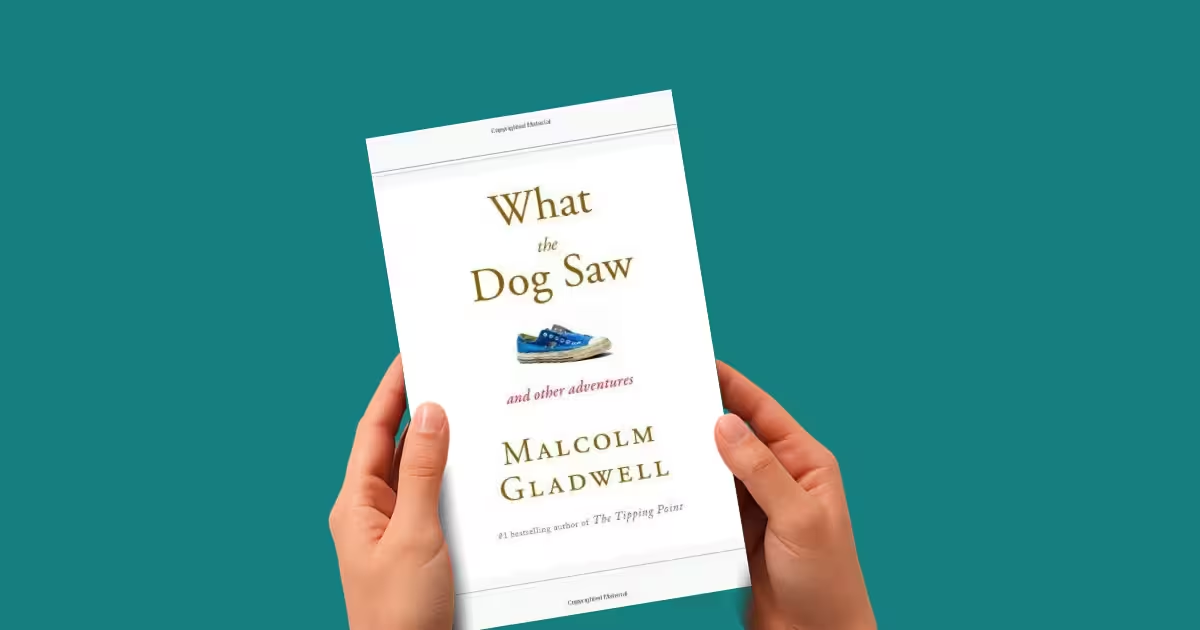
Did you know that a two-second silent video clip of a teacher can predict their semester-long student evaluations with startling accuracy? Or that the same man who invented the Showtime Rotisserie once had his father’s wife hire hitmen to kill him? Malcolm Gladwell’s What the Dog Saw is packed with these kinds of mind-bending revelations.
This isn’t just another business book or pop psychology digest—it’s a masterclass in curiosity, a decade’s worth of the New Yorker’s most provocative journalism, and an invitation to see the world through someone else’s eyes.
If you’ve ever wondered why we fail under pressure, how we make snap judgments about strangers, or why Heinz ketchup remains unbeatable, this collection will give you answers you didn’t know you were looking for.
Table of Contents
Overview
What the Dog Saw and Other Adventures is Malcolm Gladwell’s fourth book, published on October 20, 2009, by Little, Brown and Company. It’s a compilation of 19 of his favorite articles originally published in The New Yorker between 1996 and 2008.
The book is divided into three parts: “Obsessives, Pioneers, and Other Varieties of Minor Genius,” which profiles fascinating but often overlooked people like Ron Popeil and Cesar Millan; “Theories, Predictions, and Diagnoses,” which tackles complex problems like the Challenger explosion, the Enron collapse, and homelessness; and “Personality, Character, and Intelligence,” which questions how we judge others—from job candidates to serial killers.
This isn’t a book with a single, unified thesis. Instead, it’s a greatest-hits collection that showcases Gladwell’s signature style: starting with a puzzling person or situation, weaving in academic research, and landing on a counterintuitive insight that reframes how you think about the topic.
As Gladwell himself writes in the preface, the driving force behind every piece is simple curiosity: “What does it feel like to be a doctor? … We want to know what it’s like inside someone else’s head.”
Reader suggestion
What the Dog Saw is perfect for:
Curious general readers who love learning random but useful facts about psychology, business, and human behavior.
Fans of Gladwell’s previous work (The Tipping Point, Blink, Outliers)—this is essentially the B-sides and greatest hits that inspired those books.
Managers and leaders who want to understand why hiring interviews are practically useless and how to actually identify talent.
Writers and journalists looking for a masterclass in narrative non-fiction structure and storytelling.
What the Dog Saw is not for:
Readers seeking a cohesive, unified argument. This is a collection of essays, not a single-thread book like Outliers or The Tipping Point. Some readers find it disjointed.
Those who prefer deep dives over broad surveys. Gladwell covers 19 different topics; if you want exhaustive detail on any one subject, you’ll need to look elsewhere.
Academics or specialists in fields like psychology or criminology—Gladwell’s critics (including Harvard psychologist Steven Pinker) have accused him of oversimplifying complex research.
Readers who dislike Gladwell’s style. If you find his “teacherly simplicity” condescending or his habit of drawing startling contrasts gimmicky, this book will likely frustrate you.
What the Dog Saw Summary
Reading What the Dog Saw felt like sitting down with the world’s most interesting dinner guest for nineteen consecutive conversations. Each essay stands alone, but together they paint a picture of a writer obsessed with one question: Why do people do what they do?
Here’s what I took away from each section.
Part One: Obsessives, Pioneers, and Other Varieties of Minor Genius
Gladwell opens with profiles of people who are brilliant at what they do but aren’t household names—what he calls “minor geniuses.”
“The Pitchman” is a fascinating profile of Ron Popeil, the infomercial king behind the Showtime Rotisserie and Veg-O-Matic. Gladwell traces Popeil’s family history back to the boardwalk pitchmen of Asbury Park, New Jersey, and shows how the art of the pitch—making the product the star, not the salesman—was passed down through generations.
The essay reveals that Popeil’s father, S.J. Popeil, was a cold, distant figure who essentially abandoned Ron as a child. Ron’s second wife even tried to have S.J. killed. Despite this, Ron became the most successful of them all.
The essay ends with a QVC appearance where Popeil sells over a million dollars’ worth of rotisseries in a single hour. “You know, we’re going to hit a million dollars, just on the first hour,” one QVC executive says in awe.
“The Ketchup Conundrum” asks a deceptively simple question: Why is there only one brand of ketchup that dominates the market, when mustard has dozens of varieties?
Gladwell introduces us to Howard Moskowitz, a food scientist who discovered that there’s no such thing as a “perfect” product—only perfect products for different segments of consumers. Moskowitz helped Prego create “extra-chunky” spaghetti sauce, which became a billion-dollar category. But ketchup, Gladwell argues, is different.
Heinz ketchup hits all five fundamental tastes—sweet, sour, salty, bitter, and umami—in perfect balance.
A sensory analysis of World’s Best Ketchup (a gourmet challenger) found that while it had more tomato flavor, it lacked Heinz’s “amplitude”—the harmonious blending of flavors that makes Heinz so universally appealing.
“What the Dog Saw” is the title essay and one of the most memorable. Gladwell profiles Cesar Millan, the “Dog Whisperer,” who can calm the most aggressive dogs with a touch. But the essay isn’t really about dogs—it’s about movement and presence.
Gladwell brings in movement analysts who break down Millan’s posture, gestures, and timing. One analyst describes Millan’s movements as “a gorgeous little dance.”
The essay also reveals Millan’s personal struggles: his marriage nearly failed because he treated his wife like one of his dogs. The turning point came when a therapist told him: “Women have their own psychology.”
This essay brilliantly illustrates Gladwell’s method—looking at a familiar subject from an unexpected angle to reveal something new.
Part Two: Theories, Predictions, and Diagnoses
This section tackles big, messy problems—the kind that don’t have simple solutions.
“Open Secrets” makes a crucial distinction between puzzles and mysteries. A puzzle, like finding Osama bin Laden, has a definite answer if you have enough information.
A mystery, like what would happen in post-invasion Iraq, is inherently ambiguous; more information often makes it harder, not easier, to understand. Gladwell applies this framework to the Enron scandal.
He argues that Enron wasn’t a case of hidden information—it was a case of too much information that was too complex to understand. Jonathan Weil, the Wall Street Journal reporter who broke the story, got his information from Enron’s own public filings. The problem wasn’t that Enron hid the truth; it was that nobody could make sense of the truth once it was disclosed. “The truth wasn’t hidden,” one law professor notes. “But you’d have to look at their financial statements, and you would have to say to yourself, ‘What’s that about?’”
“The Picture Problem” examines how we place too much faith in images. Gladwell draws a brilliant parallel between radiologists reading mammograms and CIA analysts reading satellite photos. Both face the same challenge: pictures promise clarity but often deliver confusion.
A study found that ten radiologists looking at the same 150 mammograms caught anywhere from 37% to 85% of cancers. One radiologist recommended immediate workups on 64% of healthy patients.
The essay also covers the Gulf War Scud hunt, where pilots using \$4.6 million targeting pods claimed a hundred kills—but the actual number was zero. “It was like driving down an interstate looking through a soda straw,” one pilot said.
“The Art of Failure” is a personal favorite. Gladwell distinguishes between choking and panicking. Choking is thinking too much—reverting to explicit, mechanical control when you should be relying on instinct. Panicking is thinking too little—your mind goes blank and you revert to primal instincts.
The essay uses the example of Jana Novotna, who choked away a 4-1 lead in the third set of the 1993 Wimbledon final. “When Jana Novotna faltered at Wimbledon, it was because she began thinking about her shots again,” Gladwell writes. “She lost her fluidity, her touch.”
He contrasts this with John F. Kennedy Jr. , who panicked in the 1999 plane crash that killed him.
Kennedy was a novice pilot in bad weather; when he lost the horizon, his mind went blank. “Panic is the opposite of choking. Choking is about thinking too much. Panic is about thinking too little.”
Part Three: Personality, Character, and Intelligence
The final section questions how we judge other people—and how often we get it wrong.
“Late Bloomers” challenges the assumption that genius is tied to precocity. Gladwell contrasts Picasso (a conceptual prodigy who peaked early) with Cézanne (an experimental late bloomer who didn’t hit his stride until his sixties).
Cézanne couldn’t even draw well as a young man. “The young Cézanne couldn’t draw,” Gladwell writes, quoting art critic Roger Fry.
The essay also profiles Ben Fountain, who quit his law job at 32 to write fiction and didn’t achieve success until he was 48, after eighteen years of rejection. Fountain made thirty research trips to Haiti.
By contrast, Jonathan Safran Foer wrote Everything Is Illuminated at nineteen after a single three-day trip to Ukraine.
Gladwell’s point is that late bloomers need patrons—people like Fountain’s wife, who supported him for sixteen years while he wrote. “Late bloomers’ stories are invariably love stories,” Gladwell writes.
“Most Likely to Succeed” tackles the “quarterback problem”—jobs where nothing you learn about a candidate before hiring predicts how they’ll perform.
Gladwell applies this to teaching. Research shows that the difference between a good teacher and a bad teacher is a full year’s worth of learning. But credentials like master’s degrees and teaching certifications don’t predict effectiveness.
The solution? Lower the barriers to entry and use a rigorous apprenticeship system to evaluate teachers on the job. “What does it say about a society,”
Gladwell asks, “that it devotes more care and patience to the selection of those who handle its money than of those who handle its children?”
“Dangerous Minds” is a takedown of criminal profiling. Gladwell shows that the famous FBI profilers—like John Douglas, the model for Silence of the Lambs’ Jack Crawford—are essentially using the same techniques as psychics and astrologers.
Their profiles are so vague and contradictory that they can fit almost any suspect. The essay recounts the case of the “Mad Bomber” George Metesky, where psychiatrist James Brussel supposedly predicted he’d be a middle-aged Slav in a double-breasted suit.
In reality, Brussel made numerous wrong predictions (including that the bomber was German, not Slav) and the real hero was a Con Edison clerk who found Metesky’s name in personnel files.
“The Talent Myth” argues that Enron collapsed because of its obsession with hiring “the best and brightest.” Enron followed McKinsey’s “War for Talent” playbook to the letter—ranking employees, rewarding stars disproportionately, and promoting people based on potential rather than performance.
The result was a narcissistic culture where failure was rewarded as long as you were “talented.” “What if Enron failed not in spite of its talent mind-set but because of it?” Gladwell asks.
“The New-Boy Network” questions the value of job interviews. Research shows that interviewers make snap judgments in the first few seconds, and those judgments are surprisingly predictive of final evaluations—but not because interviews work.
It’s because interviewers are biased by first impressions, which then color everything else they observe. The solution is “structured interviewing”—scripted questions and rigid scoring—but most employers reject it because it “doesn’t feel right.”
“Troublemakers” uses the example of pit bull bans to explore the problem of generalizations and profiling.
Gladwell shows that breed is a terrible predictor of dangerousness—the real predictors are factors like whether the dog is neutered, chained, or owned by an irresponsible person.
The essay uses the story of Jayden Clairoux, a two-year-old attacked by pit bulls in Ottawa, to illustrate how politicians choose easy, ineffective solutions (banning the breed) over harder, more effective ones (enforcing existing laws about dangerous dogs). “It’s always easier just to ban the breed,” Gladwell concludes.
What the Dog Saw Analysis
What the Dog Saw is an extraordinary collection—not because every essay is perfect, but because the best ones are so good they change how you see the world. Gladwell has a gift for finding the strange, counterintuitive truth hiding in plain sight.
He makes you care about ketchup, hair dye, and dog training because he shows you that these seemingly trivial subjects are really about something much bigger: how we make decisions, how we judge others, and how we understand ourselves.
The title essay is a masterpiece. Gladwell doesn’t just profile Cesar Millan—he uses Millan to explore the nature of presence and communication.
He brings in movement analysts to deconstruct Millan’s posture, bringing a level of rigor to a subject that could easily have been dismissed as fluff. The result is an essay that’s as much about human interaction as it is about dogs.
I also loved “The Ketchup Conundrum.” Who knew that there was a science to why Heinz dominates? Gladwell’s explanation—that Heinz hits all five fundamental tastes in perfect balance—is the kind of insight that makes you think about every food product differently.
The sensory analysis of World’s Best Ketchup, where trained tasters found it lacked “amplitude,” is a perfect example of Gladwell’s method: taking a seemingly simple question and answering it with unexpected depth.
That said, What the Dog Saw has its weaknesses. Because it’s a collection of previously published essays, there’s no unifying narrative thread. Some essays are much stronger than others. “Blowup,” about the Challenger disaster, feels dated and less original than the other pieces.
And Gladwell’s critics have a point: he sometimes oversimplifies complex academic research to fit his narrative. Psychologist Steven Pinker, reviewing What the Dog Saw for the New York Times, calls him “a minor genius who unwittingly demonstrates the hazards of statistical reasoning and who occasionally blunders into spectacular failures”, while other accused his books of being “intellectual tourism”—skimming the surface of many fields without truly understanding any of them.
Still, I think Pinker misses the point.
Gladwell isn’t trying to be an academic. He’s a journalist and storyteller. His goal isn’t to present the definitive truth about any subject—it’s to make you think, to make you curious, to show you that the world is more interesting and complicated than you assumed.
On that count, What the Dog Saw succeeds brilliantly.
Strengths and Weaknesses
Strengths
Exceptional Storytelling: Gladwell is one of the best narrative non-fiction writers working today. He has a gift for making complex ideas accessible and engaging. Every essay starts with a compelling hook and builds to a satisfying conclusion.
Counterintuitive Insights: The book is packed with ideas that challenge conventional wisdom. Why is Heinz ketchup unbeatable? Why do smart people sometimes fail? Why are job interviews useless? Gladwell provides answers that are surprising but convincing.
Breadth of Subjects: From dog trainers to financial scandals to breast cancer screening, Gladwell covers an astonishing range of topics. If you’re curious about the world, you’ll find something to fascinate you.
Deep Research: Gladwell doesn’t just make assertions—he backs them up with academic studies, expert interviews, and detailed reporting. The sensory analysis of ketchup, the movement analysis of Cesar Millan, and the research on teacher effectiveness are all meticulously documented.
Personal and Human: Gladwell writes in a conversational, accessible tone. He’s not lecturing you—he’s inviting you to think alongside him. The personal anecdotes (like his own experience with plagiarism in “Something Borrowed”) add warmth and authenticity.
Weaknesses
Lack of Cohesion: Because it’s a collection of essays, not a unified book, What the Dog Saw can feel disjointed. There’s no single argument or thesis holding it together.
Oversimplification: Critics have accused Gladwell of dumbing down complex research. In “The Talent Myth,” for example, he blames Enron’s collapse entirely on its “talent mind-set,” ignoring other factors like outright fraud.
Uneven Quality: Not every essay is a home run. Some, like “Blowup” (about the Challenger), feel less fresh and original than the best pieces.
Dated References: The book was published in 2009, and some of the topics—like Enron and the early days of the Iraq War—feel like ancient history.
Gladwell’s “Formula”: Once you’ve read a few of his essays, you start to notice the pattern: start with a puzzle, introduce a counterintuitive twist, bring in academic research, land on a surprising conclusion. Some readers find this formulaic.
Comparison with Similar Works
What the Dog Saw is most similar to Malcolm Gladwell’s other books: The Tipping Point, Blink, and Outliers. All share the same style: accessible writing, counterintuitive insights, and a focus on psychology and human behavior. The difference is that this is a collection of essays rather than a single extended argument.
It also resembles Steven D. Levitt and Stephen J. Dubner’s Freakonomics, which uses economic principles to explain everyday phenomena. Both books are driven by curiosity and a willingness to ask unconventional questions.
For readers who enjoy the essays on failure and decision-making, Daniel Kahneman’s Thinking, Fast and Slow offers a deeper dive into the psychology of judgment. For those interested in the Enron and Challenger essays, Charles Perrow’s Normal Accidents provides a more academic treatment of technological disasters.
Conclusion
What the Dog Saw is a marvelous, thought-provoking collection that showcases Malcolm Gladwell at his best. It’s not a perfect book—it’s a greatest-hits album, and like any greatest-hits album, some tracks are stronger than others. But the best essays are so good they make the whole thing worthwhile.
Who should read this book? Anyone who’s ever been curious about why people do what they do. Managers will benefit from the essays on hiring and talent. Writers will learn from Gladwell’s narrative techniques. And general readers will simply enjoy the ride—the chance to spend a few hours with one of the most imaginative nonfiction writers of our time.
As Gladwell writes in the preface, the book is an invitation to see the world through someone else’s eyes: “That’s what we really want to know—what the dog saw.” After reading this book, you’ll see ketchup, job interviews, dog trainers, and even yourself a little differently. And that, I think, is the mark of a truly great collection.







