
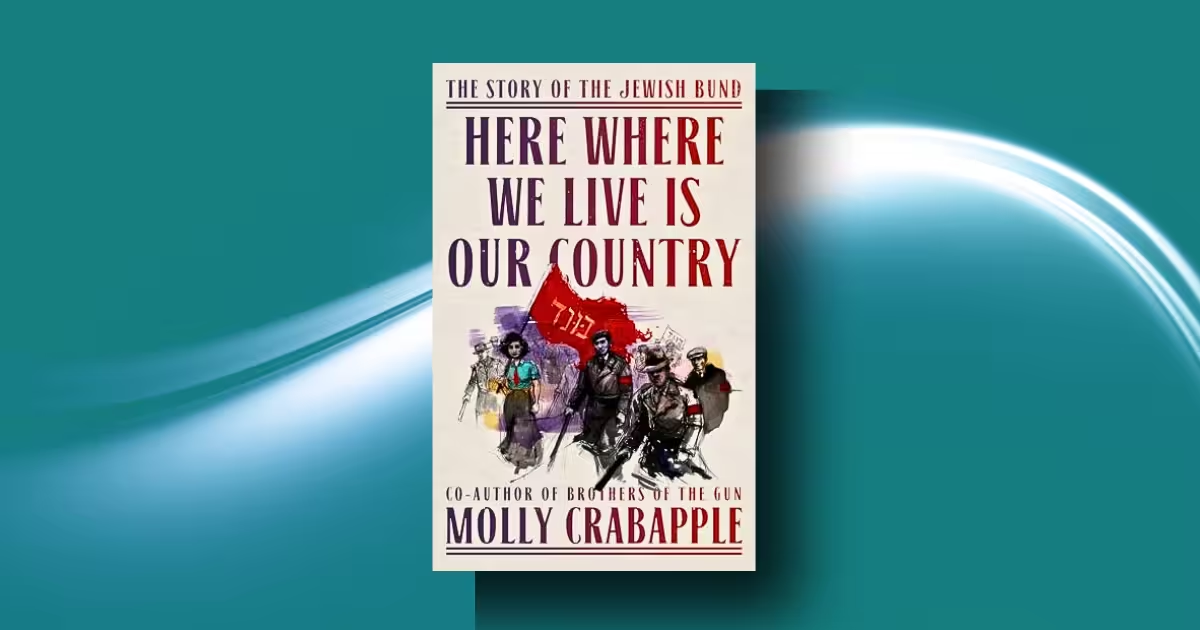
Do you ever feel like the history we are taught is just a catalog of winners, leaving the most vibrant, soul-stirring “failures” to rot in the basement of time? If you’ve ever looked at the world today and wondered if there was ever a version of solidarity that didn’t require a flag or a border, then Molly Crabapple’s Here Where We Live Is Our Country will show you how to find a home in the very struggle for it.
Here Where We Live Is Our Country is best for history buffs who crave the “view from below,” activists seeking a blueprint for solidarity without ethnonationalism, and anyone currently grappling with Jewish identity, socialism, or the complex ethics of the Israel-Palestine conflict.
It’s for the readers of The Guardian or The New Yorker who want their history with a side of grit and visual artistry.
But not a good read for those looking for a dry, neutral academic textbook or readers who prefer their history to be a neat, linear progression of state-building and “progress.”
If you want a book that validates modern nationalism without question, you’ll likely bounce off these pages within the first chapter.
Table of Contents
1. Introduction
Here Where We Live Is Our Country: The Story of the Jewish Bund is a 480-page masterpiece by the acclaimed artist and journalist Molly Crabapple, published by One World in April 2026. This is not just a book; it is a “defeated person’s history of the 20th century”.
Context: Molly Crabapple is a “time traveler and a necromancer”, known for her reporting from the front lines of Occupy Wall Street, the Syrian civil war, and the streets of Ukraine. As an artist-journalist, she brings a “novelist’s mastery of detail” to a subject that has long been relegated to dusty Yiddish archives. The book is a radical history of the General Jewish Labor Bund—once the most powerful Jewish political force in Eastern Europe.
Purpose: The central idea of the book is that liberation, dignity, and solidarity must begin exactly where we stand. Crabapple argues that the Bund’s philosophy of Do’ikayt (Hereness) offers a moral roadmap for our contemporary struggles with nationalism and repression, reminding us that “solidarity across difference” is the only thing that can truly save us.
2. Background: The Forgotten Giant
Before the Holocaust and before the rise of the State of Israel, there was the Bund. Founded in a secret meeting in a Vilna attic in October 1897, the Bund was secular, socialist, and uncompromisingly anti-Zionist. While Zionism looked toward a future in Palestine, the Bundists shouted, “Dortn, vu mir vohnen, dort is unzer land!”—”There, where we live, there is our country!”.
They weren’t just a political party; they were a “beautiful alternate world built out of love and grit”. They ran soup kitchens, schools, sports clubs (Morgenstern), and theater troupes, all while maintaining “street-fighting militancy” against Tsarist police and antisemitic pogromists.
3. Here Where We Live Is Our Country Summary
This book is a journey through the “murdered world” of the shtetl and the bustling, radical streets of interwar Poland.
The Great-Grandfather’s Ghost:
The narrative begins with Crabapple’s great-grandfather, Sam Rothbort, a post-Impressionist artist who tried to “paint back into existence” his lost world. Through his eyes and the lives of key Bundist figures, we see the rise of a movement that aimed to turn “Jewishness” into a revolutionary identity.
The Giants of the Bund:
Vladimir Medem: The “legendary leader” who listened to the early fractures of the Russian Social Democratic Labor Party from London, grappling with whether Jewish workers needed their own autonomous party.
Henryk Erlich and Viktor Alter: The movement’s moral anchors. Erlich famously argued that a Jewish state in Palestine would lead to an “eternal fear of the external enemy” and a “spiritual climate” where progress could not grow. Both were eventually executed by Stalin’s secret police during WWII, a tragic irony for leaders of a movement that had fought so hard for the Russian Revolution.
Marek Edelman: The last surviving commander of the Warsaw Ghetto Uprising. Edelman remained in Poland after the war, despite the Kielce pogrom and Communist harassment, because “someone had to look after the dead”.
The War Years and the Uprising:
The book reaches its emotional peak during the Holocaust. It documents the Bund’s role in the ZZW and the Warsaw Ghetto Uprising in 1943. It captures the sheer heartbreak of Arthur Zygielbojm, the Bund’s representative in London, who committed suicide in May 1943 to protest the world’s indifference to the Nazi massacres.
The Post-War Dissolution:
By 1949, under extreme pressure from the Soviet-backed Polish government, the Bund was forced to dissolve. The survivors scattered to DP camps in Germany, New York, and Paris, carrying the embers of Do’ikayt with them but finding themselves increasingly marginalized by the global pivot toward Zionism.
4. Here Where We Live Is Our Country Analysis
As a reader, I found Here Where We Live Is Our Country to be a poignant, groundbreaking recovery of a “lost continent” of human thought.
Crabapple effectively supports her argument by weaving personal family history with rigorous archival research. She doesn’t just tell us the Bund was influential; she shows us the ” babies of communists” who needed milk and the “lovers on the barricades” who shared poems between strikes.
The book fulfills its purpose by proving that the Bund’s defeat was not a result of moral failure, but of a total, “richly tragic” historical crushing by both Nazism and Stalinism.
However, as The Forward points out, Crabapple’s narrative is romantic and occasionally “one-sided,” focusing on the street-fighting militancy while sometimes glossing over the internal debates that might complicate the Bund’s legacy.
My Opinion:
This is an important, revelatory work that feels like a “roadmap for our revolution today”. In a world where ethno-nationalism is again on the rise, the Bundist insistence that “you didn’t have to change who you were” to fight for a better world is the most inspiring thing I’ve read in years.
5. Strengths and Weaknesses
Strengths:
Vivid Imagery: Being an artist, Crabapple writes with “colors” and “lush, high-tempo” prose.
Relevance: The book directly addresses the 2026 zeitgeist—the “crisis of Jewish identity” and the search for “solidarity across difference”.
Emotional Weight: The descriptions of Zygielbojm’s death and Edelman’s post-war resilience are deeply moving.
Weaknesses:
Bias toward Militancy: It prioritizes the “insurgent poets” over the more bureaucratic or moderate elements of the movement.
Narrow Lens on Israel: Some critics argue that the book views Israel primarily through the “prism of its founding ideology” rather than as a contemporary reality.
6. Comparison with Similar Works
While Man’s Search for Meaning by Viktor Frankl explores individual resilience in the face of the Holocaust, Crabapple’s work explores collective resilience and political meaning. It shares the narrative energy of Mike Duncan’s Hero of Two Worlds and the radical edge of Naomi Klein’s Doppelganger.
7. Conclusion
Here Where We Live Is Our Country is a must-read for anyone who feels “homeless” in the current political landscape. It is suitable for both specialists in Yiddish history and a general audience looking for a “vivid, human and radical history”.
Molly Crabapple has given us more than a history book; she has given us a tool for the future. As the Bundist DPs wrote in 1947: “Even Hitler’s unparalleled massacre… could not eradicate from our souls the faith in true international socialism”.
Molly Crabapple on the Jewish Bund
In this video, Molly Crabapple discusses the core concepts of her book and the enduring legacy of the Bund’s “hereness” philosophy.







