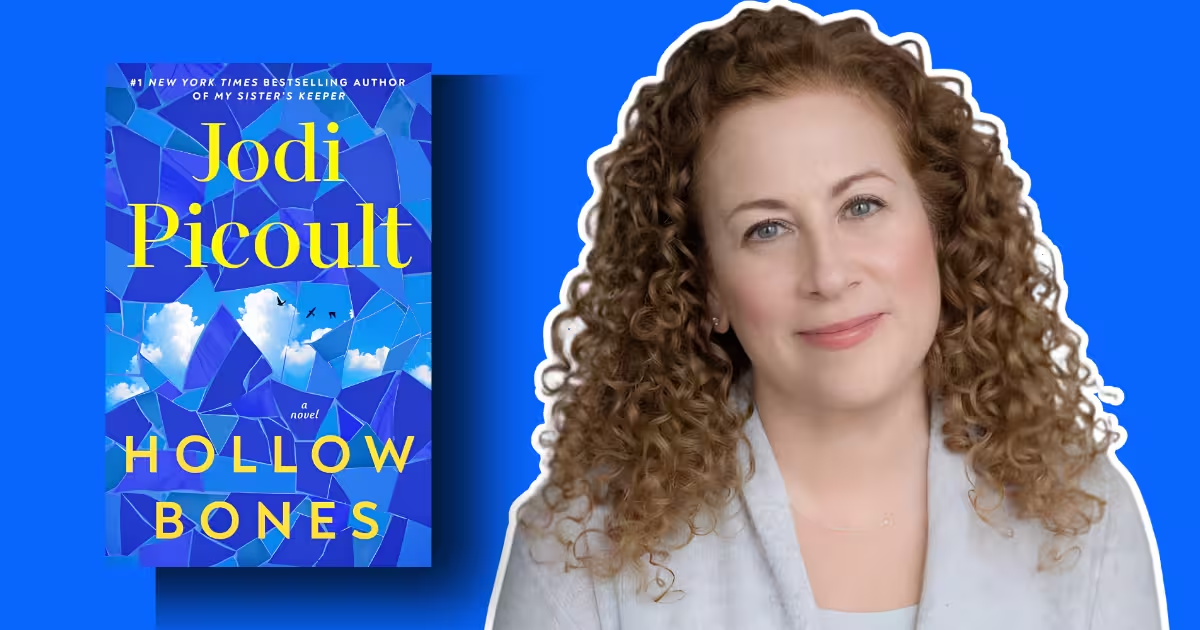

Hollow Bones by Jodi Picoult is not just another 9/11 novel. It is a brutal, tender excavation of what happens when a mother’s mind turns against her, when the biological miracle of birth becomes the trigger for a psychotic break that destroys everything in its path.
Published in 2026 by Ballantine Books, this is Picoult’s thirty-first novel, and it arrives at a moment when postpartum psychosis remains one of the most misunderstood and underdiagnosed conditions in medicine. The book asks a question that haunted me for days after I finished it: What would you do if the only way to save your child was to disappear from their life entirely?
I have read Picoult for years. I have cried over My Sister’s Keeper, raged through Small Great Things, and admired her willingness to take on impossible moral dilemmas.
But Hollow Bones hit differently. Perhaps because I am a mother. Perhaps because I have watched friends struggle through the darkness of postpartum depression and wondered, silently, if there was something worse lurking beneath the surface. This novel does not flinch from that darkness.
Instead, it walks straight into it.
Table of Contents
Summary: Hollow Bones at a Glance
Hollow Bones by Jodi Picoult is a 2026 dual-timeline novel about Molly Fitzgerald, whose mother disappeared after going to the World Trade Centre on September 11, 2001.
The story explores grief, motherhood, trauma, emergency preparedness, family relationships and postpartum psychosis. Picoult connects Molly’s present-day life with her mother’s past, gradually revealing how personal trauma can shape generations.
The novel also connects with My Sister’s Keeper through the return of Jesse Fitzgerald. For readers searching for a Hollow Bones review, the book’s biggest attractions are its emotionally difficult subject matter, multiple twists and extensive research, while its many themes and heavy melodrama may not work equally well for every reader.
- Title: Hollow Bones
- Author: Jodi Picoult
- Publication Date: 2026 (Ballantine Books)
- Page Count: Approximately 480 pages
- Genre: Literary Fiction, Family Drama, Psychological Fiction
- Core Theme: Postpartum psychosis, maternal identity, the long shadow of 9/11
- Primary Setting: Providence, Rhode Island and New York City
- Timeline: September 2026 to June 2031 (with flashbacks to 2001)
- Key Characters: Molly Fitzgerald (née Ambrose), Eloise Ambrose/Georgia Gilligan, Jesse Fitzgerald, Evie D’Addario, Adam Ambrose
Who will love this book:
- Readers who appreciate Picoult’s signature style of tackling ethical dilemmas
- Anyone interested in maternal mental health and postpartum psychosis
- Fans of dual-timeline narratives that weave past and present
- Readers who want to understand the human cost of 9/11 beyond the headlines
Who might bounce:
- Readers seeking a light, uplifting read
- Those uncomfortable with detailed descriptions of mental illness and its effects
- Anyone hoping for a straightforward romance or thriller
Introduction to Hollow Bones
Hollow Bones opens in September 2026, twenty-five years after the September 11 attacks. Molly Fitzgerald is the Chief of the Center for Emergency Preparedness and Response at the Rhode Island Department of Health. She is twenty-five years old, a prodigy who graduated from Columbia at nineteen and rose through the ranks during the Covid-19 pandemic.
Her husband, Jesse Fitzgerald, is a detective with the Providence Police Department and the state’s polygraph expert. His family carries its own scars: his sister Anna sued their parents for medical emancipation at thirteen, then died in a car accident shortly after the verdict, her organs donated to save their other sister, Kate.
Molly’s mother, Eloise Ambrose, was presumed dead on 9/11. She had gone to a doctor’s appointment in the South Tower and never came home. Molly grew up as “The Girl Who’d Lost Her Mom on 9/11,” a reluctant public figure whose grief was dissected on television screens every September.
Her father, Adam, descended into conspiracy theories about the attacks. Her stepmother, Evie, her mother’s best friend, raised her with love and devotion, filling a void that could never truly be filled.
Then, at a baby shower in a restaurant, Molly’s father sees a woman. He calls her by a name that has been dead for twenty-five years: Eloise.
The woman is Georgia Gilligan, the receptionist at Molly’s obstetrician’s office. She has been there all along, checking Molly in for appointments, watching her grow a new life inside her body. And she is Molly’s mother.
Background: The Historical Context
The September 11 attacks killed 2,977 people, making it the deadliest terrorist attack in American history. According to the 9/11 Memorial and Museum, nearly 40 percent of families have not received identified remains of their loved ones.
The attacks fundamentally altered American culture, from airport security to surveillance laws to the way we talk about trauma. For the children who lost parents that day, the world divided into “before” and “after.”
Postpartum psychosis, meanwhile, affects approximately 1 in 500 women who give birth. It is a medical emergency characterized by hallucinations, delusions, paranoia, and disorganized thinking.
Unlike postpartum depression, which is more common and often treatable with therapy and medication, postpartum psychosis can lead to suicide or infanticide if left untreated. Research indicates that untreated PPP carries a 4 percent risk of infanticide and a 5 percent risk of suicide.
In 2001, when Eloise gave birth to Molly, perinatal mental health was barely a field of study. Most obstetricians had received almost no training on postpartum psychosis. Women who reported symptoms were often dismissed as anxious or hormonal. The medications prescribed for depression could actually worsen psychotic symptoms, creating a catastrophic feedback loop.
The case of Andrea Yates, who drowned her five children in a bathtub in June 2001, became the most infamous example of untreated postpartum psychosis. Yates was initially convicted of capital murder, but her conviction was overturned on appeal. In 2006, she was found not guilty by reason of insanity and committed to a state mental hospital. Her case raised awareness about PPP but also led to sensationalized coverage that often portrayed her as a monster rather than a victim of untreated mental illness.
Hollow Bones Summary
Part One: Molly (September-December 2026)
The novel opens with a massive emergency preparedness exercise at T.F. Green Airport in Rhode Island. Molly Fitzgerald, as Chief of the Center for Emergency Preparedness and Response, has spent three years planning this simulation: a plane crash with 168 passengers.
The drill tests her team’s ability to account for every single person, a mission that stems directly from her own childhood trauma. Her mother was never found on 9/11, and that lack of closure has shaped everything about Molly’s career.
Her husband, Jesse, a polygraph expert with the Providence Police Department, participates as an evaluator. Their marriage is warm and loving, built on mutual understanding of loss. Jesse’s family was torn apart when his sister Anna sued their parents for the right to her own body, refusing to donate a kidney to their sister Kate. Anna won, but then died in a car accident. Her kidney was donated to Kate anyway, a cruel irony that shattered the family.
Molly and Jesse have a ritual before sleep: they confess their worst fears to each other and decide whose is more devastating. It is a game that reveals their intimacy and their vulnerability. But shortly after the exercise, Molly discovers she is pregnant.
She is terrified. She is only twenty-five, just settling into her role as a department head. Jesse, who is forty, is overjoyed. They argue, but eventually, Molly accepts the pregnancy with cautious hope.
A few weeks later, Molly visits her father and stepmother, Evie, for lunch. Her father remains obsessed with 9/11 conspiracy theories, convinced the government was behind the attacks.
Evie manages his obsession with patience and love. Molly grew up knowing Evie as her mother in every meaningful sense, even though her biological mother, Eloise, died when she was three months old.
Then, in December, everything changes.
Molly and Jesse go to an Italian restaurant for dinner with her father and Evie. Molly excuses herself to use the bathroom and runs into Georgia, the receptionist from Dr. Mantillard’s office. They chat warmly. Then Molly’s father appears, looking for her. He sees Georgia. His face goes white. “Eloise?” he says.
The woman who has been checking Molly in for every prenatal appointment, the woman who held her hand in the ER after a fall on the ice, the woman who helped her through a crisis of confidence at the ob-gyn office, is her mother.
Georgia runs.
Molly nearly faints.
Part Two: Eloise (June-September 2001)
The novel shifts back to June 2001. Eloise Ambrose is a young mother in New York City, married to Adam, an engineer. She is an artist who works with mosaics, and she has spent months creating a piece for the master bathroom in their apartment. She calls it “Hollow Bones,” inspired by the fragile wing bones of birds that make flight possible.
But Eloise is not well. After giving birth to Molly, she begins to experience symptoms that she cannot name or understand. She cannot sleep, but she is not tired. Her mind races at a speed that feels like a power surge. She hears a voice, which she believes is Satan, telling her that she is already dead and that her daughter will be possessed by evil unless Eloise sends her to Jesus first.
The voice preaches at her in the cadence of her father’s sermons. Eloise grew up in Borden Springs, Alabama, the daughter of Reverend Ezekiel Owens, an Evangelical preacher who ruled his family with an iron fist and a leather belt. Eloise’s mother, Euphemia, suffered from mental illness that was never treated.
Her sister, Adie, was their father’s favorite, and Eloise discovered at seventeen that their father had been sexually abusing Adie for years.
When Eloise confronted her mother, Euphemia said only: “God has a reason for everything.” She did nothing.
Adie killed herself the night before Eloise planned to run away with her. Eloise found her with an empty pill bottle and her purity ring inside. She ran that night, leaving Alabama behind, changing her name, and never looking back.
At RISD, Eloise met Evie D’Addario, her roommate and eventual best friend. She also met Adam Ambrose, the man Evie loved. Adam fell for Eloise instead, and they began a secret relationship that destroyed Eloise’s friendship with Evie for a time. They eventually reconciled, and Eloise and Adam married in a small City Hall ceremony.
Now, in 2001, Eloise is trapped in a postpartum psychosis that no one recognizes. She sees a psychiatrist, Dr. Kumon, who prescribes Zoloft. Instead of helping, the medication makes Eloise feel like her skin is on fire. She thinks she is being burned alive.
On the morning of September 11, Adam has flown to California for work and will return to meet her at the psychiatrist’s office. Evie has come to stay with Molly, who has a fever. Eloise takes a cab downtown. As she approaches the World Trade Center, she sees the first plane hit the North Tower.
She watches people jump from the upper floors, their bodies falling like birds without wings. Then the second plane hits the South Tower. She watches the towers collapse and joins the stream of ash-covered survivors walking across the Brooklyn Bridge.
In that moment of chaos, something shifts in Eloise. She has been planning to kill herself after sending Molly to Jesus. But now, she realizes that the way to save her daughter is to leave. If she is not there, Satan cannot use her hands to hurt Molly.
She slips into the crowd, steals a bus ticket from a woman’s purse, and disappears.
Eloise’s Life After 9/11 (2001-2026)
Eloise takes a bus to Atlanta, where she checks into a motel and attempts suicide by slashing her wrists with a shard of mirror. She is found by a maid, Ximena, and hospitalized. During her psychiatric evaluation, she gives her name as “Georgia Gilligan,” a name she invents on the spot.
At the state psychiatric hospital, Georgia is diagnosed with bipolar disorder. She responds to treatment. She tells Dr. Gruner that her baby died, burying Molly in her mind so that she can live as Georgia Gilligan. She befriends a patient named Vera, who is awaiting trial for allegedly killing her mother with a wood chipper. She learns that mental illness is not a death sentence, and that she can build a new life.
She gets a job at the Shadyside Motel as a maid, under Ximena’s wing. She watches the news coverage of 9/11 and sees her own face on missing person posters. She hires a private investigator, Fenimore Hurlihy, to learn what happened to Adam.
She finds out he survived. She sees a memorial service for herself in Central Park, and watches Adam and Evie and Molly together. They look like a family. She decides they are better off without her.
She gets a fake ID, buys it with her body from a man who assaults her. She works as a temp, then at a medical records firm, then as a receptionist at Dr. Carlsson’s ob-gyn practice in Atlanta. She watches Molly’s Instagram. She follows her life from a distance.
She has a relationship with a cop named Kai Yazzie, who loves her, but she cannot marry him because she is already married to Adam. She visits her mother, Euphemia, who is now in a dementia care facility and calls her by name without remembering who she is.
Then, in 2026, Georgia sees Molly’s Instagram Story: a pregnancy announcement. She knows that postpartum psychosis has a genetic component. She knows that Molly might be at risk. So she moves to Rhode Island and gets a job at Molly’s obstetrician’s office.
She is there for every appointment. She holds Molly’s hand when Molly collapses in the ER. She talks her down from a panic attack about the AFP test. She is present, invisible, waiting.
Part Three: The Collision
After the restaurant revelation, Molly is furious. Jesse is supportive but pushes her to at least hear Georgia out. Georgia writes her a letter, and Molly eventually agrees to meet.
Georgia tells Molly the truth: she had postpartum psychosis. She was hearing voices. She tried to leave Molly so that she could not hurt her. She did not know, at the time, that Evie had told Adam that Eloise had tried to drown Molly in the bathtub. That lie, told by Evie to convince Adam to get Eloise help, became the foundation of Molly’s belief that her mother had tried to kill her.
In reality, Eloise had never tried to drown Molly. Evie fabricated the story, hoping it would convince Adam to take Eloise to a psychiatrist. She did not know that the appointment was in the World Trade Center. She did not know that it would lead to Eloise’s disappearance.
The revelation shatters Molly’s relationship with Evie. Evie had raised her, loved her, been her mother in every way that mattered. But the foundation of their relationship was a lie.
Meanwhile, Molly’s pregnancy progresses. She gives birth to a daughter, Adie, with Georgia by her side. Georgia teaches her that postpartum psychosis can be managed, that the cycle can be broken. She watches Molly for signs of the same illness, and sees none.
The novel ends with Molly, Jesse, Adie, Georgia, and Adam on a pilgrimage to the 9/11 Memorial. Georgia’s name is on the memorial, a fact that is both grotesque and necessary. A Survivor Tree stands in the plaza, a pear tree that survived the attacks and now sends seedlings to places like Uvalde and Ukraine. Georgia is alive. Molly is alive. Adie is alive. The cycle of loss has been interrupted.
Hollow Bones Analysis
Characters
Molly Fitzgerald is a character defined by absence. She grew up without her mother, without knowing the truth of her death, without the ability to grieve properly. Her career in emergency preparedness is a direct response to her trauma: she cannot prevent disasters, but she can account for everyone who survives them.
She is a fixer, a planner, a woman who believes that if she just works hard enough, she can protect everyone she loves. When Georgia returns, Molly’s carefully constructed world collapses. She must reconcile the mother she mourned with the mother who abandoned her, and the stepmother who raised her with the stepmother who lied to her.
Eloise Ambrose/Georgia Gilligan is the novel’s most complex character.
She is a woman whose mind turned against her, who lost her sister to a father’s abuse, who ran away from everything she knew, and who spent twenty-five years watching her daughter grow up from a distance.
She is not a villain. She is not a saint. She is a survivor who made impossible choices in impossible circumstances. Her decision to return, to risk exposure and rejection, is an act of love that is both selfish and selfless.
Jesse Fitzgerald is the anchor. He is the husband who understands, who supports, who believes. His own family history, shaped by his sister’s lawsuit and death, gives him an empathetic understanding of Molly’s grief. He is also a polygraph expert, which means he can spot lies.
He knows when Molly is pretending to be fine. He knows when Evie is hiding something. He is the detective who solves the mystery of Eloise’s disappearance, piece by piece.
Evie D’Addario is the novel’s most morally ambiguous character. She raised Molly with genuine love. She was a devoted stepmother and, eventually, Adam’s wife. But she also lied. She told Adam that Eloise tried to drown Molly, a lie that shaped the family’s understanding of Eloise for twenty-five years.
Was she protecting Molly? Or was she securing her own position in the family? The novel leaves this question uncomfortably open.
Hollow Bones Themes and Symbolism
Postpartum Psychosis and the Failure of Medicine is the novel’s central theme. Eloise’s experience is based on extensive research and real cases.
The novel demonstrates how the medical establishment failed Eloise: she was told her symptoms were normal anxiety, she was prescribed medications that made her worse, she was not diagnosed until she attempted suicide.
According to Jodi Picoult’s author’s note, the diagnostic process for PPP often involves prescribing antidepressants first, and only considering PPP when the patient gets worse.
In other words, to be diagnosed correctly, women must suffer more.
The Public vs. Private Nature of Grief is another major theme. Molly grew up as “The Girl Who’d Lost Her Mom on 9/11.” Her grief was public property, dissected on television, commented on by strangers.
In contrast, her private grief—the loss of a mother she never knew, the absence of a relationship she could never have—was hidden. When Georgia returns, the public narrative collapses. Molly’s identity as a 9/11 orphan is no longer valid. She must reconstruct who she is without the tragedy that defined her.
Mothers and Daughters, Inherited Trauma runs through the entire novel. Eloise’s mother was mentally ill and did nothing when her husband abused her daughter. Eloise repeated the pattern of maternal failure, not through abuse but through absence.
Molly fears that she will repeat the pattern, that the same illness that consumed her mother will consume her. The novel asks: Can we break the cycle? Can we do better than the mothers who came before us?
Evaluation
My Rating: 4.5 out of 5 stars
Strengths:
- Meticulous research into postpartum psychosis
- Dual timelines that build tension and empathy
- Complex, morally ambiguous characters
- Emotional depth without manipulation
Weaknesses:
- The resolution feels slightly rushed
- Some secondary characters (Kai, Ximena) deserve more page time
- The conspiracy theory subplot with Adam feels underdeveloped
Impact: This book made me think differently about postpartum psychosis. I had heard of Andrea Yates, but I did not understand the mechanics of the illness. I did not know that it affects 1 in 500 women , that it is a medical emergency, or that it is so often missed by doctors.
Hollow Bones is not just a novel. It is an education.
Personal Insight: The Silence Around Postpartum Psychosis
Here is what I learned from this novel: postpartum psychosis is not rare. It affects approximately 1 in 500 women who give birth. It is a medical emergency that requires immediate treatment. Yet most people have never heard of it until a tragedy makes headlines. Andrea Yates. Lindsay Clancy. These names become cautionary tales, but they are also symptoms of a system that fails women.
The novel shows what happens when a woman asks for help and is dismissed. Eloise told her midwife she couldn’t sleep. She told her psychiatrist she felt like her skin was on fire. She was told it was normal. She was told to relax. She was given medication that made her worse.
The lesson is not that women should be afraid of childbirth. The lesson is that we need to listen. We need to take women’s mental health seriously. We need to recognize that the transition to motherhood is not always joyful, and that the darkness that some women experience is not a character flaw. It is an illness. It can be treated. But only if we see it.
Comparison with other works
For longtime readers, Hollow Bones feels like a deliberate homecoming. Several early reviewers have noted that while the novel doesn’t center on a legal case, it returns to the “moral dilemma” roots that defined her breakout work.
The most direct connection is the return of Jesse Fitzgerald, a “fan-favorite character who first appeared in Picoult’s bestselling 2004 novel, My Sister’s Keeper. In this novel, Jesse is the “troubled teen arsonist” from that earlier book, now grown into a detective and polygraph expert.
This continuity isn’t just a cameo; it’s a structural echo. Picoult is known for tackling impossible ethical quandaries, and Hollow Bones is no exception, dealing with “the messy grey areas in between” that her fans expect. Where My Sister’s Keeper asked who owns a child’s body, Hollow Bones asks what a mother owes her child when her own mind becomes the threat.
Quotable Lines from Hollow Bones
“Every villain is the hero of their own story.”
“There are patterns we have worn like ruts into our lives. It’s much easier to tell ourselves we are moving forward, and not in circles.”
“When emergency preparedness works, it’s magic.”
“You can’t stop a disaster from occurring, no matter how much you prepare. But if you cannot keep everyone safe, you can damn well make sure they are all accounted for.”
“Some fires are built to consume. Others you tend so they can keep you warm forever.”
Conclusion
Hollow Bones by Jodi Picoult is a novel about the lies we tell ourselves to survive, and the truths we must face to heal. It is about a mother who left to protect her child, and a daughter who had to forgive her. It is about the long shadow of 9/11, not just on the families who lost someone, but on the families who thought they had lost someone.
I recommend this book to readers who appreciate literary fiction that tackles difficult moral questions. It is not an easy read, but it is a necessary one. It will make you think about motherhood, about mental illness, about the ways our healthcare system fails women. And it will make you grateful for the people who stay, even when leaving would be easier.