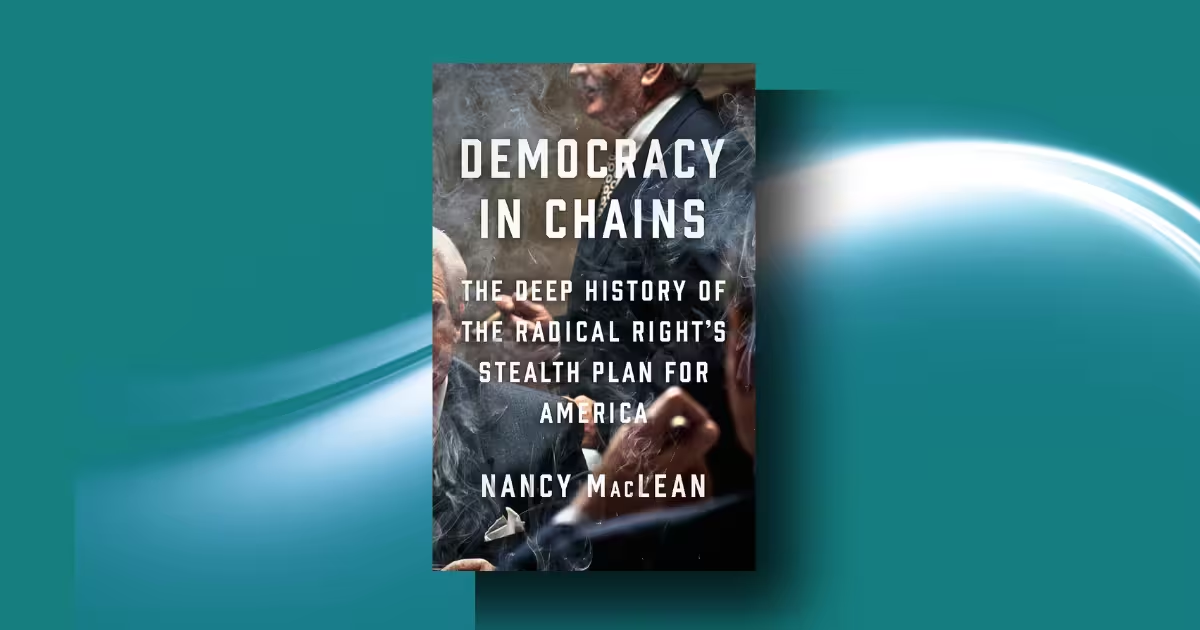

Democracy in Chains: The Deep History of the Radical Right’s Stealth Plan for America by Nancy MacLean is a polarizing examination of how a small group of wealthy donors utilized the economic theories of James M. Buchanan to systematically weaken American democratic governance. MacLean argues that this is not standard partisan politics.
She frames it as a calculated, decades-long project to save capitalism from democracy. I have read heavily on political economy, and this specific angle provides a fresh lens for viewing modern legislative gridlock.
Table of Contents
1. Summary and Reader Recommendation
Who is the target audience for this exhaustive historical critique? You will love this book if you are a student of political science, a progressive activist, or someone trying to understand the sudden surge in state-level legislative maneuvers to restrict voting and dismantle unions.
You will bounce from this text if you adhere strictly to libertarian free-market principles, as you will likely find MacLean’s framing of these economic theories overly hostile.
In short, the book asserts that Nobel laureate James M. Buchanan developed a framework called “public choice economics” which treats all collective political action as a form of coercion against taxpayers. Billionaire Charles Koch then funded the institutionalization of this theory.
Their combined efforts trained operatives to infiltrate the Republican Party and rewrite the rules of government. Their goal is to make it impossible for majorities to enact social programs, tax the wealthy, or regulate corporations.
2. Introduction to the Author and Context
Who exactly is Nancy MacLean and what drove her to write this? MacLean is a historian of American social movements at Duke University who initially stumbled upon this story while researching state-subsidized education vouchers. She discovered an unlisted archive at George Mason University containing the personal papers of James McGill Buchanan.
Democracy in Chains falls firmly into the genre of investigative political history.
The primary argument is that the radical right operates akin to a fifth column.
They know their goals are unpopular with the general public. Instead of trying to win elections through persuasion, they focus on altering the rules of democratic governance so that the majority can no longer impose its will on the propertied minority.
3. Background of the Ideological Shift
Where did the radical right’s modern strategy actually begin? The ideological foundation of this movement traces back to 1956 in Virginia, right after the U.S. Supreme Court’s Brown v. Board of Education decision. At that time, Colgate Whitehead Darden Jr., the president of the University of Virginia, feared the federal government’s intervention in state affairs.
James M. Buchanan, a newly hired economist at UVA, proposed creating a new academic center. Buchanan promised to train thinkers to fight the “perverted form” of liberalism that sought to expand the government’s role in social life.
For Buchanan, the Brown decision represented federal coercion. He viewed taxation for public improvements as a form of legally sanctioned gangsterism directed at property owners. This localized Virginia resistance eventually mutated into a national project.
4. Democracy in Chains Summary
What are the specific steps Buchanan and his allies took to enact this vision? The narrative tracks several key phases of the movement, detailing how a fringe academic theory became the operational playbook for a massive political network.
First, MacLean establishes the roots of Buchanan’s philosophy. Buchanan was deeply influenced by John C. Calhoun, the antebellum South Carolina senator who engineered constitutional mechanisms to protect elite slaveholders from the democratic majority.
Calhoun viewed taxation as class conflict, arguing that government intervention created a class of “tax producers” and “tax consumers”. Buchanan applied this exact logic to the 20th century. He labeled social movements, labor unions, and civil rights groups as the “collective order”. He believed that if these groups used their numbers to secure government benefits, it constituted coercion of the minority taxpayers.
Second, the book details the transition from theory to action. Buchanan realized early on that politicians would not voluntarily shrink government because they relied on voter approval to stay in office. His solution was a “constitutional revolution”. He wanted to put legal shackles on public officials so they could not respond to majority demands, regardless of their personal sympathies.
Third, MacLean introduces Charles Koch, the entrepreneurial force who weaponized Buchanan’s theories. By the late 1990s, Koch had invested millions into Buchanan’s center at George Mason University. Koch understood that their ideas were vastly unpopular. He told his team, “Since we are greatly outnumbered,” they could not rely on open persuasion. Koch insisted on a stealth strategy, warning that “The failure to use our superior technology ensures failure”.
Finally, the book connects this history to recent political events. MacLean points to actions like Governor Scott Walker stripping public employees of collective bargaining rights in Wisconsin in 2011.
She also highlights the aggressive push for voter suppression laws across 41 states in 2011 and 2012, aiming to restrict the franchise of low-income and minority voters. These are not isolated incidents. They are the tactical implementation of Buchanan’s mandate to change the rules of the game so that democracy cannot interfere with raw capitalism.
5. Democracy in Chains Analysis and Commentary
Does the author successfully prove her controversial claims? MacLean builds a highly documented case using archival materials, but she interprets these documents through a very specific, and sometimes adversarial, lens.
My commentary aligns with reviewers from major outlets who recognize the sheer volume of evidence she unearthed. She effectively maps the funding networks connecting the Cato Institute, the Heritage Foundation, and the American Legislative Exchange Council to this core ideology.
However, her application of motive is aggressive. She assesses Buchanan’s public choice theory not as a legitimate academic inquiry into government inefficiency, but as a malicious tool for oligarchy.
She fulfills her stated purpose of tracing the stealth plan, but readers must be aware that she treats the subjects of her research as antagonists. Like reading The Sense of an Ending, the narrative relies heavily on memory and pieced-together archives, making it a compelling, yet distinctly subjective, historical account.
6. Strengths and Weaknesses
What are the best and worst parts of this historical account? The most compelling strength of the book is MacLean’s archival discovery at Buchanan House.
She provides concrete proof of the coordinated strategy between Charles Koch and academic economists, lifting the veil on how dark money creates model legislation.
The narrative surrounding the 1951 student strike at Robert Russa Moton High School led by Barbara Rose Johns is brilliantly written. It shows exactly what the libertarian establishment was reacting against: organized, collective demands for basic equality.
The primary weakness is her tendency to conflate economic libertarianism with the explicit defense of white supremacy. While she accurately notes that Calhoun defended slavery as “a positive good”, and that Buchanan’s early work was used by segregationists, she sometimes stretches to make Buchanan himself a cartoon villain.
She occasionally ignores standard economic counterarguments to focus purely on the political damage caused by the Koch network.
7. Comparison with Similar Works
How does this compare to other books on political economy? This text stands apart from standard economic histories because it reads almost like a political thriller.
If you compare it to Dark Money by Jane Mayer, MacLean’s book provides the intellectual and philosophical origins that Mayer’s financial tracking left out.
While Mayer followed the dollars, MacLean followed the ideas. If you read Marion Nestle’s Food Politics, which I also analyzed recently, you see a similar theme of industry influencing public policy. However, MacLean exposes a movement trying to dismantle the very structure of the policy-making apparatus itself.
8. Conclusion
Should you add this to your reading list? You should absolutely read this if you want a detailed understanding of how modern political gridlock was intentionally engineered.
It is highly suitable for general audiences who follow current events, though academic economists might bristle at her interpretations. The book leaves you with a stark realization: the political chaos we see today is not an accident of extreme partisanship. It is the successful execution of a fifty-year plan.