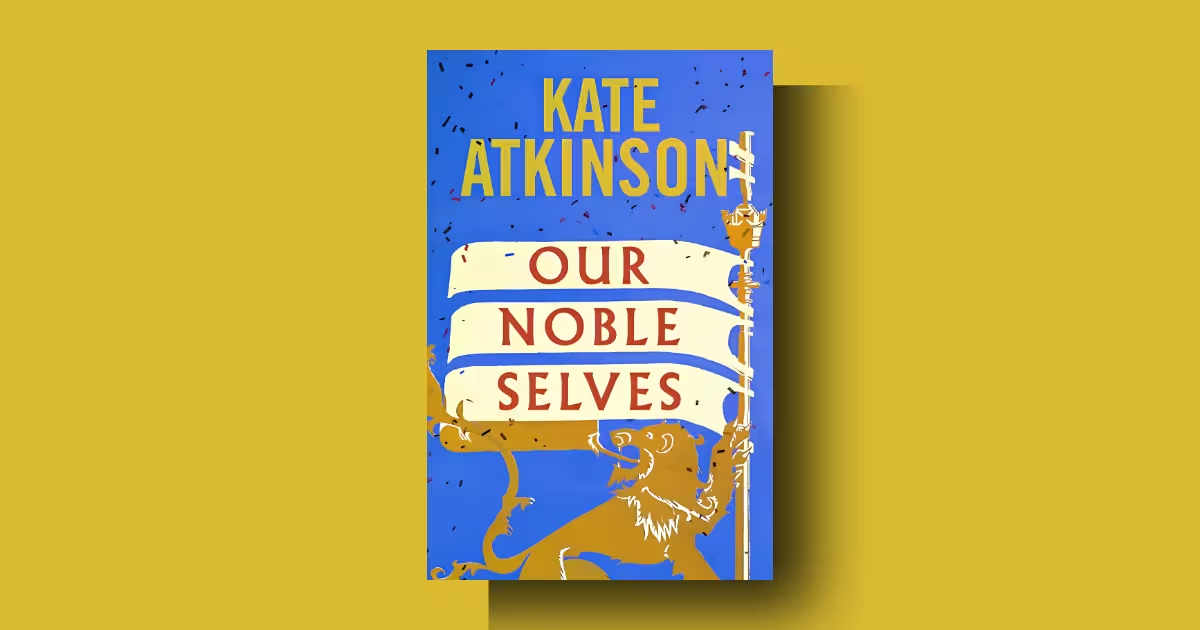

Our Noble Selves by Kate Atkinson is a masterful blend of historical fiction, dark comedy, and spy thriller set against the backdrop of the 1951 Festival of Britain. The novel follows Harry Flynn, a war-scarred journalist and former POW, who takes a seemingly harmless job at the Festival Office and is quickly embroiled in a deadly conspiracy involving former fascists, government spies, and a missing Frenchwoman.
It’s a story about a nation trying to paper over its wartime trauma with optimism and pageantry, while individuals struggle with the ghosts of their past. The book is a must-read for fans of Atkinson’s Transcription and Life After Life, offering a unique, witty, and poignant look at postwar Britain.
The Festival of Britain in 1951 was designed to be a tonic for a shattered nation, a dazzling display of modern design and national pride meant to distract from the ration books and bomb sites.
Yet, as Kate Atkinson reveals in her brilliant new novel, Our Noble Selves, the bright lights of the South Bank cast some very dark shadows indeed.
This isn’t just a nostalgic trip down memory lane; it’s a sharp, witty, and deeply human story about what happens when a country tries to forget its past and the people who simply can’t.
Table of Contents
Introduction
Our Noble Selves is the fifteenth novel by Kate Atkinson, published by Doubleday on September 15, 2026. Atkinson, a Whitbread Book of the Year winner for her debut Behind the Scenes at the Museum, has long been fascinated by the Second World War and its aftermath, exploring these themes in novels like Life After Life and A God in Ruins.
This new work returns to that fertile ground, focusing on a very specific and fascinating moment in British history: the Festival of Britain.
Background
To understand Our Noble Selves, you need to understand the Festival of Britain. It was a government-backed exhibition held on the South Bank of the Thames in London, designed to promote British science, technology, design, and industry.
The goal was to lift the spirits of a nation still deep in the “doldrums” of postwar austerity. As Gerald Barry, a real historical figure and the novel’s fictionalized Festival organizer, tells Flynn, “The country’s stuck in the doldrums; we need to see the future and to know we’re in touching distance of it. We hope the whole thing will be a beacon for change, a sort of tonic for the nation” .
The Festival was a massive undertaking, featuring the futuristic Royal Festival Hall, the giant Skylon tower, the Dome of Discovery, and countless exhibitions celebrating everything from the “Land of Britain” to “Power and Production.”
It was, as Atkinson notes in her author’s note, an “enormous success with the public,” drawing over eight and a half million visitors during its five-month run.
However, beneath the surface of this national celebration, there was a country grappling with profound loss, trauma, and a shifting identity on the global stage. The novel uses this historical backdrop to brilliant effect, exploring the gap between public optimism and private suffering.
Our Noble Selves Plot Summary
The novel opens in 1949 with Harry Flynn, a man “presumed dead,” sitting on a bench in St. James’s Park. He is approached by his old boss at the News Chronicle, Gerald Barry, who offers him a job working on the upcoming Festival of Britain.
Flynn, a former foreign correspondent who was captured by the Japanese in Singapore and forced to work on the Burma Railway, is a ghost of his former self. He has returned to London to find both his parents dead of heart attacks and his younger brother, Charlie, lost when his submarine, the Tigris, disappeared in 1943.
Haunted by his past and plagued by nightmares, Flynn is barely functioning, working a menial job at a printing press and drinking away his memories.
Flynn’s life has been a series of disastrous attempts at normalcy. He had a brief, failed marriage to a war widow named Ivy Shears, whose life—complete with a mock-Tudor semi in Wealdstone, a resentful stepdaughter named Veronica, and a small white terrier called Mrs. Betty—represented a “ready-made life” he thought he could slip into.
But the marriage was a mistake, and one morning he simply walked out, fleeing back to London and a solitary existence in Romilly Street, Soho. Working at the Festival Office in Savoy Court, Flynn finds a motley crew of fellow survivors. There’s the melancholy Welshman Evans, who survived a week on a lifeboat in the Arctic after his ship was torpedoed; the portly, clubbable Badger, who came from money and had a mysterious wartime role in the Secret Service; the irrepressible fourteen-year-old gofer known simply as “The Boy”; and the enigmatic Miss Ogilvie, a formidably intelligent Scotswoman of a certain age who joins the team from the Typography department.
Flynn’s job is a series of absurd tasks, from compiling a poetry anthology to sourcing a stuffed cat for a “Room for an Elderly Lady”. He is also tasked with monitoring the Festival Cake competition, which is won by the ghastly Mitzi Blinkhorn, a flamboyant and talentless cook with a mysterious past.
Flynn’s mundane existence is shattered when he has a drink with Delphine Dubois, a cantankerous Frenchwoman who works in the Homes and Gardens Pavilion.
The date is a disaster, but it ends with Delphine leaving in a taxi to meet someone called “Zheel”.The next morning, Flynn wakes up in his flat with a black eye, bruises, and absolutely no memory of how he got them.
He later discovers Delphine’s bloodstained silk scarf, printed with little Eiffel Towers, in his desk drawer. When Delphine fails to show up for work, her friend Frida reports her missing, and the police, led by the suspicious Inspector Vigo, begin to view Flynn as the prime suspect.
The plot thickens when Flynn is drawn into a shadowy world of blackmail and espionage. He is contacted by Major Archie Blinkhorn, Mitzi’s husband, a sleazy former Fascist and black marketeer.
Archie asks Flynn to retrieve some compromising photographs of Mitzi from a flat in Half Moon Street, which turns out to be Delphine’s flat.The photos are of Mitzi and her lover, who has a distinctive jade-green eye color and a distinguishing mark—the same eyes as Giles Dangerfield, a prominent Festival official with a sinister edge and a political past as a Fascist sympathizer.
Flynn soon learns that Delphine, whose real name was Colette Paquet, was a former SOE agent and Nazi collaborator. She had been the mistress of Giles Dangerfield during the war and was blackmailing both him and Archie with the photographs.
A web of former Fascists, government agents, and personal vendettas begins to close in on him. His colleague Badger, it turns out, knew Delphine during the war, she betrayed his entire spy network, and he is working for MI5 to cover up a conspiracy involving Dangerfield.
The investigation is taken over by Lydia Fairchild, a glamorous socialite who works for MI5 and with whom Flynn has a brief affair. She reveals that the intelligence services were using Delphine to gather evidence against Dangerfield but that their plan went spectacularly wrong.
Delphine was killed by an unexpected player: Cynthia Blinkhorn, Mitzi’s socially awkward and deeply unhinged daughter. Cynthia was obsessed with Flynn and jealous of his connection to Delphine, and she killed her with a spear-point knife.
In a final act of violence, Mitzi Blinkhorn is killed when a Calor gas canister explodes in the Farmhouse Kitchen where she was baking the Festival Cake.
The second body found in the wreckage is Giles Dangerfield, who had gone to see her. Meanwhile, Cynthia, after a terrifying confrontation with Flynn at Battersea Funfair, is killed when she falls from the Big Dipper roller coaster.
The novel ends with the Festival concluding. Flynn has survived the conspiracies, and he has taken on responsibility for his stepdaughter, Veronica, whose mother Ivy has been arrested in France for her involvement in a smuggling ring. He is no longer just a man adrift; he has become a father.
The story ends on a note of tentative hope, with Flynn ready to face “the road ahead”.
Our Noble Selves Analysis and Critique
Characters
Harry Flynn: Flynn is a classic Atkinson protagonist, a quiet, intelligent, and observant man carrying a deep well of trauma. He is described as “quietly magnetic” and is inexplicably attractive to women, a fact he never quite understands. His character development is the core of the novel.
At the start, he is a passive survivor, “plodding to the end on the path of endurance”. By the end, through his relationship with Veronica and his navigation of the conspiratorial maze, he begins to actively engage with life again.
He is a man learning to feel love after years of emotional ossification, a process that is “terrifying” for him.
Veronica Shears: Initially an eight-year-old “belligerent” child, Veronica reappears as a formidable thirteen-year-old. She is fiercely intelligent, relentlessly pragmatic, and has a “sangfroid” that would impress a war veteran.
She reads sensationalist detective novels like The Love Nest and is far more street-smart than Flynn. She is the catalyst for much of the plot’s later movement, her persistence driving Flynn to investigate the barman and uncovering the truth about the frame-up.
Her relationship with Flynn is the emotional heart of the novel, evolving from mutual wariness to a deep, if unspoken, parental love.
Giles Dangerfield: The novel’s primary antagonist, Dangerfield is a man of “handsome, patrician” looks and “jade-green” eyes. He is a former Fascist, a wartime traitor, and a man of “sinister depths” hiding behind a veneer of respectability.
He represents the unaddressed evil of the pre-war and wartime establishment that has been allowed to continue in the postwar world. His character is a chilling reminder that the line between traitor and hero can be terrifyingly thin.
Maud Ogilvie: A “thin, teachery sort” with a “canny corvine brain,” Maud is far more than she appears.She is a deep-cover agent, working for MI5, who has been “in the game since Methuselah”. She provides Flynn with a fake alibi and is a master of deception, embodying the hidden, darker side of the establishment.
She is a brilliant creation, a spinsterish “maiden aunt” who is, in fact, a ruthless and effective operative.
Archie and Mitzi Blinkhorn: Archie is a “bantam cock” of a man, a failed Fascist, an embezzler, and a blackmailer, who remains loyal to Mitzi in his own twisted way. Mitzi (née Ada Clegg) is a former prostitute turned “cook” and media personality, a “terrible cook” and a “charlatan” who is nonetheless a “trooper”.
They are both grotesque and yet oddly pathetic figures, products of a chaotic and morally ambiguous era.
The Supporting Cast: The novel is populated by a rich and eccentric cast, all of whom are quietly haunted by the war. Evans, the melancholic Welshman, represents the quiet, enduring suffering of those who survived the Atlantic convoys. Badger, the Norfolk toff with a secret SOE past, is a man of “many secrets” who hides his true nature behind a façade of geniality.
The Boy, Terence, is the beating, optimistic heart of the office, a symbol of the future who is nonetheless being raised by the survivors of the past. Each character adds a layer to the novel’s rich tapestry of postwar trauma.
Our Noble Selves Themes and Symbolism
The Festival of Britain as a Symbol: The Festival itself is the novel’s central symbol. On the surface, it represents a bright, optimistic, modern future, “a beacon for change”.
However, Atkinson uses it to expose the cracks in this narrative. The Festival is built on a bomb site, its construction plagued by delays and strikes, and its bright facade obscures a seedy underbelly of corruption, espionage, and murder.
It is a “straw” lion and unicorn, an ephemeral spectacle that will be “consigned to the scrapheap”. The novel argues that the public optimism of the Festival was, in many ways, a necessary fiction, a “noble” lie told to a nation that was not ready to face its demons.
Trauma and Memory: The novel is a profound exploration of how individuals and nations deal with trauma. Flynn’s inability to talk about his war experiences is a central theme. He represents a generation of men who were expected to “get on with it,” to “treat the past as if it barely existed.
The novel suggests that this repression is not a solution but a form of “ossification,” a petrification of the heart that prevents true human connection. The past, however, always “breaks through into the present,” whether through nightmares or the reappearance of old crimes.
The novel’s title, a military toast meaning “to us,” is deeply ironic. It speaks to a self-congratulatory attitude that masks a more complicated and troubled reality.
The Deception of Appearances: Our Noble Selves is a novel of surfaces. Nothing is what it seems. The “benevolent” Festival is a cover for a spy operation.
The “respectable” Dangerfield is a traitor. The “harmless” Miss Ogilvie is a lethal agent. The “bumbling” Archie is a dangerous manipulator. Even the dog, Mrs. Betty, is named with an honorific that implies a respectability she does not possess.
This theme of deception is woven into the fabric of the novel, mirroring the era’s obsession with secrets, loyalty, and the fear of infiltration.
The Search for Love and Connection: Amidst the darkness, the novel is ultimately about the search for connection. Flynn, who believes he has “never learnt how to love,” finds an unexpected and transformative love for his stepdaughter, Veronica. This is not a romantic love, but a “terrifying” paternal love that “flayed the skin off you”.
is this connection that gives him a reason to “carry on,” to move from mere endurance to active living. The novel suggests that in a world of betrayal and lies, the only true “noble” self is the one that can love and be loved.
Evaluation
My Opinion: Our Noble Selves is a superb and deeply satisfying novel, an outstanding addition to Kate Atkinson’s already impressive body of work. It is a “comedy, not a tragedy, but there are plenty of tragic moments”.
It is a story that is “tangled and dark but also quite funny,” a testament to Atkinson’s unique ability to find humour in the bleakest of circumstances. It is a poignant, witty, and intelligent novel that cements her status as one of the finest writers of her generation.
Strengths: The novel’s greatest strengths are its compelling characters, its masterful plotting, and its vivid, almost tactile, sense of time and place. Atkinson’s prose is as sharp as ever, full of “dry, self-questioning, detached, quirky” observations that are entirely her own. The character of Veronica is a particular delight, a force of nature who steals every scene she is in.
The historical details about the Festival are woven in seamlessly, never feeling like an info-dump, but rather an integral part of the story.
Weaknesses: For some readers, the pacing in the first half might feel slow, as it focuses on establishing the setting and characters. The plot is convoluted, full of twists and turns, and some readers might find it difficult to keep track of all the conspiratorial threads. The resolution, while satisfying, is somewhat chaotic, with a high body count that might feel slightly melodramatic.
Impact: The novel resonated with me on an emotional and intellectual level. It is a powerful meditation on trauma, memory, and the lies we tell ourselves and our nations to survive.
It made me think about the silent suffering of a generation that returned from the war and was expected to just get on with things. It is a novel that stays with you long after you finish it.
Comparison with Similar Works: The novel shares thematic DNA with Atkinson’s own Transcription (2018), which also deals with postwar espionage and the consequences of wartime actions. It also has echoes of Graham Greene’s “entertainments,” with their blend of espionage, moral ambiguity, and flawed protagonists.
Fans of Sarah Waters’ The Little Stranger will appreciate the novel’s atmosphere of postwar decay and hidden secrets.
Personal Insight: The Festival of Britain’s Contemporary Relevance
The most important theme of Our Noble Selves for me is the way nations use public spectacle and nostalgia to avoid dealing with deep-seated trauma and systemic injustice. The Festival of Britain was a massive, government-funded “tonic” for a nation in crisis.
This leads to a crucial contemporary parallel: how governments and societies today often use grand events—Olympics, World Expos, royal jubilees—to project an image of unity and progress while ignoring social inequality, political corruption, and the lingering effects of historical wrongs.
For instance, the novel’s exploration of the “Establishment” protecting its own—whether it’s a war criminal like Dangerfield or a fascist like Braithwaite, mirrors modern concerns about the “deep state” and the failure of institutions to hold powerful figures accountable.
The novel shows that the “truth and loyalty” of the Badgley family motto are easily twisted to serve the powerful, not the just.
Additionally, Flynn’s personal struggle with PTSD, which he calls “the past breaking through,” is a powerful reminder that national amnesia is never a cure for individual pain.
The novel teaches us that healing requires not forgetting, but confronting. As a consequence, it challenges us to look beyond the “pageantry” of our own times and ask what painful truths our current celebrations might be designed to obscure.
Furthermore, the novel highlights the role of the press. Flynn’s colleague, the obituary writer from Birmingham, is a hack who writes favourable puff pieces in exchange for access. This is a timeless criticism of a media that fails to act as a watchdog. Hence, the novel is a cautionary tale about the importance of an independent and courageous press in a healthy democracy.
Ultimately, the most profound lesson is about the power of personal connection. Flynn’s redemption doesn’t come from exposing the conspiracy or clearing his name.
It comes from his love for Veronica. This shows that even when the grand narratives of nation and ideology are rotten, the small, private acts of love and care for another human being can provide the only real “beginning of many good things.”
Our Noble Selves Quotes
“It was a meagre, empty kind of household, where the examined life was not encouraged and where love and affection were in short supply.”
“Grief and love were inseparable bedfellows. It seemed as good a reason as any to try to avoid both.”
“The country’s stuck in the doldrums; we need to see the future and to know we’re in touching distance of it.”
“A few years later and they start wanting to remember again. A few decades later and they’re wallowing in it.”
“He was not whole, he would never be whole, but, like the hundreds of thousands, perhaps millions, of men before him who had returned from a war, he was getting on with his life by treating the past as if it barely existed.”
“How did Veronica even know the opening hours of public houses? Flynn had never given much thought to what it would be like to be a parent… He had certainly never imagined the feral creature that was Veronica Shears.”
“The past broke through into the present occasionally, usually in the form of nightmares or a recurrent bout of malaria, but Flynn had determined to cast off both quickly.”
“This was love, he thought. He’d always known it would be terrifying.”
“We tell ourselves stories to make ourselves feel better. The past absolves itself with this kind of fiction.”
Conclusion
Our Noble Selves is a triumph. It is a novel that works on multiple levels: as a gripping spy thriller, as a poignant historical drama, and as a sharp, witty comedy of manners. It is a book about a country trying to reinvent itself and a man trying to find a reason to live. Kate Atkinson has crafted a story that is both deeply entertaining and profoundly moving.
I would recommend this book to:
- Fans of Kate Atkinson’s previous work, especially Transcription and Life After Life.
- Readers who enjoy historical fiction with a strong sense of time and place.
- Anyone who loves a good spy thriller with a complex, morally ambiguous plot.
- Readers who appreciate witty, intelligent dialogue and eccentric, well-drawn characters.
Our Noble Selves is a significant novel because it reminds us that the past is never truly over. It is a “record for posterity” that suggests the most noble thing we can do is to confront our ghosts, both national and personal, and find the courage to love in the ruins.