
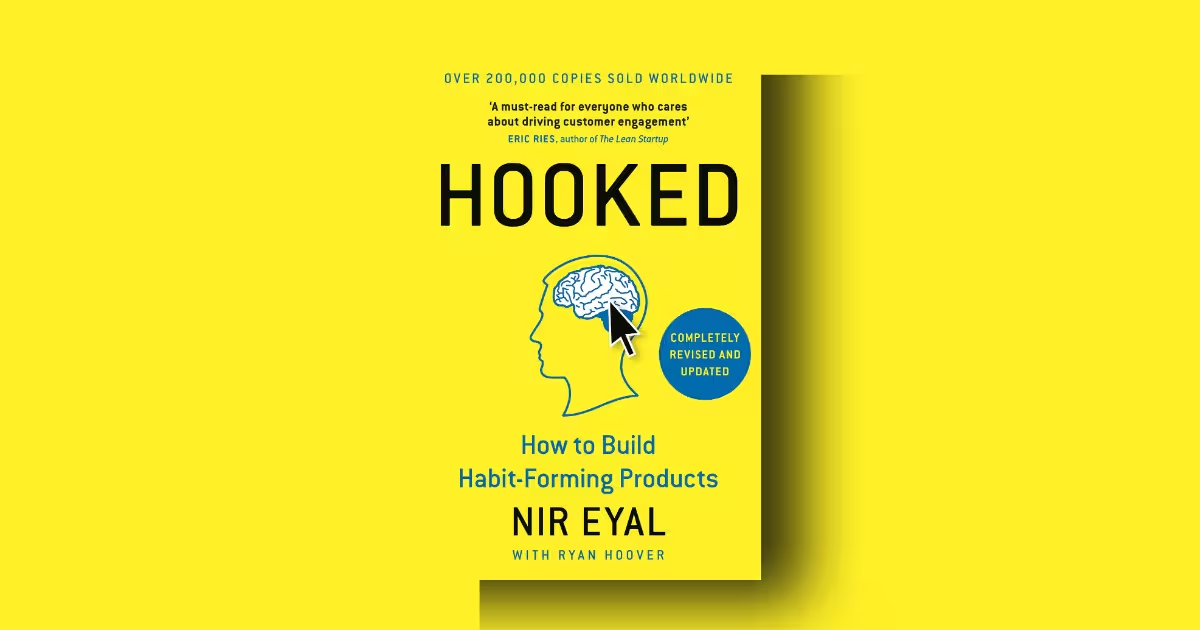
Hooked: How to Build Habit-Forming Products by Nir Eyal (with Ryan Hoover) is a practical framework for understanding how technology companies engineer user behavior. Published in 2014, the book has sold over 500,000 copies worldwide and became a Wall Street Journal bestseller.
Eyal, an Israeli-born American author who teaches at the Stanford Graduate School of Business, presents the Hook Model, a four-phase process (Trigger, Action, Variable Reward, Investment) that companies use to build products people can’t stop using.
Here’s the thing: this book made me uncomfortable. Not because it’s badly written, it’s actually quite good, but because it lays out, in clear, practical terms, exactly how your attention is being harvested. And once you see it, you can’t unsee it.
Reader Recommendation: Who Will Actually Love It, Or Bounce
Love it if:
- You’re a product manager, UX designer, or startup founder building a digital product that needs repeat engagement
- You’re a marketer who wants to understand what actually drives user retention
- You’re curious about the psychology behind why you can’t stop checking your phone
- You appreciate frameworks with clear, actionable steps
Bounce if:
- You’re looking for a self-help book about breaking your own bad habits (Eyal wrote Indistractable for that)
- You want deep academic rigor, this is practical, not theoretical
- You’re uncomfortable with the idea of deliberately engineering user behavior (and you might be, after reading this)
Table of Contents
1. Introduction
Book: Hooked: How to Build Habit-Forming Products
Author: Nir Eyal, with Ryan Hoover
Publication: First published in 2014 by Penguin Random House (ISBN: 978-1591847786)
Pages: Approximately 256 pages
Sales: Over 500,000 copies sold worldwide
Hooked Context
Hooked sits at the intersection of consumer psychology, behavioral economics, and product design. Eyal came to this topic through an unusual path. After graduating from Stanford’s MBA program in 2008, he co-founded a company that placed ads in online social games. He watched companies make billions selling virtual cows while advertisers spent fortunes trying to influence people. This sparked his obsession with one question: how do products change our actions and, at times, create compulsions?
Eyal has taught courses on applied consumer psychology at the Stanford Graduate School of Business and the Hasso Plattner Institute of Design. His writing has appeared in Harvard Business Review, The Atlantic, Psychology Today, and Fast Company.
Hooked Purpose
The central thesis of Hooked is deceptively simple: habit-forming products connect a user’s problem with a company’s solution frequently enough to form a habit. Eyal argues that in an age of infinite distractions, amassing millions of users is no longer enough, companies must build habits to survive. The book provides a repeatable framework (the Hook Model) for doing exactly that.
2. Background
Before diving into the Hook Model, it’s worth understanding why Eyal wrote this book. In 2008, he was part of a Stanford MBA team starting a company backed by some of Silicon Valley’s brightest investors. Their mission: build a platform for advertising in online social games.
Eyal admits he “didn’t get it at first”. He found himself standing at the water’s edge wondering, “How do they do it?”. He embarked on a journey to learn how products change our actions, and found no guide. Businesses skilled in behavior design guarded their secrets. There was no how-to manual for building habit-forming products.
So he built one. He documented observations of hundreds of companies, drew insights from academia (consumer psychology, human-computer interaction, behavioral economics), and began consulting for Silicon Valley companies from small startups to Fortune 500 enterprises. In 2012, he co-designed and taught a class at Stanford on the science of influencing human behavior.
The result was the Hook Model.
3. Hooked Summary
The Hook Model: An Overview
The Hook Model has four phases: Trigger, Action, Variable Reward, and Investment. Eyal uses the acronym ATARI to help remember it (Trigger, Action, Reward, Investment).
Let me walk you through each phase.
Phase 1: Trigger
A trigger is the actuator of behavior, the spark plug in the engine. Triggers come in two types: external and internal.
External triggers are sensory stimuli in our environment that tell us what to do next. They come in four varieties:
- Paid triggers: Advertising, search engine marketing. Habit-forming companies don’t rely on these for long, imagine if Facebook needed to buy an ad to get you to check your feed.
- Earned triggers: Favorable press mentions, viral videos. These can drive spikes but are short-lived.
- Relationship triggers: Word-of-mouth, referrals from friends. PayPal’s viral growth came from people sending money to each other, the allure that someone sent you money was a huge incentive to open an account.
- Owned triggers: App icons, email newsletters, push notifications. These consume real estate in the user’s environment and require the user’s opt-in permission.
Internal triggers are the brass ring. You can’t see, touch, or hear them, they manifest automatically in your mind. Emotions, particularly negative ones, are powerful internal triggers: boredom, loneliness, frustration, confusion, indecisiveness.
“Emotions, particularly negative ones, are powerful internal triggers and greatly influence our daily routines. Feelings of boredom, loneliness, frustration, confusion, and indecisiveness often instigate a slight pain or irritation and prompt an almost instantaneous and often mindless action to quell the negative sensation.”
Eyal gives the example of Yin, a Stanford student hooked on Instagram. She uses it whenever she fears a special moment will be lost forever. The fear is the internal trigger; Instagram is the solution.
The key insight: Products that successfully create habits attach to internal triggers. Users show up without any external prompting. The first-to-mind solution wins.
Phase 2: Action
The action phase is where behavior happens. Eyal draws on Dr. BJ Fogg’s Behavior Model, which states that for any behavior to occur, three things must be present at the same time: Motivation, Ability, and a Trigger (B = MAT).
Motivation comes from three core drivers:
- Seeking pleasure and avoiding pain
- Seeking hope and avoiding fear
- Seeking social acceptance and avoiding rejection
Ability is about simplicity. Fogg identifies six elements that influence a task’s difficulty:
- Time
- Money
- Physical effort
- Brain cycles (mental effort)
- Social deviance (how accepted the behavior is)
- Non-routine (how much it disrupts existing routines)
“The answer is always to start with ability. The fact is, increasing motivation is expensive and time-consuming… influencing behavior by reducing the effort required to perform an action is more effective than increasing someone’s desire to do it.”
The key insight: Make your product so simple that users already know how to use it. Twitter’s homepage evolution from 2009 to 2012 shows this in action, the company radically simplified its design, reducing cognitive load and making the desired action (sign up or sign in) as easy as possible.
Phase 3: Variable Reward
This is where the Hook Model gets interesting, and a little unsettling.
Variable rewards are what distinguish the Hook Model from a plain vanilla feedback loop. Predictable rewards don’t create desire. The unsurprising response of your fridge light turning on doesn’t drive you to keep opening it. But add some variability, say a different treat appears every time you open it, and intrigue is created.
The neuroscience behind this is compelling. Research shows that dopamine levels surge when the brain is expecting a reward, not when it receives one. Introducing variability multiplies the effect, creating a focused state that suppresses areas of the brain associated with judgment and reason while activating parts associated with wanting and desire.
Eyal categorizes variable rewards into three types:
1. Rewards of the Tribe (social rewards)
Driven by our connectedness with others. We seek acceptance, attractiveness, importance, and inclusion. Facebook, Twitter, and Pinterest thrive on tribal rewards.
“With every post, tweet, or pin, users anticipate social validation. Rewards of the tribe keep users coming back, wanting more.”
Stack Overflow is a fascinating example. Software developers write detailed, time-consuming answers for free because other members can vote responses up or down. The process of accumulating upvotes is highly variable, no one knows how many they’ll receive.
2. Rewards of the Hunt (material resources and information)
The search for resources defines this reward type. Where we once hunted for food, today we hunt for information. Slot machines, Twitter feeds, and Pinterest’s infinite scroll all leverage this.
3. Rewards of the Self (intrinsic motivation)
We are driven to conquer obstacles, even if just for the satisfaction of doing so. Video games, email (the pursuit of “inbox zero”), and Codecademy all tap into this.
Important caveats:
- Variable rewards must fit into the narrative of why the product is used. Mahalo.com offered monetary rewards for answering questions and failed; Quora offered social recognition and succeeded.
- Maintain a sense of autonomy. When Quora automatically opted users into a feature that exposed their browsing history, users revolted.
- Beware of finite variability. FarmVille became predictable and lost its appeal. Infinite variability, like user-generated content on YouTube or Facebook, has longer staying power.
Phase 4: Investment
The final phase is where the user does a bit of work. This isn’t about opening your wallet, it’s about actions that improve the service for the next go-around.
Eyal identifies several psychological principles at work here:
The IKEA Effect: We irrationally value our own efforts. In a 2011 study by Dan Ariely, Michael Norton, and Daniel Mochon, students who folded origami valued their creations five times higher than outside observers. The more effort we put into something, the more we value it.
Consistency with past behaviors: In a famous study, suburban residents who first agreed to place a small “Be a safe driver” sign in their window were much more likely to later agree to place a large, ugly “Drive Carefully” sign on their lawn. Small investments lead to big changes.
Avoiding cognitive dissonance: Like the fox in Aesop’s fable who decides the grapes he can’t reach must be sour, we change our perceptions to avoid psychological discomfort.
“The more users invest time and effort into a product or service, the more they value it. In fact, there is ample evidence to suggest that our labor leads to love.”
Investments can take various forms:
- Content: Songs added to iTunes, photos shared on Facebook
- Data: LinkedIn profiles, Mint.com financial data
- Followers: Twitter’s value grows with each person you follow
- Reputation: eBay and Airbnb scores
- Skill: Learning Adobe Photoshop makes switching harder
Loading the next trigger: The investment phase also sets up the next external trigger. When you follow someone on Twitter, you’ve loaded a trigger, the next time they tweet, you’ll be notified.
“Habit-forming technologies leverage the user’s past behavior to initiate an external trigger in the future. Users set future triggers during the Investment Phase, providing companies with an opportunity to re-engage the user.”
4. Hooked Analysis
What I Found Compelling
Eyal’s framework is elegant in its simplicity. The Hook Model gives you a clear lens for analyzing why certain products stick and others don’t. I found myself mentally categorizing every app I used while reading, “that’s a variable reward,” “that’s an investment,” “that’s an internal trigger.” It’s the kind of framework that changes how you see the world.
The book is also remarkably prescient. Written in 2014, it predicted the explosion of habit-forming technology that we now take for granted. The examples Eyal uses, Pinterest, Instagram, Twitter, Snapchat, have only grown more dominant. As one reviewer noted, “practically any brand Nir Eyal chooses as a pedagogical example… is more successful now than when he wrote the book”.
What Made Me Uncomfortable
Eyal is upfront about the manipulative potential of his framework. He includes a chapter on “The Morality of Manipulation” and introduces the Manipulation Matrix, which asks two questions:
- Would I use the product myself?
- Will the product help users materially improve their lives?
This places creators into four quadrants: Facilitator (yes/yes), Peddler (no/yes), Entertainer (yes/no), and Dealer (no/no).
But here’s my problem with this framing: Eyal essentially says, “Here’s how to manipulate people. But only do it if you’re a good person.” It’s a bit like handing someone a loaded gun and saying, “Only shoot bad guys.”
Critics have pointed this out. One reviewer called it “one of the most malicious books I’ve ever read”. Another compared Eyal’s ethical framework to the tobacco industry’s strategy of emphasizing personal responsibility while minimizing corporate accountability.
“Eyal’s ethical solution to this problem is simply to leave it in the hands of organizations themselves to behave properly… If you cut through the oratory, the shape of Eyal’s argument is this: you should trust the people who want you addicted to have your best interests in mind.”
I think this criticism has merit. The book gives you a powerful tool for behavior change but trusts that you’ll use it ethically. That’s a lot of trust to place in product managers under pressure to hit growth targets.
The Vitamin vs. Painkiller Distinction
One of the book’s most useful concepts is the distinction between vitamins and painkillers. Vitamins are nice-to-haves; painkillers solve an obvious need.
“Habit-forming technologies are both. These services seem, at first, to be offering nice-to-have vitamins, but once the habit is established, they provide an ongoing pain remedy.”
This explains why products like Facebook and Instagram seemed frivolous at first but became essential. A habit is when not doing an action causes a bit of pain.
5. Strengths and Weaknesses
Strengths
- Practical framework: The Hook Model is actionable. You can apply it immediately to your product or service.
- Rich examples: Eyal draws on real companies, Facebook, Twitter, Instagram, Pinterest, Google, Snapchat, making the concepts concrete.
- Scientific grounding: The book cites research from psychology, neuroscience, and behavioral economics.
- Clear writing: Eyal explains complex concepts in plain language. It’s a quick read (about 250 pages).
- Ethical consideration: The book includes a chapter on the morality of manipulation, which is more than many business books offer.
Weaknesses
- Dated examples: The book was published in 2014. Some examples feel dated, and newer platforms (TikTok, for instance) aren’t covered.
- Surface-level ethics: The moral framework feels like an afterthought. Critics have rightly pointed out that it doesn’t adequately address the power imbalance between companies and users.
- Limited scope: This is a book about building habit-forming products, not about breaking habits. If you’re looking for the latter, read Eyal’s Indistractable instead.
- Missing the craving: As one reviewer noted, Atomic Habits includes “craving” as a separate step between trigger and response. Eyal skips it, assuming it’s self-evident. This feels like a gap.
6. Comparison with Similar Works
Hooked vs. Atomic Habits (James Clear, 2018)
These two books are often mentioned together, and for good reason. Both deal with habit formation. But they approach it from opposite directions.
Hooked is written for product designers: how to build habits in others.
Atomic Habits is written for individuals: how to build habits in yourself.
Clear’s framework is Trigger → Craving → Response → Reward. Eyal’s is Trigger → Action → Variable Reward → Investment. The difference is subtle but important. Clear emphasizes the craving (the desire for change) while Eyal jumps straight to action.
One reviewer put it well: “If Hooked teaches how to build habits, Atomic Habits teaches how to break them, or redesign them consciously”.
Hooked vs. The Power of Habit (Charles Duhigg, 2012)
Duhigg’s book popularized the habit loop (Cue → Routine → Reward) and introduced the concept of “keystone habits.” Hooked builds on this foundation but adds the investment phase and focuses specifically on technology products.
Hooked vs. Contagious (Jonah Berger, 2013)
Both books explore why certain products and ideas spread. Berger focuses on word-of-mouth and social transmission; Eyal focuses on behavior design and habit formation.
7. Conclusion
Final Verdict
Hooked is an important book, perhaps the most important book on product design of the last decade. It explains, in clear terms, why we can’t stop checking our phones, why we scroll endlessly through feeds, and why some apps feel impossible to quit.
But it’s also a troubling book. It gives you the blueprint for building habit-forming products and trusts that you’ll use it ethically. That trust may be misplaced.
“Building habit-forming technology is indeed a superpower. If used irresponsibly, bad habits can quickly degenerate into mindless zombie-like addictions.”
Recommendation
Read this book if:
- You’re building a digital product and want to understand what drives engagement
- You’re curious about the psychology behind technology addiction
- You want to understand why you can’t stop checking your phone
Skip this book if:
- You’re looking for help breaking your own habits (read Indistractable instead)
- You’re uncomfortable with the ethics of behavior design
- You want deep academic rigor rather than practical frameworks







