
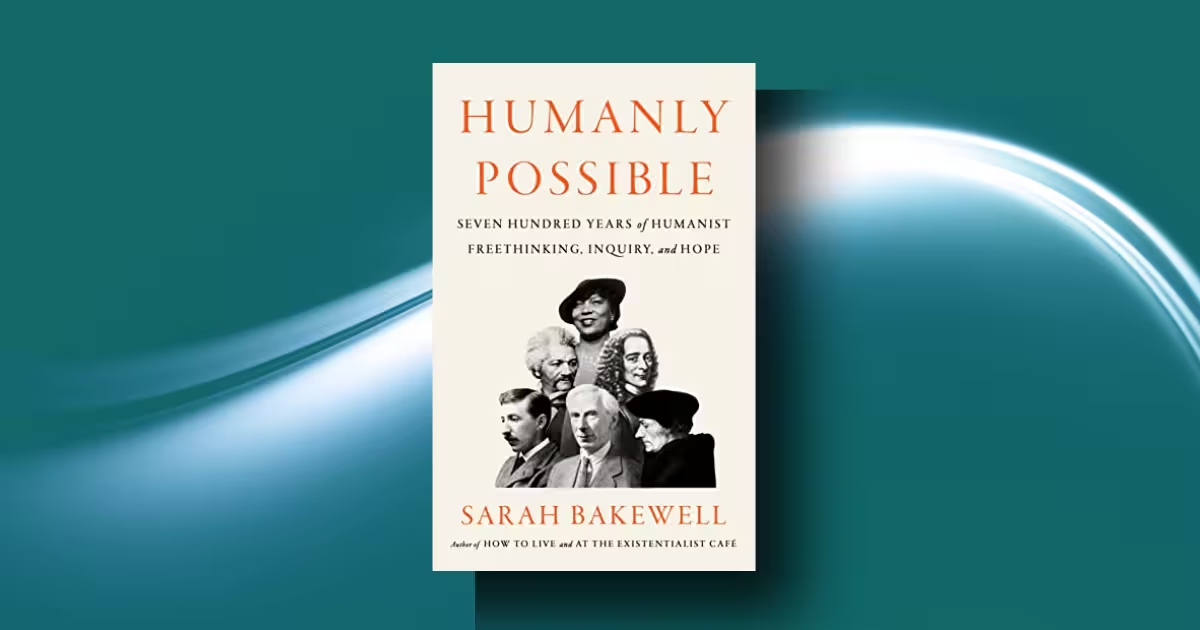
Why do we constantly search for meaning in a world that often feels overwhelmingly chaotic? Does the answer lie in some divine blueprint, or is it hidden right here within our own messy, beautiful, and profoundly human connections? Humanly Possible by Sarah Bakewell investigate the answers to the questions in a brilliant way.
Humanly Possible is best for History buffs, philosophy enthusiasts, and freethinkers looking for a comprehensive, uplifting, and beautifully narrated journey through 700 years of human-centered thought.
Not for readers seeking rigid theological dogmas, those who prefer strict chronological textbooks without personal narrative flair, or anyone uncomfortable with questioning established traditions and authority.
Table of Contents
1. Introduction
Humanly Possible: Seven Hundred Years of Humanist Freethinking, Inquiry, and Hope is a masterful and sweeping intellectual history by the award-winning author Sarah Bakewell, published by Penguin Press in 2023.
Context: Bakewell, a lifelong humanist and acclaimed biographer, takes us on an intellectual adventure through the evolution of humanism. Bakewell’s book operates on this exact frequency, capturing the essence of what it means to place shared humanity, cultural vibrancy, and moral responsibility at the center of our lives.
Purpose: The central thesis of Humanly Possible is that humanism is a coherent, shared tradition driven by three perennial principles: freethinking, inquiry, and hope.
Bakewell seeks to prove that, despite the horrors and anti-humanist movements of history, the humanist focus on earthly well-being, empathy, and social connection remains our most vital and resilient framework for living a good life.
2. Humanly Possible Summary
The book begins with a deceptively simple question: “What is humanism?”. Bakewell illustrates that humanism is a semantic cloud of meanings, yet it is held together by a focus on the “human dimension” of life—a realm of culture, ethics, and art that exists between the purely physical and the divine. She grounds her narrative in the ancient Greek philosopher Protagoras’s bold assertion that “Man is the measure of all things”.
Throughout the book, she contrasts this humanist optimism with “anti-humanism”—the tendency to emphasize human misery, original sin, or the subjugation of the individual to totalitarian states and ideologies.
Bakewell’s chronological journey properly kicks off in the 1300s, against the grim backdrop of the Black Death.
Here, we meet Petrarch and Giovanni Boccaccio, who pioneered the studia humanitatis (human studies). Petrarch, an obsessive manuscript hunter, retrieved works by Cicero and Virgil, essentially reviving classical eloquence to offer moral comfort during an era of unimaginable loss and grief. Boccaccio, famous for The Decameron, celebrated earthly pleasures, human psychology, and intellectual connections, famously asserting that the arts and sciences should not be repressed by religious fear.
Together, they built a bulwark against the “sleep of forgetfulness,” hoping their descendants would emerge into a “pure radiance” of intellectual rebirth.
Moving into the 1400s and 1500s, Bakewell introduces us to brilliant provocateurs like Lorenzo Valla. Valla used cutting-edge philology and historical reasoning to expose the Donation of Constantine as an eighth-century forgery, daringly undermining the Catholic Church’s absolute territorial claims over Western Europe.
Valla epitomizes the humanist commitment to critical inquiry over blind obedience. During this era, the printing press revolutionized the spread of humanist thought.
Figures like Aldus Manutius popularized portable, beautifully designed books with clear italic fonts, accelerating the democratization of knowledge and freeing texts from their monastic prisons.
Bakewell devotes significant space to the prolific northern humanist Desiderius Erasmus, who sought to harmonize intellectual inquiry with civilized, peaceful living.
Erasmus loathed the cruelty of medieval schooling and advocated for an education that nurtured humanitas—good manners, abundant learning, and “friendship among many”.
He was a fierce opponent of war and fanaticism, preferring moderation and tolerance over the violent dogmatism of his contemporaries.
We then transition to Michel de Montaigne, who practically invented the personal essay (essais, or “tryouts”) as a tool for exploring the chaotic, diverse reality of the human condition.
Montaigne famously trashed humanistic pieties, claiming that he only read books to enhance life, not to blindly worship classical authorities.
He embraced human fallibility and diversity, recognizing that all humans share an essential nature that binds us in profound empathy.
As the narrative enters the Enlightenment of the 18th century, the focus shifts to “meliorism”—the belief that human effort can actually improve the world and alleviate suffering. Voltaire is a central figure here.
Following the catastrophic Lisbon earthquake of 1755, Voltaire brutally mocked the religious “optimism” which claimed that whatever happens is God’s will and therefore “right”. In Candide, he championed a pragmatic humanism: we must focus on fixing earthly problems and “cultivate our garden”.
This era also saw the rise of deism and atheism, with thinkers like David Hume arguing that morality does not require religion; it naturally springs from human “sympathy” and fellow feeling.
The 19th and 20th centuries presented monumental challenges to humanism. Charles Darwin’s theory of evolution firmly placed humanity within the animal kingdom, stripping away our divine pedestal but reinforcing our interconnectedness with nature.
Thinkers like T. H. Huxley championed “scientific humanism,” arguing that education must be rooted in scientific inquiry and rational observation.
Meanwhile, figures like John Stuart Mill and Harriet Taylor Mill fought for political liberalism, women’s rights, and the freedom of individuals to pursue their “largest and highest” sphere without state interference.
However, the 20th century also birthed the most horrific anti-humanist movements in history: fascism, Nazism, and totalitarian communism, which sought to mold humans into mere instruments of the state.
Bakewell poignantly chronicles the despair of humanists like Stefan Zweig and Thomas Mann, who watched civilized values crumble into barbarism.
Yet, even in the darkest times, the humanist spirit survived through acts of resistance and preservation, such as the daring rescue of the Warburg Library and the smuggling of Vasily Grossman’s masterpiece Life and Fate out of the Soviet Union.
Ultimately, the book reveals that humanism is a continuous “work in progress”.
It is not a static dogma but a resilient, adaptable craft.
From the drafting of the Universal Declaration of Human Rights in 1948 (heavily influenced by humanist and Confucian ethics) to the modern manifestos of Humanists International, Bakewell concludes that our best hope for the future lies in embracing our shared humanity, protecting our earthly environment, and making the rational choice to pursue happiness here and now.
3. Humanly Possible Analysis
Humanly Possible is an outstanding, poignant, and marvelously constructed achievement.
She does not merely recount history; she breathes vibrant life into it. Reading her book feels like sitting in a sunlit room with the brightest, most empathetic minds of the last seven centuries.
Her prose is clear-eyed, deeply moving, and entirely devoid of the dry academic dust that often plagues historical texts. It is an intoxicating celebration of the human spirit.
Bakewell supports her arguments with an overwhelming, yet highly accessible, array of evidence.
Her use of primary sources, letters, and historical anecdotes—from Poggio Bracciolini’s thrilling manuscript hunts in monastic dungeons to Frederick Douglass’s fierce Ciceronian oratory against the horrors of slavery—creates a logically impenetrable case for the enduring power of humanist thought.
The book undeniably fulfills its stated purpose: it defines a notoriously “foggy” concept by mapping the tangible, lived experiences of the people who championed it.
Bakewell brilliantly illustrates that humanism isn’t just an abstract philosophy; it is an active, ongoing effort to alleviate suffering and promote joy
4. Strengths and Weaknesses
Strengths: The absolute greatest strength of Humanly Possible is its warmth and narrative pacing. Bakewell weaves together biography, philosophy, and history seamlessly.
Her inclusion of figures often overlooked in traditional Western histories—such as the 14th-century feminist Christine de Pizan and the idealistic creator of Esperanto, Ludwik Zamenhof—adds vital depth and diversity to the narrative.
Her balanced tone, acknowledging both the triumphs of humanists and their occasional hypocrisies (like Hume’s inexcusable racial prejudices), makes her an incredibly trustworthy guide.
Weaknesses: If I must point out a shortcoming, it is that the sheer volume of characters occasionally threatens to overwhelm the reader. In covering 700 years in roughly 400 pages, some profound philosophical transitions feel slightly rushed.
Furthermore, while she does mention Eastern philosophies like Confucianism (and the concept of ren), the book remains heavily Eurocentric in its focus. A deeper dive into non-Western humanist traditions would have made this already stellar work truly universal.
5. Comparison with Similar Works
Humanly Possible sits comfortably alongside Stephen Greenblatt’s The Swerve: How the World Became Modern, which also chronicles the thrilling rediscovery of classical texts (specifically Lucretius) that birthed the Renaissance.
However, Bakewell’s scope is much broader, tracking the philosophical lineage all the way through the Enlightenment and into the 21st century.
It also acts as a spiritual successor to her own previous works, How to Live (about Montaigne) and At the Existentialist Café, but Humanly Possible feels far more expansive, serving as a grand synthesis of her entire career’s focus on human-centric philosophy.
6. Conclusion
I cannot recommend Humanly Possible highly enough.
It is exceptionally well-suited for general audiences who want to understand the intellectual foundations of the modern secular world, as well as for specialists looking for a beautifully synthesized narrative of history.
If you have ever felt a deep sense of moral duty despite lacking religious conviction, or if you simply believe that human connection, intellectual inquiry, and compassion are our best tools for survival, this book will feel like a homecoming.
It is a vital, necessary read for our deeply divided times.







