
Last updated on May 22nd, 2026 at 10:41 am
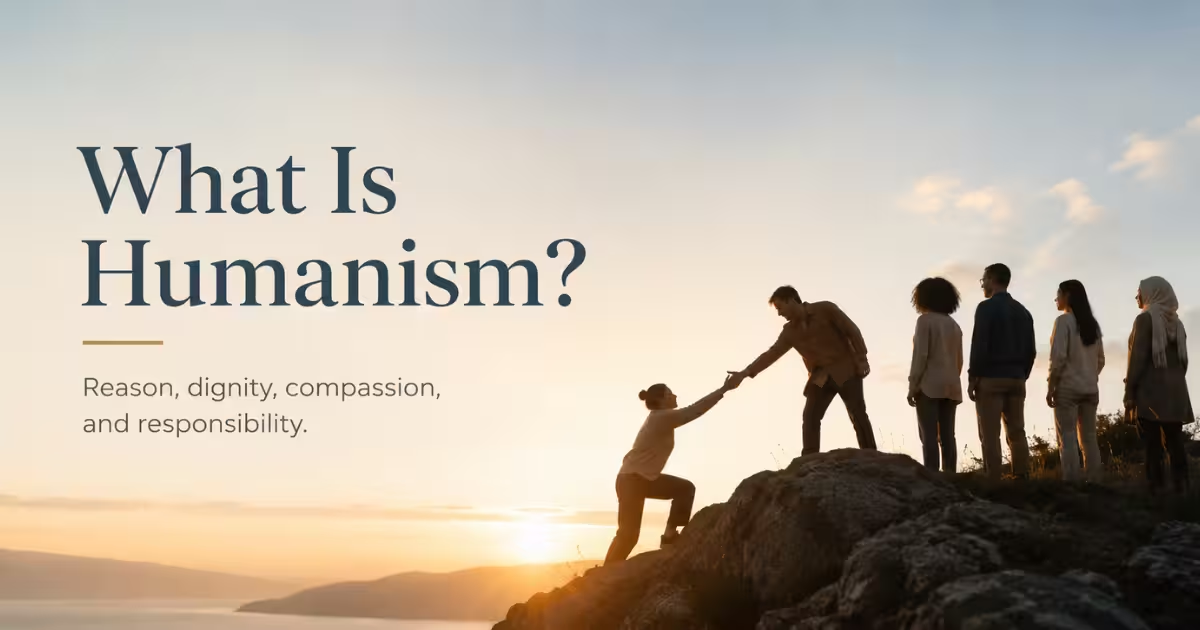
What is humanism? Humanism is a way of thinking and living that puts human dignity, reason, compassion, and responsibility at the center of life. Instead of relying on supernatural authority, humanism asks how people can create meaning, make ethical choices, and build a better world through evidence, empathy, freedom of thought, and concern for human welfare.
Humanism is a worldview that places human dignity, reason, compassion, freedom, and responsibility at the center of life. It asks a practical question: how can human beings live meaningful, ethical, and fulfilling lives using reason, evidence, empathy, and shared human values rather than relying on supernatural authority?
Modern humanist organizations describe humanism as an ethical life stance grounded in human welfare, critical inquiry, and concern for the common good. The American Humanist Association defines humanism as a philosophy that affirms people’s ability and responsibility to lead ethical lives that contribute to humanity’s greater good.
Humanists International’s 2022 Amsterdam Declaration presents modern humanism as a developing, non-dogmatic worldview rooted in reason, ethics, human rights, and global responsibility.
Humanism matters today because the world is facing problems that require human judgment: artificial intelligence, climate change, political polarization, religious conflict, inequality, loneliness, and the search for meaning in increasingly secular societies.
Table of Contents
What Does Humanism Mean?
Humanism is not a single church, party, or rigid doctrine. It is better understood as a broad tradition of thought that asks human beings to take responsibility for truth, ethics, justice, and meaning.
At its core, humanism usually includes five ideas:
- Human dignity matters. Every person deserves respect.
- Reason and evidence matter. Beliefs should be open to questioning.
- Ethics can be human-centered. People can be moral without appealing to divine command.
- Freedom of conscience matters. Individuals should be free to think, doubt, believe, or not believe.
- We are responsible for one another. Human problems require human compassion and action.
Historically, the term “humanism” has several meanings.
Britannica notes that Renaissance humanism began as a system of education and inquiry in northern Italy during the 13th and 14th centuries and later spread across Europe. It emphasized classical learning, moral philosophy, rhetoric, history, human dignity, and active civic life.
In modern usage, humanism often refers to a human-centered ethical worldview rather than only a Renaissance educational movement.
Is Humanism the Same as Atheism?
No. Atheism is mainly about belief in God; humanism is about how to live.
An atheist does not believe in a god.
A humanist may also be an atheist or agnostic, but humanism adds a positive ethical framework: how to seek truth, build meaning, treat others, support freedom, and improve society.
This distinction matters.
Humanism is not merely a rejection of religion. It is a constructive philosophy of life. It asks what humans can do with the life we have, the knowledge we can test, and the moral responsibilities we share.
The Main Principles of Humanism
1. Reason and critical thinking
Humanism values reason because human beings are fallible. We make mistakes, inherit prejudices, and often believe things because they are familiar rather than true. Humanism encourages skepticism, debate, science, and self-correction.
This does not mean humanists think humans are perfectly rational. It means they believe reasoned inquiry is one of our best tools for reducing error.
2. Ethics without supernaturalism
Humanism argues that morality can be grounded in human experience: suffering, flourishing, freedom, fairness, empathy, and the consequences of our actions.
A humanist does not need to believe that morality comes from outside the human world. Instead, morality emerges from the needs and dignity of conscious beings who can be harmed, helped, oppressed, educated, loved, or ignored.
3. Human dignity and rights
Humanism strongly overlaps with the modern language of human rights. The Universal Declaration of Human Rights, proclaimed by the UN General Assembly in 1948, presents human rights as a common standard for all peoples and nations.
Humanism supports this kind of universal moral concern: not because people belong to one religion, nation, race, or tribe, but because they are human.
4. Freedom of thought and conscience
Humanism depends on the freedom to think openly. That includes the freedom to question tradition, criticize power, change one’s beliefs, or live without religious belief.
This is not only a philosophical issue.
Humanists International’s Freedom of Thought Report examines discrimination and persecution against humanists, atheists, and the non-religious around the world.
Its 2025 report states that it studies how non-religious people are treated because of their lack of religion or absence of belief in a god, including legal discrimination, restrictions on expression, and violations of freedom of thought.
5. Meaning in this life
Humanism says meaning is not something we must wait for or receive from beyond the world.
Meaning can be created through love, knowledge, work, creativity, service, friendship, beauty, justice, and care for future generations.
This is one reason humanism remains attractive to many people today. It does not deny grief, death, or uncertainty. It asks how we can live well despite them.
Why Does Humanism Matter Today?
Humanism matters because more people are asking non-religious questions about meaning
In the United States, Pew Research Center’s 2023–24 Religious Landscape Study reports that 29% of U.S. adults identify as religiously unaffiliated.
This does not mean all of them are humanists, atheists, or anti-religious. It does mean many people are looking for language, community, and moral frameworks outside traditional religious identity.
Humanism offers one possible answer: a life of meaning based on reason, compassion, responsibility, and human connection.
Humanism matters because technology needs ethics
Artificial intelligence, biotechnology, surveillance, automation, and digital platforms raise urgent questions: What should be automated? Who is accountable when systems harm people? How do we protect dignity, privacy, fairness, and human agency?
UNESCO’s Recommendation on the Ethics of Artificial Intelligence identifies human rights and dignity as central to AI ethics and emphasizes transparency, fairness, and human oversight.
That is deeply compatible with a humanist approach: technology should serve human flourishing, not reduce people to data points, consumers, or tools.
Humanism matters because democracy needs citizens, not spectators
Humanism is not only private self-improvement. Renaissance humanism emphasized active civic life, and modern humanism continues that concern.
Britannica describes the older ideal of humanitas as involving not only compassion and understanding but also judgment, prudence, eloquence, and active participation in public life.
Today, democracies need citizens who can reason, listen, disagree, evaluate evidence, resist propaganda, and defend the dignity of people outside their own group. Humanism trains attention toward those habits.
Humanism matters because plural societies need shared ethics
Modern societies contain believers, atheists, agnostics, spiritual seekers, skeptics, and people who do not fit clean labels. A plural society cannot depend on everyone accepting the same theology.
Humanism helps by offering a shared ethical language: dignity, evidence, freedom, fairness, compassion, and responsibility.
Religious people can agree with many of these values, even if they ground them differently. Non-religious people can embrace them without pretending to hold beliefs they do not hold.
Humanism matters because it resists dehumanization
Many political and cultural conflicts begin by shrinking people into categories: enemy, foreigner, heretic, consumer, statistic, criminal, demographic, or algorithmic profile.
Humanism pushes in the opposite direction. It insists that persons are not abstractions. They are conscious, vulnerable, social beings whose lives matter.
Common Misunderstandings About Humanism
1. “Humanism means humans are perfect.”
No. Humanism does not claim humans are perfect. In fact, humanism takes human error seriously. That is why it values criticism, evidence, education, and democratic accountability.
2. “Humanism means science can answer every question.”
No. Science is essential for understanding the natural world, but human life also involves meaning, art, love, grief, interpretation, and moral judgment. Humanism respects science without reducing life to laboratory data.
3. “Humanism is anti-religion.”
Not necessarily. Humanism rejects supernatural authority as the foundation for ethics, but many humanists defend freedom of religion as part of freedom of conscience. A humanist society should protect both believers and non-believers.
4. “Humanism is selfish because it focuses on humans.”
This is a weak reading of humanism. Humanism focuses on human responsibility, not human arrogance. A serious humanist ethic includes concern for animals, ecosystems, future generations, and the conditions that make life possible.
Humanism in Everyday Life
Humanism is not only a theory. It can shape ordinary decisions.
A humanist approach to life might ask:
- Is this belief supported by evidence?
- Does this action reduce harm or increase well-being?
- Am I treating this person as fully human?
- What are the consequences of my choices?
- Am I willing to revise my view if better evidence appears?
- What kind of world am I helping to build?
In that sense, humanism is practical. It is about how to think, how to live, and how to act when no perfect authority can remove the burden of responsibility.
A Simple Definition of Humanism
Humanism is a reason-based and compassion-centered approach to life that affirms human dignity, seeks truth through inquiry, grounds ethics in human welfare, and calls people to build meaning and justice in this world.
It matters today because the future will not be decided only by machines, markets, governments, or traditions. It will be shaped by human choices. Humanism reminds us that those choices should be guided by dignity, evidence, empathy, and responsibility.
Best Books on Humanism
These are the strongest books to read or cite for this topic, selected for clarity, credibility, historical range, and relevance to modern readers.
1. Understanding Humanism by Andrew Copson, Luke Donnellan, and Richard Norman
Best for: A clear, systematic introduction to modern humanism
Routledge describes this book as an accessible overview of humanist beliefs, practices, and values as a non-religious worldview. It covers humanism as both a historical tradition and a lived contemporary stance. (Routledge)
2. Humanism: A Very Short Introduction by Stephen Law
Best for: Beginners who want a concise philosophical overview
Stephen Law’s book explains humanism, science, reason, moral responsibility, secular society, and the claim that life can have meaning without religion.
3. The Little Book of Humanism by Alice Roberts and Andrew Copson
Best for: Accessible inspiration, quotations, and everyday reflection
This book presents humanist wisdom through stories, quotations, meditations, and reflections on ethical and fulfilling life grounded in reason and humanity. (Hachette UK)
4. Humanism: A Beginner’s Guide by Peter Cave
Best for: Readers who want humanism connected to ethics, politics, climate, pandemics, and technology
The updated edition explores humanism through religious belief, ethics, politics, climate emergency, global pandemics, and technological change.
5. What Is Humanism For? by Richard Norman
Best for: Understanding humanism’s role in a secular age
Published by Bristol University Press in 2025, this short book asks what humanism is for in a world where religious belief is declining but people still seek purpose and guidance.
6. Humanly Possible: Seven Hundred Years of Humanist Freethinking, Inquiry, and Hope by Sarah Bakewell
Best for: A rich historical narrative of humanist thinkers
Sarah Bakewell’s book traces 700 years of humanist freethinking, inquiry, and hope, introducing readers to writers, scientists, artists, and philosophers who tried to understand what it means to be human.
7. The Philosophy of Humanism by Corliss Lamont
Best for: A classic statement of secular humanist philosophy
Humanist Press describes Lamont’s book as a positive account of humanism that draws from philosophers and scientists to explain how humanism fits into a broader worldview.
8. Humanism and Democratic Criticism by Edward W. Said
Best for: Humanism, democracy, literature, and public intellectual life
Edward Said argues for a democratic form of humanism that is self-critical, culturally expansive, and publicly engaged.
Columbia University Press describes the book as a defense of humanistic education and democratic ideals in an interdependent world.
FAQ: Humanism
1. What is humanism in simple words?
Humanism is the belief that human beings can live ethical, meaningful lives using reason, compassion, evidence, and responsibility.
2. Do humanists believe in God?
Many humanists are atheists or agnostics, but humanism is not only about disbelief in God. It is mainly about living ethically and meaningfully without relying on supernatural authority.
3. What are the main values of humanism?
The main values of humanism include dignity, reason, compassion, freedom of conscience, equality, responsibility, and concern for human welfare.
4. Why is humanism important today?
Humanism is important today because modern societies need shared ethical principles for technology, democracy, human rights, pluralism, and the search for meaning beyond traditional religious structures.
5. Is humanism against religion?
Humanism is not necessarily hostile to religion. It rejects supernatural authority as the basis for ethics, but it can still defend freedom of religion, freedom of belief, and freedom of conscience.
5. Can humanism give life meaning?
Yes. Humanism argues that meaning can come from relationships, creativity, knowledge, service, justice, love, and the effort to improve life for others.







