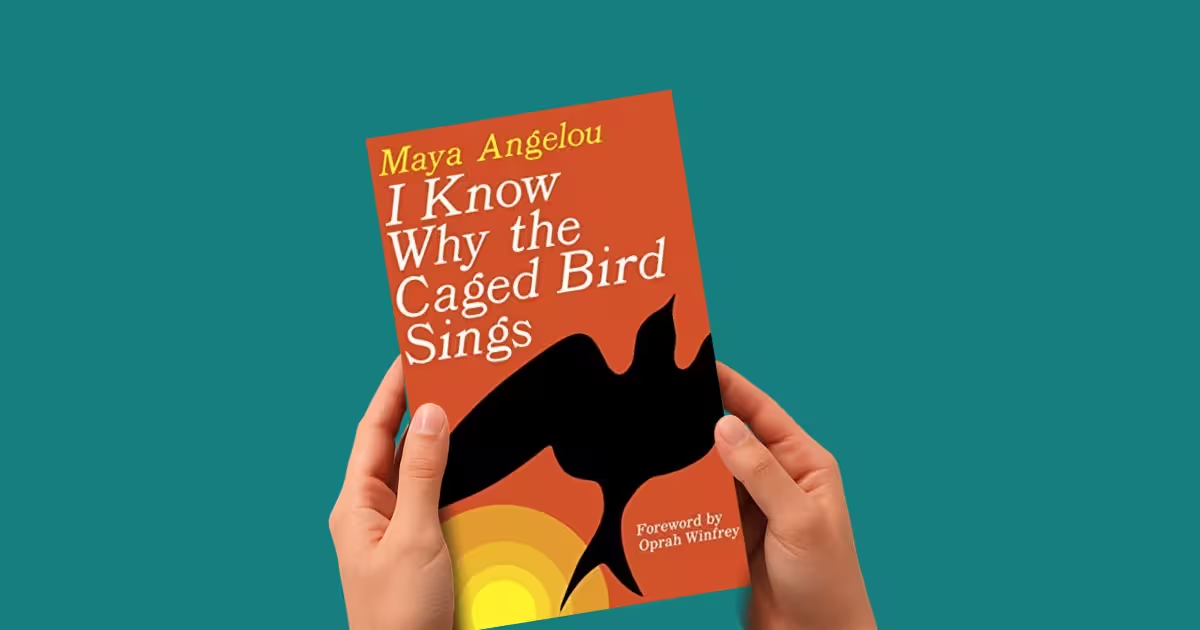

What makes a young Black girl who stops speaking for nearly a year grow up to become one of the most powerful voices in American literature? This question sits at the heart of Maya Angelou’s extraordinary memoir, I Know Why the Caged Bird Sings. It’s a question I found myself asking again and again as I turned each page—and it’s precisely why this book still matters, fifty-five years after its first publication.
I Know Why the Caged Bird Sings is Maya Angelou’s unflinching autobiography of her childhood and teenage years—from being sent to live with her grandmother in the segregated South at age three, through surviving rape at eight and choosing silence as survival, to becoming a teenage mother at sixteen.
It’s a story about how literature, family love, and fierce determination can help a person rise above racism, trauma, and displacement to find their own voice.
Best For / Not For
| Best For | Not For |
|---|---|
| Readers who appreciate raw, honest memoirs about overcoming adversity | Those seeking a light, uplifting read without difficult subject matter |
| Anyone interested in American civil rights history from a personal perspective | Readers triggered by detailed accounts of child sexual abuse |
| Students of literature wanting to understand autobiographical fiction | People who prefer neatly structured, linear narratives (the book is episodic) |
| Fans of Toni Morrison, James Baldwin, or Alice Walker | Those uncomfortable with frank discussions of racism and sexuality |
| Anyone who believes in the redemptive power of words and storytelling | Readers who struggle with non-chronological, memory-driven narratives |
Table of Contents
Introduction
Maya Angelou’s I Know Why the Caged Bird Sings first appeared in 1969, published by Random House. It was the first of seven autobiographies Angelou would write, chronicling her life from early childhood to adulthood.
The book became an instant phenomenon—it spent two years on the New York Times bestseller list and was nominated for the National Book Award.
The title comes from Paul Laurence Dunbar’s poem “Sympathy,” which Angelou uses as an epigraph. That choice says everything about what this book tries to do: show how the caged bird—the oppressed, the silenced, the marginalized—still finds a way to sing.
Angelou wrote the book at the urging of her friend James Baldwin and editor Robert Loomis, who challenged her to write an autobiography that was also a work of literature. She succeeded beyond anyone’s expectations. The book doesn’t just recount events; it transforms memory into art.
Background
To understand Caged Bird, you need to understand the world Angelou grew up in. The book covers roughly 1930 to 1945—the Great Depression through World War II. This was the era of Jim Crow in the American South, where segregation wasn’t just law but a brutal, everyday reality.
Stamps, Arkansas, where Angelou spent most of her childhood, was a small town where “the segregation was so complete that most Black children didn’t really, absolutely know what whites looked like”.
The Southern Black experience Angelou describes was shaped by poverty, violence, and the constant threat of white supremacy. Yet she also shows the rich community life, the deep religious faith, and the fierce dignity that sustained Black families through these years.
The book emerged at a pivotal moment—1969, just after the height of the Civil Rights Movement and the assassinations of Martin Luther King Jr. and Malcolm X. Angelou, who had worked with Dr. King as the Northern Coordinator for the Southern Christian Leadership Conference, was writing not just her personal story but a collective story of Black survival and resistance.
I Know Why the Caged Bird Sings Summary
Part One: Stamps, Arkansas (Age 3 to 8)
I Know Why the Caged Bird Sings opens with three-year-old Marguerite Johnson (Maya) and her four-year-old brother Bailey Jr. arriving in Stamps, Arkansas, wearing tags on their wrists that read “To Whom It May Concern”. Their parents’ marriage had fallen apart, and their father shipped them to live with their grandmother, Annie Henderson.
Momma—as they soon call her—runs the only Black-owned general merchandise store in town. She’s a formidable woman: tall, strong, deeply religious, and fiercely independent. She had built her business from a mobile lunch stand serving sawmen and seedmen, eventually constructing a store in the heart of the Negro area.
Life in Stamps follows a rhythm of work, church, and survival. The children help in the store, learn their times tables with Uncle Willie (Momma’s crippled son), and navigate the complex social codes of the segregated South.
A key early moment comes when the “powhitetrash” children taunt Momma on her porch. They mock her, do handstands to expose themselves, and call her by her first name—yet Momma hums hymns and refuses to show anger.
Maya, watching from behind the screen door, is furious and confused. But later she understands that Momma had won the contest through dignity and restraint.
Uncle Willie, crippled from a childhood accident, represents another layer of struggle. He’s proud, sensitive, and forced to endure the world’s contempt for his disability.
When white strangers visit the store, he stands erect and hides his cane, pretending he isn’t lame. Maya understands his need to escape, even briefly, the prison of his body.
The First White Love and the First Awakening
During these years, Maya discovers literature. She falls in love with William Shakespeare—”my first white love”. She also memorizes poetry by Paul Laurence Dunbar, Langston Hughes, and James Weldon Johnson. Books become her refuge and her window to a larger world.
She also discovers the joy of friendship with Louise Kendricks, a girl who becomes “my first friend”. Together they invent secret languages, share confidences, and challenge the unknown. These moments of connection are precious in a world otherwise defined by separation—from white society, from their absent parents, and even from each other.
Part Two: St. Louis (Age 8 to 9)
Momma sends Maya and Bailey to St. Louis to live with their mother, Vivian Baxter. This is Maya’s first encounter with her beautiful, glamorous mother—a woman so stunning that Maya is “struck dumb” and immediately understands “why she had sent me away. She was too beautiful to have children”.
But St. Louis brings tragedy. Vivian’s boyfriend, Mr. Freeman, sexually abuses Maya. The first time, he holds her and she feels “at home”—she even thinks he might be her real father. But the second time, he rapes her. Eight years old, terrified, Maya is threatened: “If you tell, I’m gonna kill Bailey”.
When Maya finally does tell—after Bailey discovers her bloody underwear—Mr. Freeman is arrested. In court, Maya lies on the witness stand, saying the assault had never happened before. Mr. Freeman is given a light sentence and released. He’s found dead shortly afterward, kicked to death, presumably by Maya’s uncles.
Maya believes her lie killed him. She stops speaking. “I had sold myself to the Devil and there could be no escape,” she writes. “The only thing I could do was to stop talking to people other than Bailey”.
Part Three: Return to Stamps (Age 9 to 13)
Maya and Bailey return to Stamps. Maya remains silent for nearly a year. She retreats into books, convinced that her words might “poison people”.
Her salvation comes through Mrs. Bertha Flowers, the “aristocrat of Black Stamps”. Mrs. Flowers invites Maya to her home, gives her tea cookies, and reads to her from A Tale of Two Cities. She tells Maya: “Words mean more than what is set down on paper. It takes the human voice to infuse them with the shades of deeper meaning”. Through Mrs. Flowers, Maya begins to speak again—and to understand the power of language.
Growing Up in Stamps
The next few chapters show Maya navigating adolescence in Stamps. The Joe Louis fight in 1936 becomes a moment of collective Black pride—when Louis defeats a white contender, “My race groaned. It was our people falling… This might be the end of the world”. When Louis wins, the relief is overwhelming: “Champion of the world. A Black boy. Some Black mother’s son”.
Maya graduates from eighth grade, wearing a butter-yellow dress her grandmother made.
But the ceremony is ruined when a white speaker, Mr. Donleavy, praises the new microscopes and art teachers for the white school while telling the Black students they’ll become “Jesse Owenses and Joe Louises”. Maya feels the weight of her race as an unbearable burden: “It was awful to be Negro and have no control over my life”.
But then Henry Reed leads the audience in the Negro National Anthem—”Lift Ev’ry Voice and Sing”—and Maya understands for the first time what it means to be part of “the wonderful, beautiful Negro race”.
Part Four: California (Age 13 to 16)
Momma decides to take Maya and Bailey to California. They live first in Los Angeles, then San Francisco. Bailey, now a teenager, falls in love with a girl named Joyce, who eventually leaves with a railroad porter. He takes up with a white prostitute and becomes increasingly estranged from his mother.
Their relationship explodes when Bailey defies Vivian’s curfew. He moves out, vowing never to return. Vivian, despite her anger, helps him get a job on the railroad. The Oedipal tension between mother and son is heartbreaking—they can’t live with or without each other.
Mexico and After
Maya spends a disastrous summer with her father in southern California. His girlfriend Dolores resents her. When Dolores calls Vivian a whore, Maya slaps her, and Dolores cuts Maya with a hammer.
Maya runs away and spends a month living in a junkyard with a group of homeless teenagers. This experience, oddly, gives her a sense of belonging she’d never had. “The unquestioning acceptance by my peers had dislodged the familiar insecurity”.
Pregnancy and Motherhood
Returning to San Francisco, Maya becomes pregnant at sixteen through an awkward, unromantic sexual encounter. She hides her pregnancy for eight months, graduating from high school just before giving birth.
Her son is born. “I had a baby. He was beautiful and mine. Totally mine”. I Know Why the Caged Bird Sings ends with Maya sleeping with her newborn son beside her, learning that “if you’re for the right thing, then you do it without thinking”.
I Know Why the Caged Bird Sings Analysis
Character Analysis
Marguerite Johnson (Maya)
Maya is the book’s protagonist and narrator—Angelou’s younger self. She begins as a shy, insecure child who feels ugly and unwanted. “Wouldn’t they be surprised when one day I woke out of my black ugly dream, and my real hair, which was long and blond, would take the place of the kinky mass”.
She believes she’s really white, cursed by a cruel fairy stepmother.
Her transformation is the book’s central arc. She moves from silence to voice, from self-hatred to self-acceptance, from victim to survivor. The rape is the turning point—not because it breaks her, but because it forces her to confront the world’s cruelty. Her silence becomes a form of resistance, and her eventual speech becomes a declaration of power.
Bailey Johnson Jr.
Bailey is Maya’s older brother and “the greatest person in my world”. He’s charming, clever, and protective of Maya. When adults insult her appearance, Bailey exacts revenge with sly wit. He’s her anchor in a chaotic world.
But Bailey also struggles. His love for their mother, Vivian, is almost Oedipal in intensity. He can’t compete with her glamorous men, so he tries to become a man himself—too fast, too young. His departure from home is painful but inevitable. He represents the difficulty of growing up Black and male in a world that offers few paths to dignity.
Momma (Annie Henderson)
Momma is the moral center of I Know Why the Caged Bird Sings. She’s strict, religious, and practical—but also loving in her own undemonstrative way. She teaches Maya to work hard, to be clean, and to “keep your legs closed”.
Her confrontation with the powhitetrash children is a masterclass in dignity. She refuses to give them the satisfaction of seeing her angry. Later, when a white dentist refuses to treat Maya, Momma intimidates him into paying her back and banishes him from Stamps.
She’s formidable—and she’s also the source of Maya’s survival instinct.
Vivian Baxter
Maya’s mother is beautiful, glamorous, and fiercely independent. She’s a nurse who prefers gambling to nursing, a woman who shoots a business partner who disrespects her. She’s also surprisingly supportive: when Maya wants to become a streetcar conductor, Vivian says, “Can’t do is like Don’t Care. Neither of them have a home”.
Vivian’s relationship with Maya is complex. She’s not a traditional mother—she’s too busy living her own life. But she’s also the one who teaches Maya about self-reliance and courage. Her aphorisms (“Life is going to give you just what you put in it”) become Maya’s guiding philosophy.
Mr. Freeman
The rapist is a minor character who appears in only a few chapters. Yet he haunts the entire book. Maya’s initial pity for him (“I felt very sorry for Mr. Freeman”) gives way to terror and then to guilt. His death, which she believes she caused, sends her into silence.
Mr. Freeman represents the predatory adult world that children can’t understand. He’s also a reminder that abuse often comes from within the community, not just from outside.
Mrs. Bertha Flowers
Mrs. Flowers is the “aristocrat of Black Stamps”. She’s refined, educated, and elegant—everything Maya aspires to be. She’s also the one who rescues Maya from silence by introducing her to the power of literature and voice.
She tells Maya: “Language is man’s way of communicating with his fellow man and it is language alone which separates him from the lower animals”. This lesson—that words are what make us human—becomes Maya’s salvation.
I Know Why the Caged Bird Sings Themes
The Caged Bird
The title’s metaphor comes from Paul Laurence Dunbar’s poem. The caged bird sings “with a fearful trill” of “things unknown, but longed for still”. It sings not because it’s happy but because it’s trapped—and singing is the only freedom available.
In I Know Why the Caged Bird Sings, Maya is the caged bird. She’s trapped by racism, poverty, and trauma. But she finds a way to sing—through literature, through voice, through storytelling. The song becomes her survival.
Racism and Displacement
Racism isn’t just a backdrop in I Know Why the Caged Bird Sings—it’s a daily reality that shapes every aspect of Maya’s life. She grows up “aware of her displacement”, understanding that she’s not supposed to exist in the spaces white people occupy.
The book shows racism’s subtle cruelties: the white children who mock Momma, the dentist who refuses to treat Maya, the speaker who tells Black students they’ll only ever be athletes. But it also shows Black resilience: the community that gathers for Joe Louis’s fight, the church that offers spiritual sustenance, the family that refuses to be broken.
Silence and Voice
After the rape, Maya stops speaking for nearly a year. Silence becomes her refuge—but also her prison. She learns that “to achieve perfect personal silence all I had to do was to attach myself leechlike to sound”.
Her eventual return to speech, prompted by Mrs. Flowers, is a rebirth. She learns that words have power—not just to communicate but to heal. This theme echoes throughout Angelou’s later work: the belief that storytelling is a form of resistance and survival.
The Power of Literature
Books save Maya. She falls in love with Shakespeare, Dickens, and Poe. She memorizes poetry and recites it to herself. Literature gives her a world beyond Stamps, beyond racism, beyond her own pain.
As an adult, Angelou became a writer because she understood that words could change lives. The book itself is proof: by telling her story, she gave voice to countless others who had been silenced.
Family and Community
Despite the dysfunction—absent parents, traumatic abuse, bitter arguments—family is what sustains Maya. Momma’s love, Bailey’s protection, even Vivian’s fierce independence—all contribute to her survival.
The Black community in Stamps is also a source of strength. The church, the store, the shared rituals of life—these create a sense of belonging that white society denies. Maya learns that she’s part of something larger than herself.
I Know Why the Caged Bird Sings Evaluation
This is a masterpiece. I don’t say that lightly. I Know Why the Caged Bird Sings is one of those rare books that changes how you see the world. It’s raw, unflinching, and deeply human. Angelou writes with such clarity and honesty that you feel you’re living inside her skin.
Strengths
The voice. Angelou’s prose is extraordinary—poetic without being precious, direct without being flat. She captures the confusion of childhood, the pain of trauma, and the joy of survival with equal precision. A passage like “If growing up is painful for the Southern Black girl, being aware of her displacement is the rust on the razor that threatens the throat” is both devastating and beautiful.
The honesty. Angelou doesn’t spare herself. She shows her own pettiness, her jealousy, her shame. She doesn’t romanticize poverty or victimhood. She tells the truth, even when it’s ugly.
The structure. The episodic format works perfectly for a memoir. Each chapter is a self-contained story that also advances the larger narrative. This makes the book accessible and memorable.
The humor. Despite the heavy subject matter, the book is often funny. Bailey’s imitations of Reverend Thomas, the “incident” with Sister Monroe in church, the absurdity of white racism—Angelou finds comedy in the midst of tragedy.
Weaknesses
The pacing in the middle. Some readers may find the Stamps sections repetitive. The episodic structure, while effective, sometimes feels like a collection of vignettes rather than a tightly plotted narrative.
The distance. Angelou writes about her younger self with remarkable detachment. This is both a strength and a weakness—it gives the book clarity but sometimes makes it hard to feel the immediacy of her pain.
Controversies
The book has been banned repeatedly since its publication. Critics have objected to its depictions of rape, sexual abuse, and racism. In 2024, it was removed from Iowa school libraries under a law requiring removal of books with “sex acts”. In 2025, it was among books purged from the U.S. Naval Academy library.
Angelou herself responded to these bans with characteristic wit. “Many times I’ve been called the most banned,” she said. The irony is that the book’s honesty about trauma is precisely what makes it valuable—especially for young readers.
Comparison with Similar Works
I Know Why the Caged Bird Sings belongs to the tradition of Black autobiography that includes Frederick Douglass’s Narrative, Richard Wright’s Black Boy, and James Baldwin’s Notes of a Native Son. But Angelou’s book is different: it’s written by a woman, about a girl’s experience, and it centers on sexual violence and the female body.
It also anticipates later memoirs like Alice Walker’s The Color Purple (which is fiction but shares similar themes) and Toni Morrison’s The Bluest Eye (which explores Black girlhood and self-hatred). Angelou’s influence on contemporary memoir—from Mary Karr to Roxane Gay—is undeniable.

Adaptation
The book was adapted into a made-for-TV film in 1979, directed by Fielder Cook and starring Constance Good as young Maya.
Angelou co-wrote the screenplay. The film aired on CBS and was filmed in Vicksburg, Mississippi.
The film takes some liberties with the source material.
It adds a scene between Maya and Uncle Willie after the Joe Louis fight, and changes the graduation scene so that Maya, not Henry Reed, leads the audience in the Negro National Anthem.
These changes reflect Angelou’s evolving vision of her own story.
Personal Insight with Contemporary Educational Relevance
Five Lessons from I Know Why the Caged Bird Sings
1. Silence can be survival—but voice is liberation. Maya stops speaking after her rape, believing her words might “poison people”. But she eventually learns that silence is its own kind of death. In an age of online harassment and social anxiety, this lesson is crucial: finding your voice is an act of courage, not aggression.
2. Literature saves lives. Maya’s love of Shakespeare, Dickens, and Dunbar gives her a world beyond Stamps. She reads to escape, to understand, to become someone else. In a time when reading is declining, this book reminds us why books matter.
3. Dignity is a form of resistance. When the powhitetrash children mock Momma, she doesn’t scream or fight. She hums hymns and waits them out. Maya later understands that Momma won the contest by refusing to engage on their terms. In a world that often demands performative outrage, this is a powerful lesson.
4. Trauma doesn’t define you. Maya is raped, silenced, and shamed. But she doesn’t stay broken. She becomes a mother, a writer, a civil rights activist. Her story is proof that pain can be transformed into purpose.
5. You can choose your family. Maya’s biological parents are absent or unreliable. But she finds family in Momma, Bailey, Mrs. Flowers, and eventually her own son. Family isn’t just blood—it’s who shows up.
I Know Why the Caged Bird Sings Quotes
“If growing up is painful for the Southern Black girl, being aware of her displacement is the rust on the razor that threatens the throat. It is an unnecessary insult.”
“I thought I had died—I woke up in a white-walled world, and it had to be heaven. But Mr. Freeman was there and he was washing me… ‘I didn’t mean to hurt you, Ritie. I didn’t mean it. But don’t you tell… Remember, don’t you tell a soul.'”
“I discovered that to achieve perfect personal silence all I had to do was to attach myself leechlike to sound. I began to listen to everything… After a minute or two, silence would rush into the room from its hiding place because I had eaten up all the sounds.”
“Words mean more than what is set down on paper. It takes the human voice to infuse them with the shades of deeper meaning.”
“It was awful to be Negro and have no control over my life. It was brutal to be young and already trained to sit quietly and listen to charges brought against my color with no chance of defense.”
“The caged bird sings with a fearful trill, of things unknown, but longed for still, and his tune is heard on the distant hill, for the caged bird sings of freedom.”
“Life is going to give you just what you put in it. Put your whole heart in everything you do, and pray, then you can wait.”
“If you’re for the right thing, then you do it without thinking.”
Conclusion
I Know Why the Caged Bird Sings is essential reading. It’s not always comfortable—it forces you to confront racism, sexual violence, and the brutal realities of growing up poor and Black in America. But it’s also full of joy, humor, and hope.
This book is for anyone who has ever felt silenced, displaced, or invisible. It’s for readers who believe in the power of words to change lives. It’s for anyone who wants to understand what it means to survive—and to sing anyway.
Fifty-five years after its publication, I Know Why the Caged Bird Sings remains as urgent as ever. In a time of book bans and culture wars, Angelou’s voice is a reminder that stories matter—that telling the truth is an act of resistance, and that the caged bird still sings.