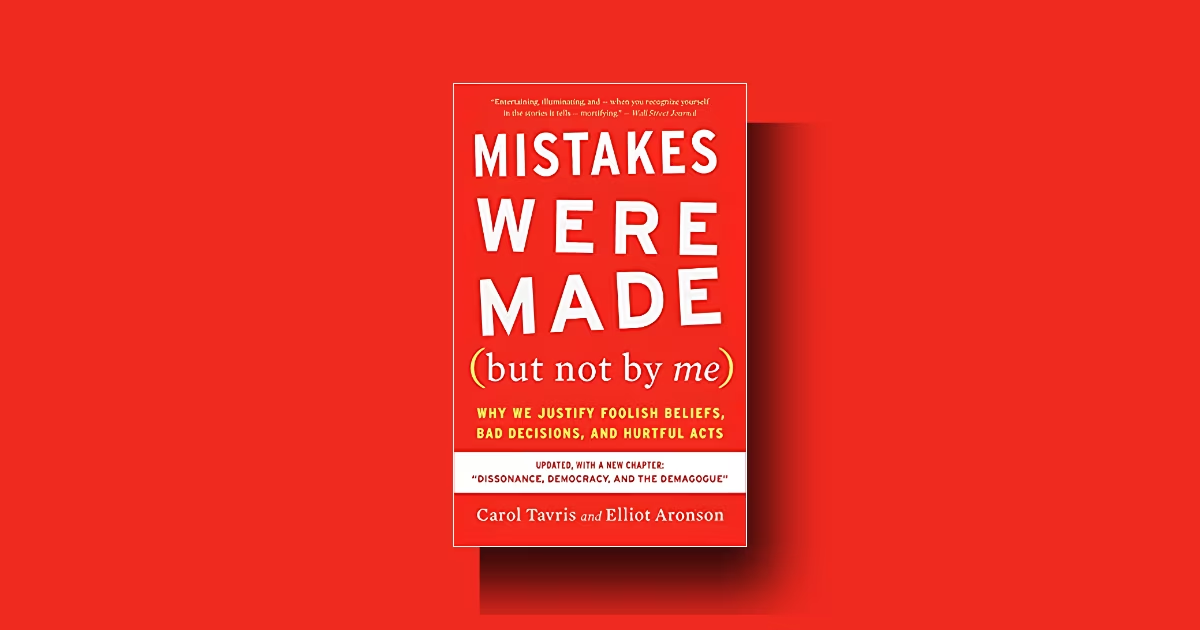

Mistakes Were Made (But Not by Me) is the book that finally answers a question most of us ask about other people and never about ourselves: how do liars, bullies, crooked officials and stubborn spouses live with themselves? Carol Tavris and Elliot Aronson’s answer is short and uncomfortable. They live with themselves “exactly the way the rest of us do.”
The engine is cognitive dissonance, the mental itch we feel when “I am a good, smart person” collides with “I just did something foolish or cruel.” Rather than change the first belief, we rewrite the second. I finished the third edition (2020) feeling slightly bruised, because the book kept catching me in the act.
That is the ugly part. The healing part is that it also shows you, with real experiments and real names, how to stop.
Table of Contents
Brief Summary
- What it is: A nonfiction social psychology book by Carol Tavris and Elliot Aronson, first published by Harcourt in 2007, revised in 2015, and expanded into a third edition by Mariner Books (Houghton Mifflin Harcourt) on August 4, 2020, at 464 pages.
- Core argument: Self-justification, driven by cognitive dissonance, is more dangerous than an outright lie, because the person doing it believes their own story. It blocks us from seeing mistakes, so we can never correct them.
- Key model: The “pyramid of choice.” Two people start at the top, a millimeter apart. After one small decision and a round of self-justification each, they slide down opposite faces and end up at opposite corners of the base, each certain they were always right.
- Where it applies: Politics (Iraq, Watergate, Vietnam), memory, psychotherapy and the recovered-memory panic, wrongful convictions, marriage, family feuds, torture, and, in the new final chapter, loyalty to Donald Trump.
- The cure: Notice the dissonance, name both beliefs, and keep them separate (“I am a decent person” and “I made a mistake” can both be true). Build outside checks like recorded interrogations, surgical checklists and independent review boards, because most of us will not self-correct on our own.
- My verdict: One of the most useful psychology books for everyday life I have read. It is sharp, funny, and well sourced. Its weak spots are a heavily U.S.-political final chapter that dates quickly and a few research claims (like the “backfire effect”) that later studies have softened.
Who will love it, and who will bounce
You will love Mistakes Were Made (But Not by Me) if you:
- Keep having the same argument with a partner, sibling or co-worker and cannot see why neither of you budges.
- Work in medicine, law, policing, therapy, management or research, where one unadmitted error can cost lives or years.
- Enjoyed Kahneman’s Thinking, Fast and Slow but wanted more stories and fewer probability puzzles.
- Want a readable, evidence-based explanation of why facts often fail to change minds.
You may bounce if you:
- Want a neutral, apolitical book. The authors are open about their views, and the 2020 chapter is a sustained critique of Trump and his supporters.
- Are looking for a step-by-step self-help workbook. Advice is here, but it is woven into the stories rather than listed.
- Already know social psychology well. Much of the lab material (Festinger, Milgram, Aronson and Mills) will be familiar.
Introduction
Mistakes Were Made (But Not by Me): Why We Justify Foolish Beliefs, Bad Decisions, and Hurtful Acts is a popular psychology book by social psychologists Carol Tavris and Elliot Aronson.
Context: who wrote it and why that matters
The book is about the most ordinary sentence in public life. The title mocks the passive voice that politicians and executives use to admit error without admitting responsibility.
The introduction opens with a gallery of examples, including Henry Kissinger (“Mistakes were quite possibly made by the administrations in which I served”), Cardinal Edward Egan, JPMorgan Chase CEO Jamie Dimon, and McDonald’s apologizing to vegetarians over beef flavoring in its fries. The political journalist Bill Schneider, the authors note, called this construction the “past exonerative” tense.
The authors’ credentials are the reason the book works.
Elliot Aronson (born January 9, 1932) earned his PhD at Stanford in 1959 under Leon Festinger, the man who created cognitive dissonance theory. The book is dedicated to Festinger.
According to Wikipedia’s summary of his career, Aronson is the only person in the American Psychological Association’s history to win all three of its major awards (for research, teaching and writing). He also created the “jigsaw classroom” in Austin, Texas, in 1971 and wrote the classic textbook The Social Animal.
Carol Tavris (born 1944) holds a PhD in social psychology from the University of Michigan. She is the author of Anger: The Misunderstood Emotion and The Mismeasure of Woman and has spent her career attacking what she calls psychobabble and pseudoscience.
So this is not a journalist summarizing other people’s work. One of the authors ran several of the experiments he describes. When the book says Aronson “arrived at Stanford University as a graduate student in psychology” in 1956, the same year Festinger started teaching there, you are reading history from a participant.
Purpose: the central thesis
The thesis sits in the introduction. Self-justification “is not the same thing as lying or making excuses.” A liar knows he is lying. A self-justifier has persuaded himself. That is why, in the authors’ words, self-justification is “more powerful and more dangerous than the explicit lie.” It lets people believe that what they did was the best, even the only, thing they could have done. And because we cannot learn from a mistake we will not admit, the authors ask the book’s key question: how can we learn from our mistakes “unless we first admit that we made those mistakes?”
Background
Cognitive dissonance began with a doomsday cult. In the 1950s, Leon Festinger and two colleagues infiltrated a group that believed the world would end on December 21, 1954, and that a flying saucer would rescue the faithful at midnight on December 20. Their leader is called “Marian Keech” in the research (the study became the 1956 book When Prophecy Fails). Many followers quit jobs, gave away houses and spent their savings.
Festinger predicted something counterintuitive.
Believers who had waited alone at home would quietly lose faith. But those who had given up everything and waited together would believe more strongly after the prophecy failed, and would start recruiting. That is what happened. At 4:45 a.m., Mrs. Keech announced that the group’s faith had saved the world.
Members who had never sought publicity began calling the press. “Mrs. Keech’s prediction had failed,” the authors write, “but not Leon Festinger’s.”
The book says dissonance theory has inspired “more than three thousand experiments.” It also offers one of the funniest confessions in popular science. Aronson and his wife bought a bland suburban house instead of a charming one near campus. Soon after, he bought a used canoe and drove it home in a freezing Minnesota January, months before the lake would thaw.
His wife took one look and burst out laughing, telling him to go ask Leon Festinger. The canoe was pure dissonance reduction. Even the man who helped build the theory could not escape it.
Mistakes Were Made (But Not by Me) Summary
I wrote this summary so that you get the full argument, the key studies and the main stories. If you read only this section, you will know what the book teaches.
Introduction: Knaves, Fools, Villains, and Hypocrites
Why do people defend decisions that are clearly wrong? Because admitting the error threatens their self-image, and most people will protect the self-image first. The authors show this with a set of puzzles they solve later in the book:
- The Dinka and Nuer peoples of Sudan still pull out children’s front teeth, a custom that likely began during a tetanus (lockjaw) epidemic so the sick could drink through the gap. The epidemic ended long ago. The custom did not.
- In the 1840s, childbed fever killed about 15 percent of women in one Vienna maternity ward, and one-third at the epidemic’s peak. Ignaz Semmelweis had students wash their hands in chlorine solution, and the women stopped dying. His colleagues rejected the evidence.
- Psychiatrist Marynia Farnham built a career in the 1940s and 1950s telling women not to have careers, while having one herself.
- Detectives in Kern County, California, believed a career criminal facing six years in prison over a woman with no record and documents backing her account, because the criminal’s story supported their theory that Patrick Dunn killed his wife.
The authors also flag an everyday gray zone. Researchers ask wives and husbands what share of housework they do, and the total always exceeds 100 percent. Nobody is necessarily lying. Each spouse remembers in a way that flatters their own role. This is the book’s first hint of a theme it returns to repeatedly: memory is a “self-serving historian.”
Self-justification is not all bad, they add. It “lets us sleep at night.” Without it we would torture ourselves over every choice. The trouble starts when it stops us from seeing errors at all.
Chapter 1: Cognitive Dissonance, the Engine of Self-Justification
What is cognitive dissonance? It is a state of tension that arises when a person holds two psychologically inconsistent ideas, such as “Smoking could kill me” and “I smoke two packs a day.” The most direct fix is to quit. If that fails, the smoker reduces dissonance by deciding smoking is not that harmful, or helps her relax, or keeps her weight down.
This chapter carries most of the book’s science. The main findings:
1. Effort makes us love what we suffered for. In the famous Aronson and Mills experiment at Stanford, students had to pass an “initiation” to join a discussion group about sex. Some read lurid passages aloud from novels such as Lady Chatterley’s Lover (very embarrassing for 1950s students). Others read mild sexual words from a dictionary. Then everyone heard the same deliberately dull recording of the group discussing the secondary sex characteristics of birds.
The mild-initiation students found it boring. The severe-initiation students rated it interesting and the people sharp.
The book adds a real-world echo from Mauritius: men who endured the painful kavadi ritual during the Hindu festival of Thaipusam, pierced with skewers and dragging carts by hooks for more than four hours, later donated more to the temple than those in a low-ordeal ritual.
2. Believing is seeing. Confirmation bias is dissonance at work. The authors use a blind test in which 21 professional violinists played new and old instruments while wearing goggles. Thirteen chose a new violin as their favorite, and everyone’s least favorite was a Stradivarius. Violinists who own Strads found reasons to dismiss the research.
In politics, before the Iraq invasion about 46 percent of Democrats supported it, but by 2006 only 21 percent remembered having done so. Before the war, 72 percent of Democrats believed Iraq had WMDs, yet later only 26 percent remembered believing it. People on both sides reduce dissonance, just in different directions.
3. Absence of evidence becomes evidence. General John DeWitt, the U.S. Army’s West Coast commander in World War II, admitted there was no evidence of sabotage by Japanese Americans, then argued that the absence of sabotage was “a disturbing and confirming indication” that it was coming.
4. Irrevocable decisions make us more certain. At a racetrack, bettors who had just placed a two-dollar bet were far more confident in their horse than people still waiting in line. The practical rule that follows is one of the most useful in the book: before a big purchase or decision, don’t ask someone who has just done it. They are motivated to convince you it was right. Ask someone still deciding, or look at controlled data.
5. Venting does not drain anger. It feeds it. Michael Kahn, a Harvard graduate student and a committed Freudian, set out to prove catharsis works. He insulted students, then let some report him to his supervisor.
Those who “vented” ended up angrier at him and with higher blood pressure. Having harmed him, they had to justify it by deciding he deserved it. The same loop explains bullying: a boy who joins in taunting a weaker child later decides the victim is “a nerd and a crybaby,” which makes the next attack easier. Aggression begets self-justification, which begets more aggression.
6. Kindness works the same way, in reverse. Students who did a personal favor for an experimenter (returning their prize money) liked him more. Four-year-olds who chose to give a sticker to a sad puppet later shared more with another puppet than children who were told to share. Benjamin Franklin used this deliberately: he won over a hostile legislator by asking to borrow a rare book, not by doing him a favor.
7. Experts are not immune. Citing Philip Tetlock’s work, the book notes that professional forecasters are rarely more accurate than laypeople. In 2010, 23 economists, fund managers and others signed a letter warning that the Federal Reserve’s bond buying would cause inflation. Four years later inflation was still low. Of the 23, 14 did not reply to reporters and the other nine said their views had not changed.
8. Dissonance protects low self-esteem too. A person who believes she is unlovable feels dissonance when someone loves her, and may resolve it by deciding he will leave once he knows “the real me.”
9. The pyramid of choice. This is the book’s master metaphor. Two students with identical, lukewarm views on cheating face an exam. One cheats, one does not. A week later, the cheater has decided cheating is no big deal.
The one who resisted now thinks cheaters should be expelled. They began “a millimeter apart” and end at opposite corners of the base, each convinced they always felt that way. Jeb Stuart Magruder’s slide into Watergate, which started with justifying Bob Haldeman’s tantrum over a missing golf cart, shows the same slope in real life.
So does the Milgram obedience study: two-thirds of participants went all the way to what they thought was a dangerous shock level, one small, justified step at a time. Magruder later told Judge John Sirica he had lost his “ethical compass.” The authors’ summary is chilling: get an honest man to take one step at a time, “and self-justification will do the rest.”
The chapter ends on a hopeful note with conservative columnist William Safire, who, aware of his own dissonance, publicly criticized Dick Cheney’s secret energy task force just as he had once criticized Hillary Clinton’s secret health-care task force.
Chapter 2: Pride and Prejudice . . . and Other Blind Spots
Why can we see bias in everyone except ourselves? Because the brain comes with what Lee Ross called “naive realism,” the conviction that we see the world “as it really is,” so anyone who disagrees must be biased.
The evidence is striking:
- Ross showed Israeli citizens a peace proposal written by Israeli negotiators but labeled as Palestinian. They liked it less than a Palestinian proposal labeled as Israeli.
- Geoffrey Cohen found Democrats will back a harsh welfare plan if told their party proposed it, and Republicans will back a generous one if told theirs did.
- A study of 4,519 votes by Supreme Court justices between 1953 and 2011 found conservative justices on the Roberts court supported conservative speakers’ free-speech claims about 65 percent of the time and liberal speakers’ about 21 percent. Liberal justices showed a smaller gap, about 10 percent, in their own direction.
How does corruption start? One small gift at a time. The authors call this “the road to St. Andrews,” after Republican leader Tom DeLay’s golf trip to Scotland paid for by lobbyist Jack Abramoff. First comes lunch, then a local golf game, then Scotland. Science followed the same road after a 1980 Supreme Court ruling allowed patents on genetically modified bacteria.
The book cites the funding bias that followed: in 161 studies of four chemicals, only 14 percent of industry-funded studies found health harms, versus 60 percent of independently funded ones. When 108 forensic psychologists and psychiatrists rated identical sex-offender files, those told they worked for the prosecution scored higher risk than those told they worked for the defense.
The Andrew Wakefield vaccine case is the chapter’s darkest example. His 1998 Lancet paper linking the MMR vaccine to autism was later partly retracted by ten of its thirteen authors after it emerged he had been paid more than $800,000 by lawyers representing parents. He never signed the retraction.
The authors note that a Danish study of more than 650,000 children found no link, yet many parents had spent years justifying their fears and would not climb back up the pyramid. The result, per the book: the worst U.S. whooping cough epidemic since 1959 in 2012, and more than 1,250 measles cases in 2019.
Small gifts matter more than people think. A national survey found 84 percent of physicians had received something from drug companies, and the authors report that from August to December 2013, drug and device makers paid $3.5 billion to health professionals and teaching hospitals.
The key mechanism is reciprocity, which Robert Cialdini documented with Hare Krishna fundraisers handing flowers to airport travelers. Carl Elliott’s brother Hal, a psychiatrist, described sliding from a free community talk to promoting a company’s antidepressant. His comparison with a party that ends on a plane to Bangkok is the most memorable passage in the chapter.
Prejudice gets the same treatment. Al Campanis, the Dodgers executive who defended Jackie Robinson, told Ted Koppel on Nightline on April 6, 1987, that Black men might lack “the necessities” to be managers. The authors argue he was neither a monster nor a victim, but a man with a blind spot. Crucially, they show that the arrow often runs backward: discrimination comes first, and the stereotype is invented later to justify it.
The treatment of Chinese workers in the 19th-century American West proves the point. When their labor was needed for the railroad they were called “very trusty”; when jobs grew scarce they became “criminal” again.
The chapter closes with the antidote: trusted critics. Albert Speer described Hitler’s inner circle as a “hall of distorting mirrors.” Abraham Lincoln, by contrast, put rivals such as William Seward, Salmon Chase and Edward Bates in his cabinet.
Chapter 3: Memory, the Self-Justifying Historian
Can you trust a vivid, emotional memory? Not fully. The authors argue that memory is reconstructive, not a video recording, and that it bends in a self-flattering direction.
Carol Tavris opens with her own shock. She vividly remembered her father reading James Thurber’s The Wonderful O to her. Then she found her first edition, published in 1957, a year after her father died. Someone else had read it to her.
Social psychologist Anthony Greenwald called the self a “totalitarian ego” that rewrites history to protect itself. The research here is some of the most memorable in the book:
- In 1962, psychiatrist Daniel Offer interviewed 73 teenage boys. Thirty-four years later, at age 48, the men’s guesses about what they had said as teens were “no better than chance.” Nearly half remembered thinking high-school sex was okay; only 15 percent had actually said so at 14.
- Michael Conway and Michael Ross put 106 students through a useless study-skills course. Afterward, the students misremembered their starting skills as worse than they had reported, so they could believe they had improved. The authors quote the researchers’ phrase: “getting what you want by revising what you had.”
- Cognitive psychologist Ralph Haber, a specialist in autobiographical memory, “remembered” leaping at a Stanford offer against his mother’s wishes. Old letters showed he had decided to stay at Michigan, and it was his mother who urged him to go.
The chapter then turns to false memories with serious consequences. Binjamin Wilkomirski’s Holocaust memoir Fragments (1995) won the 1996 National Jewish Book Award before historians showed its author was Bruno Grosjean, a Swiss man born in 1941 who was never in a camp. The authors argue, following historian Stefan Maechler, that this was self-persuasion rather than calculated fraud.
Alien abduction “memories” follow the same arc. Sleep paralysis affects about 30 percent of people, with about 5 percent also experiencing waking hallucinations. Skeptic Michael Shermer saw “aliens” during sleep deprivation in the Race Across America and recognized them as a memory of a 1960s TV show. Believers studied by Susan Clancy, by contrast, gathered confirming evidence until they could not tell their false memories from real ones.
The chapter ends with memoirist Mary Karr, who set out to write that her father abandoned her as a teen and found the facts said the opposite: he kept showing up and she was the one who left. That honesty, the authors suggest, is rare and freeing.
Chapter 4: Good Intentions, Bad Science, the Closed Loop of Clinical Judgment
Why did so many therapists believe in repressed memories? Because clinical practice is a closed loop. What therapists see confirms what they believe, and what they believe shapes what they see.
The authors describe two “moral panics” of the 1980s and 1990s. The first was recovered-memory therapy, in which adults with no memory of abuse came out of therapy “remembering” years of incest or satanic ritual. Alongside it came multiple personality disorder. Sybil (1973) sold more than five million copies, 40 million Americans watched the 1976 TV film, and by the mid-1990s more than 40,000 people believed they had “alters.” Journalist Debbie Nathan’s 2011 biography later showed Sybil’s psychiatrist had largely concocted the story.
The second panic hit daycare centers, beginning with the McMartin Preschool case in 1983. Children told investigators of satanic rituals, flying planes and underground chambers. Kelly Michaels of New Jersey was convicted on 115 counts and sentenced to 47 years, then freed after five when an appeals court ruled the children’s testimony had been tainted.
To their credit, Tavris and Aronson admit they both initially believed the McMartin teachers were guilty, “where there’s smoke, there’s fire,” and felt foolish when the full story emerged.
The science they present is decisive:
- Richard McNally, in Remembering Trauma, concludes that the idea of the mind repressing trauma is “psychiatric folklore.” Real trauma is usually hard to forget, not easy.
- In Sena Garven’s experiment modeled on the McMartin interviews, three-year-olds agreed with over 80 percent of false allegations once social pressure and praise were added.
- Nearly 70 percent of children who were physically abused do not grow up to abuse their own kids, a fact invisible to clinicians who only meet the ones who do.
- A 2014 survey found only 17.7 percent of science-oriented clinical psychologists believed traumatic memories are often repressed, versus 60 percent of general therapists, 69 percent of psychoanalysts and 81 percent of hypnotherapists and NLP practitioners.
The book’s best line on this topic is that science is “a form of arrogance control.” Its method exists to show that we might be wrong. The chapter ends with therapist Linda Ross, one of very few who publicly admitted she had helped destroy families, telling a client’s parents she understood they might never forgive her.
Chapter 5: Law and Disorder
Why do prosecutors fight to keep innocent people in prison? Because releasing them means admitting they sent an innocent person away, which clashes with their view of themselves as the good guys.
The cases are brutal. Thomas Lee Goldstein spent 24 years in prison on the word of a jailhouse informant who had testified against ten other men. The Central Park Five, convicted after interrogations of 14 to 30 hours, were cleared in 2002 when serial rapist Matias Reyes confessed and his DNA matched; New York City later settled for $41 million without admitting error.
Prosecutor Linda Fairstein still insisted, years later, that they were guilty. In the Stephanie Crowe case, detectives who had extracted a false confession from her 14-year-old brother never accepted that a drifter, Richard Tuite, was the killer, even after her blood was found on his sweatshirt.
The numbers are sobering. By 2019, per the book, the Innocence Project had recorded 365 DNA exonerations, and the National Registry of Exonerations had logged nearly 2,500 exonerations since 1989. Law professor Samuel Gross estimated wrongful felony convictions at 1 to 5 percent. About 13 to 15 percent of exonerated prisoners had confessed to crimes they did not commit.
The authors dissect the Reid Technique, whose promoters say they have trained more than 500,000 law enforcement workers. It presumes guilt, so every denial counts as more evidence of guilt.
When Saul Kassin and Christina Fong tested 44 experienced detectives who averaged nearly 14 years on the job, they did no better than chance at spotting liars, yet believed their accuracy was close to 100 percent. Training raised confidence, not accuracy. Steven Drizin and Richard Leo’s review of 125 false confessions found more than 80 percent came after interrogations of more than six hours.
The fixes are practical: electronically record all interrogations, adopt the UK’s non-accusatory PEACE interviewing model, and create conviction integrity units staffed by prosecutors with no original case to defend. The book’s sharpest line here is that “doubt is not the enemy of justice; overconfidence is.”
Chapter 6: Love’s Assassin, Self-Justification in Marriage
What really kills a marriage? Not conflict, not differences, not even anger. Self-justification does.
The centerpiece is the story of Frank and Debra, from Andrew Christensen and Neil Jacobson’s book Reconcilable Differences. After dinner with a seemingly perfect couple, Debra wants to talk about their distance; Frank wants to sleep. She follows him, turns lights back on, pulls away his pillow; he locks himself in the guest room.
Both tell the same facts. What differs is that each defends not what they did but who they are. Frank is “tolerant”; Debra is “human.” Each sees the other’s traits as flaws and their own as virtues.
The key mechanism is attribution. Happy couples excuse a partner’s bad moments as situational (“he’s stressed”) and credit good moments to character (“he’s the dearest guy”). Unhappy couples do the reverse.
The authors draw on John Gottman’s research with more than 700 couples: contempt is among the strongest signs a relationship is in free fall, and stable couples keep about five positive interactions for every negative one. In one study of 56 couples followed up three years later, Gottman’s team predicted all seven divorces, partly from how the couples retold their history. Donna, who kept a “hate book” of her husband’s slights, shows how the confirmation bias turns a love story into a case file.
The chapter’s model couple, Charlie and Maxine, married more than 40 years, show the way out. He learned to stop yelling; she learned that some anger is legitimate and later took an assertiveness course. Neither became a new person. “But each of them moved.” The chapter closes with Vivian Gornick admitting, at 65, that much of her loneliness was self-inflicted and not only the result of sexism.
Chapter 7: Wounds, Rifts, and Wars
Who started it? In most feuds, each side says the other did, and both believe it.
The authors trace this through Jim and Karen, a couple stuck a year after his affair; the Terri Schiavo family war, which escalated after a 1993 malpractice award of $750,000 for her care and $300,000 for her husband; and the Iran hostage crisis, in which 52 Americans were held for 444 days. Americans saw an unprovoked attack.
Many Iranians traced it back to the CIA-backed 1953 coup against Mohammad Mossadegh.
Roy Baumeister’s research explains why victims and perpetrators live in separate worlds. When 63 people wrote a story of being hurt and another of hurting someone, perpetrators minimized, excused and “closed” the event, while victims described lasting damage. Only one of the 63 victim stories granted the perpetrator any justification.
A neat lab experiment adds a physical twist: when partners were told to press back on each other’s fingers with equal force, each retaliated harder than they had received, because pain felt seems stronger than pain inflicted.
The chapter also covers the self-justification of torture after 9/11, including Dick Cheney’s insistence that the CIA’s harsh interrogation methods were not torture and a December 2014 Pew poll in which 51 percent of Americans still called the CIA’s methods justified.
John McCain’s statement that the debate “isn’t about our enemies; it’s about us” is quoted at length. The hopeful ending is South Africa’s Truth and Reconciliation Commission, Nelson Mandela’s belief that you make peace by working with your enemy, and Vietnam veteran William Broyles meeting a former Viet Cong woman who told him simply that the war was over.
Chapter 8: Letting Go and Owning Up
How do you admit a mistake without hating yourself? You steer between “the Scylla of blind self-justification” and “the Charybdis of merciless self-flagellation.”
This is the practical heart of the book. Key lessons:
Admitting error makes people trust you more. In one study of 556 people, an injured pedestrian was more forgiving and more willing to settle when a cyclist gave a responsibility-accepting apology. Hospitals that disclose and apologize for errors tend to face fewer lawsuits, not more.
Leaders who own mistakes gain respect. John F. Kennedy took full blame for the Bay of Pigs in 1961 and his popularity rose. Robert E. Lee said of Pickett’s Charge, “All this has been my fault.” Eisenhower’s unused D-Day failure note is the book’s most moving example: he crossed out “the troops have been withdrawn” and wrote “I have withdrawn the troops.”
Separate the person from the act. Israeli leader Shimon Peres, on Reagan’s 1985 Bitburg visit, said a friend who makes a mistake “remains a friend, and the mistake remains a mistake.” The authors ask readers to apply that to themselves: “I remain a decent, smart person and the mistake remains a mistake.”
Stop treating mistakes as proof of stupidity. Harold Stevenson and James Stigler watched a Japanese boy fail at drawing cubes for 45 minutes without embarrassment; American observers were more uncomfortable than he was. Carol Dweck’s research shows children praised for effort handle mistakes better than those praised for being “naturals.”
Don’t lecture scam victims. Anthony Pratkanis found that “How could you be so stupid?” pushes victims deeper into the fraud. Respect and questions work better.
Build outside checks. Surgical checklists, recorded interrogations and independent review boards catch errors individuals will not.
The chapter’s final section, “Act 2,” is the book’s philosophical core. Aronson reads F. Scott Fitzgerald’s “There are no second acts in American lives” as a warning that Americans want to skip the struggle and jump to redemption.
Real self-compassion must be earned. The authors contrast Reggie Shaw, who killed two people while texting and became a national campaigner against distracted driving, with Eric Fair, a former Abu Ghraib interrogator who keeps telling students “I tortured.”
The distinction they draw is subtle and wise: he says “I tortured,” not “I am a torturer,” which separates action from identity.
Chapter 9: Dissonance, Democracy, and the Demagogue
Why did so many Republicans who once despised Donald Trump become his loyal defenders? The authors’ answer is the pyramid of choice, applied to a whole party.
Written as a letter to readers dated December 24, 2019, the chapter opens with a historical parable: Pope Pius XI’s step-by-step accommodation of Mussolini, drawn from David Kertzer’s The Pope and Mussolini. The pope accepted crucifixes in classrooms and Catholic education in exchange for silence, until it was too late. The authors are careful to say they are not calling Trump Mussolini, only pointing to shared traits of demagogues.
They then trace three paths. Some Republicans left early, like George Will. Many slid down the pyramid, such as Lindsey Graham, who once called Trump a “race-baiting, xenophobic, religious bigot” and later became a defender. White evangelicals, 81 percent of whom voted for Trump in 2016, resolved dissonance by redefining what a godly leader must be. James Comey’s description of how officials lose their integrity ends with the line “He has eaten your soul.”
A smaller group stopped the slide, including Michael Cohen, Jim Mattis, Justin Amash, Peter Wehner, climate scientist Maria Caffrey, Foreign Service officer Chuck Park and Ambassador Marie Yovanovitch.
The chapter cites the Washington Post‘s count of 15,413 false or misleading claims by December 17, 2019.
The closing message is broader than one president. Democracy depends on norms, and citizens must be willing to admit they were wrong. “Donald Trump does not learn from his mistakes,” they write, “but we remain hopeful that our nation can.”
Mistakes Were Made (But Not by Me) Analysis
Mistakes Were Made (But Not by Me) is one of the most humane and useful psychology books of the century so far, a book that manages to be funny about our worst habits without ever letting us off the hook. I finished it slightly embarrassed and oddly relieved, which I suspect is the effect the authors wanted.
Does the evidence support the argument?
Mostly, yes. The book rests on controlled experiments rather than anecdote, and the authors explain why that matters (the fraternity-initiation example is a clear lesson in why random assignment beats correlation). They cite primary researchers by name, from Festinger and Milgram to Kassin, Gottman, McNally and Tetlock. Where they tell stories, the stories illustrate a finding rather than replace it.
There are soft spots. The book describes the “backfire effect” (people clinging harder to false beliefs when corrected) as a “frequently replicated finding.” A large 2019 study by Thomas Wood and Ethan Porter in Political Behavior, testing 52 issues across five experiments with more than 10,100 participants, found backfire effects to be rare. Most people moved toward the facts, even if they did not change their political views.
The Milgram experiment, which the authors use as a model of gradual entrapment, has also faced scholarly criticism of its methods, notably in Gina Perry’s Behind the Shock Machine (2012). And dissonance theory itself has long had rivals, such as Daryl Bem’s self-perception theory, which the book does not engage. None of this sinks the argument, but a more skeptical reader might want the authors to apply their own “arrogance control” to their favorite findings.
Does it fulfill its purpose?
It does. The stated aim is to help readers recognize “the siren song of self-justification” and choose owning up over covering up. The pyramid of choice alone is worth the price. I now catch myself building a case after a decision, not before, and that small awareness changes conversations.
Among popular psychology books, it has also been influential: it holds a 4.04 average from more than 29,000 ratings on Goodreads, and at publication Michael Shermer wrote in Scientific American that the authors “brilliantly illuminate” the fallacies behind irrational behavior. The Guardian called it “excellent,” according to Wikipedia’s summary of its reception.
Strengths
One idea, many worlds. A single mechanism explains a canoe in January, a wrongful conviction and a marriage in freefall. That makes the book easy to remember and apply.
Authors who admit their own errors. The canoe, The Wonderful O, their early belief in the McMartin accusations, and the preface’s mock-defensive reaction to a hostile Amazon review. The book practices what it preaches.
Practical takeaways. Don’t ask recent buyers for advice. Separate the mistake from your identity. Praise effort. Record interrogations. Ask “Could I be wrong?” before a fight, not after.
Humane tone. They never sneer at the people they study. Magruder, Campanis and even Wilkomirski are presented as people who slid, not monsters.
Strong writing. Lines like “It’s the people who almost decide to live in glass houses who throw the first stones” stay with you.
Weaknesses
The Trump chapter. I understand why the authors wrote it, and the pyramid analysis of Republican leaders is sharp. But it is openly partisan, it was written in December 2019 and is already dated, and it will cause exactly the defensive reaction the book warns about in half its readers. A chapter on self-justification on the political left, which the authors mention only briefly, would have been more persuasive.
U.S.-centric. Almost every case, statistic and legal reform is American. Readers elsewhere will need to translate.
Some repetition. The pyramid returns in nearly every chapter. It is a strong metaphor, but by chapter 7 I felt it being hammered.
Light on the brain. A brain-imaging study by Drew Westen is mentioned, but readers wanting neuroscience will find little.
Minor data glitches in the ebook. My digital copy contains a few obviously corrupted numbers (a date range ending in “2079,” for example). These look like conversion errors, not the authors’, but readers quoting statistics should check a print edition.
Books Like Mistakes Were Made (But Not by Me)
What should you read next if you liked Mistakes Were Made (But Not by Me)? Here is how it compares with its nearest neighbors.
When Prophecy Fails by Leon Festinger, Henry Riecken and Stanley Schachter (1956). The original field study of the doomsday group. Short and historically important, but dated. Tavris and Aronson give you its lessons with 60 years of follow-up research.
Thinking, Fast and Slow by Daniel Kahneman (2011). Broader in scope, covering heuristics and biases in judgment. More technical, less about morality and relationships. Kahneman explains how we err; Tavris and Aronson explain why we refuse to admit it.
Influence by Robert Cialdini (1984). Cialdini’s reciprocity and commitment principles are cited in chapter 2. Read it for the persuasion side of the same coin.
Being Wrong by Kathryn Schulz (2010). A more literary and philosophical book about error. Warmer, less empirical.
Black Box Thinking by Matthew Syed (2015). Focuses on how aviation and medicine build systems that learn from mistakes, which pairs well with chapter 8’s call for external checks.
Think Again by Adam Grant (2021) and The Scout Mindset by Julia Galef (2021). Newer, more upbeat guides to changing your mind. They are lighter on the dark cases (wrongful convictions, torture) that make Tavris and Aronson hit harder.
The Art of Thinking Clearly by Rolf Dobelli. A quick catalog of biases.
If you are building a reading list, Mistakes Were Made (But Not by Me) belongs in my 100 Best Psychology Books of All Time and alongside the picks in 10 Life-Changing Books on Human Behavior. For the policy side of decision-making, see my review of Nudge.
Frequently Asked Questions
What is the main idea of Mistakes Were Made (But Not by Me)?
The main idea is that cognitive dissonance drives people to justify their beliefs and actions rather than admit error, and that this self-justification, not lying, is behind most stubbornness, corruption, injustice and broken relationships.
What is the pyramid of choice?
It is the authors’ model of how two people who start with nearly identical views make one different decision, justify it, and gradually slide to opposite extremes, each convinced they always believed what they now believe.
Is Mistakes Were Made (But Not by Me) based on real research?
Yes. It draws on decades of experiments in social psychology, many of them in cognitive dissonance, which the authors say has generated more than 3,000 studies. Elliot Aronson conducted several of the key ones himself.
Which edition should I read?
The third edition (Mariner Books, 2020) is the most complete, with updated research and a new chapter on democracy and Trump. If you want to skip the Trump material, the second edition (2015) ends before it; according to the preface, that edition is where the authors first addressed people who cannot stop blaming themselves.
Is the book politically biased?
The authors are open about their views. Earlier editions drew complaints about criticism of George W. Bush, which the authors discuss in the preface. The third edition’s final chapter is a direct critique of Donald Trump and his supporters.
Conclusion
Should you read Mistakes Were Made (But Not by Me)? Yes, and I would say that even to readers who will argue with its last chapter. It is written for general readers, not specialists, and it asks nothing more than attention and a little humility.
People in medicine, law, policing, therapy, management and any long relationship will get the most from it, because those are the places where one unadmitted error does the most damage.
What stays with me is not the Iraq War or Watergate but Frank locked in the guest room and Aronson’s canoe sitting in a frozen garage. The book makes self-justification visible in small, silly moments, so you can catch it before it becomes a large, cruel one. It will not make you immune. The authors are clear that nobody is.
But it gives you a sentence to say when you feel yourself sliding down the pyramid: I made a mistake, and I am still a decent person. Both can be true.
References
- Tavris, Carol, and Elliot Aronson. Mistakes Were Made (But Not by Me): Why We Justify Foolish Beliefs, Bad Decisions, and Hurtful Acts, third edition.
- Publisher details, third edition (Mariner Books, August 4, 2020, 464 pages): Point Reyes Books listing
- First edition details and critical reception (Harcourt, 2007; Shermer in Scientific American; The Guardian)
- Elliot Aronson biography, Stanford PhD under Festinger, APA awards, jigsaw classroom.
- Carol Tavris biography, University of Michigan PhD and awards.
- Goodreads rating (4.04 from 29,715 ratings at time of writing).
- Wood, Thomas, and Ethan Porter. The Elusive Backfire Effect: Mass Attitudes’ Steadfast Factual Adherence. Political Behavior, 2019.
- Perry, Gina. Behind the Shock Machine: The Untold Story of the Notorious Milgram Psychology Experiments. ResearchGate, 2012.