

Last updated on April 26th, 2026 at 09:10 am
Why do some individuals effortlessly shape history while the rest of us merely drift through our daily routines? Mastery by Robert Greene reveals that this “genius” is not a divine spark, but the systematic result of a radical “second education”—an apprenticeship that fuses our unique genetic inclinations with the deep, evolutionary grain of the human mind.
Mastery is best for ambitious creators, digital entrepreneurs, and anyone hungry to uncover the blueprint of historical titans to apply to their own craft.
It is absolutely not for those seeking overnight success hacks, magic formulas, or quick fixes that bypass the grueling hours of deep focus.
Table of Contents
1. Introduction
Mastery by Robert Greene, published in 2012 by Viking Penguin.
Mastery is a monumental work of non-fiction that operates at the intersection of biography, cognitive neuroscience, and self-help. Robert Greene, the bestselling author of The 48 Laws of Power, takes his trademark historical analysis and applies it to the concept of human brilliance.
Instead of focusing on raw, manipulative power, this book maps out the architecture of genius.
Greene’s central thesis is that genius is not a genetic accident or a divine gift. Instead, “There exists a form of power and intelligence that represents the high point of human potential.” This ultimate power is accessible to all of us if we are willing to submit to a rigorous, sequential process of apprenticeship, creative expansion, and eventually, mastery.
Background: In our fast-paced digital era, we often fetishize speed and technology.
We search for the newest app or the fastest shortcut to rank our websites and build our businesses. But Greene argues forcefully against this.
He notes, “It is the height of stupidity to believe that in the course of your short life… you can somehow rewire the configurations of your brain through technology and wishful thinking, overcoming the effect of six million years of development.”
To truly outrank the competition—whether in search engines or in life—we must align with the deep, evolutionary grain of the human brain.
2. Mastery Summary
If you want to extract the absolute maximum value from Mastery, you must understand its core progression.
Greene divides the journey into distinct phases. What I learned from this book completely reshaped how I view skill acquisition, and I am going to lay out the exact roadmap here so you have the entire framework at your fingertips.
Phase I: Discover Your Calling (The Life’s Task)
Before you can master anything, you have to know what you are meant to master. At your birth, a seed is planted, which is your absolute genetic uniqueness.
The Hidden Force: Greene uses the story of Leonardo da Vinci to illustrate this. Born out of wedlock and barred from formal universities, Leonardo was left to wander the forests, sketching what he saw. This primal inclination—a fascination with the intricate details of nature—became the hidden force that guided his entire life, leading him away from the petty court politics of Florence and toward his universal studies of anatomy, flight, and art.
The Strategies: How do we find this calling today?
Return to your origins: Albert Einstein was transfixed by a compass at age five; Marie Curie was mesmerized by her father’s lab instruments. We must look back at what fascinated us before society told us what to care about.
Occupy the perfect niche: V. S. Ramachandran followed his unique childhood obsession with anomalous seashells into the highly specialized niche of visual psychology and phantom limb syndrome.
Avoid the false path: Wolfgang Amadeus Mozart had to violently rebel against his domineering father to leave the safe path of a court performer and embrace his true love: composing operas ..
Let go of the past: Freddie Roach, a burned-out boxer, found his true calling by adapting his deep knowledge of the ring into becoming a legendary trainer.
Phase II: Submit to Reality (The Ideal Apprenticeship)
Once you find your field, you enter the most dangerous phase: the Apprenticeship. “The goal of an apprenticeship is not money, a good position, a title, or a diploma, but rather the transformation of your mind and character.”
The First Transformation: Charles Darwin was a mediocre student who was almost forced into the church by his father.
But upon joining the HMS Beagle, he subjected himself to immense physical and mental drudgery. He spent the first months passively observing, then acquiring skills, and finally developing his world-shattering theories of natural selection.
The Three Steps:
Deep Observation (The Passive Mode): When entering a new environment, mute your colors. Learn the explicit rules and the hidden power dynamics.
Skills Acquisition (The Practice Mode): This is where the famous “10,000 hours” rule comes in. You must embrace the tedium of practice until a skill moves from the frontal cortex and becomes hardwired into your nervous system.
Experimentation (The Active Mode): Before you feel entirely ready, you must test yourself. Take on responsibility and expose yourself to public critique.
Key Strategies: Always value learning over money. Benjamin Franklin chose a harder, longer nine-year apprenticeship at a printing shop simply because it gave him access to the books and texts he needed to teach himself how to write.
Phase III: Absorb the Master’s Power (The Mentor Dynamic)
Life is short. Trying to learn everything through trial and error is incredibly inefficient. You need a mentor to streamline the process.
The Alchemy of Knowledge: Michael Faraday, a poor bookbinder’s apprentice, managed to transcribe the lectures of the great chemist Humphry Davy.
By making himself indispensable as a lab assistant, Faraday absorbed Davy’s entire experimental mindset, eventually making discoveries in electromagnetism that eclipsed his master’s .
The Dynamic: A mentor acts like the philosopher’s stone in alchemy, heating up the base metal of raw information and turning it into the gold of practical, active knowledge. However, the ultimate goal of this dynamic is to eventually outgrow the mentor. As the Spanish proverb goes, al maestro cuchillada—to the Master goes the knife.
You must absorb their power and then forge your own independent identity.
Phase IV: See People as They Are (Social Intelligence)
You can be a brilliant coder, writer, or designer, but if you lack social intelligence, you will be destroyed by the political maneuverings of others.
Thinking Inside: Benjamin Franklin learned this the hard way. Early in his career, his naïveté and unchecked charm caused his brother to turn against him and led to him being stranded in London by a fast-talking governor. Franklin realized he had to step back, detach from his own ego, and learn to truly read others.
The Seven Deadly Realities: We must learn to recognize these universal human flaws: Envy, Conformism, Rigidity, Self-obsessiveness, Laziness, Flightiness, and Passive Aggression.
Strategies: Temple Grandin, severely hindered by autism, learned to view her social interactions as if analyzing a machine. By looking at herself objectively through the feedback of others, she altered her behavior and became a world-renowned speaker and scientist.
Phase V: Awaken the Dimensional Mind (The Creative-Active)
As you emerge from your apprenticeship, your mind must expand. You must resist the urge to become conservative and protective of what you know.
The Dimensional Mind: You must blend the discipline you acquired during your apprenticeship with the “Original Mind” of your childhood—that primal sense of wonder and flexibility.
Strategies for Creativity:
Negative Capability: Coined by poet John Keats, this is the ability to endure uncertainty and mystery without immediately jumping to a rigid conclusion.
Serendipity: Maintain a notebook. Let your mind wander. The brain is a dual processing system that naturally looks for hidden connections.
The Evolutionary Hijack: Paul Graham bypassed the agonizing prospect of coding for Windows by suddenly realizing he could build a program that ran directly on the web server itself—creating Viaweb and pioneering e-commerce.
Phase VI: Fuse the Intuitive with the Rational (Mastery)
After 20,000 hours of intense focus, a qualitative shift happens in the brain.
The Third Transformation: Marcel Proust spent decades moving through high society, writing failed novels, and battling asthma.
But he accumulated such a vast internal database of psychology, memory, and social observation that when he finally sat down to write In Search of Lost Time, he had an intuitive grasp of the entire mosaic.
The Fingertip Feel: The human brain is designed to internalize complexity. Cesar Rodriguez, an Air Force pilot, practiced flight routines so exhaustively that during a real, life-or-death dogfight with an Iraqi MiG, his body executed flawless evasive maneuvers without conscious thought.
The Universal Man: We must strive to synthesize all forms of knowledge. Johann Wolfgang von Goethe extended his studies from literature to geology, botany, and anatomy, predicting the course of history because he grasped the interconnected “life force” of nature itself.
3. Mastery Analysis
Mastery is, without a doubt, one of the most important and poignant books written on human potential in the 21st century. It acts as an incredible antidote to a culture that has become obsessed with instant gratification, “life hacks,” and the illusion that technology can replace genuine cognitive development.
Greene meticulously supports his arguments by weaving together history, cognitive science, and evolutionary biology.
For instance, he doesn’t just state that practice is important; he explains the neurological mechanics of the frontal cortex freeing up space as skills become hardwired into the nervous system.
He perfectly fulfills his stated purpose of demystifying “genius.” He proves that figures like Einstein and Mozart were not magical freaks of nature, but individuals who possessed an intense, obsessive focus and benefited from extreme early immersion in their respective fields.
This book provides the definitive blueprint for any query related to “how to achieve greatness,” “the 10,000-hour rule,” or “finding one’s life purpose.” It anchors subjective advice in objective, historical reality.
4. Strengths and Weaknesses
Strengths: What I found incredibly compelling is how Greene integrates the stories of contemporary masters (like neuroscientist V.S. Ramachandran or robotics engineer Yoky Matsuoka) alongside historical titans. It bridges the gap between the Renaissance and the digital age.
I particularly loved the concept of “Negative Capability” —the idea that allowing the mind to rest in uncertainty without reaching for immediate facts is the true genesis of creativity.
It fundamentally changes how one approaches research and content creation.
Weaknesses: If I had to point out a shortcoming, it would be the sheer density and occasional repetition of the biographical arcs.
Greene frequently circles back to the same figures (like Freddie Roach or Temple Grandin) across multiple chapters. While this is done to highlight different phases of their lives, it can sometimes disrupt the pacing.
Additionally, the book assumes a baseline level of stability in the reader’s life; the luxury of spending seven to ten years in a low-paying apprenticeship is a difficult reality for those facing extreme systemic or economic barriers today.
5. Comparison with Similar Works
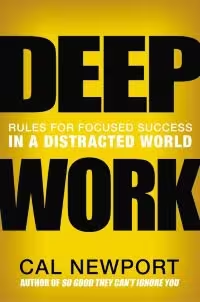
When placed next to Malcolm Gladwell’s Outliers or Cal Newport’s Deep Work, Mastery stands out as the most comprehensive.
While Gladwell popularized the 10,000-hour rule, he focused heavily on external circumstances, luck, and timing.
Greene takes a much more empowering, internal approach, emphasizing how our own psychological resilience and strategic choices dictate our path.
Compared to Deep Work, which offers tactical advice for focus, Greene provides the overarching philosophical reason why that deep work matters.
6. Conclusion: The Final Verdict
I highly recommend Mastery to anyone who feels a stirring dissatisfaction with the conventional, assembly-line trajectory of modern careers.
It is an absolute must-read for digital publishers, creatives, artists, scientists, and entrepreneurs. It is accessible to a general audience but possesses the intellectual rigor to satisfy specialists in cognitive psychology and history.
According to historical data and deep neurological research, the brain is remarkably plastic.
You are not locked into your current limitations. If you are willing to embrace the pain of the apprenticeship, suffer fools gladly in the social arena, and push your mind into the active-creative phase, the ultimate power is waiting for you.