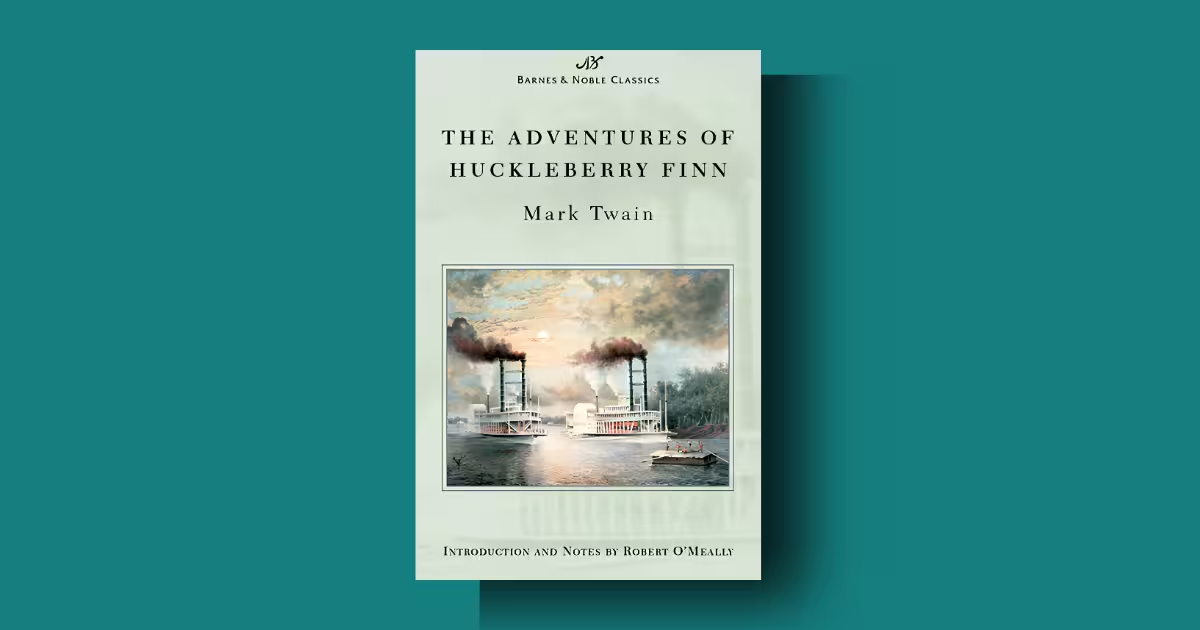

Huckleberry Finn is the story of a barefoot, half-feral Missouri boy who fakes his own murder to escape his drunk father, then teams up with Jim, an enslaved man fleeing the same river town, on a raft trip down the Mississippi. Mark Twain published it in December 1884 in Britain and February 1885 in America, and it’s been arguing with American readers ever since.
Who will love Huckleberry Finn: anyone who wants to see the birth of the modern American voice on the page, readers who like their humor mixed with real moral weight, and people curious why a 140-year-old book still tops banned-book lists.
Who will bounce: readers who can’t get past unfiltered 19th-century dialect and a racial slur that shows up 219 times, and anyone hoping for a tidy, uncomplicated hero’s journey. The ending divides even scholars, so go in ready for an argument, not a bow tied neatly on top.
Table of Contents
Introduction
Adventures of Huckleberry Finn is Mark Twain’s 1884 novel (published in the U.S. in 1885), a direct sequel to The Adventures of Tom Sawyer (1876).
Twain, born Samuel Langhorne Clemens on November 30, 1835, in Florida, Missouri, worked on the manuscript on and off for roughly eight years before it reached print, and the first American edition ran 362 pages with 174 illustrations by E.W. Kemble.
I’m coming to it again in 2026, not long after Percival Everett’s James put Jim’s side of this same river journey back on bestseller lists and reopened a debate that Twain, honestly, started himself.
Background
Twain set the novel roughly a decade or two before the Civil War, in the 1830s and 1840s, but he wrote it in the 1870s and 1880s, after slavery had already ended.
That gap matters. He’s not reporting live from the antebellum South; he’s looking back at it, needling it, from a country still arguing over what Reconstruction had actually accomplished.
The book’s Mississippi River setting draws directly on Twain’s own boyhood in Hannibal, Missouri, and his years as a licensed steamboat pilot before the war shut down commercial river traffic in 1861. His pen name itself comes from the river: “mark twain” was the leadsman’s call for two fathoms of water, a safe depth for a boat to pass.
Huckleberry Finn Summary
Huckleberry Finn opens the book already a minor celebrity. He and Tom Sawyer found treasure at the end of the previous book, and the Widow Douglas has taken Huck in to “sivilize” him, with her sister Miss Watson adding lessons in manners, spelling, and religion on top.
Huck hates almost all of it. He’s a boy who’d rather sleep in a hogshead barrel than a real bed, and the opening chapters are as much about his discomfort with polite society as anything else. He briefly joins Tom’s made-up gang of robbers, which turns out to be all fantasy and no actual crime, and Huck quits it once the novelty wears off.
Trouble shows up in the form of Pap Finn, Huck’s abusive, alcoholic father, who resurfaces once he hears Huck has money (his share of the treasure from the first book, held safely by Judge Thatcher). Pap kidnaps Huck and locks him in an isolated cabin across the river, beating him regularly.
After weeks of this, Huck saws his way out through a wall, fakes his own murder by smashing the cabin door, spilling pig’s blood, and dragging a sack of rocks to the river to fake a body being dumped, and escapes to Jackson’s Island.
On the island, Huck runs into Jim, Miss Watson’s enslaved man, who has fled because he overheard Miss Watson planning to sell him downriver for $800, which would separate him from his wife and children. The two agree to travel together. When a rising river brings a dead man drifting past on a floating house, Jim looks at the body and tells Huck not to look; readers only learn much later (deep in the final chapters) that the dead man was Pap Finn himself, meaning Huck spends most of the novel unknowingly free of his father the entire time.
Huck and Jim build a rough camp and gather supplies from the drifting wreckage, then set off downriver by raft, planning to reach Cairo, Illinois, where the Ohio River meets the Mississippi and Jim can turn north into free territory.
A dense fog separates them for a terrifying stretch (Huck cruelly tricks Jim afterward into thinking it was all a dream, then feels genuine shame once Jim calls him out for making a fool of a friend who’d been sick with worry, and Huck actually apologizes, an unusual moment of humility for a white boy toward a Black man in fiction of this period).
They discover they’ve drifted past Cairo in the fog without knowing it, which means going back means paddling upstream through slave territory, essentially trapping them further south instead of closer to freedom.
The middle third of Huckleberry Finn turns episodic. Huck stays with the Grangerford family for a while, only to watch their multi-generational blood feud with the Shepherdsons erupt into a massacre that kills several people Huck had grown fond of, including his young friend Buck.
Then two con men join the raft: a middle-aged grifter claiming to be the “Duke of Bridgewater” and an older one claiming to be the long-lost Dauphin of France. Huck privately concludes early on that neither is remotely who he says he is, but plays along because objecting seems pointless and possibly dangerous.
The Duke and King run several scams together, including a disastrous Shakespeare performance and impersonating the relatives of a recently deceased man named Peter Wilks to steal his inheritance from his three orphaned nieces, particularly Mary Jane Wilks, whom Huck grows to genuinely respect. Huck secretly works to save the girls’ money and expose the fraud, risking his own safety in the process. Eventually the con men’s greatest betrayal lands: while Huck is away, the King sells Jim to a local farmer, Silas Phelps, using a forged reward notice claiming Jim is a runaway slave from a New Orleans plantation, for forty dollars.
Huck is devastated and briefly wrestles with genuine religious guilt over helping a slave escape, since Southern Christian teaching of the era framed this as theft and sin.
He writes a letter to Miss Watson revealing Jim’s location, intending to do “the right thing” by 1840s Southern moral standards, then remembers everything Jim has done for him on the river, tears the letter up, and says the line the whole novel turns on: he decides he’d rather go to hell than betray his friend.
Huck arrives at the Phelps farm and is mistaken for Tom Sawyer, whom the Phelpses are expecting for a visit. Huck plays along, and the real Tom Sawyer arrives shortly after and, in on the ruse, poses as his own younger half-brother Sid.
Tom already knows something crucial that he keeps from Huck for chapters purely for the sake of drama: Miss Watson has died and freed Jim in her will, meaning Jim has actually been a free man this entire final stretch of the book. Rather than simply telling Huck and Jim this, Tom insists on staging an elaborate, book-inspired “prison escape” for Jim, complete with fake messages, secret tunnels, and unnecessary danger, purely because it matches the adventure stories he’s read.
The escape plan goes wrong; Tom gets shot in the leg during the chaotic getaway, and Jim, now a free man who could easily have kept running, chooses to stay behind and help nurse Tom rather than save himself, at real risk to his own safety.
Jim’s loyalty and dignity in that moment force even the local farmers to treat him more decently than expected, though he’s still held in chains until Tom’s family confirms the truth. Once Tom reveals Miss Watson’s will, Jim is released for good, and Tom rewards him forty dollars “for being such a good prisoner.”
In the final pages, readers learn Pap Finn was indeed the dead man on the floating house back at the start of the river journey, and that Huck’s original inheritance is presumably intact.
Aunt Sally, having briefly believed Huck to be Tom, now wants to adopt and “sivilize” him properly. Huck, in the novel’s famous closing line, says he can’t stand that idea, since he’s “been there before,” and announces he’s lighting out for the western territory ahead of the rest, to stay ahead of civilization one more time.
Huckleberry Finn Characters
Huck Finn narrates the entire novel in his own uneducated, phonetically rendered dialect, which was itself a radical choice for American fiction in 1884.
He starts the book as a boy who parrots the racist assumptions of his time almost automatically, and Twain never lets him magically transcend that; instead, Huck’s growth happens in small, halting, specific decisions, most importantly the moment he chooses loyalty to Jim over the religious and social teaching that told him helping an enslaved man escape was a sin.
That moral arc, built from lived experience rather than a sudden conversion, is the novel’s real engine.
Jim is an enslaved man on the run, and modern criticism (unlike a lot of earlier 20th-century commentary) tends to stress how much practical intelligence, patience, and moral seriousness Twain actually gives him, even while the book still filters him constantly through Huck’s limited, era-bound perspective and through minstrel-adjacent comic conventions that have not aged well. Jim’s decision to stay with the wounded Tom instead of running for his own freedom is arguably the single most morally weighty act in the entire book, and it’s telling that Tom, not Jim, gets rewarded and celebrated for it in the text’s own logic.
Tom Sawyer returns in the final chapters and, frankly, damages the book for a lot of readers. He already knows Jim is legally free and drags out an unnecessary, dangerous game purely to satisfy his taste for storybook adventure, treating Jim’s real captivity as material for entertainment.
It’s the clearest evidence in the novel of the gap between how white children of privilege and enslaved adults experience the exact same events.
Pap Finn is Huck’s father, a violent, illiterate drunk whose racist tirade about a free Black college professor from Ohio being allowed to vote is one of the ugliest and most pointed passages in the book, a piece of satire aimed squarely at poor white Southern resentment. His death, unrevealed until near the end, quietly closes out Huck’s fear of him without ever giving Huck (or the reader) a cathartic confrontation.
The Duke and the Dauphin are two nameless con artists who exploit religion, grief, and class anxiety for money, and their schemes let Twain satirize gullibility, performative aristocracy, and small-town credulity all at once. Their eventual betrayal of Jim for cash is the book’s bluntest statement that greed erodes whatever thin loyalty existed on that raft.
Widow Douglas and Miss Watson represent well-meaning but coercive respectability. It’s a sharp irony that Miss Watson, who spends the book trying to sell Jim downriver, is also the one who frees him in her will, suggesting even a flawed, complicit person can still do the right thing eventually, if belatedly.
The Grangerfords and Shepherdsons exist mainly to expose the emptiness of Southern “honor” culture; their feud has apparently run for decades, and nobody involved, including the children Huck befriends, can even explain what started it.
Huckleberry Finn Themes
Freedom versus civilization runs the whole Huckleberry Finn. Huck’s discomfort with the Widow Douglas’s rules mirrors, in a lighter key, Jim’s much higher-stakes fight for actual legal freedom, and Twain deliberately puts the two escapes side by side so readers feel the difference in what’s actually at risk.
The Mississippi River itself is the novel’s central symbol, a space of temporary equality and honesty that exists nowhere on either shore. On the raft, Huck and Jim talk as near-equals; the moment they touch land, whatever society they land in reasserts its old, ugly hierarchies almost instantly.
Scholars have long pointed out the raft’s honesty stands in direct contrast to nearly every “civilized” setting in the book, which turns out to run on lies, violence, or both.
Religion and superstition get satirized constantly, from Miss Watson’s rigid Sunday teachings to Jim’s folk beliefs about hairballs and signs, and Twain uses both to suggest that formal religion and folk superstition serve the same human need to explain an unpredictable world, without necessarily making anyone more moral.
Conscience versus law is most explicit in Huck’s decision to “go to hell” rather than turn Jim in, a moment where Twain has his narrator consciously reject the moral instruction of his entire society because his direct, personal experience with Jim contradicts it. That’s arguably the most important sentence in 19th-century American fiction, and it still lands.
Performance and fraud, embodied by the Duke and King, and echoed in Tom Sawyer’s insistence on staging Jim’s escape like a novel, suggest Twain’s deeper suspicion of storytelling itself when it’s used to serve the storyteller’s ego rather than anyone’s real good.
Evaluation
I’ll say plainly what I think: Adventures of Huckleberry Finn is a genuinely radical book wearing the costume of a boy’s adventure story, and that mismatch is exactly why it keeps causing trouble a century and a half later.
Strengths: the vernacular narration was groundbreaking, and it still reads as fresh and specific rather than dated in the way a lot of 1880s prose does. Huck’s voice carries real comic timing and real ache in the same paragraph, sometimes the same sentence. The river sections, especially the fog scene and Huck’s crisis of conscience over the letter to Miss Watson, are as good as American fiction gets.
Weaknesses: the final third, once Tom Sawyer takes over, drags. Tom’s elaborate, cruel game with a man he knows is already free reduces Jim to a prop in someone else’s story right when the book should be honoring him most, and this shift bothered readers as far back as Hemingway, who argued the novel should end when Jim gets sold and everything after is “just cheating.”
Influential critics from T.S. Eliot to Ralph Ellison enshrined it as essential — not just a great book but, in the words of Lionel Trilling, “one of the central documents of American culture, and I land somewhere in between: it’s frustrating, but it’s frustrating on purpose, because it shows how easily even a friend can slide back into treating a Black man’s freedom as entertainment.
Impact and controversy: this is one of the most banned and challenged books in American history. Massachusetts’s Concord Public Library banned it in March 1885, just months after publication, calling it coarse and unsuited to respectable readers.
That controversy never really stopped; the American Library Association has repeatedly listed it among the most frequently challenged classics, mainly over its use of a racial slur that appears 219 times in the text, according to Twain scholar Alan Gribben’s count.
In 2011, Gribben produced a NewSouth Books edition replacing that word with “slave,” which triggered its own furious debate about whether sanitizing Twain’s language protects readers or erases the exact history the novel is trying to indict.
More recently, in 2016, two New Jersey state legislators introduced a resolution to remove the novel from public school curricula statewide, arguing its language could humiliate students, a debate that’s still very much alive in school districts today.
Comparison with similar works: Percival Everett’s James (2024) retells this same river journey entirely from Jim’s point of view, and reading them back to back changes how nearly every scene in Twain’s original lands; if you want a deeper dive into that novel specifically, I covered it in a separate review on Sopranu.
Harriet Beecher Stowe’s Uncle Tom’s Cabin (1852) tackles slavery from an earlier, more overtly sentimental abolitionist angle, while Harper Lee’s To Kill a Mockingbird (1960) borrows Huck’s structure of a child narrator processing adult racial injustice they don’t fully understand yet.
Adaptation: the novel has been filmed repeatedly. MGM’s 1939 version starred Mickey Rooney as Huck. A 1960 MGM film directed by Michael Curtiz, starring Eddie Hodges, cost roughly $1.36 million to make and brought in about $2.75 million at the box office.
Disney’s 1993 version, The Adventures of Huck Finn, starred Elijah Wood as Huck and Courtney B. Vance as Jim, cost around $11 million, and earned about $24.1 million worldwide; reviews were generally positive toward the cast but noted it compresses and softens parts of the book.
Personal Insight With Contemporary Relevance
Reading this again right after James made one thing obvious to me: the argument over Huckleberry Finn was never really about the book being finished. It’s about who gets to narrate the river. Five things stuck with me on this pass.
First, Huck’s moment of choosing Jim over his own religious training is still the clearest fictional model I know for how people actually change their minds, not through argument, but through relationship. Second, Tom Sawyer’s cruelty toward a man he knows is free is an uncomfortably accurate portrait of how privilege can turn someone else’s real danger into a game.
Third, the Duke and King’s cons work because towns want to believe flattering stories about themselves, which tracks with how misinformation spreads today. Fourth, the 2016 New Jersey resolution and the ongoing school challenges show this fight over who controls the narrative isn’t history, it’s current, and it will likely resurface again given how frequently the book still lands on banned-book lists.
Fifth, and this is the one I keep circling back to, Everett’s James proves the story was always big enough to hold a second telling; Twain wrote a satire aimed at white American self-deception, and Everett answered it by giving the person Twain filtered through Huck’s eyes a voice of his own.
Huckleberry Finn Quotes
A few verified lines, kept short and attributed by chapter, since I’d rather send you to the full public-domain text for anything longer:
“All right, then, I’ll go to hell.” (Huck’s decision not to turn Jim in, one of the most quoted lines in American literature.)
“It’s lovely to live on a raft.” (Huck, describing life on the river with Jim.)
“Human beings can be awful cruel to one another.” (Huck, reflecting late in the novel.)
“Persons attempting to find a motive in this narrative will be prosecuted…” (Twain’s tongue-in-cheek opening “Notice,” warning readers not to over-read the book.)
Jim, on the raft, arguing that the stars “was made” rather than “just happened,” while Huck insists it would have taken too long to make so many.
Conclusion
Adventures of Huckleberry Finn earns every bit of its reputation as a foundational American novel, and it earns every bit of its controversy too; those two facts aren’t in tension, they’re the same fact. Fans of American literary history, satire with real teeth, and anyone trying to understand why the country still argues about who gets to tell its stories should read it, ideally alongside Everett’s James.
Readers who want a comfortable, uncomplicated childhood adventure story should know upfront that this isn’t that, and that the discomfort is very much the point Twain was going for.