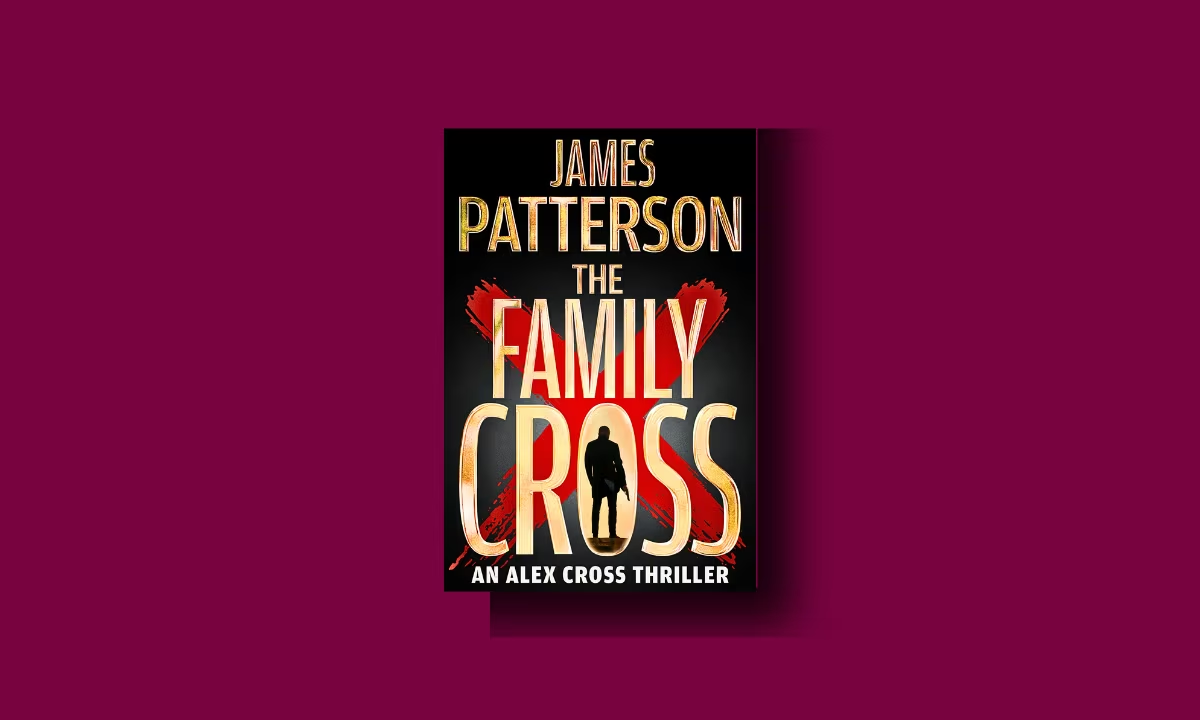
The Family Cross by James Patterson is an Alex Cross thriller that spends as much time beside Nana Mama’s hospital bed as it does under a crumbling DC off-ramp, and that split is the best thing about it. It went on sale on October 19, 2026 from Little, Brown, and it follows a run of victims who are shot and then burned, a homeless camp nicknamed the Bridge to Nowhere, and a stroke that threatens the woman who raised Alex.
My verdict: a fast, warm, slightly overstuffed read that rewards series loyalists and gives newcomers a decent way in. Spoilers start at the plot summary, so stop at the verdict if you want to stay clean.
The Family Cross at a Glance
What it is: Book 36 in the Alex Cross series by James Patterson, per Blackstone’s listing. Some retailers number it differently, so check your edition.
Publisher and date: Little, Brown and Company, October 19, 2026, 384 pages in hardcover.
Core story: A defrocked minister is found shot and burned in an Audi under an abandoned ramp. Alex Cross and John Sampson chase a killer nicknamed the Firebug while Nana Mama fights a stroke, a brain injury and her own mortality.
Twist, in one line: There is no single Firebug. Several killers are at work, and the Firebug cases were copied by people with their own reasons.
Verdict: Three and a half stars. The family scenes are the heart of The Family Cross. The mystery is busy and sometimes convenient.
Reader recommendation
If you have followed Alex Cross for years and care about Nana Mama, Sampson, Bree and the kids, this one will land, and you will probably get a little teary somewhere around the NCAA finals.
It also suits readers who like short chapters, quick reversals and a social conscience tucked inside a police procedural. People who want a tight, single-villain puzzle may bounce, because the case splits into several strands and a few of them are resolved by confession rather than detection.
Anyone sensitive to scenes of burning, child endangerment or abuse of teenage girls should know the book touches all three, though it handles them without lingering.
Introduction
The Family Cross is written by James Patterson and published by Little, Brown and Company. The Hachette listing gives the hardcover ISBN as 9780316569743 and the on-sale date as October 19, 2026. An audiobook read by Dion Graham is also listed.

I read The Family Cross in full before writing this, and the quotations below come from my copy, with chapter numbers given so you can check them.
Quick Verdict
A brisk, affectionate Alex Cross thriller that is at its strongest in the Cross living room and weaker in its conspiracy plotting. Recommended for series fans and readers who like family-driven crime fiction.
Should You Read It?
| Pros | Cons |
|---|---|
| Nana Mama’s recovery gives The Family Cross real emotional weight | The murder plot splits into several strands, and some are tied off by confession |
| Strong, specific setting in the Bridge to Nowhere camp | A few antagonists, such as Hayes and Winthrop, read as one-note |
| Very short chapters keep the pace high | The conspiracy around Frost and Lear stays thin and is resolved offstage |
| Sampson, Bree, Ali and Jannie all get real scenes | Hawk’s psilocybin episodes can feel overplayed |
| A hopeful, humane view of people living rough | The ending is sudden and will divide readers |
What Is It About?
Alex Cross and John Sampson investigate a series of murders in which victims are shot and then set on fire with aviation gas, tracing them to a homeless encampment under an unfinished ramp.
At home, Alex’s grandmother Nana Mama suffers a stroke and a head injury, and the family has to decide how much to fight for her. The two stories collide with a real-estate scheme and a thirteen-year-old boy who saw too much.
Rating
3.5 out of 5 stars.
Background
Does it matter if you have read the earlier books? Not much. Alex Cross is Patterson’s best-known detective, introduced in Along Came a Spider in 1993, and the series now has a television life too: the Penguin page for this novel notes the Prime Video series Cross, starring Aldis Hodge.
The Family Cross re-explains the household quickly: Alex’s wife Bree, his children Damon, Jannie and Ali, his partner Sampson, and Nana Mama, who is in her nineties and still records YouTube lectures on literature.
The setting leans on a real problem. In Washington, DC, the January 2025 count found 5,138 people experiencing homelessness, and Street Sense reported that older residents are the fastest-growing group of unhoused people in the region.
Patterson’s camp has its own elderly residents on the lowest, most exposed tiers, which matches that pattern.
The Family Cross plot summary
Part 1: The ghost ramp (chapters 1 to 7)
Nana Mama, Regina Cross, wakes at five on a stormy Friday, prays, writes her to-do list and watches her grandson Alex leave for the soup kitchen at St. Anthony’s.
Across Southeast DC, a thirteen-year-old named Boog, who lives with no adult in a plywood shack under an abandoned cloverleaf nicknamed the Bridge to Nowhere, sees a black Audi on the old road.
He spots a figure inside, smells fuel, and sees a thin line of blue flame race across the mud. The car explodes. Boog tells the neighbors there is someone inside, and they laugh.
Alex and John Sampson are serving breakfast when a woman called Anna Bananas, who has Tourette’s and likely bipolar disorder, rants about “people under the bridge.” Soon after, they are called to the burned Audi. The body inside has a small-caliber bullet wound at the back of the skull, so he was shot before the fire.
Anna turns up, claims she was with them when it happened, and eventually admits that her children, fourteen-year-old Emma and nine-year-old Luke, live there. Emma says her friend Boog called 911.
Boog makes the detectives buy him two cheeseburgers before he talks. What he saw: the flame, the lighter-like torch, a shadow in the brush. Then he adds that the dead man wore a clerical collar.
Part 2: Nana falls (chapters 8 to 19)
While Alex works, Nana Mama tries to write about Ernest Gaines and loses a word. Her right hand tingles. She steps out for her gardening hat, loses her balance and falls onto the bricks.
Ali comes home from school and finds her. He calls 911, but ambulances are swamped, so Alex and Sampson race home, strap her to one of Sampson’s orange traction boards, and drive her to St. Anthony’s in the back of his F-150.
Dr. Sydney Ames, the trauma surgeon and a family friend, discovers a broken arm, a gash and a minor ischemic stroke that likely caused the dizziness before the fall. Worse, the CT shows dangerous brain swelling. Alex, who holds medical power of attorney, authorizes a craniectomy.
During the long wait in the chapel, he remembers arriving at Nana’s house at nine, newly orphaned, and the rule she made her grandsons follow: kneel nightly and name three good things. Dr. Ames brings the news that Nana survived surgery and will be kept in a medically induced coma.
Part 3: Trolls, collars and a girl in pigtails (chapters 20 to 41)
Sampson explores the camp’s social order. The north embankment is ruled by Lainey Locket, a gaunt, articulate woman with a legal double-barrel shotgun. The south side belongs to Hawk, Alejandro Rodriguez, an ex-Delta operator who talks to the spirits of the men he killed and microdoses mushrooms. Locket mentions a young man known as Choir Boy, supposedly thrown out of a seminary.
Hawk tells the detectives about an earlier shot-and-burned body behind a condemned apartment building off New York Avenue.
Another body appears near a strip club: a girl of about fifteen, shot and burned while still alive. Her purse holds a fake Ohio ID, so she calls herself Corey McGovern. Alex realizes she is the girl in pigtails and a yellow cap they saw passing Hawk’s shelter.
Her phone shows a photo of Corey with Hawk and Choir Boy. Sampson then finds motel footage showing her entertaining clients: first a man in black who drives an Audi, then a baby-faced man who is plainly Choir Boy, then Hawk, who kisses her at the door and is gone for eight hours.
Part 4: Money, professors and a monastery (chapters 42 to 63)
Bree, who works in corporate security, finds that a developer, Frost and Lear, has been quietly buying every parcel around the ramp and owns the New York Avenue building where the first victim burned.
A third victim, Georgetown theology professor Drake Conway, is found burned in Rock Creek Park. Alex finds his backpack in a ditch. The press names the killer “the Firebug.”
Alex calls a Vermont monastery and learns Choir Boy is Aldous Campbell, a novice expelled after a piglet died. The Audi victim is identified as Dylan Sentinel, a defrocked Methodist minister with a long record of accusations of sexual abuse of homeless girls and women. Campbell is traced to St. Anthony’s, where he plays the organ and sings.
He is drunk, tells them he is not the killer, and drops a bomb on Alex: Alex’s estranged brother Charlie is homeless and had been squatting in the New York Avenue building. Alex fears the first victim is Charlie.
Part 5: Fire at Dulles (chapters 64 to 75)
Alex gets a cheek swab to compare with the first body. Bree meets Frost, Tatiana Volt and Egon Bijan, two investors who seem to be laundering money.
Alex and Sampson follow a tip that Hawk pumps aviation fuel at a Dulles private terminal. Hawk, high on mushrooms, sees them, opens the avgas trailer, and drives away flicking a lit cigarette into the spill.
The explosion destroys a plane and wounds several people. Hawk dances on top of the tanker, whistle in his mouth. Alex tases him and performs the Heimlich when he inhales the whistle.
The next morning Anna Bananas is found beaten to death by the river. Emma, Luke and Boog have vanished.
Part 6: Copycats (chapters 76 to 95)
Sampson and Alex find that Hawk, now in federal custody, cannot be the killer of Anna. Phone records tie Corey McGovern’s burner contact to Colin “Bing Bang” O’Hare, another veteran, and Brundage, a former detective turned new high troll, discovers that O’Hare was Drake Conway’s nephew by marriage.
Alex finds Jeffrey Frost executed in the New York Avenue building, with Charlie’s wool cap and old coach’s jacket on the floor. Medical examiner Janice Taylor confirms the first victim is not Charlie, which is a huge relief.
A foot chase through Georgetown University follows. Detectives Hayes and Winthrop, convinced Brundage is the Firebug, shoot him while O’Hare escapes. Choir Boy suggests where the missing kids might hide, and Alex and Sampson find a burned building near Takoma Park.
Part 7: The ending (chapters 96 to 107)
Inside, Boog and Luke are zip-tied and Emma is unconscious. O’Hare arrives with a pistol and makes the detectives bind themselves. He confesses: he did not kill the first victim or Sentinel, but he copied the pattern when he murdered Corey, who tried to stab him, and then killed his uncle Drake Conway for an inheritance. He denies killing Anna or Frost.
As he is about to shoot Boog, a bearded, soot-covered man crashes through the burned ceiling shouting, “Not in my house. Not today.” He swings a pipe, kills O’Hare and takes a bullet. He is Charlie. He survives surgery and later agrees to go to rehab.
Days later, Bijan breaks into the Cross home, holds Nana and her nurses at gunpoint, and boasts that he killed the first homeless man to scare off squatters and shot Frost to take the properties. When he aims at Nana, she throws her bedpan in his face and Alex shoots him dead.
The FBI learns Bijan was Egon Brezec, a Chechen with organized crime ties, and seizes Tatiana Volt’s assets.
One question remains: who killed Sentinel and Anna? Sampson ran Lainey Locket’s fingerprints from her shotgun and learned she is Alice McCall, who once accused Sentinel. She admits she killed Sentinel with a gun and avgas, copying the earlier murder, and that she killed Anna when Anna worked it out. Before arrest she lets go of the rebar and falls from the girder.
At the end, Jannie runs a great 400 meters at Notre Dame and finishes third in the nation. Nana Mama, watching from the stands, seems to collapse. Patterson never writes the word, but the last lines tell us the family has changed forever.
Analysis
Characters
Who is the real lead of The Family Cross? Nana Mama. Alex does the detecting, but she gets the best scenes, and her coma sequences, where she drifts through memories of being left at a bus station at eight, give the story a tenderness the case lacks.
Her dry humor survives aphasia (“What else I have? IV line?”), and the bedpan moment is The Family Cross‘s most memorable beat.
Alex Cross is steady, almost serene, and his psychology background gives him a reflective streak, as when he notes that people at the bottom only recover once they ask for help. He is less sharp as a detective here. He is led to each answer by confession or someone else’s discovery, and the Locket reveal is Sampson’s work.
John Sampson is the more active partner, and his storyline with Boog, in which he feeds a hungry kid while pressing him for information, is the most human thing in the investigation.
Boog, Emma and Luke are The Family Cross‘s conscience. Boog’s “Do it” to O’Hare is a real moment of courage, and Emma’s quiet management of her family’s shelter is a small portrait of resilience.
Hawk, Brundage and Choir Boy are damaged men who keep being treated as suspects. Brundage is the best of them: a disgraced detective who slowly looks after the camp, then sobers up and tries to earn his old life back with a doomed citizen’s arrest.
Lainey Locket is the most interesting villain because she is also a victim. Her motive is understandable, and her shotgun and speech about “karma” make sense afterward. My only complaint is that the clues to Alice McCall are thin until the last chapters.
Bijan and Volt are the weakest, a stock criminal pair whose motives are delivered in a villain’s monologue.
Themes and symbolism
Invisibility. The first line of dialogue on the subject comes from Anna, who says a society is “judged by the way it treats the people on the lowest rungs” (Ch. 3). Later Sampson complains that the media cares about a professor and not a homeless girl (Ch. 49). The theme is not subtle, but it is sincere.
Copycat violence. The most original idea in The Family Cross is that no one man is the Firebug. A real killer’s method leaks into public imagination, and others borrow it. Volt’s furious line in Chapter 72 about copycats is a quiet foreshadowing.
Family and mortality. The title works on several levels: the Cross family, the family Alex finds in the camp, and Charlie’s return. The ending makes clear that Nana Mama’s life is the structure holding everyone together.
Voice and language. Choir Boy’s tenor and Nana’s broken sentences mirror each other. One gains a voice as the other loses hers.
Symbols. The ghost ramp, a road that goes nowhere, is a neat image for a city that has built a hierarchy on its embankments, and Boog compares it to Animal Farm. Fire stands for punishment and cover-up. Nana’s nightly “three good things” is the book’s answer to both.
Evaluation
The Family Cross is a brisk, tender and uneven thriller that saves its best scenes for a hospital room and a bedpan.
Strengths
The family scenes are excellent. Short chapters make The Family Cross almost impossible to put down. The camp is vividly drawn, with its tiers, sentries and unspoken rules. The track-race sequences are exciting even if you know the result.
Weaknesses
Too many things are solved by confession. Hayes and Winthrop exist mainly to be wrong. The Frost and Lear conspiracy is introduced, then handled quickly by the FBI. A few coincidences, such as Charlie being in the right ceiling at the right moment, ask a lot of the reader.
The ending is the thing readers will argue about. Nana Mama does not die on the page, but the tone leaves little doubt. I found it moving rather than cheap, because the book spends so many chapters on her stubbornness and humor. Others will feel cheated by the cliffhanger.
Comparison with similar works
Within the series, this sits closer to Cross My Heart, which Apple Books describes as putting Cross’s family under threat, than to the serial-killer puzzles of the early books. It is also gentler than Triple Cross, whose Family Man plot is far more violent.
What the book teaches about who we stop seeing
Is homelessness mostly a problem of single adults on the street? Not quite. The book shows children, elderly people and veterans under the ramp. The 2025 DC count found 5,138 people, and the 2026 count, according to Street Sense, rose 5 percent with family homelessness up 16 percent. Only 718 slept outside on that night, so camps like the Bridge to Nowhere are the visible tip of a larger problem.
Five lessons I took from it:
Hunger buys honesty slowly. Sampson gets more from Boog with a burger than a badge.
Disorder does not mean danger. Anna Bananas sounds chaotic and sees more clearly than the cops.
Convenient suspects hide real ones. Hayes and Winthrop chase Brundage and nearly lose the case.
A hierarchy forms wherever people are abandoned. The camp’s tiers copy the city’s.
Asking for help is the hinge. Choir Boy, Charlie and Brundage each turn when they stop going solo.
Quotable lines
- “Still here” and “Still kicking. Still smiling.” Nana Mama’s morning mantra (Ch. 1).
- “Judged by the way it treats the people on the lowest rungs.” Anna Bananas (Ch. 3).
- “This could really be it. The end of an era.” Alex in the ER (Ch. 12).
- “Make life masterpiece.” Nana, in broken speech, at her best (Ch. 50).
- “Not in my house. Not today.” Charlie, bursting through the ceiling (Ch. 97).
- “Not today.” Nana, a second before the bedpan flies (Ch. 101).
- “What else I have? IV line?” Nana, answering how she thought of it (Ch. 102).
- “We were the Cross family before, and now we were the Crosses forever after.” The last page (Ch. 107).
Conclusion
The Family Cross is not the tightest mystery in the series, but it may be one of the most affectionate. The Firebug puzzle works best when it forces Alex to look at people he usually passes, and the Cross household scenes show why anyone bothers to keep fighting.
I would hand it to series regulars, to readers who like their thrillers with a heart, and to anyone who liked the family-under-pressure side of Cross My Heart.
Skip it if you want a cold, clever whodunit. It matters because it treats a forgotten camp with respect and gives a ninety-something grandmother the best scene in The Family Cross.
The Family Cross

The Family Cross by James Patterson is an Alex Cross thriller that spends as much time beside Nana Mama's hospital bed as it does under a crumbling DC off-ramp, and that split is the best thing about it. It went on sale on October 19, 2026 from Little, Brown, and it follows a run of victims who are shot and then burned, a homeless camp nicknamed the Bridge to Nowhere, and a stroke that threatens the woman who raised Alex.
URL: https://www.sopranu.com/the-family-cross-james-patterson-review/
Author: James Patterson
3.5
Pros
- Moving Nana Mama storyline; vivid camp setting; very short, fast chapters; strong supporting cast
Cons
- Several strands resolved by confession; thin conspiracy plot; one-note antagonists; divisive ending