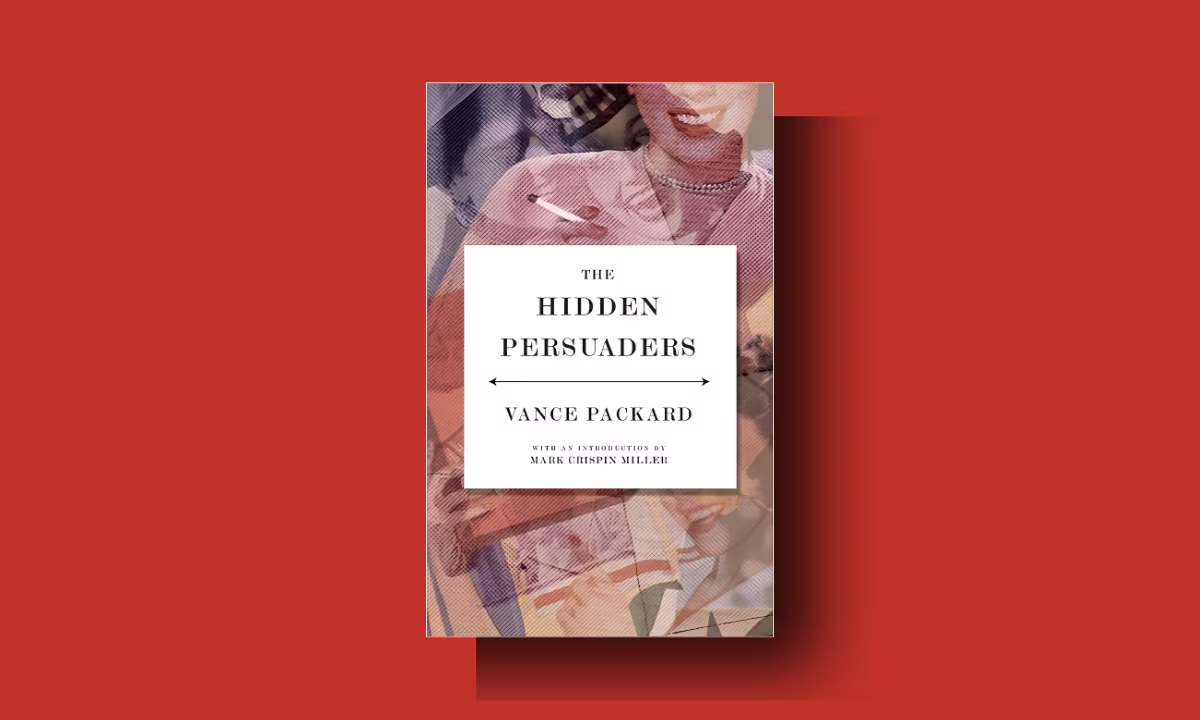
The Hidden Persuaders by Vance Packard is a 1957 exposé of how advertisers, political strategists and corporate managers used psychoanalysis and social science to steer what Americans buy, believe and vote for. It is thin on proof and generous to its sources, yet it still explains why a brand feels like a friend, why a “bargain” two-for-29-cents price works, and why you are rarely sure why you bought something.
I read the 2007 reissue (the IG Publishing edition with Mark Crispin Miller’s introduction, about 240 pages), and what follows is a full guide to what the book argues, where it holds up, and where later history turned against it.
Table of Contents
The Lessons at a Glance
Core thesis. Marketers decided that people do not know what they want and will not tell the truth about it, so they hired psychologists and anthropologists to find the “hidden” emotional triggers behind purchases (Chapters 1 to 3).
Method. Depth interviews, word association, ink-blot and picture tests, even hypnosis and eye-blink cameras (Chapter 4).
Product strategy. Sell an image, a feeling or a permission slip, not a product. Cosmetics sell hope, cars sell status, cake mixes need the cook to “add fresh eggs” so she still feels creative (Chapters 5 to 9).
Social strategy. Target by class and status anxiety, and by children as “consumer trainees” (Chapters 10 to 16).
Spread beyond shopping. Politicians, public-relations firms and employers adopted the same toolkit (Chapters 17 to 21).
Packard’s own warning. The deepest offence is invading the “right to privacy in our minds,” in his closing words (Chapter 23).
Biggest caveat. The evidence is mostly what the persuaders told Packard about themselves, and he admits motivation research is far from exact (Chapter 22).
Quick Verdict
A pioneering, readable and uneven exposé that overrates the power of the persuaders but correctly predicts their ambitions. Read it as a history of how modern marketing thinks, and as a checklist for spotting emotional pressure in your own buying.
Should You Read The Hidden Persuaders? Pros and Cons
| Pros | Cons |
|---|---|
| Names real firms, researchers and campaigns, so every chapter has a concrete case | Much of the evidence is self-reported by marketers who had reason to sound infallible |
| Short, vivid chapters you can read in any order | Treats consumers as more predictable than they are |
| Covers consumers, voters, workers and children in one argument | Almost no attention to people outside the middle-class market |
| Packard questions his own sources in Chapters 22 and 23 | No endnotes in the edition I read, a problem Miller flags in the introduction |
| Explains the roots of branding, packaging and political image-making | Some examples now read as quaint or sexist |
What Is The Hidden Persuaders About?
It is a report on “motivation research,” the 1950s industry that used psychology to find the unconscious reasons people choose products, candidates and causes.
Packard follows the practice from supermarkets and car showrooms into political campaigns and corporate personnel offices, then ends by asking whether the whole enterprise is valid and whether it is moral.
Rating
4 out of 5 stars. One star off for the soft evidence and the 1950s blind spots. Four stars stay because the central question, when persuasion becomes manipulation, has not gone away.
Who Should Read It, and Who May Bounce?
Marketers, designers, students of media and politics, and anyone who has ever wondered why a purchase felt more emotional than rational will get the most from this book, because it shows the thinking behind techniques that still shape shop shelves and screens.
Readers who want controlled experiments, statistics and footnotes may bounce off the anecdotal style, and so will anyone hoping for a how-to manual.
If you want proof that advertising works, this is the wrong book. If you want to understand what its practitioners believed about you, it is the right one.
Introduction: Title, Author and Context
The Hidden Persuaders was first published in April 1957, and, per Miller’s introduction, it reached the top of the New York Times nonfiction list on August 4 and stayed there into late September.
A report on the book’s legacy notes that about three million copies were in print by 1975.
Vance Packard was a magazine journalist, not a psychologist or an economist. According to Miller, he had worked as a staff writer for American Magazine until it folded, and he hoped the book might sell 12,000 copies. It became the first of a bestselling trilogy that continued with The Status Seekers (1959) and The Waste Makers (1960). That background matters.
Packard writes like a reporter who has found a story, and he is at his best when he lets executives talk.
His stated purpose is plain from the first page. He wants to describe large-scale efforts “to channel our unthinking habits, our purchasing decisions, and our thought processes” with tools borrowed from psychiatry and the social sciences. He does not call for a ban, a law or a boycott.
He calls for public scrutiny.
Background
They turned to psychology because the old methods stopped predicting behavior. Chapter 2 gives the reasons. Surveys misled: a ketchup maker’s customers said they wanted a new bottle and then rejected it in stores, and women praised a traditional waiting room after they had overwhelmingly chosen a modern one.
Production also outran demand. Packard cites gross national product rising more than 400 percent since 1940 and the 1955 Advertising Age warning that consumers might skip buying around 40 percent of what is made, with a depression following.
Products had also grown alike, which is why David Ogilvy is quoted saying reason plays little part when brands are technically identical.
The industry’s answer was to treat shoppers as bundles of fears and wishes. By Packard’s account, the movement became serious after the Second World War, with Ernest Dichter and Louis Cheskin competing to be called its father. Historical context helps too. The same year Packard published, Americans were absorbed by Cold War fears of brainwashing, and that anxiety helped his argument land.
Summary of The Hidden Persuaders
Chapter 1. The Depth Approach
Packard opens with a warning and a sorting of examples. Some manipulation is “simply amusing,” some is “disquieting.”
He says two-thirds of America’s hundred largest advertisers had geared campaigns to motivation analysis, that a Chicago agency studied the housewife’s menstrual cycle to time food appeals, and that fund-raisers, churches and employers were learning the same tricks. He is careful to add that a majority of ad men still do honest work.
Chapter 2. The Trouble with People
Marketers found three problems with customers.
People do not know what they want, they will not say honestly what they want, and they are not rational. The evidence is a string of short experiments. Housewives judged three boxes of identical detergent differently depending on the box color.
Forty percent of people who said they disliked kippered herring had never tasted it. A store that sold a fourteen-cent item for two for 29 cents saw sales rise 30 percent. Chrysler read surveys literally, built for “sensible” buyers, and watched its market share fall from 26 percent in 1952 to about 13 percent in 1954, before restyling brought it back.
The chapter also introduces the economic pressure behind everything else. Executives began talking of “psychological obsolescence,” making owners ashamed of things that still worked, and of becoming “merchants of discontent.”
Chapter 3. So Ad Men Become Depth Men
Packard explains the three levels marketers cared about, the conscious, the half-aware and the fully hidden, and introduces the main figures. Ernest Dichter ran a thirty-room institute above the Hudson and charged $500 a day for advice.
Louis Cheskin tested packages “on the unconscious level.” Burleigh Gardner built Social Research around class. James Vicary tested words and measured eye blinks.
The Advertising Research Foundation published directories listing 82 research outfits and 150 social scientists for hire. Trade journals such as Printer’s Ink, Tide and Fortune treated all of this as mainstream.
Chapter 4. And the Hooks Are Lowered
The techniques are borrowed from the clinic: depth interviews, group “reveries,” Rorschach and Thematic Apperception tests, the Szondi test (used on whisky drinkers), galvanometers, eye-blink cameras and even hypnosis.
Packard also reports a London Sunday Times story about a New Jersey cinema flashing ice-cream ads too fast to see, and he notes that his own academic source was skeptical and that the paper’s sources would not come forward.
He ends by listing trade-press evidence that the approach had become common, including Fortune’s 1956 estimate, as Packard reports it, that about half of consumer-product advertising money came from industries where at least one major maker had tried it.
Chapter 5. Self-Images for Everybody
When brands cannot be told apart, sell an image. In a test of 300 smokers loyal to three brands, only 35 percent picked their own brand blind, barely above chance.
Pierre Martineau tells Philadelphia ad men the aim is to “create an illogical situation,” love without reason. Examples include Cheskin’s growing four-leaf clover on a margarine package, Ogilvy’s eye-patch man for Hathaway shirts, and Procter and Gamble giving Ivory, Camay, Crisco and Golden Fluffo distinct personalities.
The logic is narcissism: people buy a projection of themselves.
Chapter 6. Rx for Our Secret Distresses
This chapter is about guilt. Dichter’s rule was that selling self-indulgence means offering absolution. Smokers, studied through a 350-person depth study, were found to use cigarettes for tension relief and, above all, to prove mature vigor. Candy makers were told to push bite-size pieces so buyers could feel moderate.
The chapter shows motivation research doing what it does best, which is turning a product problem into an emotional permission.
Chapter 7. Marketing Eight Hidden Needs
Packard lists needs ads can attach to products, among them emotional security, reassurance of worth, ego gratification, creative outlets, love objects, a sense of power, roots and immortality.
Freezers become “islands of security,” air conditioners appeal to people who crave enclosure, and detergent ads should honor the housewife’s unappreciated work. The best-known case is the cake mix. Women felt that adding only water was not real baking, so makers left the cook something to do, such as adding fresh eggs.
Chapter 8. The Built-In Sexual Overtone
Sex had long sold goods, but depth researchers made it subtler. Perfume makers learned that sexual promises left buyers disappointed and disloyal. Dichter’s “Mistress versus Wife” study for Chrysler argued that men daydream about convertibles but marry sedans, a gap he said the hardtop closed.
Packard also covers the Maidenform dream campaign and a study treating pens as body images.
Chapter 9. Back to the Breast, and Beyond
Freudian oral theory becomes a sales tool. Smoking, chewing and sipping are framed as grown-up versions of infant comfort, and Social Research’s milk study ties the drink to security. Packard is openly amused, though he reports the claims as the researchers made them.
Chapter 10. Babes in Consumerland
Packard argues the supermarket itself became a persuasion machine, with about seven in ten purchases made on impulse by the figures he cites. Vicary’s hidden camera reportedly recorded shoppers’ blink rates dropping to about 14 a minute, which he called a “hypnoidal trance,” then spiking when the cash register rang.
This is a vivid scene, but it rests on one researcher’s claim, and I could not independently verify the study.
Chapters 11 and 12. Class, Caste and Upward Strivers
Packard presents Lloyd Warner’s six social classes as a marketing manual. Merchandisers focused on the upper-lower and lower-middle groups, about 65 percent of a typical community. He then shows how status anxiety is used: a bourbon drinker who is promoted quickly “discovers” Scotch, buyers pay for the look of a large stove they will not use, and shoppers reject small cars because, when probed, the worry about “safety” was really fear of looking small to neighbors.
This is also where his blind spots show, because he rarely looks below the market that mattered to advertisers.
Chapter 13. Cures for Our Hidden Aversions
Products are treated as patients with inferiority complexes. The prune, a “joyless Puritan” in Dichter’s phrase, was relaunched as a “wonder fruit,” and Vicary’s profiling of buyers is also described. The theme is rebranding as therapy.
Chapter 14. Coping with Our Pesky Inner Ear
Words and names get tested. In one Vicary word-association test, a brewer’s coined term “lagered” produced beer associations in 34 percent of people and “slow, tired, drunk, lazy” in 36 percent, so it was dropped. Tire makers, who suffer from the way drivers first notice the brand name during a blowout, get the same treatment, and Philip Morris’s shift toward the word “gentle” is cited alongside a 26 percent first-quarter sales rise.
Chapter 15. The Psycho-Seduction of Children
Packard quotes David Riesman calling children “consumer trainees” and reports an ad in a trade journal for classroom materials promising that “eager minds can be molded to want your products.” The aim is lifelong brand loyalty. For a modern reader this may be the most uncomfortably current chapter.
Chapter 16. New Frontiers for Recruiting Customers
A multimillion-dollar drive pushed men to buy more clothes, with hat makers telling males that every hat they own “just went out of style.” The same chapter shows industries trying to widen demand by redefining what a normal household should own.
Chapter 17. Politics and the Image Builders
This is the book’s second half, and it moves from shoppers to citizens.
Packard traces the “Hucksters Take Over” headlines of 1950 and notes that by 1952 professional persuaders were in the inner councils of at least one party, citing a Brookings Institution study of the 1952 campaign that found professional propagandists had pervasive influence on the Eisenhower side, while the Democrats used fewer professionals.
By 1956, the Republicans had booked large blocks of prime television time and Rosser Reeves had applied the toothpaste logic of repetition to voting. Packard also reports that William Benton, a Democrat and ad man, used mass-merchandising methods in his own Senate race, and that Democrats later tried to catch up with their own research advisers.
His point is not about any one party. It is that both parties adopted the sales model. He also describes Richard Nixon through the eyes of the journalist Richard Rovere, who saw “an advertising man’s approach.”
Chapter 18. Molding “Team Players” for Free Enterprise
Employers used psychological testing and “social engineering” to select and shape conformist managers. Packard draws on William H. Whyte’s warning about “rationalized conformity” and Riesman’s idea of the other-directed person, who follows the crowd rather than inner goals.
Chapter 19. The Engineered Yes
Public relations becomes the persuaders’ biggest field. Packard counts roughly 40,000 practitioners, quotes Edward Bernays’ manual The Engineering of Consent, and cites a federal judge who called publicity “a black art.”
Chapter 20. Care and Feeding of Positive Thinkers
Executives were deliberately talking up the economy because a national “buying mood” mattered. Packard cites Tide admitting that much of the cheerful talk was “carefully calculated psychology,” and University of Michigan research that connected optimism with spending.
Chapter 21. The Packaged Soul?
He closes the reporting with possible futures. One is John G. Schneider’s satirical novel The Golden Kazoo, in which a 1960 presidential race is run by two ad agencies. Another is a Florida planned community, Miramar, where friends come with the house. Packard presents them as warnings, not predictions.
Chapter 22. The Question of Validity
The book then turns on itself. Packard lays out four criticisms of motivation research. First, enthusiasts oversold it as a cure-all. Second, clinical tests were applied to mass behavior without proof they transfer.
Third, results depend on the skill of the interviewer, and the Advertising Research Foundation’s Wallace Wulfeck said sample sizes were a worry, with the largest depth sample he had seen being 200. Fourth, findings were often accepted without checking by conventional methods.
Cheskin admits “sometimes I think we can go in too deep,” and one agency research director says in 20 to 30 percent of its studies it finds nothing useful. Packard still concludes the approach “is here to stay,” because marketers had no better tool.
Chapter 23. The Question of Morality
His verdict is measured. He sees constructive uses, including less crude advertising, but he is troubled by the assumption that anything raising gross national product is good, by social scientists being “used,” and by the creation of wants as an economic engine. He proposes ethical codes from the Advertising Research Foundation, the Public Relations Society of America and the American Psychological Association. His final judgment is that the worst offence is invading the “right to privacy in our minds.”
Analysis and Critique: Does the Evidence Hold Up?
Honestly, only partly. Miller says the book is largely anecdotal, lumps different methods together under “M.R.,” and relies mostly on what top practitioners said, who had every reason to look infallible. A later essay in the Los Angeles Review of Books agrees that the book was thin on evidence and gave motivational researchers too much credit.
Packard’s own Chapter 22 supplies most of the criticism a skeptic would make, though, as Miller observes, it arrives late and almost as an afterthought.
The strongest defense is the one Packard gives himself. Whether or not every technique worked, the persuaders believed it did and spent real money on it. The Fortune and Printer’s Ink figures he cites make that point better than any single anecdote.
What about subliminal ads?
This is where the book is most often misunderstood. Many people assume The Hidden Persuaders proved that secret flashes sell popcorn.
It did not. According to Miller, Packard treats the one cinema claim he mentions with skepticism and never argues that advertisers used subliminal techniques. The timing also tells against the myth. Packard’s book appeared in April 1957, and Vicary’s famous Fort Lee movie-theater claim came at a press conference in September 1957.
Vicary admitted in 1962 that the experiment was a gimmick to attract customers to his failing business, and the advertising trade body 4A’s later noted that the idea was revived by Wilson Bryan Key in 1973.
So the irony is double. The book that gets blamed for the subliminal scare did not make the claim, and the researcher behind that scare is also one of Packard’s sources for the supermarket “trance” and word tests. That does not disprove those studies, but it is a good reason to treat Vicary’s results with caution.
Strengths
The best parts are the chapters where the persuaders speak for themselves. The cake-mix egg, the prune relaunch and the small-car “safety” answer are memorable because they show a gap between stated reasons and real ones. Penn State’s coverage of the Packard papers quotes a professor calling it the first book to treat modern advertising seriously.
The Wellcome Collection’s essay on the book highlights Packard’s picture of ad men “systematically feeling out our hidden weaknesses and frailties” and links it to later warnings about online manipulation.
Weaknesses
Miller also calls the book ahistorical and apolitical. Packard treats covert persuasion as a trend inside marketing rather than a product of the economic system, and he leans on a nostalgic, Jeffersonian picture of the independent citizen.
The gender framing is dated, with housewives cast as the default irrational shopper. His readers are the people ad men cared about, which leaves out the poor.
My take
The Hidden Persuaders is an unsteady, brilliantly timed alarm bell, more important for the question it asks than for the answers it gives.
Does the Book’s Warning Still Matter? What Changed in 70 Years
Yes, but the problem has moved. LARB’s Mark Bartholomew notes that Packard unmasked hidden practices, while many of today’s advertising techniques operate beyond our field of vision. In my reading, the tools have shifted from depth interviews to data, but the aim Packard described is the same.
A column by Nicole Hemmer, published in US News and World Report, goes further and says that we have long since handed over “the privacy of our minds” to corporations.
Regulators now use language Packard would recognize. The FTC’s staff report on dark patterns names four families of manipulative design: deception, hidden information, unauthorized charges and privacy subversion. Cancellation mazes and confusing consent banners are the modern cousins of the cake mix that left the cook one small task, built on the same idea that the interface can shape the choice.
I did not verify the current status of the FTC’s “click to cancel” rule, so check that before citing it.
Three practical habits follow from Packard, and none needs a PhD:
- Ask what feeling the ad is selling. If a skin cream costs ten times a bar of soap, you are buying a promise.
- Test your loyalty blind. In Chapter 5, most smokers could not pick their own brand. Try it with coffee or soda.
- Notice permission slips. “Just a bite,” “you deserve it” and “treat yourself” are Dichter’s absolution formula at work.
Books Like The Hidden Persuaders
The Status Seekers and The Waste Makers by Vance Packard. The same author on class anxiety and planned obsolescence, both mentioned in Miller’s introduction.
The Lonely Crowd by David Riesman and The Organization Man by William H. Whyte. Packard leans on both for the idea of other-directed conformity. Riesman gives the theory, Whyte the corporate version.
The Engineering of Consent, edited by Edward Bernays. The public-relations manual Packard quotes, useful as the persuaders’ own side.
Reality in Advertising by Rosser Reeves and Confessions of an Advertising Man by David Ogilvy. According to Miller, both books implicitly argue that no hidden persuaders exist and that ads succeed through clear selling propositions.
Subliminal Seduction by Wilson Bryan Key. Often confused with Packard, and a good test case for how myths spread.
Influence by Robert Cialdini. A modern, research-based look at persuasion, recommended by one marketing writer for its six themes of social proof, scarcity, consistency, reciprocation, liking and authority.
Reader Reception
On Goodreads, the work page showed an average of 3.84 from 1,345 ratings when I checked, which fits my own mixed feeling: widely read, rarely loved. Reviewers there describe the prose as clear and accessible, assertive but not rigorous.
I could not find a related post on sopranu.com through search, so I have not linked to one. If you have a relevant sopranu.com article on advertising, persuasion or consumer culture, it would fit naturally under the Books Like section.
Conclusion: Is The Hidden Persuaders Worth Reading?
Yes, if you take it for what it is. It is not a rigorous study, and its heroes and villains are sometimes the same men. But it records, in the persuaders’ own words, the moment business decided that logic sells less than longing. Marketing students, political observers, designers and curious general readers will all find something.
Specialists wanting experimental data should pair it with a modern consumer-psychology text.
My closing recommendation is simple.
Read Chapters 2, 5, 7 and 22 first. They give you the problem, the image strategy, the emotional needs and the book’s own self-critique in about fifty pages.
The Hidden Persuaders

The Hidden Persuaders by Vance Packard is a 1957 exposé of how advertisers, political strategists and corporate managers used psychoanalysis and social science to steer what Americans buy, believe and vote for. It is thin on proof and generous to its sources, yet it still explains why a brand feels like a friend, why a "bargain" two-for-29-cents price works, and why you are rarely sure why you bought something.
URL: https://www.sopranu.com/the-hidden-persuaders-vance-packard-review-summary/
Author: Vance Packard
4
Pros
- Concrete named cases; covers consumers, voters and workers; self-critical final chapters; influential history of branding
Cons
- Anecdotal evidence from interested sources; overstates how predictable people are; no endnotes in this edition; dated gender and class assumptions