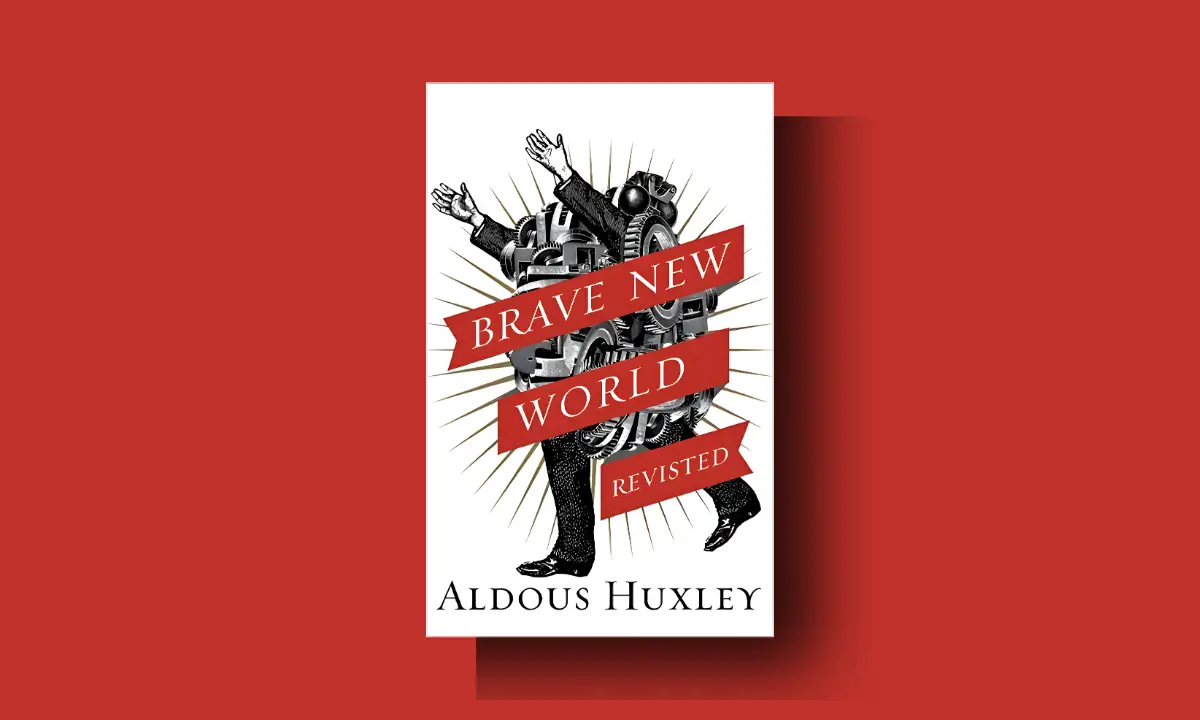
Is Brave New World Revisited still worth reading in 2027? Yes, though not because Huxley forecast the future well. He expected every overcrowded, poorer country to fall under totalitarian rule within about twenty years, and he leaned on subliminal advertising claims that their author later admitted were “a gimmick”.
What survives is the book’s central fear, that people will hand over their freedom if you keep them fed, amused and calm. Neil Postman later built an entire book on that idea, and after reading Huxley’s twelve short chapters myself, I understand why it refuses to die.
Table of Contents
What You Need to Know in 60 Seconds
The setup. Huxley wrote this in 1958, twenty-six years after the novel first appeared in 1932, to test his prophecy against real life. His verdict: the nightmare is arriving much sooner than he guessed (Chapter I).
The thesis. Two blind forces, runaway population and over-organization, push societies toward central control. Human manipulators speed it up with propaganda, advertising, brainwashing, drugs and sleep-teaching (Chapters I to X).
The twist. Control by reward and distraction works better than control by terror, so Huxley bet on Brave New World over 1984. In a 1949 letter he had already told Orwell that rulers would find less wasteful ways to govern.
The cure. Teach people the facts of human diversity, the values of freedom, charity and intelligence, and the habit of dissecting propaganda. Spread property and power into small self-governing groups (Chapters XI and XII).
What failed. The Communist takeover forecast, subliminal projection, the fear of falling intelligence, and the case for sleep-learning.
What held. Distraction as a political tool, advertising aimed at the unconscious, the appetite for tranquillizers, politics sold like deodorant, and young people’s weak faith in democracy.
Quick Verdict
A sharp, uneven and often prophetic essay that gets many details wrong and the big warning right. Read it for the argument, and check its science before you trust it.
Should You Read Brave New World Revisited?
Yes, if you like arguments more than plots, and no, if you want a tidy, up-to-date science book. Here is the short version.
| Pros | Cons |
|---|---|
| Short: twelve chapters you can finish in a weekend | Several headline predictions failed, including the Communist takeover |
| Names the distraction problem decades before smartphones | Leans on the debunked popcorn experiment and thin sleep-learning evidence |
| Chapter V reads Hitler’s own theory of crowds with chilling clarity | Chapter II’s fear of declining human stock reads as dated and uncomfortable |
| Offers concrete remedies in education and decentralization | Its remedies are sound on paper but untested, and Huxley admits we rarely act on them |
| Written by a novelist, so the sentences travel fast | Praises LSD as almost costless, which looks naive |
What Is Brave New World Revisited About?
It is a non-fiction sequel in which Huxley checks the predictions of his 1932 novel against the world of 1958. He argues that overpopulation, bureaucratic over-organization and new tools of persuasion are dragging free societies toward a gentle, pleasure-based dictatorship.
His answer is education for freedom, backed by spreading power into small, self-governing groups.
Rating
4 out of 5 ★★★★☆
I take off one star for the failed forecasts and dated science. The central warning has aged too well to take off more.
Who Will Love It, and Who May Bounce?
You will get the most from this book if you have read Brave New World or 1984 and want the argument behind the fiction, if you study or teach media, politics or advertising, or if you simply suspect your attention is no longer fully your own. Students of propaganda will find Chapters IV to VII a compact primer.
You may bounce if you want a modern, evidence-first account of persuasion, because Huxley writes with 1950s psychology and some of what he trusts has not survived.
Readers who dislike eugenic language will also wince in Chapter II. If you need a plot, skip it. This is an essay, and a dense one, though it moves faster than its subject suggests.
Who Wrote Brave New World Revisited, and When Did It Appear?
Aldous Huxley, the English novelist born in 1894, published Brave New World Revisited in 1958, and he lived in California from 1937 until his death in 1963. The SF Encyclopedia lists the first edition under Harper and Brothers of New York, though some library records give Harper and Row. A public library catalogue note says most of the material first ran in the newspaper Newsday under the title “Tyranny over the Mind.”

Brave New World Revisited is social criticism, a mix of essay, reportage and polemic rather than a scientific study. Huxley was no scientist. He reads like a very well-read novelist borrowing from Pavlov, Freud, Erich Fromm, Bertrand Russell and B. F. Skinner.
His thesis, stated in the first chapter and repeated in the last, is that free societies are drifting toward a non-violent totalitarianism. Blind forces such as population pressure and over-organization push the drift along, deliberate manipulation speeds it up, and only a deliberate education for freedom can slow it.
Why Did Huxley Write a Sequel to His Own Novel?
He wrote it because the world seemed to be catching up with his fiction. In Chapter I he admits that in 1931 he believed there was plenty of time, and that the nightmare of total organization sat safely in the sixth or seventh century After Ford.
By 1958 he felt a good deal less sure.
The mood of the late 1950s explains the urgency. In October 1949 he had written to Orwell that a ruling oligarchy would find less arduous ways to govern than terror, and that those ways would resemble Brave New World. In 1957 Vance Packard’s The Hidden Persuaders became a best seller, and James Vicary announced his subliminal popcorn results that September. Huxley also mentions the Sputnik launch of October 4, 1957, which he waves away as irrelevant to the world’s hungry masses. Add the Cold War, and you can see why he sounded worried.
Summary: What Does Brave New World Revisited Argue?
Each chapter adds one piece to a single case: free societies are sliding toward gentle control, and few people are resisting. The book has twelve chapters, and I have followed them in order, so you can use this section as a stand-in for the text.
Chapter I, Over-Population
Huxley opens Brave New World Revisited by admitting his 1931 optimism was wrong. He had believed the completely organized society was centuries away, and in 1958 he sees it around the next corner.
He then separates the two nightmares. 1984 runs on punishment and fear, while his own fable runs on rewards and manipulation, which he argues works better, since punishment only pauses unwanted behavior. Genetic standardization, babies in bottles, he rules out for now, so future control will happen after birth.
Even the Soviet Union, he notes, had started paying its scientists and engineers handsomely while still using terror on the bottom of the pyramid.
Then comes the demographic argument. World population was about 250 million at the start of the Christian era, just under 2 billion in 1931 and 2.8 billion when he wrote. It was growing by about 43 million a year, the equivalent of another India every four years, and would double in under fifty years. Penicillin, DDT and clean water make death control cheap, while birth control demands money, literacy and cooperation from millions of people.
His chain of cause is the book’s first big claim. Crowding creates economic insecurity, insecurity creates unrest, unrest hands power to central governments, and power, once held, is rarely given back.
Add Communism, and he predicts that within twenty years all over-populated, underdeveloped countries would probably be under totalitarian rule. He dismisses the Space Age as irrelevant to the hungry masses, for whom this will be the Age of Over-population. Even the United States faces an indirect threat, he says, because a permanent war footing means permanent control.
Chapter II, Quantity, Quality, Morality
Huxley now worries about quality as well as numbers. Modern medicine and social care let children with hereditary defects survive and have children of their own, so he fears average health, and perhaps intelligence, will slide. He leans on the psychologist W. H. Sheldon, who warned that the best stock was being outbred. I could not verify those claims, and the book does not prove them.
The chapter ends with a moral knot instead of a solution. DDT wipes out malaria, then leaves more people than an island can feed. Kindness to the sick spreads genetic weakness. Huxley asks what we should do when good means produce bad ends, and offers only a call for intelligence and goodwill.
Chapter III, Over-Organization
Technology, Huxley argues, concentrates power. Mass production and mass distribution crush the Little Man and reward the Big Man. Under a dictatorship the State controls Big Business. In a democracy such as America, he says, what the sociologist C. Wright Mills called the Power Elite does, and it also owns the media. He bends a Churchill line to make the point: “never have so many been manipulated so much by so few.”
He then asks what this does to individuals, quoting Erich Fromm: a society can look healthy because people adjust perfectly to something abnormal.
Huxley adds his own idea, the Will to Order. Science and art turn confusion into pattern, which is harmless there. In politics and economics, the same urge becomes a taste for uniformity, and tidiness turns into an excuse for despotism. Organization is necessary, but too much turns people into automata.
Humans, he insists, are moderately gregarious, more like wolves than termites, so a society can be an organization but never an organism. Yet a new Social Ethic, described in William Whyte’s The Organization Man, tells people to prize adjustment, teamwork and “dynamic conformity.”
Huxley mocks social engineers who see no need for anyone to supervise them, mocks Elton Mayo’s claim that people most want to work alongside others, and mocks the romantic picture of medieval peace. He closes with a neat contrast. In 1984 rulers use pain and sexual puritanism to keep tension high.
In Brave New World, they allow sexual freedom and inflict “a hardly less humiliating pleasure.”
Chapter IV, Propaganda in a Democratic Society
Huxley starts with Thomas Jefferson’s faith that people with a free press and literacy can govern themselves. He mostly agrees, but only if they get a fair chance, and he argues overpopulation and over-organization are taking it away. He separates rational propaganda, which appeals to enlightened self-interest with honest evidence, from non-rational propaganda, which runs on repetition, scapegoats and passion.
Mass media, he says, are neutral forces. But ownership is concentrating: small local papers vanish because pulp, presses and syndicated news cost too much, so the East has political censorship and the West has economic censorship.
Then he makes the point I find most important. The early champions of free speech imagined propaganda as either true or false. They missed a vast industry devoted to the unreal and the irrelevant, built on man’s “almost infinite appetite for distractions.”
He compares the Roman games, notes that the feelies and orgy-porgy of his novel are used on purpose to keep people from noticing political reality, and adds that religion and entertainment can both become the “opium of the people” if people live there instead of here. A society that spends its attention elsewhere will struggle to resist anyone who wants to control it.
Today’s dictators rely on repetition, suppression and rationalization, and tomorrow’s, he predicts, will add non-stop distraction until reason drowns in a sea of irrelevance.
Chapter V, Propaganda Under a Dictatorship
This is Brave New World Revisited’s most gripping chapter. Huxley opens with Albert Speer’s testimony after the war that Hitler’s was the first dictatorship to use modern technology, radio and loudspeakers above all, to deprive eighty million people of independent thought and create an “uncritical recipient of orders.”
Huxley adds that the Nazis never got round to conditioning their lower leaders properly, which may be one reason they failed.
He then reads Hitler as a student of crowds, using the dictator’s own words. Hitler held the masses in contempt, believed feeling beats fact, and aimed above all at the ruined, anxious lower middle class.
He gathered them in vast halls where individuals dissolve. Huxley calls the result herd-poisoning, a drug-like state in which people lose reason, conscience and responsibility. An orator exploits it better than a writer, because a reader sits alone and sober while a crowd arrives already intoxicated.
Hitler’s rules were few bare necessities, stereotyped formulas, endless repetition, a one-sided attitude and no arguing with opponents. Intellectuals resist because they want evidence. Marching, quoting Hermann Rauschning, kills thought.
Huxley’s reply is careful. Hitler was right about people in masses and wrong about people as individuals. Virtue, intelligence, sin and stupidity belong to individuals in small groups, while mindlessness is a symptom of the herd. The chapter ends on a question: how do we protect the individual before it is too late even to ask?
Chapter VI, The Arts of Selling
Huxley pictures Western propaganda as Dr. Jekyll and Dr. Hyde in the chapter of Brave New World Revisited. Honest editors sit on one side, and on the other sit advertising psychologists who study unconscious fears to sell products.
He points to Vance Packard’s The Hidden Persuaders and warns that capitalism needs mass consumption, but what suits the economy can harm citizens. The commercial persuader has it easier, since nobody starts out prejudiced against beer, and harder, since he cannot stir hatred the way Hitler did.
His example is cosmetics. Manufacturers do not sell lanolin, a cosmetics man tells him, they sell “hope.”
The recipe is to find a common fear or wish, link it to the product, and build a bridge of symbols from fact to dream. We buy vitality instead of oranges, and prestige instead of cars. Symbols can also work through sheer fascination, whether religious pageantry or the Nuremberg rallies, which a British ambassador compared to the finest ballet.
Singing commercials work like hymns and marching songs, and Huxley jokes that Orpheus has allied with Pavlov. Children are the softest target. He quotes a marketer, Clyde Miller, who happily imagines conditioning millions of children to buy a product the way soldiers respond to a drill command.
Politics, he says, now copies the method. Voters’ unconscious fears are surveyed through “interviews in depth,” slogans are tested, candidates are coached to look sincere on camera, and great issues get five minutes at most, ideally sixty seconds.
Candidates are merchandised like deodorants, which guarantees that voters never hear the truth about anything.
Chapter VII, Brainwashing
The previous two chapters covered wholesale persuasion. Now Huxley turns to the hypodermic needle, methods aimed at individuals.
He starts with Pavlov, whose dogs broke down under prolonged stress, and with soldiers in two world wars, who showed the same collapse as “shell shock” or “battle fatigue.” Most men, he writes, reach their limit after about thirty days of continuous combat. Everyone breaks, he adds, except the already insane.
The practical lesson for dictators is that a breaking mind is a suggestible mind. Pavlov’s dogs accepted new behavior patterns at the edge of collapse, and those patterns proved almost impossible to remove. Fear, rage, anxiety, fatigue and illness all raise suggestibility.
Huxley says this explains why Hitler preferred evening rallies, why television sponsors love evening hours, and why sickrooms have produced so many conversions. He recounts John Wesley’s sermons, which first terrified listeners with hell and then offered salvation.
He then describes how Communist police and training camps, as he understood them, used sleeplessness, suspense, forced confession and informing to break prisoners and then offer them hope inside the new creed.
He cites the Korean War, where one in seven American prisoners, we are “officially told,” collaborated gravely with the Chinese. The method matters more than the message: under the right conditions, in his words, “practically everybody can be converted to practically anything.”
Brainwashing, he concludes, is a hybrid, the tradition of 1984 on its way to becoming Brave New World.
Treat his figures here as his 1958 sources, which I could not check independently.
Chapter VIII, Chemical Persuasion
Huxley recalls the Vedic soma, a sacred plant drink, and the invented soma of his novel, which gives bliss, visions and sleep at no cost to health.
In his fable, he reminds us, the daily dose is a political institution. He then surveys the real drugs of 1958. Alcohol and opium cost too much in health.
The new tranquillizers, reserpine, chlorpromazine and meprobamate (sold as Miltown), come near to soma because they relieve tension cheaply. Iproniazid and a compound called Deaner look like candidate stimulants. He also calls LSD another aspect of soma, a vision-producer that is “almost costless” physiologically, which is the least convincing claim in Brave New World Revisited.
His political point is subtle. A dictator would not need to force the pills on anyone, he argues. It would be enough to make them available, because people already spend more on alcohol and tobacco than on schooling, and American doctors were writing 48 million tranquillizer prescriptions a year.
A tyrant could push stimulants in a crisis and sedatives between crises. Huxley also worries that too much tranquillity, imposed from outside by a chemical, is a disease of its own, and he tells a joke about giving the Soviet Union fifty billion doses of meprobamate.
He adds that drugs such as scopolamine and pentothal can raise suggestibility, and ends by noting that science is “divinely impartial,” so the same discoveries can heal or enslave.
Chapter IX, Subconscious Persuasion
Huxley begins with the Austrian neurologist Poetzl, whose tachistoscope experiments suggested that we register far more than we know. In 1957, he says, that pure science became technology when subliminal projection was announced: words such as “Drink Coca-Cola” would be flashed on screens too fast to notice.
He is skeptical of the popcorn claim, a 50 percent sales jump, because it had no controls, and he calls the evidence unsatisfactory. Even so, he thinks skilled use could become a powerful tool.
He describes “strobonic injection,” a British term, and says it works best on tired, ill or stressed people, so a scientific dictator would install projectors in schools and hospitals. The most interesting part is persuasion by association. A German aspirin maker, he recalls, printed Guatemalan calendars showing the Holy Trinity above its tablets, which was brilliant because it borrowed trust from a sacred image.
He cites New York University experiments in which a blank face looked friendlier or angrier depending on a hidden word. Then he pictures a future political meeting with hidden flashes of Lincoln or Lenin and hostile symbols whenever an enemy is named.
He admits, honestly, that he overlooked subliminal projection when writing the novel.
Here Brave New World Revisited is on weak ground. The man behind the popcorn story, James Vicary, told Advertising Age in 1962 that the original study was “a gimmick” and that its data were too small to be meaningful. Huxley doubted the claim, but he still treated the technique as a looming threat.
Chapter X, Hypnopaedia
Huxley opens in a California prison camp where volunteers received moral messages through pillow speakers at night, a small echo of the sleep-teaching in his novel.
He accepts the volunteers and the good intentions, but objects to the principle: officials in a democracy should not be tempted to use such a tool on captive audiences, and if it works, the law should regulate it.
Does it work? He cites a 1955 review by Simon and Emmons of ten sleep-learning studies, which found weaknesses in all of them and no clear proof of learning during true sleep. Yet he argues that light sleep, which still shows alpha waves, behaves much like hypnosis, so suggestions can get through.
Pediatricians already use it to treat bed-wetting and nail-biting in children, and wartime armies tried sleep instruction. A would-be dictator, he reasons, would wire hospital wards, schools and barracks, and would be happy even if the method were only ten percent effective.
He closes with suggestibility. A Massachusetts General Hospital study of 162 post-surgery patients found that about 30 percent never got relief from a placebo, about 14 percent got relief every time, and the remaining 55 percent sometimes did. The suggestible patients were more cooperative, more anxious, more religious and more emotional, but not different in age, sex or IQ.
Hypnosis researchers, he adds, suggest about a fifth of people are easy to hypnotize. If a fifth of any electorate is that open, he asks, can free choice survive skilled mind-manipulators?
Chapter XI, Education for Freedom
This is Huxley’s answer, and it starts with facts and values. The fact is human uniqueness. The Social Ethic assumes nurture is nearly everything, and he attacks the behaviorists J. B. Watson and B. F. Skinner for shrinking the individual toward zero.
He sides with William James against Herbert Spencer, with Bertrand Russell on the role of great individuals, and with the physiologist Roger Williams on biochemical individuality.
If people are really this varied, he argues, then freedom, tolerance and charity are not luxuries but biological necessities, and a State that treats people as human termites rests on a false view of nature.
Bad ethics, he adds, usually grow from mistaken beliefs: witch-hunting, Nazi racism and Communist economics all justified atrocities.
Facts are not enough, though, because a thrilling lie can beat a dull truth. So he asks for training in language and symbols, teaching children to tell the true from the false, and the meaningful from the meaningless. His cautionary tale is the Institute for Propaganda Analysis, founded in 1937 and shut in 1941. Educators, the military, clergymen and advertisers all had reasons to dislike it.
Huxley wants a happy mean between gullibility and total skepticism, guided by three values: individual freedom, charity and compassion, and intelligence. Propaganda that is both nonsensical and immoral should be rejected outright. Propaganda that is irrational but compatible with love and freedom may be tolerated.
Chapter XII, What Can Be Done?
Huxley says no single cure will do, because the disease has many causes. He begins with law and the writ of habeas corpus, which protects the body. There will never be a “habeas mentem,” he notes, because victims of mind-control do not know they are captive.
He warns that democracies may keep elections, courts and slogans while their substance turns into a non-violent totalitarianism run by an oligarchy of mind-manipulators.
On population, he lists the obvious goals: lower birth rates, more food, soil and forest conservation, new fuels. He then shows how hard each is, noting that “The Pill” had not yet been invented, that religious objections existed, and that time is against us. On over-organization he recommends spreading property widely, breaking big collectives into small self-governing groups, and humanizing cities.
He cites experiments such as the Peckham Experiment in London, and Skinner’s novel Walden Two. Yet he admits we know what should be done and still do not do it.
Then comes his darkest question: do we actually want to act? He cites polls that, in his telling, found most American teenagers had no faith in democratic institutions and would accept rule by experts.
With the Grand Inquisitor from Dostoevsky and the flightless dodo, he suggests that comfortable people trade freedom for bread and circuses, and that scientific dictators may never be overthrown. He still refuses despair, writing that it is our duty to resist them as long as freedom remains.
What Are the Big Ideas Behind the Book?
The core idea is that the likeliest tyranny is the one people welcome. Five threads run through the twelve chapters.
Reward beats terror. Huxley’s opening claim is that control through rewards and manipulation lasts longer than control through punishment. This is Brave New World Revisited’s hinge, and the reason he argues Brave New World is likelier than 1984.
Distraction is politics. Chapters IV and VI argue that an endless supply of entertainment and sales pitches can disarm citizens more efficiently than censorship.
The individual is unique. Chapters III and XI defend human diversity against the Will to Order, the urge to tidy people into uniformity.
Crowds and suggestibility are the weak point. Chapters V, VII and X argue that people in masses, or in a tired, frightened or sleepy state, can be moved almost anywhere.
Defense is education plus decentralization. Chapters XI and XII say the remedy is teaching people to read propaganda, anchoring them in small groups, and spreading property and power.
The highlights, to my mind, are Chapter V, for its use of Hitler’s own words, Chapter VI, for its anatomy of selling, and Chapter XI, for its plain, practical plea that schools teach children to analyze language.
Does Brave New World Revisited Hold Up Today?
It holds up in spirit and fails in detail, and I think that is the fairest summary. My one-line verdict: Brave New World Revisited is a fierce, uneven, startlingly modern pamphlet, wrong about the machinery and right about the appetite.
Evidence and reasoning. Huxley mixes strong sources with shaky ones. Speer’s testimony, the Simon and Emmons review and the placebo study are solid, and he often shows healthy doubt, as with the popcorn experiment and sleep-learning.
But he leans on Sheldon’s dysgenic claims that I could not verify, on Vicary’s story, and on a breezy view of LSD. His forecast that overcrowded countries would turn Communist within twenty years did not happen.
Population has also grown differently than he feared: he expected 5.5 billion people by the turn of the century, and the 2000 count was about 6.1 billion, yet the United Nations now projects a peak of 10.3 billion in the 2080s, with global fertility down to 2.3 births per woman from 3.3 in 1990.
He even wrote that the Pill had not been invented, and the FDA approved the first one on May 9, 1960, less than two years later.
Purpose. As a warning, the book works. As a program, it is thin, and Huxley says so himself in the last chapter, where he admits we know what should be done yet fail to do it.
Strengths. The prose is lively, the chapters are short, and the central insight, that distraction can govern, shaped later work. The New York Times Book Review, quoted on the publisher’s page, called the experience of comparing his fable to reality a “frightening experience, indeed.” Postman later argued that Orwell feared what we hate while “Huxley feared that what we love will ruin us.”
Weaknesses. The eugenic worry in Chapter II reads as dated and uncomfortable. The drug and subliminal chapters rely on 1950s enthusiasm. Some arguments are asserted rather than proved, and the Cold War framing narrows his imagination.
Which Books Are Similar to Brave New World Revisited?
The closest match is Huxley’s own Brave New World, which dramatizes the same ideas as fiction. For the rival vision, read Orwell’s Nineteen Eighty-Four, a world run by fear, which Huxley discusses in this book and in his 1949 letter to Orwell.
Neil Postman’s Amusing Ourselves to Death (1985) is the most direct heir, since it argues that television turned public life into entertainment.
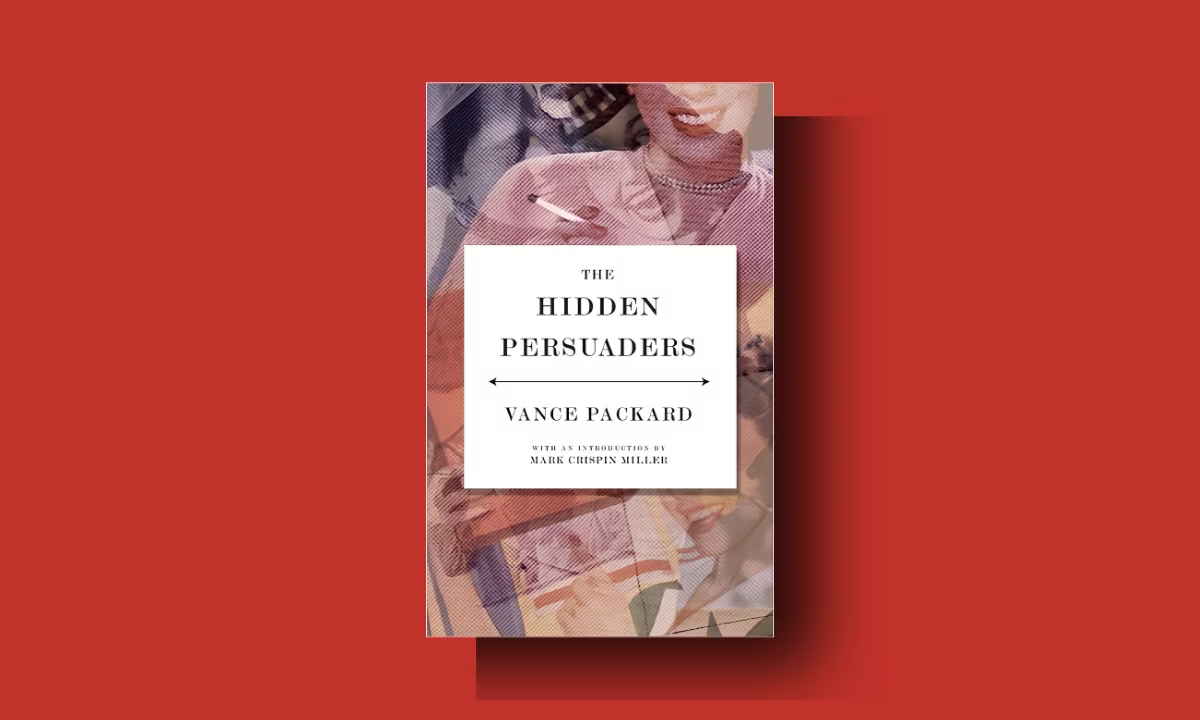
Vance Packard’s The Hidden Persuaders is the advertising source Huxley leans on in Chapter VI, though Packard also repeated the popcorn story later admitted to be fabricated. William Sargant’s Battle for the Mind, which Huxley praises in the brainwashing chapter, is the natural companion to Chapter VII.
Conclusion: Should You Read It?
Yes. Brave New World Revisited is wrong about Communist dominoes, wrong about subliminal ads, and uneasy about human breeding, yet it still names something we have not fixed. Huxley feared a world where nobody needs to ban books because nobody wants to read them, and where the pleasant distraction is the cage.
His remedy, teaching people to read language critically, still looks sensible. A Stanford study of 7,804 students found that more than 80 percent of the 203 middle schoolers shown a labeled ad took it for news, which researchers called “bleak”, and Huxley’s Chapter XI of Brave New World Revisited reads like a plea to prevent exactly that.
I would recommend it to general readers who enjoy ideas, to students of media, politics and advertising, and to anyone who has read Brave New World and wants the author’s own cross-examination of it. Specialists should treat the science with care, and verify before they cite.
It is short, it is provocative, and it is worth an afternoon.
Brave New World Revisited
Is Brave New World Revisited still worth reading in 2027? Yes, though not because Huxley forecast the future well. He expected every overcrowded, poorer country to fall under totalitarian rule within about twenty years, and he leaned on subliminal advertising claims that their author later admitted were “a gimmick”.
URL: https://www.sopranu.com/brave-new-world-revisited-review-summary/
Author: Aldous Huxley
4
Pros
- Array
Cons
- Array