
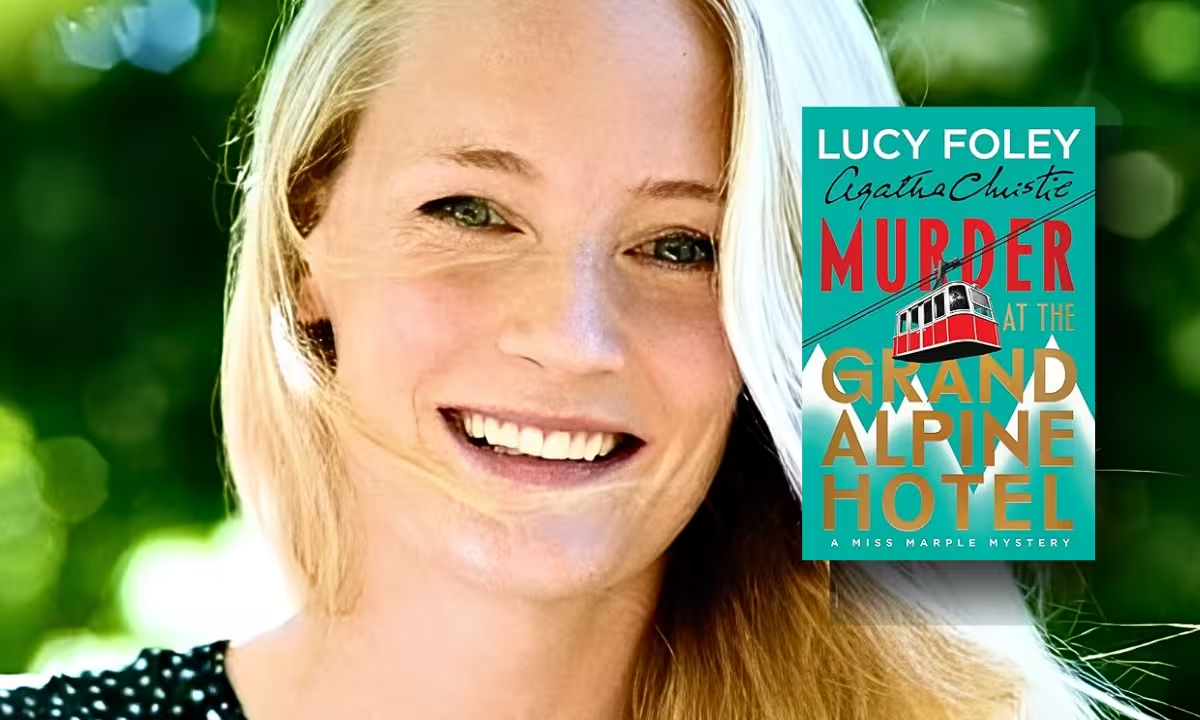

Murder at the Grand Alpine Hotel ending explained: the killers are Catherine Narracott and Sylvia Sinclair, whose public feud hides a secret alliance, until Miss Marple exposes the betrayal behind the murders.
Does Lucy Foley’s Murder at the Grand Alpine Hotel, the first Miss Marple novel since 1976, do justice to Agatha Christie’s sleuth? Mostly, yes. It is a well-built closed-circle mystery set in a snowbound Swiss hotel in 1950, with a sharp, faithful Marple at its centre. Her problem is that she spends too much of the book at the edge of it.
Below you will find a quick verdict, a full plot summary, a clearly marked ending explained section, what critics said, and how the book compares with Christie and with Foley’s own thrillers.
Table of Contents
Quick Answer
Murder at the Grand Alpine Hotel is a good, sometimes very good, Miss Marple novel that reads like a Lucy Foley thriller. The puzzle is fair and the solution lands. Marple’s voice is right. But four rotating narrators, a younger heroine and several action set pieces push Marple into a supporting role. Read it for the plot and the atmosphere. Do not expect Marple at the centre of every chapter.
Quick Facts
| Detail | Information |
|---|---|
| Title | Murder at the Grand Alpine Hotel |
| Author | Lucy Foley |
| Series | Miss Marple (authorised continuation, Agatha Christie Limited) |
| Publishers | HarperCollins (UK, September 2026); William Morrow (US, 22 September 2026) |
| Setting | A luxury hotel in the Swiss Alps, 1950 |
| Narrators | Diana Glass (The Help), Catherine Narracott (The Wife), Sylvia Sinclair (The Star), Bruno Crane (The Friend) |
| Genre | Closed-circle mystery, historical crime |
| Previous Marple novel | Sleeping Murder, October 1976 |
Snapshot
- The first full-length Marple novel in 50 years, written by the author of The Guest List.
- A rising Conservative politician dies in a gondola. A storm and a train crash cut the hotel off. More deaths follow.
- Strong: atmosphere, a clever two-stage solution, a believable Marple, and a sharp portrait of women’s lives in 1950.
- Weak: Marple is offstage for long stretches, the Christie references can feel like a checklist, and the thriller set pieces crowd the deduction.
- Rating: 3.5 out of 5.
Recommended Readers
Best for:
- Christie readers curious to see Marple outside St Mary Mead
- Fans of Foley’s multi-narrator style in The Guest List and The Paris Apartment
- Readers who like post-war settings, snowbound hotels and closed circles of suspects
Not for:
- Readers who want Marple in nearly every scene
- Anyone expecting the gentle tone of the TV adaptations: there is drug use, sexual content, domestic cruelty and wartime violence
- Purists who dislike continuation novels on principle
Why This Book Matters
Agatha Christie died on 12 January 1976. Sleeping Murder, a Marple novel she had finished long before and held back, came out that October. Since then the estate has licensed new Poirot novels from Sophie Hannah, starting with The Monogram Murders in 2014, but Marple only appeared in short fiction, most notably the 2022 anthology Marple: Twelve New Mysteries.
Foley’s contribution there was “Evil in Small Places.” Murder at the Grand Alpine Hotel is the first full Marple novel since Christie’s own.
Foley has said the estate wanted her own version, not a copy. At the Bloody Scotland festival she recalled James Prichard, Christie’s great-grandson and head of Agatha Christie Limited, writing that he did not want “a paint-by-numbers Agatha Christie Miss Marple.” She has also explained why she took Marple abroad: in her view the village belongs to Christie, and a new setting was the way to add something.
Murder at the Grand Alpine Hotel Plot Summary
Prologue: the gondola
On a winter morning in 1950, the first red gondola of the day reaches the top station above the Grand Alpine Hotel. The attendant waits for the passenger to step out. The passenger does not move, then topples onto the cabin floor. He is dead. The book then jumps back two days.
Part One: arrival
Miss Marple travels up the mountain on the hotel’s cog railway with her old friend Dolly Bantry, recently widowed and spending some of her late husband’s money on a treat. With them is Diana Glass, Mrs Bantry’s new paid companion, a quiet, efficient woman in her thirties who still works part-time at the War Office. It was Diana who handled the bookings. Marple knits a sweater for her nephew Raymond and watches everyone.
The Grand Alpine has only just reopened after the war. It stands above an old pilgrimage site, so the guest list mixes rich skiers, a Yugoslav prince with a tiny dog, a blustering English colonel, and several orders of nuns who come for the holy spring. There is a spa a short walk away, a casino down in the town, and a hand-built toboggan run called the Verglas.
Also arriving are Anthony Narracott and his wife Catherine. Narracott is a decorated war hero, holder of the Victoria Cross, and a contender to lead the Conservative Party. He limps from an old wound and charms everyone he meets. Catherine is twenty-two, polished by Cheltenham Ladies’ College and a Swiss finishing school, and trained to be the perfect political wife.
In her chapters we learn quickly that the marriage is cold, that her husband belittles her, and that her family money is nearly gone. Narracott hints that an investment is about to pay off.
Their first room contains a tin of rat poison with a silver spoon in it, placed among the cocktail things. Narracott calls it a prank but is shaken. Then his old army comrade Bruno Crane turns up: shabby, broke, drinking, and missing an earlobe. Crane makes a living in the black market and plainly hates Narracott. Catherine had no idea he was coming.
The third arrival is Sylvia Sinclair, a fading Hollywood star with platinum hair, an Irish wolfhound named Herb, and a steady supply of martinis and cocaine. She is Narracott’s mistress, and she came even though he told her not to.
Over the next two days the tension builds in small scenes. Watching climbers from the terrace through binoculars, Diana and Marple see one man on a high ledge seem to consider pushing the other off. A young man with smeared glasses and a rash on his neck, Charlie Levitt, keeps trying to corner Narracott and is brushed off. At dinner someone orders Narracott a nut tart, though he has a nut allergy. Guests in the library overhear Crane, on a balcony above, shouting about the cyanide pill he kept from the war. Marple wonders aloud whether anyone who talks that loudly wants to be heard.
Behind closed doors things are worse. In Sylvia’s suite, an argument ends with Narracott holding her under the bathwater until she nearly drowns. Crane wins a fortune at the casino and loses all of it in one spin of the roulette wheel. On the slopes, Narracott flees from Levitt in thick cloud, and Catherine nearly skis over a cliff that her husband had studied on the map.
The next night, Catherine produces a diamond earring she says she found in their bed and accuses Narracott in front of the whole dining room. She throws a martini over Sylvia. Diana, in a cubicle in the ladies’ room, overhears the two women trade insults afterwards.
That same night, Narracott and Crane cross the glacier by moonlight to an old climbing hut. They dig up a metal chest hidden under the floor. It is full of gold bars. Narracott says a buyer, a banker he refuses to name, is waiting at the hotel. Crane suspects he will be cut out.
The next morning a black flag with a howling wolf appears on the hotel flagpole, bearing the name of a wartime Resistance group, Les loups des montagnes. A French maid explains that the group fought the Nazis in the mountains and was wiped out. Narracott is badly rattled. He leaves his coffee flask at Reception to be filled, is called away to the phone for a few minutes, collects it, and boards the first gondola. Part One ends with him dead at the top.
Part Two: trapped
The news spreads through the breakfast room. Catherine faints. Charlie Levitt turns out to be a medical student and treats her, and Diana spots morphine and a bottle marked with a skull and crossbones in his bag.
Crane, meanwhile, climbs back to the hut and finds the gold gone. In a panic he breaks into Catherine’s room and ransacks it, convinced Narracott hid the treasure there. Guests drag him off. Facing arrest when the police arrive, Crane steals the mountain train. Diana runs after him and jumps aboard. The train derails in the tunnel. Both survive, but the wreck blocks the only way up or down the mountain. With heavy snow falling, the hotel is cut off.
Then a guest with prematurely silver hair, Christophe Moreau, announces that he is an inspector from the Paris police on holiday, and offers to investigate until the Swiss arrive. Mrs Bantry volunteers Marple as his assistant. Moreau shares what he knows: the coffee flask is the likely means, an empty bottle of almond oil was found in the snow, and the phone call that drew Narracott away from his flask was set up by someone else using a fake telegram.
The interviews that follow are among the best chapters. Catherine blames the actress, but the actress has a spa alibi that Catherine herself confirms. Levitt is broken open by Marple, who deduces from his chin, his colouring and his allergy that he is Narracott’s illegitimate son, and then that he is a gambler who followed his father to ask for money.
Sylvia openly admits the affair and claims Narracott planned to leave his wife. Crane lies about his whereabouts and claims that enemies from the war have come for them both.
Crane, believing he has worked out who took the gold, slips a blackmail note under a door. A reply tells him to meet in a copse of trees during the hotel’s toboggan race. While guests hurtle down the Verglas, Crane follows a troll mask hung in the branches and is beaten to death. Diana, who rode the button lift behind him, saw him head that way.
That night Diana and Moreau end up in bed together. Afterwards she finds, under his bed, prints from the roll of film missing from her camera. They show Narracott and Crane at the mountain hut by moonlight, and a third, blurred figure watching them. Moreau asks Diana to explain why she was following the two men.
The next day, while Marple and Mrs Bantry are out on a sleigh ride that Mrs Bantry cannot remember booking, Moreau is lured to Mrs Bantry’s room by a forged note and thrown from the balcony. Marple searches his room and finds a Swiss passport in another name, listing his profession as banker, plus a telegram from Narracott about a transfer. He was never a detective. He was the buyer for the gold.
Marple then turns gently on Diana: her hidden fluent French, her expensive underwear, the French antique ring she wears on a chain, the way she steered Mrs Bantry to this hotel on these dates. Diana confesses.
During the war she served as a radio operator with the Resistance group on the wolf flag. In 1943 the group ambushed a German convoy carrying gold. Two British officers arrived late, finished off the Germans, and then shot the surviving Resistance fighters, including Diana’s fiancé, Fabien. Left for dead, she spent the rest of the war in a prison camp.
Years later she recognised one of the officers in a newspaper: Anthony Narracott, the war hero. She came to the Alps to expose him and recover the gold, not to kill him.
That leaves the question of who did.
Ending Explained
Stop here if you have not finished the book.
Who is the killer in Murder at the Grand Alpine Hotel?
The killers are Catherine Narracott and Sylvia Sinclair, working together. The public hatred between wife and mistress was staged. They met months earlier, after Catherine answered a phone call from Sylvia at her husband’s London flat, called her back, and found they were being lied to by the same man. They became partners, then lovers, and planned to take the gold and disappear.
How each murder was done
Anthony Narracott: Sylvia, disguised as a nun with her platinum hair covered and no make-up, tampered with his coffee flask at Reception, apparently with nut oil to exploit his allergy. At the same time Catherine wore Sylvia’s wig, white ermine and dark glasses, took the wolfhound, and walked to the spa as “Sylvia,” giving each woman an alibi from the other.
Bruno Crane: Crane appears to have spotted the white ermine in Catherine’s wardrobe and guessed the truth. His blackmail note sealed his fate. Sylvia, who had faked being a hopeless skier, killed him in the copse during the race and escaped down a steep couloir.
Kristoph Mauer (“Inspector Moreau”): Catherine found his photograph in her husband’s wash-bag and decided he was too close to the gold and to them. Using Mrs Bantry’s stolen key and a sleigh ride apparently booked in Mrs Bantry’s name, she lured Mauer with a forged note and pushed him from the balcony while a wireless played English voices outside.
How Miss Marple solved it
Marple’s clues are domestic, which is exactly right for her:
The hair. Sylvia claimed to have spent the morning in the steam of the hammam, yet her set hairstyle was untouched. Marple compares it to a neighbour caught out by the state of his ears after a supposed trip to a Turkish barber.
The dog. The wolfhound attacked almost everyone near its mistress, yet did nothing when Catherine threw a drink in Sylvia’s face. It already knew her.
The breeding. A woman raised the way Catherine was would not make a scene in a dining room unless she meant to.
The white fur. Catherine never wore white, because it did not suit her colouring, yet a white ermine hung in her wardrobe.
The nuns. The “nun” seen at Reception around nine o’clock was in the wrong place. Real nuns were up the mountain for Terce, the morning prayer, at that hour.
The escape and the final twist
The women escape over the mountain pass into Italy on skis with the gold. Diana takes the gondola up and chases them. Catherine shoots her, and moments later an avalanche breaks loose below. Sylvia drags Catherine clear.
Two days later, two nuns board the Simplon-Orient-Express at Venice, bound for Istanbul. The train is delayed. The compartment door opens. In the epilogue we learn why: Marple, remembering Sylvia’s offhand remark about running away to Istanbul, phoned Sir Henry Clithering and had international police waiting in Venice. Catherine is to face a hearing at the Old Bailey.
Diana survived thanks to the gondola attendant. Asked whether she felt any sympathy for the women, Marple refuses: “One cannot extinguish wickedness with more of the same.”
Murder at the Grand Alpine Hotel Analysis
The voice. Marple’s habit of explaining murder through village gossip is intact, and some of the comparisons are perfect: a quarrel over church flowers, a cheated wife reading her husband’s ears. Foley told NPR she was drawn to Marple’s “lack of ego and her sense of humor,” and both come through.
The mask. Foley stages two or three moments where Diana watches Marple’s soft face harden into something almost mythic, then fade back into frailty. Christie hinted at this side of her when Marple called herself Nemesis in A Caribbean Mystery (1964). Foley makes it visible.
The cunning. Marple suspects early that Moreau is not a real policeman and plays along to stay close to the interviews. She solves the case by asking for help instead of chasing anyone. That is a fresh idea for a detective story and a thoughtful one about age.
The structure. Seeing Marple only from outside, through Diana and the suspects, is not unprecedented. Christie’s first Marple novel, The Murder at the Vicarage (1930), is narrated by the vicar. Foley pushes the idea much further, and it gives Marple some of the mystery she had in her early appearances.
Strengths and Weaknesses
Strengths
- A fair-play solution built on small physical details, in proper Golden Age style
- Rich atmosphere: the cog railway, the gondola, the toboggan run, the snowed-in hotel
- Catherine’s arc from obedient wife to something far darker is Murder at the Grand Alpine Hotel‘s best character work
- A serious post-war backdrop: stolen gold, false heroes, and women pushed into narrow roles
- Diana Glass is a strong new character
Weaknesses
- Marple is offstage for long stretches; Diana is the true lead
- Some Christie references feel bolted on
- The train crash, avalanche and mountain chase belong to a thriller and crowd out deduction
- A few early threads, such as the rat poison and the nut tart on the first night, are never clearly explained
- The village comparisons become frequent enough to lose some force
What Critics Said
Reception has been positive overall, with one recurring reservation: Marple herself.
- Kirkus Reviews praised the plotting but argued the narrators and action upstage the detective, adding: “It’s a lot harder to bring Miss Marple back to life.”
- The Boston Globe (Malcolm Forbes) called it a “fiendishly clever mystery,” while finding some Christie references contrived.
- Publishers Weekly, as collected by Book Marks, wrote: “Golden age mystery fans will adore this faithful update.” Booklist was also enthusiastic.
- Cross-Examining Crime (Kate Jackson) gave it 3.75 out of 5, praising the portrayal of Marple but calling the book “a Lucy Foley story with Miss Marple in it,” and wanting more clueing and more Marple.
The consensus matches our reading: the mystery works; the question is how much Marple you want.
Personal Reflection
I went into Murder at the Grand Alpine Hotel expecting to judge it as a Christie imitation, and within fifty pages I realised that was the wrong test. Foley is not imitating anyone. She has written her kind of novel, with its rotating confessional voices and present-tense dread, and invited Marple into it. Once I accepted that, the book became more enjoyable and also more interesting, because the friction between the two styles is where most of its ideas live.
What stayed with me most was not the puzzle but Catherine Narracott. Her early chapters read almost like satire of a 1950s good wife: the lipstick that must stay perfect, the food cut in half and pushed aside, the mother’s rules about never letting a dress out. I took her at face value, as Foley wanted me to.
When the truth arrived, I went back and reread those chapters, and they changed completely. The same sentences about performing a role were now confessions in plain sight.
That is the best trick in Murder at the Grand Alpine Hotel, and it is a trick about how easily we underestimate women who are polite, young and pretty, which is the same mistake people make about Marple when she is old, fluffy and knitting.
That parallel is, I think, the real thesis of Murder at the Grand Alpine Hotel. Every major woman in it is hidden behind a type. Marple is the dithery spinster. Diana is the plain companion. Catherine is the porcelain wife. Sylvia is the platinum bombshell. Each uses her type as cover, and the men in the book, who believe the types, pay for it. Foley never states this outright, which is to her credit. Even Mrs Bantry, the comic friend, gets a quiet thread about the fear of losing her memory, and the plot turns that fear into a weapon against her.
Where I struggled was with the ending’s moral weight. Narracott is monstrous. He and Crane gunned down surviving allies, and he mistreated his wife and nearly drowned his mistress. Mauer was ready to buy gold stolen from murdered people. I felt more sympathy for the two women than Marple does, and I suspect Foley intended that tension.
But they also shot Diana, a woman whose only aim was justice, and left her to die in the snow. That moment settles it. Marple’s flat refusal to forgive them in the epilogue felt harsh when I read it and right when I thought about it afterwards.
I also missed Marple. There are chapters where she disappears for long enough that I forgot the book was meant to be about her. Diana is a good character, and I would read a book about her, but I came for the old lady with the knitting, and she deserves more pages in her own comeback. Kirkus put this more bluntly than I would, but the point is fair.
Still, I finished it wanting another one, which is the best test a continuation novel can pass. Foley has said she would write again if it were a standalone, ideally with Marple travelling. On this evidence, I hope she does, and I hope next time Marple gets the floor.
How Murder at the Grand Alpine Hotel Compares
Versus Christie’s own Marple novels: Christie’s Marple novels generally keep the puzzle tighter and the violence further offstage. Foley’s version is darker, longer and more interested in the suspects’ inner lives. If you want the classic closed-circle structure in its purest form, our review of And Then There Were None shows the template Foley is playing with.
Versus Sophie Hannah’s Poirot novels: Hannah has been writing estate-approved Poirot novels since The Monogram Murders (2014). Foley’s Marple novel stands out for building the story around the people the detective watches rather than the detective.
Versus Foley’s The Guest List: The structure is almost identical: labelled narrators, a wedding or holiday in a remote place, a body, and a countdown to the reveal. The difference is that here a detective actually solves it.
Versus other elderly amateur sleuths: For a gentler, funnier modern take on older detectives, see our review of Richard Osman’s The Impossible Fortune. For a darker series where the past drives present-day murder, our breakdown of Louise Penny’s The Black Wolf is a good companion.
Verdict
Murder at the Grand Alpine Hotel is a clever, atmospheric mystery with a solution that plays fair and a Miss Marple who sounds like herself. It is also a Lucy Foley novel first and a Marple novel second, which will delight some readers and frustrate others.
As a return after fifty years, it proves the character still works. Next time, she should be given more of the book.
FAQs
Is Murder at the Grand Alpine Hotel worth reading?
Yes, if you enjoy closed-circle mysteries and do not mind Miss Marple sharing the stage. The plot is clever and the setting is excellent, though Marple is offstage for long stretches.
Is it an official Miss Marple book?
Yes. It is authorised by Agatha Christie Limited and is the first full-length Marple novel since Sleeping Murder (1976).
When and where is it set?
In 1950, at a fictional luxury hotel high in the Swiss Alps, reachable only by a cog railway.
Who narrates the book?
Four characters in rotating first-person chapters: Diana Glass, Catherine Narracott, Sylvia Sinclair and Bruno Crane. Miss Marple never narrates.
Who is the killer?
Catherine Narracott and Sylvia Sinclair, working together. See the Ending Explained section above.
Do I need to read Agatha Christie first?
No. The story stands alone, though Christie readers will recognise Mrs Bantry, Gossington Hall, Sir Henry Clithering and other familiar names.
Is it suitable for younger readers?
It contains drug use, sexual content, domestic abuse and wartime violence, so it is better suited to adult readers.
Will Lucy Foley write another Miss Marple novel?
Nothing has been announced. Foley has said she would be open to another if it were a standalone with Marple travelling again.





