Last updated on October 8th, 2026 at 09:36 am
The American Way of Killing is Malcolm Gladwell’s most urgent book yet, and it argues something most Americans don’t want to hear: the country doesn’t have a crime problem, it has a violence problem. Gladwell, the author of The Tipping Point and host of Revisionist History, spent years circling this subject before committing to a full-length book. The result is a story-driven, angry, and often brilliant case that America’s gun violence epidemic is a choice, not an inevitability.
And if you think you already understand the gun debate, this book will prove you wrong on almost every count.
Table of Contents
Brief Summary
The American Way of Killing: The Invention of an Epidemic by Malcolm Gladwell (Little, Brown and Company, September 29, 2026, 288 pages) argues that the United States does not have a crime problem. It has a violence problem.
Gladwell, the author of The Tipping Point and host of Revisionist History, claims Americans misunderstand their own history with guns, misunderstand the nature of lethal violence, and have convinced themselves they are over-policed when the opposite is true.
The book is divided into three parts: dishonest conversations about guns, misdiagnoses of the violence problem, and the moral absurdities that follow. Through stories ranging from a North Carolina shooting range to a 1739 slave rebellion to a modern German prison, Gladwell builds a case that America’s gun violence epidemic is a choice, not an inevitability.
Reader Recommendation: This book is for you if you follow American policy debates and want a provocative, story-driven argument about why gun violence persists. It is not for you if you want a neutral, academic overview of gun policy or a detailed legislative history. Gladwell is angry, and he does not hide it.
Introduction
The American Way of Killing is not a book about guns. It is a book about how Americans think about guns, and why almost every assumption baked into that thinking is wrong.
Malcolm Gladwell’s eleventh book arrives on September 29, 2026, published by Little, Brown and Company. It runs 288 pages.
Gladwell, a staff writer at The New Yorker and the author of eight New York Times bestsellers including The Tipping Point and Blink, spent years circling the subject of crime and policing in his podcast Revisionist History before committing to this project.
The book’s central argument is deceptively simple: America’s lethal violence is not a function of crime. It is a function of arguments that end with bullets. And the reason those arguments end with bullets, rather than with a broken nose or a black eye, is that Americans have built a society that is simultaneously flooded with guns and starved of the people whose job it is to interrupt fights before they turn fatal.
Gladwell does not write like a criminologist. He writes like a storyteller who happens to be furious. And in The American Way of Killing, he is furious at almost everyone: gun control advocates who waste political capital on assault rifle bans that do nothing, originalists who pretend the Second Amendment was about individual liberty, police reformers who cut police budgets in the name of justice, and the rest of us who look at falling homicide rates and conclude that things are getting better.
He is also, in my reading, largely correct on the big picture, even when the details get slippery. Let me walk you through what the book actually says, where it lands, and where it stumbles.
The American Way of Killing Summary
The Dishonest Conversation About Assault Rifles
Why do Americans argue about the wrong guns? Because the gun control movement has spent forty years fighting a weapon that barely shows up in the statistics.
Gladwell begins Part One, “Dishonest Conversations,” at a shooting range in North Carolina with a law professor and competitive shooter named Greg Wallace. Wallace hands Gladwell an AR-15, the civilian version of the military assault rifle that has become the symbol of America’s mass shooting crisis. Gladwell fires it, misses badly, adjusts, fires again, and hits a cardboard torso in the chest. “Would’ve put him down,” Wallace says.
Then Gladwell does what Gladwell does best. He takes a familiar debate and shows you that the terms of the debate are fake.
The assault rifle ban that Congress passed in 1994, and that states have replicated ever since, is not really a ban on assault rifles. It is a ban on certain cosmetic features: pistol grips, forward grips, adjustable stocks, barrel shrouds, threaded barrels. The 2025 Senate version of the assault weapons bill runs for seven pages listing banned guns, then adds a 96-page appendix listing all the semiautomatic rifles that are not banned.
Those rifles cost roughly the same, look essentially the same, weigh the same, use the same ammunition, and kill just as effectively. “What assault rifle bans ask of the mass shooter as he picks out his arsenal,” Gladwell writes, “is that he forgo anything on the short list and instead choose his weapon from the ninety-six pages of options in Appendix A.”
This is not gun control. It is, in Gladwell’s phrase, “gun control theater.”
Then comes the data that should end the argument. A 2025 study published in the JAMA Network Open analyzed every mass shooting in the United States between August 1966 and November 2023. The fraction of mass shootings that involved the exclusive use of an assault weapon was 7.1 percent. Handguns were used in 78 percent of mass shootings. In the same fifty-seven-year period, there were about 2 million gun-related deaths in the United States.
The death toll from those 184 mass shootings was 1,342. “There are more people killed by firearms in America in a typical month,” Gladwell writes, “than there have been people killed in mass shootings in the past half century.”
The assault rifle debate, in other words, is a conversation about a rounding error in a much larger catastrophe.
The Second Amendment Was About Slavery
What did James Madison actually mean when he wrote the Second Amendment? He meant to reassure Southern slave owners that the new federal government would not disarm their slave patrols.
This is the book’s most explosive argument, and Gladwell builds it with the patience of a prosecutor.
He starts with the grammar. The Second Amendment reads: “A well regulated Militia, being necessary to the security of a free State, the right of the people to keep and bear Arms, shall not be infringed.”
Modern readers struggle with this sentence because it uses a grammatical construction, the initial being clause, that fell out of use over a century ago. In the 2008 District of Columbia v. Heller oral arguments, the Supreme Court justices spent an hour arguing about how to parse it. Chief Justice Roberts asked why, if the amendment was about state militias, it said “the right of the people.” Justice Kennedy suggested the two clauses could be “delinked.” Justice Scalia insisted they fit together perfectly.
Gladwell then introduces Kari Sullivan, an Australian linguist who analyzed every being clause in James Madison’s writing. Madison used being clauses 976 times. Sullivan found that Madison never used a being clause as a standalone thought separate from the operative clause beside it.
No one in the late eighteenth century did. That construction had become ungrammatical a hundred years before Madison was born.
So the Second Amendment is a single thought: Because a well regulated militia is necessary to the security of a free State, the right of the people to keep and bear arms shall not be infringed. The militia clause explains the arms clause. They are not separable.
Now the historical question: Why were militias so important to Madison? Because Madison was from Virginia, the largest slave-owning state. His father owned one hundred slaves. His grandfather was allegedly poisoned to death by three slaves on the family plantation.
In South Carolina, slaves composed over 70 percent of the population. The Stono Rebellion of 1739, in which a group of enslaved men marched down a road killing every white person they encountered, had taught the planter class that a well-regulated militia was not a civic nicety. It was the armed police force that kept their world from collapsing.
Gladwell quotes the law professor Carl Bogus, who discovered that in the Virginia ratifying convention of 1788, Patrick Henry repeatedly attacked the proposed Constitution for threatening the militia system. Madison wrote the Second Amendment to reassure Henry and the other Virginia planters that the new federal government would not disarm their patrols.
Bogus puts it this way: “If I say, close your eyes, I say the Second Amendment, what image comes into your mind? I think most people would say it’s the musket in the hands of the minuteman in Lexington, in Concord. And I’m saying, No, it’s not. The real image, that is, the correct image, is the musket in the hands of the slave patrollers in the South.”
The Supreme Court’s Heller decision ignored all of this. It called the militia clause “prefatory,” a mere throat-clearing that “does not limit or expand the scope of the operative clause.” Gladwell’s response is blunt: “That is not an honest reading of the evidence.”
America’s Real Violence Problem Is Not Crime
What if the thing Americans call the crime problem is actually a violence problem? And what if those two things have almost nothing to do with each other?
In Part Two, “Misdiagnoses,” Gladwell makes his most important analytical move. He introduces the distinction between instrumental violence and expressive violence.
Instrumental violence is what we see on Law and Order. A criminal plans a robbery, a drug deal, a kidnapping. The violence is a means to an end.
Demetrius Warren, the young man who murdered the University of Chicago graduate student Amadou Cisse in 2007 over a backpack and a water bottle, committed instrumental violence. He got a gun. He planned to “hit some licks.” He drove to campus looking for victims.
Expressive violence is something else entirely. It happens in the moment, often over something trivial. A woman at a fast-food restaurant asks for a special order. The man behind her in line gets angry. Words are exchanged. He punches her. Her fourteen-year-old son runs to the car, grabs a gun, and shoots him dead in the street.
When Jens Ludwig, a criminologist at the University of Chicago, sent his colleague Harold Pollack to read through hundreds of homicide files from the Chicago Police Department, Pollack expected to find stories like the Cisse murder. He found the opposite.
The overwhelming majority of homicides were expressive. Ludwig later told Gladwell: “These shootings are not what you see on The Wire. They’re not what you see on the news. These are just run-of-the-mill arguments that go sideways.”
This pattern holds across time and geography. Gladwell cites a study of Chicago homicides from 1965 to 1990 that found instrumental homicides made up only 18 percent of the total. Expressive homicides made up more than half. A study of medieval England found that about 60 percent of rural homicides and 84 percent of urban ones were motivated by arguments. A 1969 study in Houston found the same pattern.
Why does this matter? Because the American criminal justice system is designed to deter instrumental crime. Long sentences, aggressive policing, no-nonsense judges. None of that works against a man who punches a stranger in a fast-food restaurant because he is angry and has a gun in his car. He is not weighing costs and benefits. He is not thinking at all.
“A system of punishment, designed around carrots and sticks and forcing the would-be criminal to weigh the benefits and costs of actions,” Gladwell writes, “is not designed to stop a drunken, jealous, abusive husband from pulling a gun on his wife over some exaggerated slight.”
The Cornwell Effect: How Doctors Hide an Epidemic
Why does the homicide rate keep falling if America is still so violent? Because American trauma surgeons have gotten terrifyingly good at their jobs.
This is The American Way of Killing‘s most original contribution, and it is named after Edward E. Cornwell III, a trauma surgeon who ran the trauma center at Johns Hopkins for ten years before moving to Howard University Hospital.
Cornwell once treated a twenty-five-year-old man with four gunshot wounds, including one that destroyed most of his testicles. The patient’s blood pressure was so low he was slipping out of consciousness. His pH was 7.03, far below the survivable range. He received eighteen units of blood, roughly twice his total blood volume. The trauma database predicted a 70 percent chance of death.
He lived. And the reason he lived, Cornwell suspects, is that the loss of his testicles removed a hormone that makes it harder for the male body to survive hemorrhagic shock. Girls past puberty have a 62 percent higher survival rate from traumatic injuries than boys.
This is the Cornwell Effect: the more gunshot wounds American trauma surgeons treat, the better they get at saving lives. And the better they get at saving lives, the easier it is for the rest of America to ignore the violence. “This is the great paradox of American gun violence,” Gladwell writes. “The more practice American trauma surgeons get, the better they become at saving the lives of gunshot victims. And the better they become at saving lives, the easier it is for the rest of America to shrug and walk away.”
The numbers are staggering. A study called “Murder and Medicine” concluded that improvements in trauma care from 1960 to 1999 lowered the death rate from gunshots and stab wounds by as much as 4 percent a year. Without those developments, there would have been between 45,000 and 70,000 homicides annually in the late 1990s, instead of the actual 15,000 to 20,000.
Memphis, Tennessee saw its homicide rate fall from 40 per 100,000 in 1935 to 20.22 per 100,000 in 1985, even as its aggravated assault rate nearly doubled.
The homicide rate, Gladwell says, is gunshot wounds minus doctors. And the doctors are winning.
The Under-Policing Paradox
What if the United States is not over-policed, but under-policed? And what if the defund-the-police movement got the diagnosis exactly backwards?
Los Angeles has 8,500 police officers for 3.9 million people. Berlin, a city of virtually identical population, has 18,000. Phoenix has 2,600 officers. Munich, the same size, has nearly three times as many. Dallas has 3,200. The Brussels metro area, the same size, has 7,700 and considers itself short-staffed.
The United States spends five times as much on prisons as it does on policing. Europe spends five times as much on policing as it does on prisons. America has chosen severity. Europe has chosen certainty. In Germany, the homicide clearance rate is over 90 percent. In the United States, it is just over 50 percent, and in some neighborhoods it falls into the teens.
“The simplest way to measure the capacity of a police department,” Gladwell writes, “is to calculate the number of officers it has on staff per homicide.” Japan, Italy, and Spain have about 500 police officers per homicide. The United States has 50. The police are completely overwhelmed.
Daniel Oates, the former police chief of Aurora, Colorado, told Gladwell what he would do with twice as many officers. Half would go to patrol, filling gaps in the twenty-four-hour schedule where response times are unacceptable. The other half would build relationships. “For every arrest an officer makes,” Oates said, “he does ten or fifteen or even twenty of those spontaneous interruptions” of arguments that could turn violent.
This is what Jens Ludwig saw on a ride-along in Chicago. A gigantic man had a woman pinned against a chain-link fence, screaming in her face while she held a small child’s hand. The sergeant pulled over and told the man to take a walk. The man eventually did. No arrest was made. No crime was committed. But a lethal encounter was interrupted.
Then came George Floyd and the defund movement. Los Angeles cut $150 million from its police budget. Baltimore cut $22 million. Seattle cut 18 percent. Austin went from spending 40 percent of its general fund on police to 26 percent. “To the reformers, the United States was overpoliced,” Gladwell writes. “In fact, all the evidence suggests the opposite.”
The criminologists Christopher Lewis and Adaner Usmani found that the countries with the most police capacity have the least police violence. The fewer police a country has, the more violent the police are. The United States, on their chart, sits next to Pakistan, Iran, and Brazil. “America is an early modern country in the guise of a rich country,” Usmani said.
The Moral Absurdity of Bruen and Sir John Knight
How did an obscure seventeenth-century English merchant become the reason America can’t pass gun control? Because the Supreme Court decided to care more about him than about living Americans.
In Part Three, “Moral Absurdity,” Gladwell tells the story of New York State Rifle & Pistol Association v. Bruen, the 2022 Supreme Court case that struck down New York’s Sullivan Act, a 1911 law that required a permit to carry a handgun. The Sullivan Act had been on the books for 111 years. The Supreme Court got rid of it by way of a man named Sir John Knight.
Knight was a Bristol merchant who, in 1686, burst into a church and delivered an anti-Catholic rant. He was charged under the Statute of Northampton, a 1328 law that prohibited carrying arms in public. He was acquitted. A law professor named Joyce Malcolm discovered the case and argued that it proved English common law was not hostile to carrying guns.
The problem is that Malcolm got the story wrong. When the diaries of a seventeenth-century journalist named Roger Morrice were finally decoded and published in 2007, historians discovered what actually happened. Knight left his gun outside the church. He wasn’t armed.
The case against him had nothing to do with guns. Bristol had a gun control ordinance that “puts every gun control ordinance in the United States today to shame.” And Knight was, in the words of the historian Tim Harris, “a bigot” and “a troublemaker.”
Justice Clarence Thomas wrote the Bruen majority opinion. He acknowledged that there were “multiple plausible interpretations” of the Knight case but said the court would “favor the one that is more consistent with the Second Amendment’s command.” In other words: We know the evidence is against us, and we don’t care.
The Bruen decision never mentions suicide. Not once, not even in a footnote. In 2023, there were 17,927 gun homicides in the United States and 27,300 gun suicides. The Sullivan Act had reduced gun suicide rates by 32 to 48 percent. Thousands of New Yorkers are alive because of the law that the Supreme Court threw away in the name of a man who never carried a gun into a church.
What I Actually Think of The American Way of Killing
The American Way of Killing is Malcolm Gladwell at his most urgent and his most uneven.
The book’s greatest strength is its central insight: America’s violence problem is not a crime problem, and the policies designed to fight crime cannot fix violence.
The distinction between instrumental and expressive violence is not new. Donald Black wrote about it in the 1970s. But Gladwell brings it to a general audience with the force of a revelation, and he connects it to the Cornwell Effect in a way that no one else has.
The book’s greatest weakness is that it occasionally overstates its case. Gladwell argues that “the problem isn’t assault rifles. The problem is guns.” That is true as far as it goes. But the book does not seriously engage with the question of what to do about the 400 million guns already in circulation.
He calls for more police, better training in emotional regulation, and honest conversations about the Second Amendment. He does not call for confiscation or buybacks or any of the other measures that gun control advocates have proposed. The book is better at diagnosing than prescribing.
Some critics have accused Gladwell of being too angry. T
he Irish Independent noted that he calls Americans “stupid, dishonest, morally reckless, and pedantic”. A Guardian review called The American Way of Killing “wide of the mark” and argued that Gladwell’s policy prescriptions are “thin and, at their worst, counterproductive”.
I understand that criticism.
But I also think the anger is earned. The American Way of Killing is about an epidemic that kills tens of thousands of people a year while the country argues about barrel shrouds and seventeenth-century legal cases.
Where I part ways with Gladwell is on the question of guns themselves. He is right that handguns, not assault rifles, are the weapons of mass destruction in America.
He is right that arguments, not robberies, are the engines of homicide. But a country with fewer guns would have fewer lethal arguments. He gestures at this, but he doesn’t dwell on it. Maybe that is because he knows the political reality. Maybe it is because he thinks the police and the emotional regulation programs are more achievable.
Either way, The American Way of Killing leaves you with a clearer picture of the problem and a fuzzier sense of the solution.
How It Compares to Gladwell’s Other Work
If you have read The Tipping Point, you will recognize the method. Gladwell takes a counterintuitive idea, illustrates it with a series of vivid stories, and builds toward a conclusion that feels inevitable by the last page. The difference is that The Tipping Point was about how ideas spread. The American Way of Killing is about how a country talks itself into accepting an epidemic.
Blink was about the power of rapid cognition. This book is about the failure of slow cognition. It is about a country that has had decades to think about gun violence and has produced nothing but dishonest conversations and moral absurdities.
Compared to Talking to Strangers, which was about the limits of our ability to read other people, this book is about the limits of our ability to read ourselves. Americans think they are a violent country because they are a criminal country. They are not. They are a country that has not learned how to handle anger, and that has made it very easy to turn anger into death.
Conclusion: Who Should Read This Book
Who should read The American Way of Killing? Anyone who wants to understand why the gun debate in America never changes anything, and who is willing to sit with an uncomfortable answer.
This book is not for you if you want a neutral overview of gun policy. It is not for you if you believe the Second Amendment was written to protect individual liberty. It is not for you if you think the solution to gun violence is banning assault rifles. Gladwell will annoy you on all three counts.
But if you are willing to follow a brilliant storyteller through a dark subject, The American Way of Killing will change how you think about violence, policing, and the stories America tells itself about both. It is Gladwell’s most personal book.
It is also his most political. And it arrives at a moment when the country desperately needs someone to say what he says on the final page: “Americans resolve their arguments with guns.”
That is the American way of killing. And until Americans understand it, nothing will change.
Related Books and Articles:
- Unforgiving Places by Jens Ludwig
- Crime Is Not the Problem by Franklin Zimring and Gordon Hawkins
- Madison’s Militia by Carl T. Bogus
- Slave Patrols by Sally E. Hadden
- “What We Get Wrong About Violent Crime” by Malcolm Gladwell, The New Yorker, June 2, 2025
- “The Injustice of Underpolicing in America” by Christopher Lewis and Adaner Usmani
The American Way of Killing: The Invention of an Epidemic
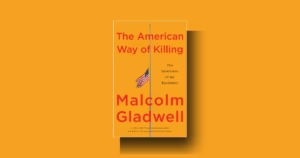
The American Way of Killing is Malcolm Gladwell’s most urgent book yet, and it argues something most Americans don’t want to hear: the country doesn’t have a crime problem, it has a violence problem. Gladwell, the author of The Tipping Point and host of Revisionist History, spent years circling this subject before committing to a full-length book. The result is a story-driven, angry, and often brilliant case that America’s gun violence epidemic is a choice, not an inevitability.
URL: https://www.sopranu.com/the-american-way-of-killing-summary-review/
Author: Malcolm Gladwell
4
Pros
- A powerful central point: America's problem is violence, not crime, so crime policy can't fix it
- Makes the instrumental vs expressive violence distinction accessible to general readers
- An original argument in the "Cornwell Effect," linking trauma-surgery skill to falling homicide rates
- Vivid, story-driven writing, from a North Carolina shooting range to the Bruen case
- Anger that, in your view, is earned given the scale of the deaths
Cons
- Sometimes overstates its case
- Doesn't seriously deal with the roughly 400 million guns already in circulation
- Better at diagnosing than prescribing, with thin policy solutions
- An angry, partisan tone that may put off some readers (you cite the Irish Independent and Guardian criticisms)
- Not a neutral or academic overview of gun policy