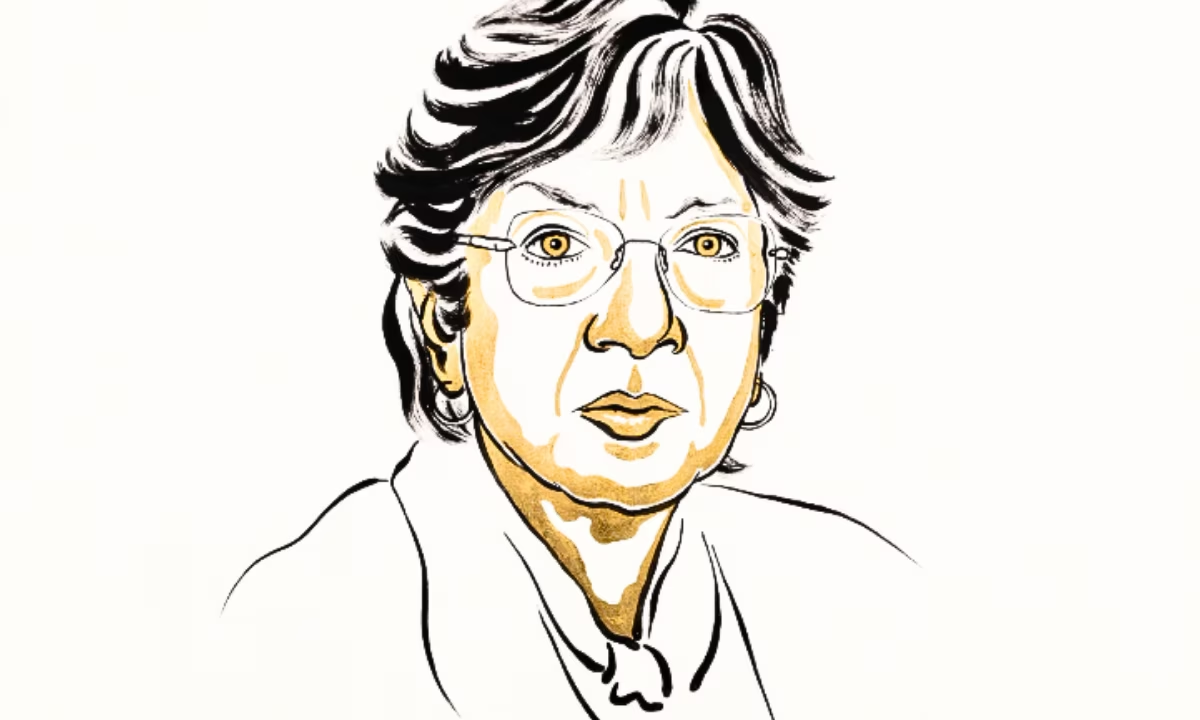

OSLO, 9 October 2026, South African jurist Navanethem “Navi” Pillay has won the 2026 Nobel Peace Prize. The Norwegian Nobel Committee honoured her “for her efforts to promote peace and international law”.
Committee chair Jørgen Watne Frydnes announced the decision on Friday in Oslo. Pillay, 85, is a former UN High Commissioner for Human Rights who has sat on the bench of the Rwanda tribunal and the International Criminal Court.
The award lands in the prize’s 125th anniversary year, and at a moment when, in the committee’s own words, the institutions of international law are under attack.
Why the committee chose her
The committee credits Pillay with leading the way, through courage and integrity, toward a more complete global legal order. Its central claim is that she was instrumental in making sure war crimes, crimes against humanity and genocide actually reach a courtroom.
It says she has widened both the reach and the practical effect of international law, holding states and national leaders to account. The committee also tied the choice directly to Alfred Nobel’s will: by pushing the use of tribunals for peace and justice, it argues, she gives modern meaning to the “peace congresses” the will names.
The statement doubled as a warning. The committee said the international legal system is under heavy strain, with judges now facing sanctions and their institutions under attack, as politics drifts toward raw power. “Whenever might overtakes right, it undermines stability, trust and peaceful co-existence,” it said.
Analysis: Read together, the citation and the warning make this a prize for an institution-builder rather than a peacemaker in a single conflict. The committee is rewarding the machinery of accountability itself, at the moment that machinery is most contested.
The Rwanda breakthroughs
The committee singles out Pillay’s work at the International Criminal Tribunal for Rwanda (ICTR). The UN General Assembly elected her to that court in 1995; she served eight years there, the last four (1999–2003) as its president.
On 2 September 1998, a three-judge trial chamber that included Pillay convicted Jean-Paul Akayesu, mayor of the Taba commune. The counts included genocide, direct and public incitement to commit genocide, and crimes against humanity including rape. The UN’s Rwanda archive describes the chamber’s finding that rape can constitute genocide as an important precedent in international criminal law.
The Nobel committee says Pillay’s influence was a major factor in that finding. It adds that the same case produced a second first: a defendant charged with incitement to genocide purely for spreading propaganda.
Harvard Law School‘s profile of Pillay says that, though three judges signed the judgment, she is credited with shaping its reasoning.
After the verdict, Pillay explained what had changed: “From time immemorial, rape has been regarded as spoils of war”. In her final year at the tribunal, she and two fellow judges also convicted three Rwandans of using media to incite genocide, described by Harvard Law School as the first case of its kind since Nuremberg.
From apartheid Durban to The Hague
Pillay was born into a family of Indian Tamil origin in Durban under apartheid. The committee notes that as a lawyer she ran up against entrenched discrimination, segregation and exclusion.
In 1967 she became the first woman to open a law practice in her home province of Natal. She defended anti-apartheid activists, exposed torture, and helped establish rights for prisoners on Robben Island.
| Period | Role |
|---|---|
| 1967 | Opens law practice in Natal, the first woman to do so |
| 1995 | Acting judge, South African High Court |
| 1995–2003 | Judge, ICTR; president 1999–2003 |
| After 2003 | Judge, International Criminal Court |
| 2008–2014 | UN High Commissioner for Human Rights |
| 2021 – recently | Chair, UN Commission of Inquiry on the Occupied Palestinian Territory and Israel |
| Now | Judge at the International Court of Justice in the Myanmar genocide case |
Sources for the table: Harvard Kennedy School, Columbia Journal of Transnational Law, United Nations, Nobel press release. Exact ICC service dates were not confirmed in the sources checked.
Her recent roles have been politically charged. The UN Human Rights Council named her chair of its three-member inquiry on Israel and the Palestinian territories in July 2021.
Il Sole 24 Ore reports that Israel’s government and others accused the commission of bias, that Pillay defended its fact-finding, and that its members resigned in 2025 amid heavy pressure and sanctions. The Nobel committee’s statement says only that she led the commission until recently, without addressing the circumstances.
She received the Sydney Peace Prize in 2025.
The field and what comes next
The committee weighed 287 nominations this year: 208 individuals and 79 organisations. Contenders discussed before the announcement included Sudan’s volunteer emergency response teams, advocates for Ukrainian children, the International Space Station and two leading international courts.
Reuters reported that the leaders of Cambodia, Israel and Pakistan said they had nominated US President Donald Trump; the committee itself never confirms nominees . The 2025 prize went to Venezuelan opposition leader María Corina Machado.
This is the prize’s 125th anniversary year. Before today it had gone to 112 individuals and 28 separate institutions since 1901.
Pillay will receive the award at the ceremony in Oslo on 10 December, the anniversary of Alfred Nobel’s death.