
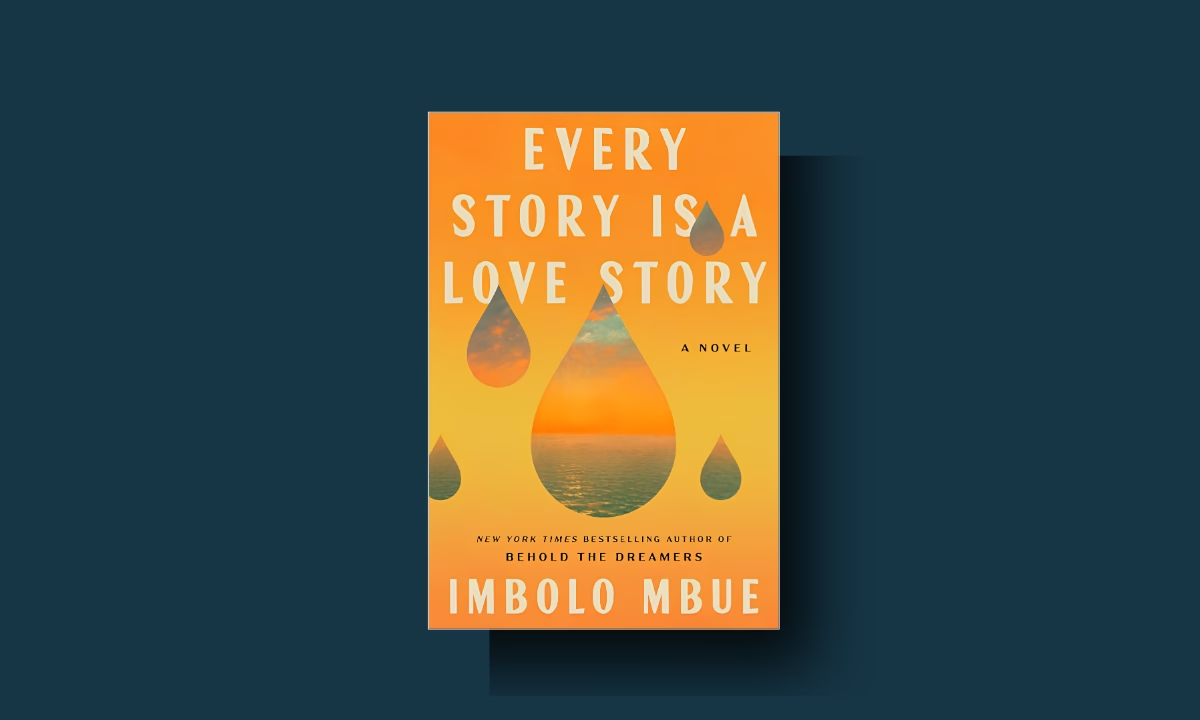

Every Story Is a Love Story by Imbolo Mbue is a novel about a Cameroonian American widower who falls in love with the woman who accidentally killed his pregnant wife, and it is far less sentimental than that sentence makes it sound. Mbue’s third novel, published by Random House on October 6, 2026, opens with an apology letter and closes on a beach in 2008, and in between it asks a question most of us would rather never face: what do you owe the person who destroyed your life by accident?
I read all 43 chapters, so below you’ll find the full plot with spoilers, the ending explained, the characters and themes, the lines worth keeping, and my honest verdict on whether the risky premise pays off.
Table of Contents
Every Story Is a Love Story at a Glance
What happens in Every Story Is a Love Story? Three years after his pregnant wife, Yoma, is hit and killed by a car while out running in Montclair, New Jersey, civil engineer Wolo Lifafa receives a letter from the driver, Victoria Snow. Against his family’s wishes he meets her, accuses her of lying, and walks away.
Later, his best friend learns the full story from her and Wolo has to accept that it really was an accident. Victoria, who turns out to be a Delta pilot, gives him a companion pass and he starts seeing the world. She also gets Yoma’s short stories a publishing deal. They fall in love.
His parents refuse to bless a marriage, so in the final present-day chapter the couple decide to have a child anyway.
A second timeline, set between 2004 and 2008, tells the story of Wolo and Yoma’s romance and a secret Wolo kept from her: his teenage half-brother raped a 14-year-old girl, and Wolo arranged her abortion.
Is it worth reading? Yes, if you like slow, morally tangled family novels. Skip it if you need closure or a likeable second-love story.
Key facts at a glance
| Detail | Information |
|---|---|
| Title | Every Story Is a Love Story |
| Author | Imbolo Mbue (Behold the Dreamers, How Beautiful We Were) |
| Publisher | Random House (US); Canongate (UK) |
| US publication date | October 6, 2026 |
| Length | 352 pages, 43 chapters |
| Audiobook | 11 hrs 55 min, read by Prentice Onayemi and Ellen Adair |
| Setting | New York City, New Jersey, Limbe and Yaoundé (Cameroon), plus Barcelona, Hiroshima, Athens, Istanbul |
| Timeline | 2004 to 2015 (two alternating strands) |
| Genre | Literary fiction, family drama, grief novel |
| My rating | 4/5 |
Suggested Readers
The short answer: patient readers of family fiction will love it, and anyone who needs a clear villain or a tidy ending will likely bounce.
You’ll probably love it if:
- You liked Behold the Dreamers and want Mbue’s eye for immigrant families, this time with a Cameroonian family spread across New Jersey and Yaoundé.
- You’re drawn to books about grief that don’t hurry the widower toward a neat recovery.
- You enjoy family arguments on the page. The Lifafa women (Keka, Jokeh, Aunty Luwa) are some of the funniest and most formidable people I’ve read this year.
- You want a novel that will start fights in a book club. Mine would split right down the middle on Wolo.
You’ll probably bounce if:
- You need a villain. Mbue gives you none, and that frustrates some readers.
- You were hoping for a romance in the genre sense. The love between Wolo and Victoria is quiet, secretive, and never fully earns his family’s approval.
- Sexual violence is a hard limit for you. The Mary Lambi subplot (Chapters 21, 23, 25, 27, 29, 31) describes a rape and a clandestine abortion in detail.
- You dislike long travel passages. The middle of the book spends real time in Barcelona, Hiroshima, Mexico City and Athens.
Introduction
Every Story Is a Love Story is the third novel by Imbolo Mbue, the Limbe-born writer whose debut, Behold the Dreamers (2016), won the 2017 PEN/Faulkner Award for Fiction and was an Oprah’s Book Club pick. Her second novel, How Beautiful We Were (2021), was named one of The New York Times‘ 10 Best Books of 2021.
Every Story Is a Love Story came out from Random House on October 6, 2026, at 352 pages, with a UK edition from Canongate. The book is dedicated “In memory of Mbella Mbue, 1975-1999,” and carries an epigraph from the Song of Solomon (3:3).
Quick Verdict
A brave, sometimes maddening novel about forgiveness that refuses to give anyone a clean exit. Recommended for readers of slow-burn family fiction who don’t mind being argued with.
Should You Read It?
| Pros | Cons |
|---|---|
| A genuinely hard moral premise handled without melodrama | Victoria stays a little too saintly; we rarely get inside her head |
| Two timelines that mirror each other in clever ways | The travel chapters in the middle drift toward brochure writing |
| Tata Munyenge, Yoma’s father, is an unforgettable character | Key revelations arrive secondhand (Ben’s long phone monologue) |
| Warm, funny family dialogue in Pidgin, Bakweri and English | The present-day story ends without resolving the family conflict |
| The Mary subplot complicates Wolo’s demand for “the truth” | The abortion subplot is heavy and may feel like a second novel |
What Is It About?
A grieving husband in New York meets the woman whose car killed his pregnant wife, discovers there was no crime, and slowly falls in love with her. Running alongside it is the story of his marriage and of a family secret in Cameroon that makes him, for once, the relative of the person who did harm.
Rating: 4/5
Background
The most useful background for Every Story Is a Love Story is Cameroonian geography, Cuban exile history, and the author’s own life.
First, Limbe, the seaside city in Cameroon’s English-speaking Southwest where Wolo and Yoma grew up (and where Mbue was born), was called Victoria from 1858 until a presidential decree renamed it Limbe in 1982.
So the killer’s first name is also the old name of the dead woman’s hometown. Mbue makes that sting in Chapter 30, when Wolo refuses to let Yoma’s story “Victoria” become the title of her book.
Second, the novel leans on real history. Victoria’s Cuban mother is said to have left Havana on one of the last Freedom Flights in 1973, with a waiting list “a million people long.” That checks out. The Freedom Flights ran from December 1, 1965, to April 6, 1973, carrying 297,318 refugees, and by March 1968 more than one million people were on the waiting list.
Third, the Lifafas’ history tracks Cameroon’s post-independence story: Wolo’s father, Wanga, goes to Colorado on a government scholarship in the 1980s, part of a generation expected to come home and run the young republic.
Finally, the most personal piece of context sits in the acknowledgments. Mbue writes: “Three times in my life, I have received letters asking me for forgiveness.” Those letters, she says, inspired Chapter One. That one admission told me this book was not built on a gimmick.
Every Story Is a Love Story Plot Summary
Every Story Is a Love Story moves between two timelines. Apart from Chapter One (Victoria’s letter), the even-numbered chapters, written in the present tense, follow Wolo from spring 2012 to October 2015. Odd-numbered chapters, in the past tense, go back to how he met Yoma in 2004, his parents’ unusual marriage, and Christmas 2004 in Cameroon. Here is the whole story in order.
Part 1: The Letter (Chapters 1 to 10)
Every Story Is a Love Story opens with the full text of a letter from Victoria Snow. She writes that she will probably never forgive herself, that she has nightmares in which he kills her, and that she wants to apologise in person. She signs off “With a broken heart.”
The man she is writing to is Wolo Lifafa, a Cameroonian American civil engineer in his early forties who lives in an apartment at Broadway and Seventy-seventh Street in Manhattan.
Three years earlier, on a Sunday morning in March 2009, his wife Yoma Munyenge, a Rutgers mathematics PhD student pregnant with twins, went for a three-mile run from his mother’s house in Montclair and was hit by Victoria’s car at a stop sign. Police cleared Victoria in under three weeks.
Wolo never believed the report. His mother, Keka, still thinks a crime was covered up.
The letter reaches him through Shiraz Kabbani, a Muslim gynecology resident from Tennessee who is the longtime roommate and best friend of Wolo’s younger brother, Dikaki. Shiraz met Victoria by chance at a party and, being a people-pleaser, agreed to deliver it.
Keka tells Wolo to put it in the garbage. Within a day, her pastor (Pastor Tunde of the Holy Ghost Fire Assembly of Newark), Wolo’s stepmother Jokeh, Aunty Luwa and Dikaki all call with the same advice.
Only his father, Wanga, a professor in Yaoundé, says the decision belongs to Wolo, though he begs him not to put anything in writing. Wolo had already signed a nondisclosure agreement as part of a wrongful death settlement. The insurance payout was $1.5 million: a million for Wolo and half a million for his lawyer.
Wolo quietly used half of his share to set up a fund for Yoma’s family in Limbe and told them the money came from Yoma’s careful savings.
Shiraz sets up a meeting for a Saturday at noon by the Bethesda Fountain in Central Park. Victoria arrives eighteen minutes late.
They walk in silence for fifteen minutes, then sit on a bench by Sheep Meadow. Victoria says she now regrets asking for forgiveness at all, after reading a guru who argues that wrongdoers should only apologise and let the wronged person decide. She tells him she came to say, “Here I am.” Wolo wants only one thing, a confession. He accuses her of being drunk or sleepy and of having friends at the Montclair Police Department.
During the argument he learns two things the media got wrong: she is not a flight attendant but a Delta pilot, and her father, partially paralysed by a stroke, lives in an assisted living facility in Chicago. Wolo tells her she will “rot in hell” and walks off without saying goodbye.
Part 2: Meeting Yoma (Chapters 3, 5, 7, 9, 11, 13, 15)
The past timeline starts in 2004. Wolo, then in his mid-thirties, is dating Linda, a polished corporate attorney in Minnesota. Keka, who has more or less adopted every newly arrived Cameroonian in New Jersey, sends him to check on Yoma, a bricklayer’s daughter from Limbe who won the US green card lottery and is starting a mathematics PhD at Rutgers.
Yoma is loud, opinionated, funny and religious. She believes in mathematical order, writes short stories on a blog, and wants to become “the C. S. Lewis of Cameroon.”
We also get the Lifafa family history.
The family moved to Colorado in the 1980s when Wolo was eleven, for Wanga’s scholarship. Keka discovered education and refused to go home. Wanga went back to Cameroon with Wolo, had an affair with a 22-year-old student named Jokeh, and got her pregnant.
Rather than divorce, Keka negotiated: Wanga would marry Jokeh as a second wife, and Keka would move back to New Jersey with Dikaki and visit Cameroon four months a year. Jokeh went on to have five children with Wanga, and the two wives became close friends.
Yoma and Keka become inseparable. At a Memorial Day weekend party, Wolo finally invites Yoma to his Maplewood apartment and they sleep together.
Two days later, Yoma demands he end things with Linda immediately. He breaks up with Linda by phone, hiding in the bathroom with the fan on, and later sends her a long apology letter with earrings from Bergdorf Goodman (Chapter 17). Yoma names herself his “alpha” and him her “omega,” and the nicknames stick.
Part 3: Mary (Chapters 21, 23, 25, 27, 29, 31, 33)
At Christmas 2004, Wolo takes Yoma to Cameroon. Before they leave, Jokeh calls in tears. Her son Osi, a teenager in lower sixth, invited a 14-year-old schoolgirl named Mary Lambi, from the Obili slum in Yaoundé, to the family house and she is now pregnant. Keka insists the matter stay “a problem for women to solve” and that Wanga must not know.
In Yaoundé, Wolo drives Mary to a quiet street and questions her like a lawyer, as his mother told him to. Mary describes how Osi forced himself on her while she begged him to stop, then gave her five thousand francs for a taxi. She wants an abortion. She is terrified her father will send her to the village.
Wolo then lures Osi to a room at the Hôtel Mont Fébé, gets him to brag about the girl over drinks, and beats him with his belt until his nose bleeds. Afterwards he makes Osi promise three times never to do it again, and then hugs him.
Keka and Jokeh refuse to pay for an abortion, calling it a sin. Wolo arranges one anyway through a doctor in Douala, recommended by his friend Ben, for $2,000 in cash. At 4 a.m. on December 26 he drives Mary and her mother, Elisa, nearly 150 miles to Douala.
The procedure goes safely. That evening, the four Lifafas (Wolo, Osi, Keka and Jokeh) visit the Lambis’ shack. Osi kneels and reads an apology Wolo helped him edit. Mary’s father, Nathaniel, a butcher at Marché Melen, tells them that on the day his daughter was born he swore he would kill for her.
Then he forgives them, as a Catholic. The Lifafas hand over three million francs (about $6,000) for Mary’s schooling. Mary, still in pain from a procedure the others know nothing about, stands up, glares at each of them, and walks out without a word.
Wolo never tells Yoma any of this, because she believes rapists should be named in public. On New Year’s Eve in Limbe he begs her to skip the nightclub and stay with him, feeling that he had “betrayed for the sake of love and killed for the sake of family.”
Part 4: The Truth (Chapters 12 to 24)
Back in 2012, the Central Park meeting leaves Wolo wrecked. He sleeps with every light on. Victoria emails suggesting they meet again with therapists, and he deletes the email.
He tries to call Beatrice, a school principal in Houston he had ghosted, and finds her number disconnected. Tata Munyenge, Yoma’s father, says that in Wolo’s place he would sit across from Victoria again and again, “until it doesn’t hurt as much.” Meanwhile, and notably, Wolo starts thinking about Mary.
He finds her on Facebook and sends her a message. She never answers. When he asks his mother why the family forgave Osi but cannot consider forgiving Victoria, Keka snaps, “Your brother did not kill your family.”
At a fiftieth-anniversary party in Boston, Wolo’s best friend, Ben, tells him people should aim for peace rather than happiness. Ben then offers to meet Victoria himself.
In Chapter 22, Victoria and her younger brother, Santiago (a private pilot she calls “Sleet,” while he calls her “Slush”), visit Ben and his wife, Lucy, at their home in the Chicago area. The truth comes out in a long phone monologue from Ben. Victoria stopped at the stop sign.
Yoma, running from behind and parallel to the car, stepped off the curb just as Victoria pressed the gas. Yoma’s GPS watch matched Victoria’s account. Victoria had screamed for help and knelt next to Yoma until the ambulance came. She had attended the wake.
She lost her engagement, could no longer drive, and moved in with her brother in Manhattan. Lucy, a lawyer, later has a police contact read the report, and it matches.
As a result, Wolo’s anger now has nowhere to go but inward. He blames himself for not stopping Yoma running while pregnant.
Part 5: The Companion Pass (Chapters 24 to 30)
Victoria offers Wolo her Delta companion pass.
He calls it a bribe. Tata Munyenge, who jokes that Cameroonians are experts on bribery, points out that a bribe needs an agreement and this has none. “Enter the plane and fly, my child,” he says. Wolo’s first trip is to Barcelona on Victoria’s flight, and she gets him upgraded to first class.
In 2013 he cuts down to a four-day work week and travels almost monthly: Honolulu and then Hiroshima in February, Mexico City at Easter, Toronto in May, Amsterdam in July, where he brings back fifteen packets of tulip bulbs for her father. Their emails become phone calls.
In Athens, Yoma’s dream city, Victoria hands him a printout of Yoma’s story “Alpha” on the Acropolis and offers to introduce him to a friend’s mother, Blanche Michaels, who runs an independent press.
Blanche signs Yoma’s collection. Wolo breaks down in the elevator afterwards and falls into Victoria’s arms.
On the flight home from Athens, Victoria tells him about her family. Her Cuban mother, Inés, left her father for her first love and moved to Spain, and Victoria barely speaks to her.
Wolo, who has just argued that cutting off a parent is never justified, has no answer. In October 2013 he joins her for the second day of a forgiveness workshop at the Omega Institute in Rhinebeck, New York, a name that hurts him because Omega was Yoma’s nickname for him.
There, he writes a letter to Mary and burns it. On the way back they stop at Burger Hill to watch the sunset. Victoria cries that she cannot believe she was “meant” to kill anyone. He kisses her, and they spend the night together.
Part 6: The Secret (Chapters 32 to 36)
They keep the relationship hidden. Only Santiago knows. They vote for Bill de Blasio in November 2013, holiday in Antigua, and eat garri and okra soup at his table, where she spills soup trying to eat with her hands.
At a SoHo party a stranger asks how they met, and Victoria answers that they met “because of a tragic accident.” Wolo visits Yoma’s grave in Limbe every December and never mentions Victoria.
On their first anniversary in October 2014, Victoria asks if he would have a child with her. Wolo, nearly forty-six, wants to marry her first. He tells Dikaki, who calls him an asshole and threatens to tell their mother. In anger, Wolo throws Dikaki’s own secret at him, his relationship with Shiraz.
Then he apologises and says, “You should be free to love Shiraz any way you want.” The brothers reconcile. Dikaki and Pastor Tunde help break the news to the parents.
Part 7: The Verdict (Chapters 37 to 41)
The past timeline reaches its high points. Wolo proposes on Yoma’s twenty-sixth birthday in September 2005 with a homemade video in which her father, sitting on his veranda in a yellow suit she bought him, tells her to marry Wolo. The four-day wedding in Limbe is enormous.
Their first year of marriage is hard: her PhD adviser doubts her and she refuses to take his surname (“Lifafa” means “broom”). The second year is better.
They buy a Colonial in Maplewood, and in 2008 Yoma learns she is carrying twins despite being on the pill.
In the present, the family meets with Pastor Tunde. Keka, furious that Wolo lied about destroying the letter, rages that he has forgotten who his wife was. Dikaki argues that a family should love its children as they are, and nearly outs himself.
Then Wanga gives the verdict: the Lifafa family of Limbe will not bless the marriage and will not meet Victoria’s family. “She may be sorry, but she’s not worthy to be your wife.”
The only elder who sides with Wolo is the one with the most right to refuse. Tata Munyenge tells him that if he has forgiven Victoria and she makes him happy, he can bring her, and any baby, to his house in Limbe, where he will pour libations.
Wolo tells him the child will be named Yoma Lifafa, boy or girl. Wolo meets Victoria’s father in Chicago, has dinner with her, Santiago, Dikaki and Shiraz, then emails his parents a beach photo with the subject line “There is a time for everything.”
Keka replies with Ecclesiastes and a warning, but also a promise that the family will always be there to hug him if things go wrong. He deletes it.
The Ending Explained (Chapters 42 and 43)
In Chapter 42, a week before their second anniversary in October 2015, Wolo and Victoria are in Istanbul. He apologises again that he cannot marry her without betraying his mother.
Victoria admits she will always long for Keka’s acceptance. Then Wolo tells her he has changed his mind about having a child outside marriage. Their situation is unique, he says, and “babies have a way of softening hearts.” She agrees to stop taking her birth control. That is the last we see of the present.
The final chapter jumps back to August 2008. Wolo takes a pregnant Yoma to Nantucket, books a room at the White Elephant, and watches her run into the cold water at Jetties Beach at sunset. Every Story Is a Love Story ends with “a beautiful alpha and her adoring omega” on the sand, months before her death.
So what does the ending mean? Mbue refuses to tell us whether Victoria gets pregnant, whether Keka softens, or whether Yoma would have forgiven anyone.
What she does instead is give Yoma the last word. The present-day story is about a man choosing to live again. The final scene reminds us of what that choice costs and of the fact that the first love never stops being his. The title clicks into place here.
Keka’s refusal is love. Wanga’s “duty… to love and protect you” is love. Nathaniel Lambi forgives out of love for his daughter. Victoria’s guilt is a kind of love for a stranger.
Even Mary’s silent walkout reads to me as the self-respect of a girl who would not perform forgiveness for the comfort of rich people. Every story in this book is a love story, and not every love story ends well.
Every Story Is a Love Story Analysis
Characters
Wolo Lifafa. He is Every Story Is a Love Story‘s great achievement and its biggest risk. He is decent, generous and funny, and he quietly funds his dead wife’s entire family.
He is also controlling about women’s clothes (he lectures Yoma on pantsuits and “alphas”), wounded when she keeps her surname, and capable of beating his brother bloody. The most uncomfortable thing about him is his hypocrisy about truth.
He demands that Victoria tell “the truth” while he hides Mary’s rape and abortion from Yoma, lies to his mother about burning the letter, and chooses what he calls “not-knowingness” about his own brother’s sexuality. I don’t think Mbue wants us to excuse him. She wants us to recognise ourselves.
Victoria Snow. She is a first officer flying Airbus A330s for Delta, 36 in 2013, a vegetarian who doesn’t drink, a meditator with a guru, and from a family of pilots. She is gentle, generous and, in my view, a little too good. Almost every scene shows her apologising, giving, or comforting.
Her anger flashes only rarely: when Wolo drags her father into his accusations, and when her estranged mother calls. A chapter from her point of view would have helped. Still, her line in Central Park, “I’m not an angel, I’m not the devil,” is the thesis of the whole novel.
Yoma Munyenge. She is dead before page one, yet she is the most alive person in Every Story Is a Love Story. She is a mathematician who loves order and a churchgoer with her own tambourine, who also writes fairy tales about women who refuse to marry kings.
She gossips constantly, buys more books than she can read, and saves the last pages of novels she loves because “The magic’s in the first reading.” Her refusal to take Wolo’s name is one of the best small scenes Mbue has written.
Keka Lifafa. Wolo’s mother is a clerk with a primary education who left Limbe and came back with a master’s degree, a CPA certification and a new marriage arrangement. She is ferocious, funny and often wrong, but never out of character. Her silent treatment of Wolo in the final chapters is painful precisely because the book has shown how much she loved Yoma.
Tata Munyenge. Yoma’s widowed father, a bricklayer, is the moral centre of the novel. He has buried a wife who died of preeclampsia and now a daughter.
His refrain, “It has already happened” (“Ei don already happen”), is not resignation but survival. He forgives himself out loud so Wolo can do the same. He is the only elder who accepts Victoria, and he has the most reason not to.
Dikaki and Shiraz. Their relationship is the novel’s quietest storyline. The family’s refusal to see it mirrors their refusal to accept Victoria, and Dikaki’s question, “What’s the point of family… if not to love each other as we are?” lands on both.
Osi and Mary Lambi. Osi is the closest thing to a villain, and even he gets a hug from the brother who beat him. Mary is the novel’s most important minor character. She is the one person who never gives the Lifafas forgiveness, and the book respects her for it.
Ben and Lucy. Wolo’s best friend and his lawyer wife carry the plot at a key moment. Ben’s monologue in Chapter 22 contains some of the book’s best writing, especially when he decides that “our hearts are disordered messes.”
Every Story Is a Love Story Themes and Symbolism
Forgiveness has conditions, and some people never meet them. Every Story Is a Love Story shows every possible stance. Keka will give her enemy water but never forgiveness.
Pastor Tunde says vengeance belongs to God. Nathaniel Lambi forgives because his church tells him to. Ben will support forgiveness but never offer it himself. Victoria’s guru says the wrongdoer shouldn’t even ask.
The Omega Institute workshop sells five tidy “stages,” and Mbue lets us laugh at it while Wolo, despite himself, feels something lift as his letter burns. Wolo never actually says “I forgive you” to Victoria. On Burger Hill he tells her he can’t, “not while she’s probably still very pissed.”
I found that more honest than a big scene of absolution.
Truth versus knowing. Wolo wants the truth about the accident, and when he finally gets it, it hurts more, because it takes away the villain. Meanwhile he refuses to know the truth about Dikaki and keeps his own truths from Yoma and his mothers. Jokeh puts it bluntly: “People only lie to those they do not respect.”
Order and chaos. Yoma tells Wolo on their first walk that math celebrates “tidiness, no chaos, no wahala.” Ben’s reply, years after her death, is that physical laws may be orderly but human hearts are not. The accident itself is pure chaos: a stop sign, a runner approaching from behind, a few seconds.
Names as symbols. Wolo tells Victoria in Chapter 32 that “Yoma” means “thing” and “Munyenge” means “happiness.” “Lifafa” means “broom.” “Victoria” is Limbe’s colonial name. “Alpha” is Yoma’s story and her unfinished novel. “Omega” is her name for Wolo and the institute where he tries to forgive her killer. In other words, nothing in this novel is named by accident.
Letters. Every Story Is a Love Story is built on letters: Victoria’s opening apology, Wolo’s letter to Linda, his unanswered Facebook message to Mary, Osi’s written apology, the burned workshop letter, Keka’s final email. Each one shows a person trying to control how they’ll be forgiven.
Smaller images. These stayed with me: the Bethesda Fountain switched off for winter on the day they meet; Wolo sleeping with every light on; the novel on Yoma’s nightstand with two pages left; the tulip bulbs planted at an assisted living home in Chicago; and Istanbul, a city on two continents, as the place where he decides to have a child with her.
Gender and power. Yoma’s stories (“No King for a Queen,” “Alpha,” “How to Take Back the Night”) are about female power and sexual violence. Her refusal to change her name echoes debates Simone de Beauvoir started long ago (see our review of The Second Sex).
The Mary storyline shows how a culture that blames girls protects boys like Osi, and how even Wolo once laughed along with boarding-school stories of coercion.
Evaluation: My Verdict on Every Story Is a Love Story
Every Story Is a Love Story is a brave and uncomfortable novel that knows the difference between forgiveness and absolution. It is not as tightly built as Behold the Dreamers, but it is the more daring book.
Strengths
The mirror structure. Putting Wolo on the wrongdoer’s-family side of Mary’s story is what makes the book serious. Without it, the novel would just be a redemption romance.
Dialogue. The family scenes, in Pidgin, Bakweri and New Jersey English, are sharp and often very funny.
Tata Munyenge. Every one of his phone calls is a small masterclass in grief.
Restraint. No courtroom, no confession, no twist. The facts of the accident come out halfway through and Mbue trusts the rest of the book to carry the weight.
Cultural detail. Bride-price lists, birthday calls across time zones, polygamy negotiated by the first wife, food mailed across states as care. It all feels lived-in.
Weaknesses
Victoria is underwritten. We see her almost only through Wolo’s eyes and Ben’s report. Her goodness can feel like a plot requirement.
The pace sags in the travel section (roughly Chapters 26 to 30). Hiroshima earns its place; Toronto and Amsterdam less so.
Telling over showing at key moments. The most important truth about the accident arrives as a phone monologue.
The abortion storyline is powerful but heavy, and Mary’s own voice is thin. She speaks in one long scene and then disappears.
The open ending will frustrate readers who want to know whether Keka ever meets her grandchild.
Comparison With Similar Works
Time (BBC, 2021). Sean Bean’s Mark Cobden kills a cyclist while drunk, writes an apology letter the widow refuses, and meets her at the end. That ending stops at “maybe one day.” Mbue goes much further, into friendship and love, and the difference is that Victoria was never drunk or negligent.
Rabbit Hole by David Lindsay-Abaire (Pulitzer Prize for Drama, 2007; film 2010). A grieving mother builds an odd bond with the teenage driver who accidentally killed her son. It’s the closest emotional cousin, but it stops well short of romance.
An American Marriage by Tayari Jones (2018). Another novel where a marriage is broken by an outside catastrophe and families judge the new love that follows.
Behold the Dreamers (2016) and How Beautiful We Were (2021). Mbue’s earlier novels are about systems: Wall Street and an oil company. This one shrinks the frame to a single family, and I think her humour benefits.
The Concubine by Elechi Amadi (1966). Wolo’s favourite high school novel, about a woman whose love brings death. He compares himself to its heroine in Chapter 40, and it’s a smart self-diagnosis.
What Every Story Is a Love Story Teaches About Accidents With No Villain
The single problem Every Story Is a Love Story takes on is one that the law can’t fix: what happens when someone dies, nobody committed a crime, and both sides are left with their grief. Here are five lessons I took from it.
There are two sets of survivors. The Hyacinth Fellowship estimates that someone in the US accidentally kills another person every 18 minutes, NPR reported in 2023 when its co-founder Maryann Gray died.
Gray hit and killed an eight-year-old boy who ran into the road when she was 22, and spent her life supporting others in Victoria’s position. Every Story Is a Love Story gives that group a face.
The truth can take away your villain. Wolo’s anger survived three years on suspicion. Once a GPS watch confirmed the stop-sign story, he lost his target and turned on himself.
Asking for forgiveness is still asking. Victoria’s guru argues that the wrongdoer should only apologise and leave the next step to the wronged person. It’s the most practical idea in the book.
Forgiveness can be learned, but it isn’t owed. In a randomized trial of Everett Worthington’s REACH workbook, 4,598 people in five countries showed less unforgiveness, anxiety and depression, Religion News Service reported; Psychology Tools notes the paper appeared in BMJ Public Health. Still, the novel’s most dignified character, Mary, never forgives, and that is allowed too.
The roads are getting more dangerous. The novel’s accident happens in 2009. The Governors Highway Safety Association says US pedestrian deaths rose 80% from 2009 to 2023, and 7,148 pedestrians were killed in 2024. A runner coming from behind a car at a stop sign is not a plot device. It is an everyday risk.
A note on the Mary storyline: Wolo calls abortion simply “illegal” in Cameroon. That’s his view, not the full legal picture. A Pan African Medical Journal study notes that Cameroon’s penal code allows abortion after rape or to save the mother’s health, with sign-off from legal and medical experts, and that unsafe abortion accounts for 25% of maternal deaths in the country.
For a 14-year-old hiding her rape from her father, that legal route was effectively out of reach, which is exactly why the scene in Douala is so frightening.
For a wider look at the psychology of grief and guilt, our list of the 100 Best Psychology Books of All Time and our review of The Anatomy of Melancholy are good next steps.
Every Story Is a Love Story Quotes
The best Every Story Is a Love Story quotes are the plain ones, where Mbue lets ordinary people say enormous things. I’ve kept them short and noted the chapter for each.
- “You owe me nothing. I owe you everything.” (Chapter 1, Victoria’s letter)
- “Sorrow is a big enough load to carry.” (Chapter 2, Tata Munyenge)
- “Nothing will ever cause one plus one to equal seven.” (Chapter 3, Yoma)
- “Instead of the truth, he got money.” (Chapter 10)
- “I’m not an angel, I’m not the devil.” (Chapter 10, Victoria)
- “His past is his present.” (Chapter 12)
- “Your brother did not kill your family.” (Chapter 16, Keka)
- “focus less on being happy and more on being at peace.” (Chapter 18, Ben)
- “The magic’s in the first reading.” (Chapter 20, Yoma)
- “our hearts are disordered messes” (Chapter 22, Ben)
- “Enter the plane and fly, my child.” (Chapter 24, Tata Munyenge)
- “No, I said, for my daughter, I will kill.” (Chapter 31, Nathaniel Lambi)
- “Don’t ever react, just respond.” (Chapter 34, Victoria)
- “I won’t ever love her as much as I loved Yoma… but I still love her.” (Chapter 36, Wolo)
- “People only lie to those they do not respect.” (Chapter 36, Jokeh)
- “She may be sorry, but she’s not worthy to be your wife.” (Chapter 38, Wanga)
- “great unions can be formed of two things most unlike.” (Chapter 42)
Conclusion
Every Story Is a Love Story is the rare grief novel that is braver than its premise. A widower falling for his wife’s accidental killer could have been a soap opera.
Mbue turns it into a careful study of how families decide who deserves mercy, and of how often we forgive our own while condemning strangers. The book has flaws: a too-gentle Victoria, a saggy middle, and an ending that will leave some readers wanting more.
Still, I finished it thinking about Tata Munyenge on his veranda, Mary walking out of her father’s shack, and Yoma laughing in cold Nantucket water.
Read it if you love family novels like An American Marriage or Mbue’s own Behold the Dreamers, if you’re interested in African diaspora life in New York and New Jersey, or if you’re working through a loss that has no villain. Pass if you need tidy closure or can’t read about sexual violence.
Above all, this book is worth reading because it asks a question most fiction dodges and answers it honestly: forgiveness isn’t one decision. It’s a series of choices, and some people we love will never agree with ours.
Every Story Is a Love Story
Every Story Is a Love Story by Imbolo Mbue is a novel about a Cameroonian American widower who falls in love with the woman who accidentally killed his pregnant wife, and it is far less sentimental than that sentence makes it sound. Mbue's third novel, published by Random House on October 6, 2026, opens with an apology letter and closes on a beach in 2008, and in between it asks a question most of us would rather never face: what do you owe the person who destroyed your life by accident?
URL: https://www.sopranu.com/every-story-is-a-love-story-summary-review/
Author: Imbolo Mbue
Pros
- A genuinely hard moral premise handled without melodrama; Two timelines that mirror each other in clever ways; Tata Munyenge (Yoma’s father) is an unforgettable character; Warm, funny family dialogue in Pidgin, Bakweri and English; The Mary subplot complicates Wolo’s demand for “the truth”.
Cons
- Victoria stays a little too saintly; we rarely get inside her head; The travel chapters in the middle drift toward brochure writing; Key revelations arrive secondhand (Ben’s long phone monologue); The present-day story ends without resolving the family conflict; The abortion subplot is heavy and may feel like a second novel.





