We live in an age of unprecedented power and paralyzing fear. We can destroy our planet many times over, yet we can’t seem to stop arguing about who gets to push the button. We have the technology to feed everyone, yet millions go hungry.
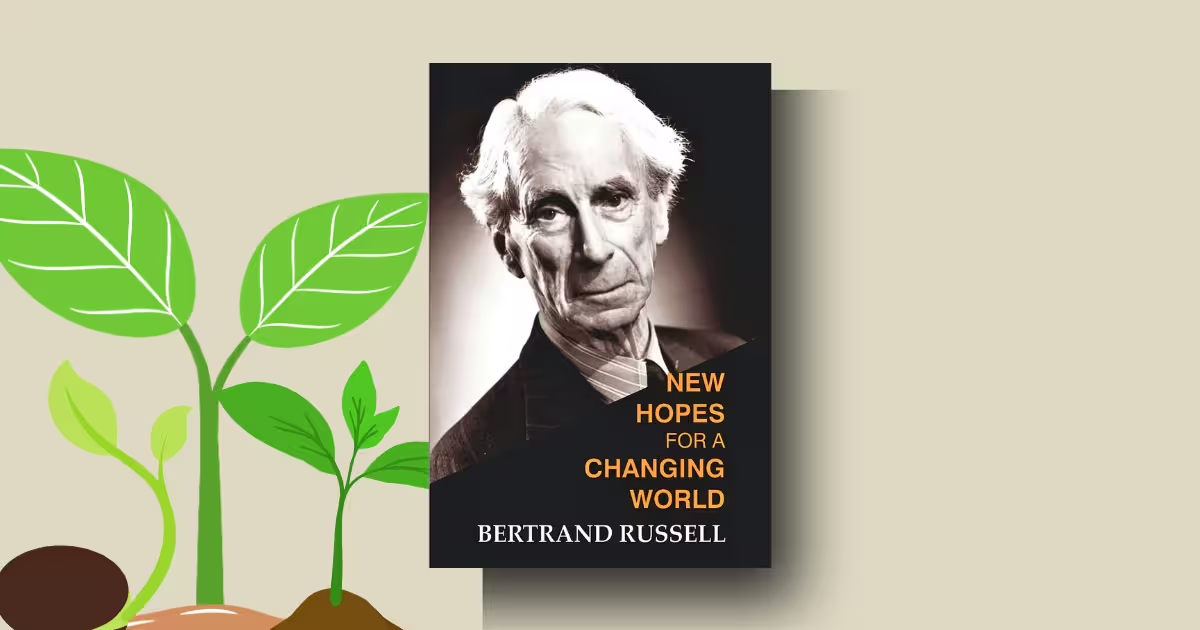
We have the knowledge to live in peace, yet we prepare for war. Seventy-five years ago, one of the greatest minds of the twentieth century sat down to write a book that would address exactly this paradox. That book was New Hopes for a Changing World by Bertrand Russell.
And here’s the thing that keeps me up at night: Russell’s diagnosis of our problems is so eerily accurate that you’d swear he was writing about 2026, not 1951.
Overview
What it is: A philosophical roadmap for humanity’s survival, written at the dawn of the atomic age by Nobel laureate Bertrand Russell.
The core argument: Modern technology has given us the power to eliminate poverty and create universal prosperity, but we remain trapped by obsolete beliefs, emotions, and habits of thought that were appropriate for earlier ages. The solution lies in resolving three fundamental conflicts: man vs. nature, man vs. man, and man vs. himself.
Why it matters now: Russell predicted the population crisis, the dangers of nationalism, the threat of nuclear annihilation, and the psychological roots of our self-destructive behavior—all with astonishing prescience. His prescriptions for world government, birth control, economic cooperation, and emotional liberation are more relevant today than when he wrote them.
Reader recommendation
New Hopes for a Changing World is highly recommended to:
- Readers who feel overwhelmed by global crises and need a rational framework for hope
- Anyone interested in the philosophical roots of nuclear anxiety and Cold War thinking
- Students of political science, international relations, and moral philosophy
- Fans of Russell’s clear, elegant prose and incisive logic
- Those seeking practical wisdom about fear, happiness, and living with uncertainty
New Hopes for a Changing World is not recommended to:
- Readers looking for light entertainment or escapism (this is serious stuff)
- Those who prefer dogmatic answers over nuanced exploration
- Anyone offended by Russell’s unapologetic advocacy of birth control and his critiques of religion
- Readers who want a purely academic treatise (this is accessible, conversational philosophy)
Table of Contents
Introduction
New Hopes for a Changing World is a philosophical and political work by Bertrand Russell (1872–1970), the British philosopher, logician, mathematician, historian, and social critic.
New Hopes for a Changing World was first published in 1951 by George Allen & Unwin Ltd in London and Simon and Schuster in New York. It is based on Russell’s broadcast lectures, “Living in an Atomic Age,” which he delivered in the early years of the Cold War.
Russell was awarded the Nobel Prize in Literature in 1950 “in recognition of his varied and significant writings in which he champions humanitarian ideals and freedom of thought”.
By the time he wrote this book, he was already one of the most influential public intellectuals of the twentieth century—a man who had lived through two world wars, witnessed the rise of totalitarianism, and was now watching humanity grapple with the terrifying implications of nuclear weapons.
Context
New Hopes for a Changing World emerged from a moment of profound global anxiety.
The Second World War had ended just six years earlier. The atomic bombings of Hiroshima and Nagasaki in 1945 had demonstrated that humanity now possessed the means to destroy itself.
The Cold War was intensifying, with the Soviet Union and the United States locked in a dangerous arms race. The Korean War was raging. The world was divided, fearful, and uncertain.
Russell, then in his late seventies, wrote this book as a kind of philosophical intervention. He wanted to offer something that the political leaders of his time seemed incapable of providing: a clear-eyed but hopeful vision of what humanity could achieve if it chose reason over fear, cooperation over competition, and wisdom over superstition.
As one reviewer put it, Russell “sits by the bedside of his old patient, Homo sapiens, and gives him a friendly pep talk on the subject of what ails him and what he can do about it”.
Purpose
New Hopes for a Changing World’s central thesis is stated clearly in the opening pages:
“Modern techniques have made poverty unnecessary, and have provided the possibility of a much higher level of general well-being than has ever existed at any former time. Failure to realize this possibility is due to the persistence of beliefs, principles, emotions, and habits of thought that were appropriate in earlier ages, but which should now be obsolete.”
Russell’s purpose is to identify the obstacles to human happiness and to offer practical solutions. He organizes his analysis around three kinds of conflict that have afflicted mankind:
- Man vs. Nature – addressed by science and technology
- Man vs. Man – addressed by politics and law
- Man vs. Himself – addressed by psychology and philosophy
Each of these conflicts, Russell argues, must be resolved if humanity is to survive and thrive. And each resolution requires not just technical solutions but profound changes in how we think and feel.
Background
To understand the urgency of Russell’s project, it helps to know a bit about his intellectual trajectory.
Russell was born into the British aristocracy in 1872. He lost both his parents by the age of four and was raised by his grandparents—his grandfather, Lord John Russell, had been Prime Minister of Britain. This privileged background gave Russell access to the best education available, but it also exposed him early to the harsh realities of power and politics.
He studied mathematics and philosophy at Cambridge, where he became one of the founders of analytic philosophy—a tradition that emphasizes clarity, logic, and the rigorous analysis of language.
Along with his collaborator Alfred North Whitehead, he wrote the monumental Principia Mathematica, which attempted to show that all of mathematics could be derived from logic.
But Russell was never content to stay in the ivory tower. He was a passionate social activist throughout his life.
He campaigned for women’s suffrage, opposed the First World War (for which he was imprisoned), advocated for nuclear disarmament, and became a leading figure in the Campaign for Nuclear Disarmament (CND) in the 1950s and 1960s.
By 1951, Russell had already written dozens of books on philosophy, mathematics, politics, education, and ethics. His History of Western Philosophy (1945) had made him a household name. His Marriage and Morals (1929) had scandalized the establishment with its progressive views on sex and relationships.
His Conquest of Happiness (1930) had offered practical advice on how to live a fulfilling life.
New Hopes for a Changing World can be seen as Russell’s attempt to synthesize all of these concerns—philosophical, political, psychological—into a single coherent vision for humanity’s future.
New Hopes for a Changing World Summary
Let me walk you through the book’s key arguments, chapter by chapter. I’ll include direct quotations from the text so you can hear Russell’s voice for yourself.
Part One: Man and Nature
Chapter I: Current Perplexities
Russell opens with a description of the mood of the age—a mood that will feel painfully familiar to anyone living in 2026:
“The present time is one in which the prevailing mood is a feeling of impotent perplexity. We see ourselves drifting towards a war that hardly anyone desires—a war that, as we all know, must bring disaster to the great majority of mankind. But like a rabbit fascinated by a snake, we stare at the peril without knowing what to do to avert it.”
This New Hopes for a Changing World’s diagnostic chapter. Russell identifies several sources of modern anxiety:
✓: The threat of nuclear war: “We tell each other horror stories of atom bombs and hydrogen bombs, of cities exterminated, of Russian hordes, of famine and ferocity everywhere.”
✓: The paralysis of uncertainty: “Our lives become balanced on a sharp edge of hypothesis—if there is to be a war one way of life is reasonable; if not, another.”
✓: The rise of simplistic thinking: “One of the painful things about our time is that those who feel certainty are stupid, and those with any imagination and understanding are filled with doubt and indecision.”
Russell also takes aim at Western imperialism, particularly in Asia and Africa. He argues that the West has spread its worst qualities—militarism, fanaticism, “ruthless belief in mechanism”—while preventing the East from acquiring its best: “the spirit of free inquiry, the understanding of the conditions of general prosperity, and emancipation from superstition”.
He also critiques traditional morality, arguing that the concept of “sin” has become obsolete:
“The whole conception of sin has, as it were, gone dead… Most people have not thought out any other system of ethics, and have not, perhaps, theoretically rejected the old system. But it has lost its hold on them.”
Russell’s alternative? A positive, life-affirming ethic based on happiness, creativity, and freedom from fear:
“The good life, as I conceive it, is a happy life. I do not mean that if you are good you will be happy; I mean that if you are happy you will be good.”
Chapter II: Three Kinds of Conflict
This short chapter lays out New Hopes for a Changing World’s organizing framework. Russell argues that the three conflicts—man vs. nature, man vs. man, man vs. himself—are not separate but deeply interconnected.
“The long ages of the other two kinds of conflict have moulded human nature to a pattern formerly appropriate, but now technically obsolete… Sin is only part of my nature, but it is the whole nature of my enemies. So at least the old-fashioned moralist believes. And therefore the soul which is not at peace with itself cannot be at peace with the world.”
The solution, Russell argues, is harmony in all three domains:
“Each kind of war should end in harmony. The conflict of man with physical nature is turned into a harmony in proportion as man learns the secrets of nature… The conflict of man with man… should end in a political and economic unification such as is sought by the advocates of world government… But it will not be a stable harmony until men have achieved a genuine harmony within themselves.”
Chapter III: Mastery Over Physical Nature
Russell provides a whirlwind history of human evolution, from our arboreal ape ancestors to the industrial age. He describes how early humans emerged from the trees, developed tools, language, agriculture, and eventually science and machine production.
The key point? Humanity’s mastery over nature is a relatively recent phenomenon, and we haven’t yet learned to use it wisely.
“The liberation from bondage to nature has left men, in theory, free to choose their own ends to a degree that was never possible at any earlier time. I say ‘in theory,’ because impulses incorporated into human nature by long ages of training and natural selection remain to determine human action independently of present physical needs.”
Russell warns that our new powers can be used for good or ill:
“Such economies, if the world remains politically what it is now, will do nothing but harm, since they will set free a greater part of human energy for the purpose of mutual destruction.”
Chapter IV: The Limits of Human Power
Russell cautions against technological arrogance. While science has given us great power, we are not omnipotent:
“Man, however scientific he may be, is not omnipotent. He is hedged in by natural limits. By means of his knowledge and technique he can diminish the narrowness of these limits, but he can never remove them wholly.”
He identifies two key limits:
✓: Exhaustion of natural resources: “Modern industry, in fact, is a kind of rape… All the long astronomical and geological ages during which the materials which we find useful have been built up, contribute a moment’s blaze, a moment’s frivolous exuberance.”
✓: Soil degradation: “Ever since agriculture began it has been carried on wastefully in most parts of the world… formerly fertile hillsides now turned into barren rock, about irrigated plains now desert, and flourishing civilizations now buried beneath the sands.”
Russell also mentions the second law of thermodynamics in characteristically witty fashion:
“If you look up this law in a textbook, you will learn that it states that entropy always increases, and if you are not a physicist you will not be much the wiser. But the law can be stated more simply, and is stated more simply by proverbial wisdom. It states, in fact, that you cannot unscramble eggs.”
Chapter V: Population
This is perhaps New Hopes for a Changing World’s most controversial and prescient chapter. Russell tackles the population problem head-on, using statistics that were shocking in 1951 and remain alarming today.
He cites Julian Huxley’s estimates:
| Year | Population |
|---|---|
| 5000 B.C. | 20 million |
| A.D. 400 | 200 million |
| A.D. 1650 | 540 million |
| A.D. 1950 | 2,200 million |
Russell notes that “every day there are 70,000 more people in the world than there were the day before; every year there are 25 million more”. At the then-current rate of increase (1.16% per annum), he calculates that in a hundred years there would be 5,400 million; in two hundred, 14,500 million; in three hundred, 45,000 million.
His solution? Birth control. And he doesn’t mince words:
“Those who oppose birth control, if they are capable of a little arithmetic, will have to admit that their opposition implies a perpetuation of needless mortality.”
He points out the hypocrisy of Western moralists who oppose birth control while benefiting from low birth rates themselves:
“I am inclined to think that the most important of Western values is the habit of a low birthrate. If this can be spread throughout the world, the rest of what is good in Western life can also be spread.”
Russell also addresses the political dimensions of population growth. The nations with the fastest-growing populations—Russia, India, China, Japan—were also the ones most likely to challenge Western dominance. As he puts it:
“Russia, India, China, and Japan contain between them about half the population of the globe. If there is no change in vital statistics, they will soon contain much more than half. On the other hand, the population of what we may call the ‘Western’ group, even liberally interpreted, is less than a quarter of the total population of the world, and is likely soon to be much less than a quarter.”
Part Two: Man and Man
Chapter VI: Social Units
Russell traces the evolution of human social organization from the family to the tribe to the nation. He argues that while technical progress has made larger social units more efficient and necessary, our psychological attachments remain stuck at smaller scales.
“As social units grow larger, the psychological mechanism from which they derive support is gradually diluted. Loyalty to one’s family is a natural emotion… But when tribes unite into a nation, the feeling of loyalty to the nation is generally, at least at first, much less vivid and compelling than the feeling of loyalty to the tribe.”
Chapter VII: The Size of Social Units
Russell explores the technical and psychological factors that determine the optimal size of a political unit. Technically, advances in transportation and communication—roads, railways, telegraphs, aeroplanes—have made larger states possible and even necessary. Psychologically, however, nationalism remains a powerful obstacle to further unification.
“The great enemy of modern conquerors is nationalism, a sentiment practically unknown in former times to all except the Jews.”
He observes that modern propaganda techniques—press, radio, education—intensify national loyalty but cannot create it where it doesn’t already exist.
Chapter VIII: The Rule of Force
Russell examines the role of force in human relations. He argues that while force is morally undesirable, it has historically been necessary for the establishment of social order:
“Although the rule of force is not a thing to be admired, and although one must be glad when it is replaced by something gentler and less unjust, it has nevertheless had a useful part to play in the development of social institutions.”
He applies this logic to international relations:
“I think the first step towards an international Government must be through the use of force. The nations must be compelled to disarm, and the international Government must have a monopoly of the more powerful weapons of war.”
Chapter IX: Law
Russell argues that law is not an alternative to force but its organized form. He traces the evolution of law from primitive codes to modern legal systems, and he reflects on the concept of justice.
“Justice is conceived by modern democrats in a way quite different from that in which it was conceived in former times. Plato’s Republic is, in form, an attempt to define justice, and after an immense discussion, it arrives at the interesting result that justice consists in giving every man his due, i.e. what it is just to give him.”
Russell’s own view is more pragmatic:
“The principle of justice demands equality except in so far as inequality can be proved to be socially useful.”
Chapter X: Conflicts of Manners of Life
Russell examines historical conflicts between different ways of life: agriculturalists vs. pastoral nomads, seafaring peoples vs. land-bound peoples, and now industrialism vs. traditional agriculture.
He notes that these conflicts have often been resolved not by military victory but by the superior productivity of the more advanced technique:
“A technique which is more efficient from the point of view of production is almost sure to spread at the expense of one which is less efficient in this respect, even if, from the point of view of war, the older manner of life is more likely to lead to victory.”
Chapter XI: World Government
Russell makes the case for world government as the only way to prevent war. He acknowledges the difficulties but argues that the alternative is unthinkable:
“If the world is to be saved from war, there must be a single Government with a monopoly of all the serious weapons of war.”
He is realistic about how such a government might come into being:
“I do not believe that the human race has sufficient statesmanship or capacity for mutual forbearance to establish a world Government on a basis of consent alone. That is why I think that an element of force will be needed in its establishment and in its preservation through the early years of its existence.”
Chapter XII: Racial Antagonism
Russell tackles the explosive issue of race. He provides a sobering survey of racial tensions around the world—in the United States, South Africa, Asia, and elsewhere.
He argues that race hatred is largely irrational:
“The instinctive root of race hatred is the fear of what is strange… The purely instinctive element in race hatred is a small item in the total, and is not hard to overcome. The fear of what is strange, which is a large part of its essence, disappears with familiarity.”
He advocates for three possible solutions to racial conflict: geographical separation, a caste system, or complete equality and intermarriage. He favors the last.
Chapter XIII: Creeds and Ideologies
Russell examines the role of fanaticism in human conflict. He traces the history of religious and ideological wars from ancient times to the Cold War.
He is critical of both Communism and anti-Communism:
“The ardent friends and the bitter enemies of Communism are alike willing to see the human race radioactively exterminated rather than compromise with the evil thing—capitalism or Communism as the case may be. All these are examples of fanaticism.”
He identifies the root causes of fanaticism as misfortune and poverty, and he prescribes security, prosperity, and liberal education as the cure.
Chapter XIV: Economic Co-operation and Competition
Russell critiques classical economics and its fetishization of competition. He argues that in the modern world, co-operation is both more efficient and more necessary.
“Modern industrial technique has made competition far less important than it used to be, and has made different industries and different parts of the world far more interdependent than they formerly were.”
He praises Keynesian economics as a way to prevent depressions:
“The broad principle is that Governments must spend and encourage spending when private people feel inclined to save, and must encourage saving or compel it by means of taxation when private people feel inclined to spend.”
Chapter XV: The Next Half-Century
Russell looks ahead to the year 2000 (which was fifty years in his future). He hopes that a third world war can be avoided, but he is not confident.
“Any day a third world war may be upon us. If it happens, it will be far more terrible than the two that have preceded it, and will postpone for an indefinite period of time the realization of such hopes as I am dealing with in this book.”
Nevertheless, he urges his readers to keep hope alive:
“Men are slow to learn, even when all that is to be learned is the road to happiness. Perhaps they can only learn by even more bitter experience than they have already had of the opposite road. But if they are to learn, if torture is to bring them sanity rather than madness, it will only be because some men have preserved sanity and hope throughout.”
Part Three: Man and Himself
Chapter XVI: Ideas Which Have Become Obsolete
Russell argues that many of our core beliefs and values are holdovers from a bygone age—an age of scarcity, struggle, and survival of the fittest.
“Human beings change their ways much more quickly than animals do… The new techniques in the material realm demand, if they are to bring their full benefit in increase of human welfare, an accompaniment of new mental habits. It is in this respect more than in any other that our world falls short.”
He singles out the ethic of struggle as particularly obsolete:
“The kernel of these beliefs and passions is the STRUGGLE FOR LIFE. Where this struggle is now still necessary, it is necessary because men are misguided, not because nature is niggardly.”
Chapter XVII: Fear
Russell identifies fear as the greatest obstacle to a good world:
“The greatest obstacle to a good world is now FEAR.”
He distinguishes between rational apprehension and irrational fear:
“It is necessary first of all to distinguish between fear as an emotion and rational apprehension of danger as a piece of knowledge. It would be foolish to be unaware of dangers when they exist, but it is very seldom that a danger can be dealt with as adequately by fear as by rational apprehension.”
He explores three kinds of fear: fear of nature, fear of other men, and fear of ourselves. The last, he argues, is the most damaging:
“Fear of self… has become to a very great extent the basis of the other fears.”
Chapter XVIII: Fortitude
Russell urges his readers to cultivate courage and hope in the face of adversity. He draws on historical examples—Plotinus, Boethius, Spinoza—to illustrate the power of philosophical resilience.
“Spinoza, who was one of the wisest of men and who lived consistently in accordance with his own wisdom, advised men to view passing events ‘under the aspect of eternity.’ Those who can learn to do this will find a painful present much more bearable than it would otherwise be.”
Chapter XIX: Life Without Fear
Russell imagines what a world without fear would look like. He emphasizes the importance of education in creating such a world:
“Educators in the past tended too much to believe in original sin, and to think that the child ought to be made into something quite different from what nature would make it… An educator should think of a child as a gardener thinks of a plant, as something to be made to grow by having the right soil and the right amount of water.”
Chapter XX: The Happy Man
Russell describes the character and life of a happy person in the society he envisions. The happy man is:
- Free from fear and guilt
- Cooperative rather than competitive
- Able to enjoy work, friendship, and family
- Able to grow old gracefully
“An individual human existence should be like a river—small at first, narrowly contained within its banks, and rushing passionately past boulders and over waterfalls. Gradually the river grows wider, the banks recede, the waters flow more quietly, and in the end, without any visible break, they become merged in the sea, and painlessly lose their individual being.”
Chapter XXI: The Happy World
Russell concludes with a vision of a unified, peaceful, prosperous world:
“Such a world is possible. It rests with men to choose whether they will create it, or allow the human race to perish in anger and sordid hate.”
His final words are both a warning and an invitation:
“Man now needs for his salvation only one thing: to open his heart to joy, and leave fear to gibber through the glimmering darkness of a forgotten past.”
New Hopes for a Changing World Analysis
Let me be honest with you: New Hopes for a Changing World is not a perfect book. It has blind spots. Russell’s confidence in the power of reason can sometimes seem naive.
His advocacy of world government, while logically compelling, ignores the deep psychological and cultural obstacles that make such a project seem utopian.
His criticisms of religion and traditional morality, while often justified, can come across as dismissive of the genuine comfort that many people find in faith.
And yet.
Reading New Hopes for a Changing World in 2026, I found myself repeatedly gasping at Russell’s prescience. He predicted:
✓: The population crisis that now threatens to overwhelm the developing world
✓: The exhaustion of natural resources and the environmental degradation that we now call climate change
✓: The dangers of nationalism and the rise of authoritarian populism
✓: The psychological roots of our self-destructive behavior—the fear, the guilt, the need for enemies
✓: The necessity of global cooperation in an age of weapons of mass destruction
Russell wrote New Hopes for a Changing World at the age of 79, in the shadow of the atomic bomb. He had every reason to be pessimistic. And yet he chose hope.
Not a naive, sentimental hope, but a rational, evidence-based hope. He believed that if people could be made to understand the facts—the facts of overpopulation, of resource depletion, of the futility of war—they would choose wisely. He believed that self-interest, properly understood, would lead to cooperation. He believed that education could create a better world.
Was he right? That depends on whether we prove him right.
Strengths and Weaknesses
Strengths
Clarity and accessibility: Russell writes with extraordinary lucidity. Complex ideas are explained in simple, elegant prose. This is philosophy for everyone.
Breadth of vision: New Hopes for a Changing World synthesizes insights from science, politics, psychology, and ethics into a coherent whole. It’s a rare example of a work that is both deeply philosophical and practically relevant.
Moral courage: Russell doesn’t shy away from controversial positions. He advocates birth control, world government, and the abandonment of traditional religious morality—all of which were unpopular in 1951 and remain controversial today.
Psychological insight: Russell understands that political problems are ultimately psychological problems. You can’t have peace in the world until you have peace in the soul. This insight is more relevant than ever.
Prescience: As I’ve already noted, Russell’s predictions about population, resources, and nationalism were remarkably accurate.
Weaknesses
Over-optimism about reason: Russell sometimes seems to believe that if people just understood the facts, they would act rationally. This underestimates the power of emotion, identity, and ideology.
Eurocentrism: Despite his criticisms of Western imperialism, Russell’s perspective is unmistakably that of a Western intellectual. He assumes that “Western values” (particularly science and democracy) are universal goods.
Naivety about world government: Russell acknowledges that world government would require force, but he underestimates the difficulty of maintaining such a government without widespread consent.
Dated references: Some of New Hopes for a Changing World’s specific examples (the Cold War, the Korean War, the politics of the 1950s) feel distant to a modern reader. The principles, however, remain relevant.
Lack of depth on certain issues: New Hopes for a Changing World is short (about 200 pages) and covers a lot of ground. Some topics—such as the detailed mechanics of world government or the specifics of economic reform—are treated only superficially.
Comparison with Other Works
New Hopes for a Changing World belongs to a genre of mid-twentieth-century philosophical works that grappled with the implications of modern technology and the threat of nuclear war. It can be compared to:
George Orwell’s 1984 (1949): Both Orwell and Russell were concerned with totalitarianism and the loss of freedom. But while Orwell painted a dystopian vision, Russell offered a utopian one.
Aldous Huxley’s Brave New World (1932): Huxley warned of a future in which technology was used to control and pacify. Russell believed technology could liberate.
Albert Einstein’s essays on peace: Russell and Einstein were friends and allies in the campaign for nuclear disarmament. Both believed that science could save humanity if used wisely.
John Maynard Keynes’s economic writings: Russell was deeply influenced by Keynes and incorporated his ideas about government spending and full employment.
The works of Julian Huxley: Russell drew on Huxley’s population statistics and shared his belief in the need for birth control.
Russell’s own earlier works: New Hopes for a Changing World is a kind of synthesis of Russell’s earlier political and philosophical writings, particularly The Conquest of Happiness (1930) and Power (1938).
Conclusion
New Hopes for a Changing World is not just a book; it’s a manifesto for survival.
Bertrand Russell wrote it at a moment when humanity stood at a crossroads. We could choose reason over fear, cooperation over competition, life over death. Or we could stumble blindly into destruction.
Seventy-five years later, we stand at the same crossroads. The weapons are more powerful, the population is larger, the resources are more depleted. And yet Russell’s message remains as urgent as ever:
“Such a world is possible. It rests with men to choose whether they will create it, or allow the human race to perish in anger and sordid hate.”
Who should read New Hopes for a Changing World?
- Anyone who feels overwhelmed by the state of the world and needs a rational framework for hope
- Students of philosophy, politics, and international relations
- Activists and campaigners who want to understand the deeper roots of our problems
- Anyone who loves clear, elegant, courageous writing
Russell was a man of immense intellect and even greater heart. He believed in humanity’s capacity for good, even when all evidence seemed to point the other way.
Reading New Hopes for a Changing World, you can feel his urgency, his compassion, and his unshakeable faith in reason.
I leave you with his final words:
“Man, in the long ages since he descended from the trees, has passed arduously and perilously through a vast dusty desert, surrounded by the whitening bones of those who have perished by the way… At last he has emerged from the desert into a smiling land, but in the long night he has forgotten how to smile. We cannot believe in the brightness of the morning.”
But Russell believed. And after reading New Hopes for a Changing World, I believe too.
The question is: will we prove him right?