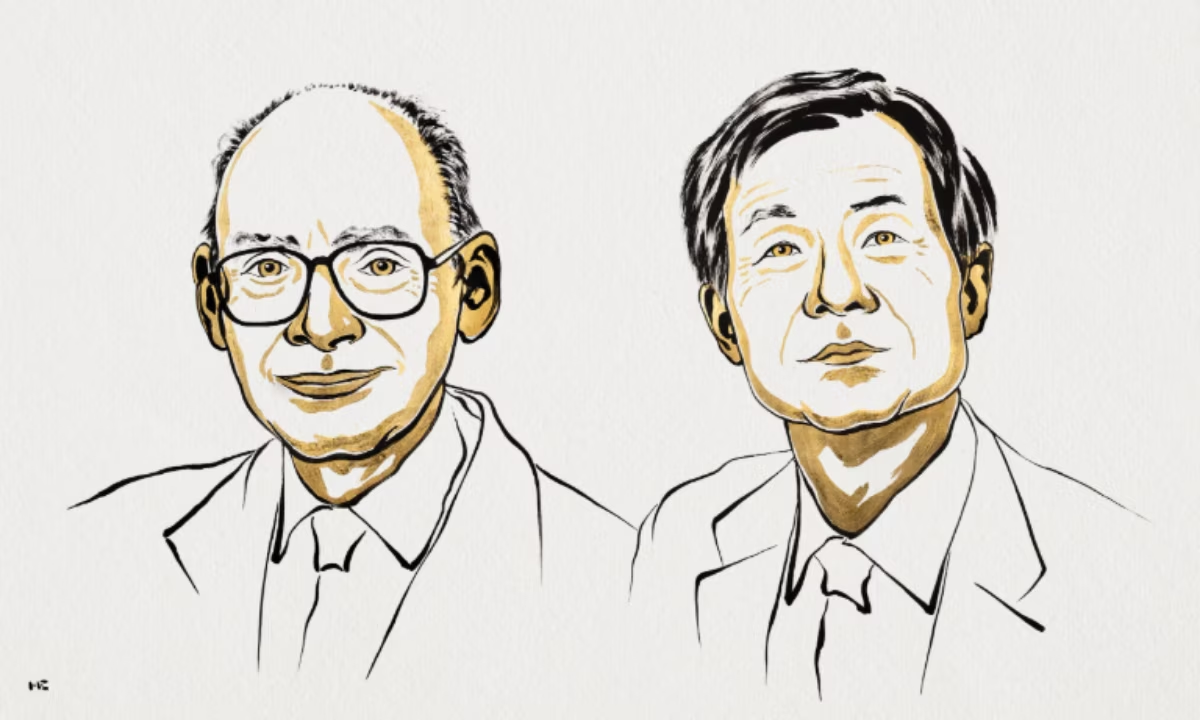

Henri B. Kagan of France and Kenso Soai of Japan won the 2026 Nobel Prize in Chemistry, announced on 7 October 2026. The award recognizes their discovery of non-linear effects and autocatalysis in asymmetric organic synthesis.
In plain terms, they showed how a tiny imbalance between mirror-image molecules can grow into a large one.
Table of Contents
Key facts
| Item | Detail |
|---|---|
| Prize | Nobel Prize in Chemistry 2026 |
| Laureates | Henri B. Kagan and Kenso Soai |
| Announced | Wednesday 7 October 2026, Stockholm |
| Awarding body | Royal Swedish Academy of Sciences |
| Prize money | 12 million Swedish crowns, about $1.2 million, to be shared |
| Affiliations | Université Paris-Sud in Orsay (Kagan) and Tokyo University of Science (Soai) |
Who won the 2026 Nobel Prize in Chemistry?
Henri Kagan of France and Kenso Soai of Japan were jointly honored for research into the mirror images of molecules, work described as decisive for developing pharmaceuticals. The Academy cited them “for the discovery of non-linear effects and autocatalysis in asymmetric organic synthesis.”
The phrase is dense, so I will unpack it below. First, the problem it answers.
What puzzle did Kagan and Soai solve?
Many molecules come in two forms that are mirror images of each other, like a left and a right hand. Amino acids are one example, and living organisms contain only one of the two variants. Chemists call this one-handedness homochirality. Life on Earth is built from L-amino acids and D-sugars.
A flask of ordinary reagents does not behave that way. Mix achiral ingredients and you normally get equal amounts of both hands. Why life ended up with only one was a question chemists could pose but not test in a flask.
Heiner Linke, chair of the Nobel Committee for Chemistry, said the pair solved a century-old mystery about how homochirality can emerge spontaneously. I would read “solved” as “showed a working chemical mechanism,” which is a narrower claim than “explained the origin of life.” More on that distinction below.
What are non-linear effects? (Kagan’s contribution)
In asymmetric synthesis, chemists use a chiral catalyst to make one mirror-image product instead of both. The natural assumption is a straight-line relationship: a catalyst that is 50 percent pure in one hand gives a product 50 percent pure in that hand.
Kagan showed that this is often wrong. The two hands of a catalyst can pair up into larger species that behave differently from the single molecules. The result can be a product purer than the catalyst that made it, which is called a positive non-linear effect, or less pure, which is a negative one. Early mechanistic discussions of positive non-linear effects feature Kagan alongside Noyori.
The practical meaning is easy to state. A catalyst that is not perfectly pure can still deliver a nearly pure product. That changes how reactions are designed and how much effort goes into purifying catalysts. In my reading, this is the most immediately useful half of the prize.
What is the Soai reaction? (Soai’s contribution)
Autocatalysis means a product helps make more of itself. Soai found a reaction where the product speeds up its own formation and, crucially, favors its own hand. The Soai reaction is autocatalytic and produces rapidly growing amounts of the same enantiomer of the product; Soai discovered it in 1995.
The textbook version adds diisopropylzinc to a pyrimidine aldehyde. Start with a very slight excess of one hand and the reaction magnifies it. In one well-studied pyrimidine system, the product reached more than 99.5 percent enantiomeric excess within four reaction cycles.
Enantiomeric excess (ee) measures how much one hand outnumbers the other.
The triggers Soai found are what made the reaction famous. Chiral inorganic crystals such as quartz and sodium chlorate can act as the initiators, which links the product’s handedness back to the origin of chirality. A reaction that turns a trace imbalance, from almost any source, into near-total one-handedness is a laboratory model for how life’s chemistry could have tipped one way.
Why did this take so long to explain?
The reaction’s behavior was clear, but its inner workings were not. For more than 25 years the chemistry community puzzled over the mechanism of the Soai reaction. A collaboration between the Denmark and Houk groups later pointed to a tetrameric zinc cluster acting as the catalyst. That lag matters, and I return to it in the assessment below.
Why does this matter for medicine?
The two hands of a drug molecule can interact with the body differently, so manufacturers usually need one hand, not a mixture. The Academy’s news release said the discoveries have been decisive for chemists who design reactions for manufacturing pharmaceuticals. Non-linear effects give process chemists more room for error with catalysts. Autocatalysis adds a different idea: a system that amplifies its own purity.
Who are the laureates?
Henri B. Kagan. Born 15 December 1930, he has won the Wolf Prize in Chemistry (2001) and the Ryoji Noyori Prize (2002). His name was already tied to this field in 2001. That year, a controversy arose when he was left out of a Nobel Prize for asymmetric catalysis, since the prize can go to at most three people. The 2001 prize went to Knowles, Noyori and Sharpless.
This year’s award reads partly as a correction of that old omission, though the Academy cites different discoveries, and I am offering that as my interpretation, not the committee’s.
Kenso Soai. Born in 1950, he studied at the University of Tokyo, did postdoctoral work with Ernest Eliel in North Carolina, and became a lecturer at Tokyo University of Science in 1981, reaching full professor in 1991. The Soai reaction carries his name.
What the prize does and does not settle
This is where I would push back on the more excited headlines.
First, the Soai reaction is a model, not a replica of early Earth. Reporting describes it as a key model for understanding the origin of homochirality. It uses a zinc reagent and a synthetic pyrimidine, neither of which obviously belongs on a prebiotic planet. It proves that amplification of a trace imbalance is chemically possible. It does not prove life began that way.
Second, the amplification depends on specific substrates and conditions. The reaction is a striking demonstration, but I would not describe it as a general method that chemists now run across industry.
Third, the two halves of the prize differ in everyday reach. Kagan’s non-linear effects shaped how chemists think about ordinary asymmetric catalysis. Soai’s autocatalysis answers a deeper but more abstract question. The Nobel Committee has bundled them because both explain how small differences grow into large ones.
How 2026 fits into Nobel week
The 2026 announcements began with the medicine prize on Monday and physics on Tuesday, with literature on Thursday, peace on Friday and economics the following Monday. Last year, the chemistry prize went to Susumu Kitagawa, Richard Robson and Omar Yaghi for metal-organic frameworks.
That prize was about building new materials. This one is about understanding a principle of nature, which I find a pleasing contrast.
FAQ
Who won the Nobel Prize in Chemistry 2026?
Henri B. Kagan (France) and Kenso Soai (Japan). The Royal Swedish Academy of Sciences announced the award on 7 October 2026 in Stockholm.
What did Kagan and Soai discover?
Kagan discovered non-linear effects in asymmetric catalysis, where product purity does not track catalyst purity in a straight line. Soai discovered an autocatalytic reaction that amplifies a tiny excess of one mirror-image molecule into a large one.
What is the Soai reaction?
An autocatalytic reaction, discovered in 1995, in which a pyrimidine aldehyde reacts with diisopropylzinc and the product alcohol catalyzes its own formation. It amplifies a small imbalance between mirror-image forms into near-complete one-handedness.
What is a non-linear effect in asymmetric synthesis?
It is a departure from the expected straight-line link between the purity of a chiral catalyst and the purity of its product. The product can come out purer (positive effect) or less pure (negative effect) than the catalyst predicts.
How much is the 2026 Nobel Prize in Chemistry worth?
Did the prize explain how life began?
No. It recognizes chemistry showing how a tiny molecular imbalance can be amplified. That is a model for homochirality, not a proven account of life’s origin.