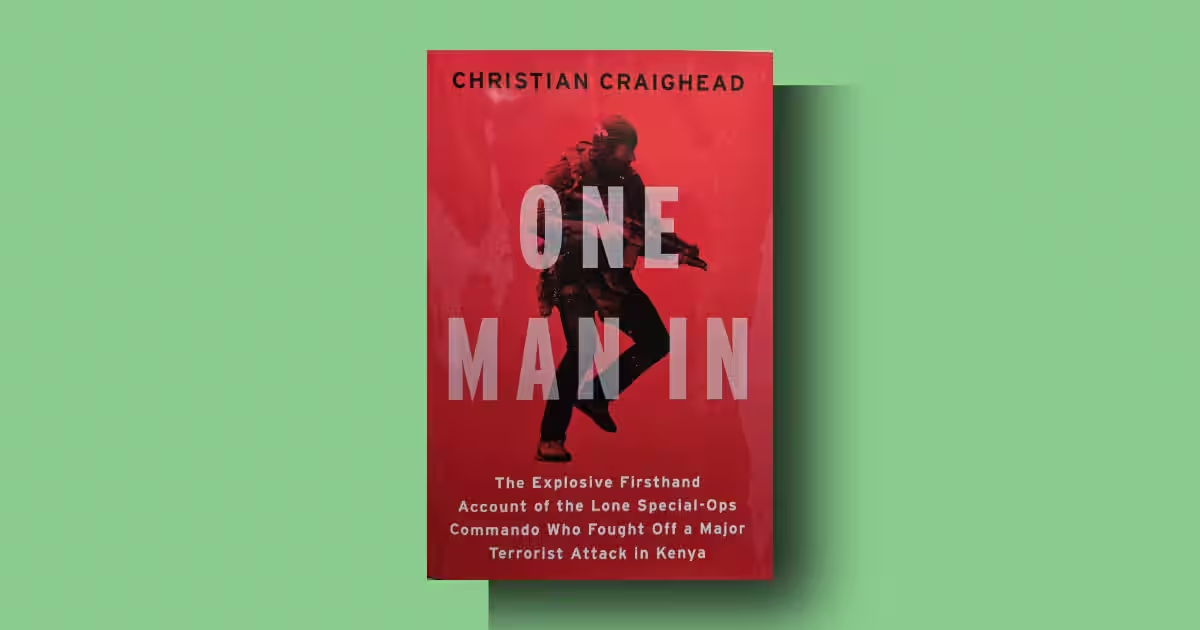

One Man In is Christian “Chris” Craighead’s first-person account of the twenty-two hours he spent fighting al-Shabaab gunmen inside the DusitD2 hotel and office complex in Nairobi on January 15 and 16, 2019, and it is the SAS memoir the British government went to court to stop. I read every chapter of this One Man In review copy expecting a slick action story.
What I got was stranger and more interesting: a thrilling rescue narrative, a painful childhood confession, and a soldier’s cold, unapologetic view of killing, all stitched together by a man who clearly believes he was born for one afternoon in Kenya. It is a brave story.
It is also, at times, an uncomfortable one to sit with, and that tension is the reason it is worth your time.
Table of Contents
Quick Summary
- What it is: A 224-page memoir by former 22 SAS operator Christian Craighead, published by Threshold Editions (Simon & Schuster) in the United States on September 15, 2026.
- What happens: An off-duty British liaison officer drives the wrong way down a Nairobi highway, walks into an active terrorist attack with no orders, evacuates hundreds of civilians, takes command of Kenyan police units, and helps kill the four remaining al-Shabaab gunmen over roughly 22 hours.
- The twist in structure: About a third of the book cuts away from Nairobi to Craighead’s violent childhood in Morpeth, Northumberland, his Parachute Regiment and Pathfinder years, and his first kills in Iraq in 2003.
- Why it made news: The UK Ministry of Defence refused permission to publish in July 2022, the High Court upheld that refusal in October 2023, and a UK injunction was reported in September 2026, days before the US edition came out.
- My verdict: Four stars for pace and tactical detail. Points off for self-mythology, a thin treatment of the Kenyan officers who did much of the shooting, and a few factual claims that other sources contradict.
Reader Recommendation for One Man In: Who Will Love It, and Who Will Bounce
You will love One Man In if you:
- Read military memoirs like Bravo Two Zero or Lone Survivor and want a modern, urban counterterrorism story.
- Care about how close-quarter battle actually works: stairwells, doors, grenades, friendly fire.
- Want a real-time, minute-by-minute account of the DusitD2 attack from inside the building.
- Follow the free-speech fight between former special forces soldiers and the MoD.
You will probably bounce if you:
- Dislike heavy profanity. One Man In swears on almost every page.
- Want a balanced political history of al-Shabaab or of Kenya’s security services.
- Are put off by a narrator who describes dead enemies as no different from roadkill.
- Expect literary reflection. This is a soldier talking, not a stylist writing.
What Is One Man In by Chris Craighead About?
One Man In is a nonfiction military memoir about a single terrorist attack and the life that prepared one man to face it. The full title is One Man In: The Explosive Firsthand Account of the Lone Special-Ops Commando Who Fought Off a Major Terrorist Attack in Kenya. The copyright page lists Christian Craighead as author (copyright 2026), Threshold Editions as the imprint, and September 2026 as the first hardcover edition. Craighead signs his acknowledgments “February 2026,” so the text was finished several years after he first tried to publish it.
Who is Christian Craighead?
Christian Craighead is a former British soldier who served 28 years in the British Army, including the Parachute Regiment, the Pathfinder Platoon, and 22 SAS.
By his own account he was born in September 1975 at Newcastle General Hospital, joined the army at 16 in September 1992, passed SAS selection in 2006 at age 30 (the upper limit, he notes, was 32), and completed seventeen operational deployments. He was awarded the Conspicuous Gallantry Cross for his actions in Nairobi, according to Wikipedia and the book itself. He has since moved to the United States.
He also published a children’s book, The Wrong Wolf, in November 2023, according to Victoria Cross Online; he quotes it as an epigraph in Chapter Nine.
What is the main argument of the book?
The central claim of One Man In is that preparation, not luck, decides who acts in a crisis, and that the right choice is often the unauthorized one. Craighead frames his decision to enter the complex as the “hard right” over the “easy wrong.”
He says plainly that most people in his position would have waited for permission, and that if things had gone badly he “would have been made the scapegoat.” A second, quieter thesis runs underneath: that a brutal, neglected childhood can be turned into purpose if someone gives the child structure.
For him, that someone was his grandmother and then the Army Cadet Force.
Background: What Happened at DusitD2 in January 2019?
The DusitD2 attack was a coordinated al-Shabaab assault on a hotel and office complex at 14 Riverside Drive, Nairobi, that killed 21 people on January 15 and 16, 2019. A suicide bomber, Mahir Khalid Riziki, detonated his vest outside the Secret Garden Café, and four gunmen led by Ali Salim Gichunge stormed the compound with rifles and grenades.
Al-Shabaab claimed the attack as a response to the US decision to recognize Jerusalem as Israel’s capital, as both the book and Al Jazeera report.
Some numbers worth knowing:
- About 700 people were in the complex that day, according to the book and the Combating Terrorism Center at West Point.
- 21 dead and at least 28 wounded in the initial count. The toll rose to 22 when the hotel nurse, Noel Kidaliza, died of her wounds almost a year later.
- Westgate comparison: the 2013 Westgate mall siege killed at least 67 people and lasted four days. DusitD2 was over in less than a day.
- Convictions: In June 2025, a Kenyan court sentenced two men to 30 years each for financing the attackers and supplying fake identity documents, per Al Jazeera.
Why was One Man In banned in the UK?
One Man In was blocked in Britain because Craighead signed a lifelong confidentiality contract as a member of UK Special Forces, and the MoD refused to give the written permission that contract requires. T
he Defence Secretary refused in July 2022. In R (Craighead) v Secretary of State for Defence [2023] EWHC 2413 (Admin), Mrs Justice Steyn held that his free-speech rights under Article 10 were “attenuated” by that voluntary contract and that the refusal was proportionate, as summarized by the Panopticon legal blog.
In September 2026, the MoD reportedly obtained a court order against UK release, and an MoD spokesperson said past and present employees “are required to uphold their contractual obligations,” according to Head Topics UK. A blog by Rob Maness dates that interim injunction to September 10, 2026, and puts Craighead’s legal costs above $130,000.
One Man In Summary: The Full Story
I have written this summary so you can follow whole One Man In without opening it. It alternates, as the book does, between the Nairobi timeline and Craighead’s past.
How does One Man In open?
One Man In opens with grenades. “Two hand grenades bounced down the stairs, coming toward me,” the prologue begins, dropping you on the sixth floor of the hotel late in the siege, with Kenyan paramilitary officers and no helmet.
It is a cold open that tells you exactly what kind of book this is. Before the story starts, though, Craighead adds a short disclaimer: the account “does not purport to be a definitive history” and rests on his memory plus published news reports, with some names changed.
The stranger on the road (Chapters 1 and 2)
On January 15, 2019, Craighead wakes at 4:30 a.m., drives about an hour and a half to a Kenyan Defence Forces range, and practices drills with his C8 rifle and Glock 19. He has been in Kenya for about a month as a British liaison officer, a posting reserved for SAS soldiers with more than ten years in the regiment. He is blunt about the Kenyan military: “not the best soldiers I’d ever seen.”
On the drive home he breaks his own rules and gives a lift to a smartly dressed stranger named Simon. Simon chatters the whole way, shows him a double-pointed blade he carries against “demons,” and on leaving turns suddenly serious: “Creeze, may God bless you many times this day.” Craighead later wonders if Simon was an angel. This scene tells you early that faith matters to the author. He carries a camouflaged Bible and a rosary into battle.
Chapter Two fills in the setup. He lunches at the Outpost Restaurant, messages a friend who works at DusitD2 (a former Royal Marine who won the George Cross for rescuing people at Westgate in 2013), and keeps a packed bag of rifle, body armor, grenades and night vision goggles by the door. He also recalls a Christmas Day visit to an orphanage where a boy named Moses told him he wanted “to be tough” so no man could hurt him again. It is a quiet mirror of what comes later in the book about Craighead’s own childhood.
The attack begins (Chapter 3)
At 3:17 p.m., by the book’s timing, Riziki detonates his vest at the Secret Garden Café. Five people die instantly, including American Jason Spindler, a 9/11 survivor who had changed careers to invest in emerging markets, and British aid worker Luke Potter, who had arrived in Nairobi only three days earlier. Four gunmen crash their car into a ditch, walk past an unresisting gatehouse, and split into pairs. Within five minutes, the book says, they have killed eight people.
The call and the drive (Chapters 4 to 6)
Craighead is stepping out of the shower when his ex-Marine friend calls and says one word, “gen,” navy slang for “this is real.” He grabs his gear. Google Maps estimates 28 minutes. He gets there in about fifteen, driving on the wrong side of the road, hitting 80 mph in bursts, with Vivaldi’s Four Seasons stuck on the stereo because he has no free hand to turn it off.
His calls to the SAS Ops Room in the UK fail because the stand-in operator does not understand the push-to-talk button. None of the Kenyan commanders on his contact list answer. At a police roadblock he bluffs: “I’m here on the orders of the president. And I need to get through.” It works.
Along the way he recalls a crash at age 22, when a truck landed on his Land Rover on the M6. The injuries he lists are extraordinary: a fractured skull needing a craniotomy, a neck broken in three places, a back broken in seven, and two weeks in a coma. Within six months he was parachuting again.
He parks near the burning cars and gears up: body armor, C8 with suppressor, pistol, a grenade and flashbang, a switchblade, and a Blackbeard pirate patch that later led the media to guess he was American.
He leaves his helmet, night vision and tomahawk in the truck, a choice he regrets for years because of what it did to his hearing. It is coming up to 4 p.m.
“No one is here yet” (Chapters 7 and 8)
At the gatehouse he finds about a dozen armed men, guards and civilians with pistols, whom he nicknames the “Free Radicals.” Nobody knows how many attackers there are. An older guard tells him: “No one is here yet. No one. No one.” A woman screams inside the compound, then the screaming stops. He asks who will come with him. Nobody does.
He goes in alone, passes the remains of the suicide bomber, and finds injured kitchen staff hiding in the café kitchen. He drags them out one by one to the gate. The SAS Ops Room finally gets through, and he later learns the room burst out laughing because he had just appeared on Sky News. He photographs the café carnage for his superiors, noting the dead still seated at their tables and a torn banner in a hair salon window reading “We Are Open.”
Geordie Boy (Chapters 9 and 10)
Here One Man In jumps back decades. Craighead grew up on council estates in Morpeth, the product, he believes, of a one-night stand. His grandmother Betty raised him while his mother worked nights.
The abuse he describes is severe: at about five, older boys shot him in both legs with an air rifle; others tied him in a sack, kicked him, and set it on fire; at eight, two older boys held him down for more than two hours, burning and beating him. “I’d come face-to-face with evil,” he writes. He also admits to his own violence, including a school headbutt that sent a boy to hospital with severe concussion.
His grandmother died of a heart attack when he was 13, shortly after an argument over a badly sewn patch on his combat jacket. His mother later left him living with a stepfather he despised.
The Army Cadet Force became his lifeline. He won “recruit of the month,” then “cadet of the month,” then “NCO of the month,” every month without a break. “Without them, I would have been a lost soul,” he says.
His GCSEs were mostly Ds, but he later learned Dari and Pashto well enough to use on operations in Afghanistan. Recruiters tried to steer him to the Royal Signals. He refused and waited for the Paras.
The hair salon and the Brave 6 (Chapters 11 to 13)
Back in Nairobi, Craighead crosses open ground under fire from the hotel roof. The Free Radicals retreat, and he recalls Tony Soprano’s line about gangsters to describe it. He throws a flashbang into the Amadiva Hair Salon and runs in. This is the moment captured in the famous AP photograph by Ben Curtis.
Two General Service Unit (GSU) police officers join him, and after a shouting match about who is in charge, they work well together. Behind locked doors they find roughly 150 people and move them out in groups of ten.
Upstairs, he slides under a desk where four women are hiding and greets them with a cheerful “Jambo,” Swahili for hello. They scream, then laugh. He admits it was probably not the best introduction.
Chapter Thirteen is the most moving part of the book, and it is not about Craighead at all. At the fintech firm Cellulant, 100 employees were at work. Managers Jeremiah Mbaria and Ashford Kuria guided 83 of them out through an emergency exit. The last 17 were spotted. Kuria was executed in a washroom.
Five men hiding under a staircase shielded a female colleague with their bodies as they were shot. She survived. Cellulant later honored them as “The Brave 6.”
Craighead then clears a 13-floor car park with the GSU officers and a Slovenian bodyguard named Daniel Prastalo, finding about four people hiding in cars on most floors. On the twelfth floor, complacent after 35 empty lockers, he opens the 36th and nearly shoots a security attendant dressed in black, a hair’s breadth from a point-blank mistake.
He is honest about this, and it is one of the best passages in One Man In.
Taking command (Chapters 14 to 17)
On the car park roof, he takes fire from what he believes was a Kenyan Air Force helicopter. A phone call to the UK Ops Room, relayed through the British High Commission, stops it within minutes. Back at the gate, an elderly senior GSU commander asks, “Can you lead my men?” He agrees and walks back in with about fifty officers behind him.
The flashback chapters here cover his training. In September 1992 he reported to Junior Para at Pirbright. Of sixty recruits, 28 passed out after six months, and only eight completed the full Paras course.
He conquered a lifelong fear of heights on the “Trainasium,” 55 feet above the ground, and has since made more than a thousand parachute jumps. He turned 18 on patrol in West Belfast, started at midnight on his birthday by his section commander. He joined the Pathfinders in 1996 (35 started selection, six passed), met his biological father at 23 and found him disappointing, and failed SAS selection twice through injury in 2000 and 2001.
In the Arlington building, a paramedic named Julius volunteers with a sledgehammer (“I can smash doors in with this”) and becomes the team’s breacher until he drives the hammer through a glass door and slices both arms open. Craighead lays down his one rule: “no one fires their weapon until I fire mine.” Nervous officers open fire at nothing anyway, and a Free Radical is shot in the leg in the chain reaction. The team rescues a group of Japanese businessmen, which later earned a note of thanks from Tokyo.
By about 6:25 p.m. a US-trained GSU Recce Squadron arrives and tries to escort him out.
All the President’s Men (Chapter 18)
This is the turning point. Craighead sends a WhatsApp to Kenya’s director-general of the National Intelligence Service, a man he had texted a polite Christmas greeting weeks earlier. The general calls back instantly, says he is with the president, and asks Craighead to stay and report directly to both of them. Craighead asks for the request in writing.
From that moment, Recce Squadron commanders treat him as their adviser, and the Kenyan request retroactively legitimizes his presence with British officials who, he says, were unhappy about it.
The siege on the sixth floor (Chapters 19 to 21)
Inside the hotel, the Recce Squadron has pinned the attackers near the seventh-floor gym, reachable only by an open internal staircase. The gunmen roll grenades down whenever they hear movement.
Craighead suggests snipers in the Grosvenor building opposite; they miss, probably deflected by glass. He shoots out a mirror the attackers could use to watch the hallway. An explosive charge is set on the “floor above,” which turns out to be the roof, and it fails twice. An improvised explosive device bounces down the stairs at dawn and cuts one officer’s leg.
A third charge breaches at 4:30 a.m., but only one grenade is dropped through the hole, because of a miscommunication Craighead partly blames on himself.
At first light, 6:40 a.m., the gunmen pray. Craighead answers with a Hail Mary. Then two attackers charge down the stairs firing.
The Kenyan officers and Craighead fire together. He shoots the first man three times in the body and once in the face; the second is brought down by the sheer volume of fire. At 7:34 a.m. he texts his contact group, the director-general included: “Two EKIA,” enemies killed in action.
His reaction is the line most readers will remember. He felt nothing, and says it was “no different to when I drive past roadkill on the motorway.”
First blood in Iraq (Chapters 22 and 23)
One Man In then flashes back to March 2003 and Operation TELIC, which the book describes as Britain’s largest overseas deployment since the Second World War, with 48,000 British troops. Leading a three-man Pathfinder reconnaissance under the call sign Three Four Delta near Al-Qurnah, Craighead stumbles into an Iraqi ambush position six feet away.
His rifle jams after one shot. He throws a grenade and, with his pistol, shoots five men in seconds. Afterward, he says, he felt “like a child who had been given the best Christmas present ever.”
He argues that being willing to kill is the core of soldiering and that officers are “squeamish” about saying so. He finally passes SAS selection in 2006 after a friend talks him out of quitting the army.
Hell’s Kitchen and the basement (Chapters 24 to 26)
Two more gunmen are in the hotel basement, where they had already killed a GSU officer and executed a staff member hiding under the stairs. First the team clears the entire hotel floor by floor. Craighead kicks in at least twenty doors and later learns the management had sent up a master key card. They enter through a kitchen where food has been cooking for seventeen hours.
The basement is dark, flooded ankle-deep with hot water from shrapnel-pierced pipes, and full of tear gas the Kenyans fired by accident. One attacker stands behind a sliding glass door that stops 5.56 mm rounds and, the book says, gives them the finger. The team sends for an M72 rocket launcher, and Craighead, clearly enjoying himself, tells them to “go get the bazooka.”
Before it arrives, sustained fire finally breaks the glass. Craighead’s earlier shots had hit the first gunman, who crawled back to his partner before both died. At 10:02 a.m. he messages the director-general that all attackers are neutralized.
In the lobby, the GSU commander thanks him publicly. At the gate, a Kenyan officer tells him: “Most white men turn up, rescue their friends and families, and then go home.” Craighead drives home around 2 p.m., nearly 33 hours after waking for the range.
Aftermath, the White House, and the epilogue (Chapters 27 to 30)
At home he showers, makes tea, and plays INXS. The UK Defence Secretary calls to thank him. He cannot sleep properly for three days. At a US embassy debrief, he watches Kenyan officers “rewriting history to suit their own purposes.”
Back in the UK, an ear specialist injects steroids through his eardrum; he collapses, sleeps, and is heard “whimpering like a dog,” the moment the siege finally catches up with him.
In November 2019 he briefs US officials in Washington, meets Vice President Mike Pence and national security adviser Robert O’Brien, and is introduced to President Trump, who thanks him for “saving American lives.” Craighead calls Trump “not only a great leader but a great man.” British superiors are furious that he went without approval.
After his Conspicuous Gallantry Cross is reported in the media, the regiment ends his Kenya posting a year early, in December 2019.
The final chapter includes the memorial stone at DusitD2 and a letter from Meyli Chapin, the American guest who hid under a sink in Room 316. She thanks him for giving back her parents, her brother, and the husband she married that August. In the epilogue, Craighead says he feels he had been “training all my life for that one day in Nairobi.”
One Man In Analysis
Is Christian Craighead’s Memoir Any Good?
Yes, One Man In is a good memoir, and in its best stretches it is an excellent one. It is a propulsive, often astonishing record of a single day, and a flawed, sometimes troubling portrait of the man who lived it. I finished it in two sittings, which I rarely do. I also closed it with a knot in my stomach that had nothing to do with the grenades.
Does Craighead support his claims with evidence?
Mostly, yes, for the events he witnessed. The timestamps are precise (3:17 p.m., 7:34 a.m., 10:02 a.m.), he quotes his own text messages, and he cites press photographs by Ben Curtis of AP, Getty and Shutterstock, which are reproduced in the photo section. The scene-setting about victims draws on NBC News and Cellulant’s public tribute.
Where he speculates, such as whether al-Shabaab targeted American diplomats, he says it is rumor and notes the US ambassador denied it.
However, there are gaps. One Man In calls both Riziki and Gichunge “ethnic Somali.” The CTC Sentinel analysis by Matt Bryden and Premdeep Bahra describes Gichunge as a Kenyan from Nyeri and notes non-Somali Kenyans in the cell, which was a large part of why analysts found the attack alarming.
Timings also differ: CTC puts the bomb at around 3:28 p.m., and Wikipedia lists a different start time. Most importantly, CTC credited Kenyan forces with “alacrity and professionalism,” while Craighead portrays many of them as slow, poorly briefed, or trigger-happy. Both can be partly true, but you only hear one side here.
Does One Man In fulfill its purpose?
It does. The book promises a firsthand account of one man’s response to a terrorist attack, and it delivers that in far more detail than any news report did.
As a contribution to the literature on urban counterterrorism, it is useful: it shows how many things go wrong even in a “successful” operation, from a GSU officer killed during a “loose clearance” in the basement to explosive charges set against a roof no one knew was a roof. Soldiers and police trainers will learn from those admissions.
What I found strong
Pace. Short chapters, cliffhanger endings, and a dual timeline that mostly works. The switch from the sixth-floor standoff to the Iraq ambush is well placed.
Honesty about near misses. The 36th locker, the single grenade, the failed breaches. Craighead does not pretend every call was right.
The victims. Chapter Thirteen on Cellulant’s “Brave 6” gives names and lives to people who could easily have been background. It lifted the book for me.
The childhood chapters. They are hard to read. They also explain, without excusing, the man’s temper and his hunger for a fight.
Humor. “Welcome to da party, mzungu,” the Recce officers joke after a grenade lands. The book is funnier than you expect.
What I found weak
Self-mythology. The Simon-as-angel framing, the “destiny” talk, and the Blackbeard branding push the story toward legend. The facts do not need it.
Cold about killing. The roadkill line and the Christmas-present line from Iraq are honest, and I respect honesty. Still, the book never really tests them. A reader who wants a soldier to wrestle with what killing does to a person will not find it here, and the ear-clinic collapse hints at more than he admits.
The Kenyans who pulled triggers. Isaiah, Jeremiah, a young medic, the sergeant: they fired alongside him on the stairs and did the shooting that broke the basement glass. They get warmth but little room. The cover’s “lone” framing sits awkwardly with a text full of other brave people, including Julius, Daniel Prastalo and the GSU pair.
Politics that date the book. The White House chapter turns briefly into praise of Trump that has little to do with Nairobi. Some readers will enjoy it; many will skim.
Coarse language. It is authentic, but the constant swearing flattens the prose in the quieter chapters.
My feeling, in one line: One Man In is a gripping and important record of courage under fire, told by a narrator who is braver with bullets than with his own feelings.
How Does One Man In Compare to Other SAS and Special Forces Memoirs?
One Man In compares most directly to Andy McNab’s Bravo Two Zero (1993) and Chris Ryan’s The One That Got Away (1995), the Gulf War books whose uproar, reports say, led to the confidentiality contracts that now block Craighead. Those books are longer patrols in open desert; Craighead’s is a vertical, indoor fight in a single building, closer in feel to a hostage-rescue manual.
Among American memoirs, Marcus Luttrell’s Lone Survivor (2007) shares the “one man” framing and the religious undertone, while Mark Owen’s No Easy Day (2012) shares the publication fight, since its author also clashed with his government over pre-publication review. Chris Kyle’s American Sniper (2012) is the nearest match in tone about killing; Kyle, like Craighead, refuses to apologize for it.
For a different view of soldiering and royalty, Prince Harry’s account of his Afghan service in Spare makes an interesting counterpoint, since Harry openly questions how the army taught him to see enemy fighters, which Craighead never does.
And if the al-Shabaab chapters make you want to understand radicalization from the inside, Mosab Hassan Yousef’s story, reviewed here as From Hamas to America, fills the gap this book leaves.
Is One Man In Worth Reading?
Yes, One Man In by Chris Craighead is worth reading, especially if you want to know what actually happened inside DusitD2 between 3:17 p.m. on January 15, 2019, and 10:02 the next morning. It is suitable for general readers who can handle graphic violence and strong language, and it is close to essential for anyone in military, police or security work, because its mistakes are as instructive as its successes.
Read it with the counterweights in mind. It is one man’s memory, openly so. The Kenyan officers who shared those stairs have their own version, and the analysts at West Point saw the Kenyan response more kindly. Read it for the Brave 6, for the boy in the burning sack who grew up to run toward gunfire, and for a story that the British government tried hard to keep off the shelves.
Then decide for yourself whether a hero is allowed to tell his own story, and how much of the legend you want to believe.
My rating: 4 out of 5.
References
- Christian Craighead, One Man In (Threshold Editions / Simon & Schuster, September 2026), ISBN 978-1-9821-7733-1. All quotations and chapter details are from this edition.
- Penguin Bookshop listing: publisher, date, 224 pages, $30.00
- Wikipedia: Christian Craighead
- Wikipedia: Nairobi DusitD2 complex attack
- Matt Bryden and Premdeep Bahra, “East Africa’s Terrorist Triple Helix,” CTC Sentinel, July 2019
- Al Jazeera: Two jailed for 30 years over 2019 Kenya hotel attack (June 19, 2025)
- Panopticon: R (Craighead) v Secretary of State for Defence [2023] EWHC 2413 (Admin)
- Head Topics UK: Craighead defies MoD ban with US memoir release (September 2026)
- Rob Maness: One Man In, Christian Craighead’s Courage, His Story and the Battle to Tell It
- We Are The Mighty: SAS operator faces arrest in the UK for his book
- Victoria Cross Online: Christian Craighead CGC