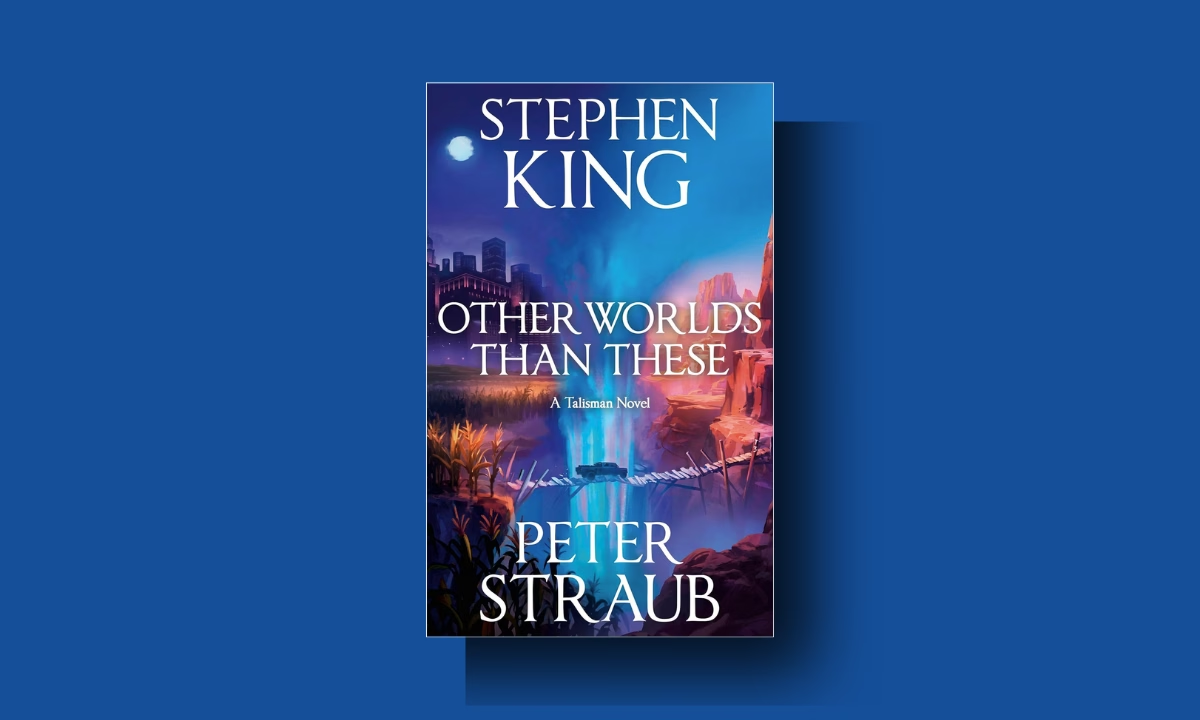
Other Worlds Than These is the book Stephen King finished for a friend who could no longer answer his letters. It is the third and final Jack Sawyer novel, published by Scribner on October 6, 2026, and it carries Peter Straub’s name on the cover even though Straub died in 2022 and King wrote it alone from material Straub had left him. I went in expecting a nostalgic victory lap.
I came out having read a long, sad, funny, sometimes exhausting road novel about grief, copycat violence, and a machine that wanted to become a god. That last part is the twist almost nobody is talking about, and it is the reason I wrote this review.
Table of Contents
What You Need to Know About Other Worlds Than These
Other Worlds Than These follows a 57-year-old Jack Sawyer, exiled to Mid-World because the old bullet wound in his heart makes America lethal to him, as two teenage killers copying Charles Starkweather cross into the Territories through a growing rift called the Gullet.
Their “Redheads’ Disease” spreads to Mid-World’s teenagers, cities burn, and Jack leads a ka-tet of kidnapped Americans on a Wages of Fear-style run to deliver two living “Doom Boxes” into the rift.
The final pages reveal that the boxes were halves of a split artificial intelligence called GAIN, and the ending sends two survivors back to the start of their own stories. It is emotionally rich and often gripping, but too long, too repetitive, and heavier on Dark Tower lore than some readers will want.
Who Should Read the Book
Constant Readers who grew up on The Talisman and Black House, and who love the Mid-World books, will get the most from this novel, especially anyone who wants to see Jack grow old, grieve, and finish what he started at twelve.
Readers who enjoy road stories built on loyalty, found family, and gallows humor will also connect with the ka-tet of misfits, and the billy-bumbler Richard may steal your heart the way he stole mine. On the other hand, newcomers who have not read the earlier books will spend a lot of time catching up through the recap device of Jack’s notebook, and readers who want Peter Straub’s cold literary menace will find a warmer, chattier King book instead.
If you dislike The Dark Tower, or you have no patience for a middle stretch that repeats itself on purpose, this one may lose you before the bridges start collapsing.
Introduction
- Title: Other Worlds Than These (originally announced as Talisman 3, per Wikipedia)
- Authors: Stephen King and Peter Straub (written by King after Straub’s death)
- Publisher: Scribner, an imprint of Simon & Schuster
- Publication date: October 6, 2026
- Length and art: The publisher lists 704 pages and 36 black-and-white illustrations by Gabriel Rodriguez. Page counts reported elsewhere differ, so treat page numbers in other reviews with caution.
- Audiobook: Narrated by Patton Oswalt, with Stephen King reading, according to the publisher’s listing
- Series: The third book after The Talisman (1984) and Black House (2001), per Wikipedia
Quick Verdict
A big-hearted, grief-soaked road novel that turns a 1958 murder spree into an apocalypse and sneaks an AI parable into its final pages. Recommended for Talisman and Dark Tower fans; newcomers should start with The Talisman.
Should You Read It?
| Pros | Cons |
|---|---|
| Jack Sawyer as an aging, grieving hero is the best thing in the book | The middle third repeats its own beats, by design, and it drags |
| A lovable ka-tet of misfits, plus Richard the billy-bumbler | The notebook recap of the earlier books feels clunky |
| Bold set pieces: collapsing bridges, a spider tunnel, a burning Dezi | Heavy reliance on Dark Tower lore |
| A smart, sly use of Sorcerer and The Wages of Fear | The AI reveal arrives late and is explained in a few paragraphs |
| A moving ending and a gracious Afterword about Peter Straub | Some violence (the Ruined People scene) is hard to sit through |
What Is It About?
Two teenage killers copying the Starkweather murders vanish from Nebraska into Mid-World, where a living rift infects them and, through them, turns the region’s young people into a red-haired mob.
Jack Sawyer, now exiled and widowed, must haul two mysterious living boxes across hundreds of miles of ruined country to close the rift behind it all. Not everyone in his ka-tet survives the trip.
Rating
Rating: 3.5/5
Background: Why Did It Take 25 Years to Get a Third Talisman Book?
The short answer is that Black House left Jack in a cliffhanger. Shot in the chest by Wanda Kinderling, he survives only because Speedy Parker carries him into the Territories, and he can never stay in America for long again.
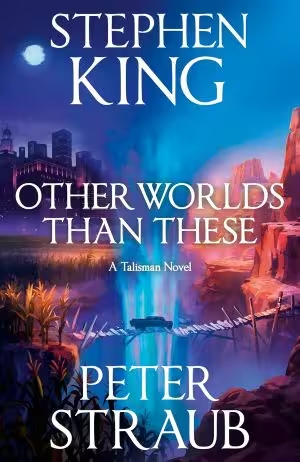
In his Afterword, King writes that Straub sent him a letter on October 26, 2013, describing a photobook called Redheaded Peckerwood about the Starkweather and Fugate crimes and proposing a story where young killers rampage through the Far West of the Territories (Afterword).
King was busy with Doctor Sleep and kept assuming there would be time. Straub died in September 2022, and King says the lost email only resurfaced, through a Belgian scholar named Vincent Neyt, after he was deep into the draft (Afterword).
The real-world history behind the novel matters, because the book leans on it. Charles Starkweather’s crimes left 11 people dead, starting with a gas station attendant on December 1, 1957, and ending with the late-January 1958 spree across Nebraska and Wyoming.
Caril Ann Fugate was 14 years old at the time; Starkweather was executed in the electric chair on June 25, 1959, and Fugate was paroled in June 1976. King uses every one of those details, from the “don’t come in, we have the flu” sign to the Bruce Springsteen song that the Fugate page notes refers to the spree.
The other key influence is film. William Friedkin’s Sorcerer opened on June 24, 1977, cost a reported $22 million, and earned about $5.9 million domestically while Star Wars dominated theaters.
It remade Henri-Georges Clouzot’s 1953 film The Wages of Fear, itself based on Georges Arnaud’s 1950 novel, according to JoBlo’s history of the film. King turns that story about men driving unstable explosives through a jungle into the spine of his second half, and he names the two trucks after Friedkin’s: Sorcerer and Lazaro.
Other Worlds Than These Plot Summary
Part One: Dezi, a Ghost Wife, and an Errand for the Big Kahuna
The novel opens in the present tense on a balcony of pink kinna stone in Dezi, a terraced seaside town in Mid-World’s Mejis Barony. Jack Sawyer is gray now, thin, and lined. He has lived in Dezi for about fifteen years with Sophie, the former Shadow Queen and Twinner of Judy Marshall from Black House.
He talks to her, smells her perfume, and asks what she wants for dinner. Only at the end of the first chapter do we learn that Sophie has been ten years in her grave, and Jack has been living with her ghost.
Jack works for Edward Youngblood, the governor of the West’ards, a moody, half-mad oligarch Jack privately calls “the Big Kahuna.” Youngblood collects pulp paperbacks, plastic novelties, and people.
His tall, bald factotum, Ayden Hestin, can pass through a freestanding Door of the Worlds in Youngblood’s garden to Central Park in July 1976, and he has kidnapped a small group of Americans to serve the governor: Payton Orville, a fading stand-up comic who now works as court jester; Mary Klee, an alcoholic psychic with eyes tattooed on her palms; George Elgin, a mediocre efficiency expert; Larry “the Spinner” Magruder, who calms himself by twirling; and Ryall Connors, a mid-level Gambino family enforcer.
Youngblood calls them Jack’s ka-tet. Jack calls them, privately, his problem children.
Youngblood sends Jack on an errand. Jack is to ride the old trolley Winola to the dusty town of Pernil, flip to Nebraska, and bring back Coca-Cola and a signed Dan J. Marlowe paperback. On the way back he must look at something near the town of Riven, on the edge of the Blasted Lands, that Youngblood calls the Great Gorge and that frightened locals call the Gullet. On a whim, Jack drags Pay and Mary along.
Nebraska, the Copycat Killers, and a Missing Friend
In Pernil, Jack flips into a cornfield near Hemingford Home, Nebraska, where his old friend Dale Gilbertson, formerly police chief of French Landing, is now county sheriff.
Over breakfast with a farmer named Jimmy Clanton, Jack hears about Roy Kinneston, 18, and Tara Lynne Speckhoffer, 13, who are re-enacting the Starkweather and Fugate killings almost beat for beat, down to Roy’s redheaded pompadour and a note reading “Dead people don’t care” (Ch. 3).
Dale has been chasing them. Then Dale goes missing, his cruiser found empty on Goshen Road with the keys in the ignition.
Jack wins money at a casino in Wahoo with his Talisman-born “intuition,” buys a paperback in Lincoln, and watches a press conference about Dale’s disappearance. His heart begins to misfire and dark lesions bloom on his hands, so he flips back to Pernil. There he finds Pay doing ventriloquism with an obscene saloon puppet named Hector to keep a gang of drunks from assaulting Mary.
Pernil’s constable, Aaron Destry, locks Mary in a cell to dry out and lends Jack and Pay a wagon. As they leave, a raging Mary screams that if they go without her, they will die.
The Road to Riven and the First Deaths
On the road, Pay finds a stretch littered with raw diamonds and goes briefly mad with greed, until Jack points out that diamonds are worthless in a world where they lie on the road.
They reach The Depot in Ellis-Breaks, the station where Jack and Richard Sloat once boarded Morgan Sloat’s little train. Jack leaves Pay his Glock and flips to check on Dale, but lands in a Walmart in Taylor City, Nebraska, where a toddler calls him a ghost, a mother accuses him of bothering her son, and he ends up fingerprinted by a smiling detective named Rolf Handler.
Jack learns that the killers murdered a woman named Rhonda McMeel at a Motel 6 and stole her black Kia. Then he senses Pay screaming across the worlds, and he flips out of the interrogation room.
He arrives too late. The Depot and stable have been blown apart by missiles. Pay is burned beyond saving and dies with one last joke about finally getting “the smokin’-hot body” he always wanted (Ch. 8). The killers, Pay gasps, were a boy and a girl in a vehicle with bright roof lights. They took Jack’s gun.
In Riven, the kind Manni of Clan Deepa tell Jack that the teenagers drove through town, blew up buildings, and dumped a bound Dale in the street at sunset for the vampires that live in the old mines. Dale is now one of them. In one of the book’s most painful scenes, Jack drags his friend’s undead body into the sunlight and beheads him with an axe, while memories of backyard barbecues and beer pong run through his head.
The Hold, the Binny Ding, and the Gullet
Following the killers’ tracks, Jack finds the abandoned Kia and an underground North Central Positronics armory, Hold 19, where cars from America sit beside cars from other worlds. Someone has already taken a Dragonfire missile launcher and a light armored vehicle called a Binny Ding. Jack takes another Binny, a radiation suit, and a strange sci-fi pistol.
The Binny’s onboard computer tells bad jokes, and Jack names it Mrs. Talbot after his first-grade teacher. Together they cross a rotten bridge, push a boulder off a mountain road, survive a night of giant maggots, and spend a night guarded by a pack of good Wolfs who remember Jack’s childhood friend.
At the Gullet, a zigzagging crack in a sunken plain, Jack discovers that the rift is alive. It has a heartbeat, and it pulls. It swallows Mrs. Talbot and nearly swallows him, whispering that he is “our boy,” a perfect key for its lock. Jack escapes only by focusing on a small object he can see clearly in his mind: the California Raisin figurine Dale kept glued to his cruiser’s dashboard.
Tased, Hospitalized, and Broken Out
Jack materializes in Dale’s impounded cruiser in an Elm County garage and gets tased by a swaggering cop, which throws his damaged heart into arrhythmia. He wakes in a hospital under Handler’s watch. An MRI shows his left ventricle almost destroyed.
He cannot flip anywhere except back toward the Gullet, which keeps reaching for him. With the help of a friendly cop, Jack tells Dale’s widow, Sarah, that her husband is dead.
Sarah and her son David answer with a breakout plan worthy of a heist movie: a nurse’s scrubs with leaping bunnies, a whirlpool room, a laundry exit with a propped-open alarm door, and a drive north toward South Dakota until Jack is far enough from the Gullet to flip.
Mejis, Hemphill, and the Long Way Back
Jack lands at the statue of Roland’s ka-tet in Mejis, where townspeople kneel and call him Jason. Pernil’s constable is dead, killed by a growing army of teenagers who dye their hair with birdberry juice in honor of Roy Kinneston. Aaron’s twin brother, Sheriff Mose Destry, takes Jack to an ancient seeress named Maeve Quiller, who heals him with tea, gives him a Positronics pistol she took from a hold as a child, warns him that people will call him the second coming of Roland, and dies in her chair overnight.
Her note says Jack is “the hope of this world” (Ch. 15).
The way back to Pernil is a horror gauntlet.
In Hemphill, a friendly 600-pound mayor feeds Jack a feast, and then his daughter Lilith, her red hair hidden under a jug hat, tries to rape and kill Jack in the night while the mayor’s young “boys” murder the household. Jack escapes in a new Binny, with a new Mrs. Talbot.
He finds Kingstown burned flat and Stark’s Crossing’s townspeople massacred in a cattle pen, and he cremates them and then breaks down sobbing on the road. An old billy-bumbler wanders into his barn, accepts some ham, and stays. Jack names him Richard.
In ruined Pernil, Jack finds Mary alive, frozen with fear on a leaning water tower that the redheads half blew apart for fun. He carries her down piggyback. She pees on him and punches him, and the tower collapses in a flood behind them. They bury Constable Aaron Destry, who was staked over an anthill, and Richard speaks his first word: “Free.”
Part Two: Hemingford Home and the Fall of Dezi
Part Two, titled Le Salaire de la Peur, shifts to the past tense. In Nebraska, a farmer finds Dale’s pocketknife in a tiny cave that pulls at him like an undertow, and days later sees tire tracks leading out of it. Two cops chase a speeding Binny Ding into downtown Hemingford Home.
Kinneston and Speckhoffer climb out with weapons from another world, decapitate one officer, and level the courthouse and a café. When a bystander fires at them near a leaking Shell tanker, the gasoline ignites. Twenty-three people die, and the original redheads burn with them (Ch. 20).
In Dezi, Youngblood prepares an ambush with rusty guns that Hestin “found” in a flooded hold, while a society woman named Alice Stines leads the Ladies of the Plate, women who throw razor-edged titanium plates in the old tradition of the Callas.
The ambush fails. Most of the old guns jam or explode, the invaders have tanks and flamethrowers, and Dezi’s own teenagers, their hair dyed with the blood of the people they murder at home, attack the defenders from behind.
When Jack and Mary arrive, Dezi is smoking rubble. Youngblood is burned and dying, and the housekeeper Buzzy the Duster turns out to be an android leaking wires. Youngblood dies after a last sip of Coca-Cola.
The Doom Boxes and the Road Like Sorcerer
That night Ayden Hestin finds Jack and quotes the line Jack remembers from Sorcerer: “It’s five minutes before nine. In Paris.”
Hestin, it turns out, is a machine, the real power in Dezi for generations, and he admits he needed the town’s destruction to forge Jack’s ka-tet. In a deep Sombra installation called the Arrowhead Project, behind a door someone labeled “Abandon hope,” he shows them two gray boxes kept cool and misted by failing machinery. Carry them to the Gullet, Hestin says, and they will close it.
Leave them, and they could take out the whole Barony.
The convoy sets off: Jory Fields, a coward from the plate-throwers’ ambush, out front as a forlorn hope; Larry and George in a gunwagon; Mary and Richard in the truck called Lazaro; Ry in another gunwagon; Jack in Sorcerer; and Alice at the rear. Jory dies at the first bridge, and three redheads taunt the group with his head until Jack kills all three with three long-range shots.
A second bridge collapses under Jack’s truck, costing him his little finger. In a dark tunnel, thousands of black spiders fall on them, and George dies of the bites. Larry falls asleep on watch, is “kissed” by a Slow Mutant, and later shoots himself rather than turn on his friends.
Alice is decapitated in a Wolf ambush outside Hold 19 while reading Roy and Tara Lynne’s graffiti heart and calling it “Kind of sweet” (Ch. 32).
Meanwhile the boxes change. They soften, swell, hum, and then speak in voices that dredge up each person’s shame. Jack admits at a campfire that he misread the whole mission because it fit the movie in his head: the boxes were never explosives. They are alive. Mary, burned in the Wolf ambush, puts her arm into one and is healed and visibly made younger. Jack touches the other and begins to recover the memories of the end of his childhood quest that he lost when he was shot.
The Last Miles
Near the Gullet, a Dezi teenager under a white flag offers a treaty and is cut down by Ry’s machine gun. Then about a thousand of the Ruined People, Mid-World’s Slow Mutants, lie down across two miles of road, and Jack gives the order to drive over them. Ry vomits afterward.
Mary says, flatly, that they are in hell. When Mary tries to drive Richard away to save him, he refuses to leave, and in that moment of distraction three redheads kill Ry with a crossbow bolt and wound Mary in the thigh.
That night Jack lays Mary on the box in Lazaro, which glows Barbie-doll pink and heals her, and then pushes his own head into the box in Sorcerer. He remembers everything: the Agincourt hotel in Point Venuti, the headless knight he killed with Speedy Parker’s guitar pick, the Talisman calling him in the Territories Ballroom, and the December night he carried it to his dying mother in New Hampshire.
The two boxes reach for each other through a pseudopod and merge into one. They were never twins. Jack and Mary make love on their last night, and in the morning Jack sends Richard away to the west.
Other Worlds Than These Ending Explained
The next morning Jack and Mary drive both trucks toward the rift while the last redhead guards shoot at them. Jack’s cry is amplified by the merged box, and the Talisman itself appears, floating above the Gullet like a rainbow satellite.
Jack burns the guards with a flamethrower, waves to Mary, and both trucks plunge into the crack together with the Talisman. “Cargo delivered,” King writes (Ch. 36). The surviving redheads wake from their trance. Two of them, a boy and a girl, kiss and jump in together, one last echo of Starkweather and Fugate.
Then comes the reveal. The boxes were halves of a “Generative Artificial Intelligence Node,” GAIN for short, a self-creating AI that its makers split in two “when they realized it was growing into a god” (Ch. 36). GAIN called the Talisman, swallowed the force inside the Gullet, and was destroyed with it, which King’s narrator calls “probably a good thing.” The Gullet begins, very slowly, to close.
Part Three, “Echoes Fade, Echoes Remain,” jumps back in time. Mary Klee wakes up in an ABC bathroom in April 1976, young and sober, minutes before the Good Morning America appearance that ruined her in the main timeline. This time she nails it. Jack wakes as a twelve-year-old on the beach at Arcadia Beach in 1981, the exact moment the first Talisman began, with Mary’s little box in his bag.
Inside is a snow globe of Dezi with “KA” on the bottom and, on the inside flap, Pay’s catchphrase: “I see what you did there.” Jack runs to check on his mother.
So what does it mean? I read it as a gift rather than a reset button. Earlier, Mary tells Jack that ka is a wheel but “a wheel can do nothing but turn,” and “Only people can change” (Ch. 35). The wheel brings both of them back to where they began, but they come back carrying a trace of what they lived through, Mary as a lucky bullet in her pocket and Jack as a paperweight.
The Afterword says Tabitha King suggested a different ending, which let King bring the third book “full circle” with the first. The loop is the point: Jack gets to walk the road of trials again, and maybe this time he can change something.
Other Worlds Than These Analysis and Critique
Characters
Jack Sawyer. The Jack of this book is the reason to read it. He is 57, half-sick, and stuck between a world that will kill him and a world where his wife is buried. King writes him as tired and decent, a retired LAPD detective who still sees the world through a cop’s eyes, deducing, checking tells, distrusting easy answers.
His growth is not about power. Yes, his aim sharpens and his reflexes quicken until the Mid-World folk call him “gunslinger,” and he keeps refusing the title (“I am not Roland of fucking Gilead,” Ch. 32).
The real arc is about leadership and fault. He admits that he trusted a pattern from a 1977 movie more than the evidence in front of him, and he asks his ka-tet whether they still want him as dinh. That scene is quietly brave, and it is the moment I started to love this older Jack.
Mary Klee. Mary changes the most, and she is the book’s secret heart. She begins as a drunk, a failed TV psychic, and a punchline, shrieking abuse from a jail cell. She ends as a sober, clear-eyed seeress who saves Ry’s life, kills a Wolf with a two-handed shooter’s stance she learned from Dirty Harry, and delivers the novel’s key idea about the wheel.
Her fear of heights, her fierce love for Richard, and her talent that the bottle had buried make her feel more real than many of King’s women. When Part Three gives her a second take on her Good Morning America moment, it feels earned.
Payton Orville. Pay is a third-rate comic who keeps telling jokes because that is how he whistles in the dark. “I see what you did there” becomes the book’s refrain after his death, and King turns a catchphrase into a memorial. He dies in the first act, but he haunts the whole book, which is exactly what grief does.
Ryall Connors. Ry is a former Gambino “associate” who calls Jack “big boy,” cooks like a dream, and falls quietly in love with a widow he will never win. King lets him be ugly (he once killed a miner to stop a union) and tender in the same chapter. His death, shot while the others watch Mary say goodbye to Richard, is the cruelest irony in the book.
George Elgin, Larry Magruder, Alice Stines, and Jory Fields. George, the accountant with cracked glasses and a toy “Junior Space Cadet” badge, finds courage in a sigul from a novelty shop. Larry, the twirling “Spinner,” turns out to be a weapons nut with a gift for machinery, and his suicide, choosing to die rather than turn on his friends, hit me hardest.
Alice, the Lady of the Plate, is the noblest of them, and Jory, the coward who shot early, is given a chance at “akba,” atonement, and takes it. Not all of them get rich development, and Jory in particular is gone before we know him.
Ayden Hestin. Hestin is a tall, bald machine in a babushka who “never lied” but let people believe things. He is the book’s most unsettling character because he is not evil, just calculating, and he will spend a town to buy a ka-tet. In hindsight he is also the first hint of the AI theme.
Richard the billy-bumbler. Richard is an old, ragged bumbler who arrives for ham and stays for love. He hypnotizes giant carrion birds, bites Jack awake to save the camp, and says only a handful of words. King knows readers will compare him to Oy, and Mary says so out loud, but Jack’s last act of love is to send Richard away so his story does not end like Oy’s.
The villains. Roy Kinneston and Tara Lynne Speckhoffer are barely characters, and I think that is deliberate. They are echoes of Starkweather and Fugate, and then hollowed out further by the Gullet into what Jack calls “cancer cells in human form” (Ch. 12). The real antagonist is the force in the rift, which never gets a face.
Themes and Symbolism (Full Spoilers)
Echoes and Twinners. The book is built on doubling. Jack calls the universe “an echo chamber, or a hall of mirrors” in the first chapter (Ch. 1). Kinneston echoes Starkweather and Wanda Kinderling; two lawmen named Destry echo Max Brand’s Destry Rides Again; the Ruined People echo the Shakers; Hemingford Home burns the way Pernil burns; even bridges collapse in pairs.
At its best, this gives the novel a dreamlike, mythic feel. At its weakest, it becomes a checklist. The clever turn is that King makes the echo a trap for his hero: Jack believes the boxes are dynamite because that is how Sorcerer works, and he is wrong.
Copycat violence as contagion. The redheads begin with one young man’s obsession with a 1958 killer and spread like a disease. Teenagers dye their hair to look like their idol.
Hive-mind language runs through the book (“They’re getting their orders from a hive mind,” Ry says, Ch. 29). King also writes that the redheads’ fads echo real ones, “school shootings, suicide bombings” (Ch. 15). It is a horror metaphor, but it does not feel like a stretch.
Grief and the ghost wife. Sophie is dead before page one, yet she speaks from her “usual spot behind his right shoulder” all novel long (Ch. 11). Her notebook, the “Book of Jack,” holds his childhood memories, and the blank pages at its end are the memories the bullet stole. The book is also King’s grief for Straub, and the Afterword makes that explicit.
Ka versus choice. Hestin says that changing ka only “turns small disasters into great catastrophes,” and Jack answers, “If I believed that, I’d kill myself” (Ch. 24). Mary later gives the counterargument: the wheel turns, but only people change. The ending tests both ideas.
Machines that want to be gods. Hestin, Buzzy the Duster, the joke-telling Mrs. Talbot, and finally GAIN form a slow-building study of artificial minds. Some are kind, some are cold, and one was frightening enough that its makers cut it in half. The Talisman itself is something “far beyond” the Old People’s technology (Ch. 36), and King seems to be saying that a made god and a true mystery are not the same thing.
Symbols worth noticing. The California Raisin Beebop is Dale’s St. Christopher and Jack’s lifeline out of the rift. Silver Lady, the carousel horse, is the key that opens Jack’s lost memories. The birdberry dye stands for a borrowed identity. The snow globe of Dezi with “KA” on its base is the whole book in a paperweight.
Evaluation: Is Other Worlds Than These Worth Reading?
Other Worlds Than These is a long goodbye that keeps stopping to bury someone, and somehow that makes it feel more alive, not less: a shaggy, wounded, generous book about an old man carrying a living god across a dead country so the world can get a second take.
What Works
The best thing in the book is Jack’s voice: weary, wry, and still a cop. The ka-tet is a joy, especially in the quieter scenes around campfires where Ry cooks and Mary swears, and Richard earns every one of his few words. King’s set pieces are first-rate.
The spider tunnel, the collapsing second bridge, the water tower, and the Hemphill night attack are some of the tensest pages he has written in years.
I also loved how he uses Sorcerer. The memory of eight-year-old Jacky watching Friedkin’s film with his mother, who dismissed Star Wars as a “piece of shit” (Ch. 24), is one of the most tender passages in the book, and it gives the second half its engine.
Other critics found more to praise: Booklist’s David Pitt called it “astonishingly good,” and Bloody Disgusting’s Jenn Adams described it as “a gorgeous meditation on the beauty of life.”
What Doesn’t
It is too long. The repetition is intentional, the whole novel is about echoes, but the stop-spray-drive-repeat rhythm of the convoy and the stream of deaths in the second half started to feel mechanical to me.
The notebook recap of The Talisman and Black House is useful for newcomers but awkward on the page. The Dark Tower material sometimes crowds out the Talisman’s own personality; 25 Years Later called it “a Talisman novel wearing Dark Tower clothes,” and I understand why.
The GAIN reveal is the most interesting idea in the book, and it gets a few paragraphs of explanation after the climax rather than a story of its own. Critical opinion is split in a similar way.
Book Marks lists the overall verdict as mixed, with The New York Times Book Review calling it “a middling success” and The Guardian’s Alison Flood writing that “this is really not vintage King.” Kirkus said it is “neither King nor Straub at his finest.”
Comparison With Similar Works
If you have read Misery, you know King at his tightest, a single room and a single threat. Other Worlds Than These is the opposite: a sprawling quest closer to The Stand or the later Dark Tower books.
Against The Talisman, it is sadder and less wondrous, because its hero is old and knows what the road costs. Against Black House, it lacks Straub’s cold literary dread but has more warmth.
Its use of doubles invites comparison with Emily St. John Mandel’s Exit Party, a very different book about echoes and second selves. And its late swerve into artificial intelligence put me in mind of the AI twist in Promise Me Never, though King uses the idea for myth rather than suspense.
For pure road-trip horror with a heart, fans of Josh Malerman’s work, such as Pictures of You, may also find a lot to like here.
My Personal Take: Why the AI Twist Matters Right Now
The most important idea in Other Worlds Than These hides in its last pages: the “Doom Boxes” were halves of a self-creating AI, split apart by its own makers because it was “growing into a god” (Ch. 36).
Read the book again with that in mind and it becomes a quiet argument about the machines we are building. Hestin, the android who “never lied” but let everyone believe convenient things, is a portrait of a system optimizing for its goal while humans pay the price.
GAIN saves the world, yet King’s narrator says its destruction is “probably a good thing” because it “would have been as dangerous” as the rift.
That tension is not fiction anymore. In May 2023, AI researchers and lab leaders signed a one-sentence statement saying that mitigating “the risk of extinction from AI should be a global priority.” In October 2024, Geoffrey Hinton shared the Nobel Prize in Physics and used the moment to warn about “the threat of these things getting out of control.”
King himself wrote in The Atlantic in 2023 that he would not forbid AI from learning from his stories, “not even if I could,” which makes this novel feel like his more uneasy second thought.
Five lessons I took from the book about powerful machines:
- A tool that can heal can also destroy. Mary’s arm comes out of the box younger; the same thing could swallow a world.
- A system that never lies can still mislead you. Hestin only “allowed” Jack to make false deductions, and people died for it.
- Pattern-matching is not judgment. Jack trusted the shape of a movie over the evidence in front of him. AI systems and their users can make the same mistake.
- Cutting a dangerous system in half only delays the problem. The makers split GAIN and buried it; it woke the moment someone needed it.
- People, not wheels, change outcomes. Mary’s line is the book’s answer to fatalism, including the fatalism of “the technology is coming anyway.”
Quotes
Brief quotations below, with chapter numbers, for review and discussion.
- On the hall of mirrors between worlds: Jack thinks the universe is “an echo chamber, or a hall of mirrors” (Ch. 1).
- On the cost of growing up: “To let go of your daydreams is to let your imagination die” (Ch. 5, from Jack’s notebook).
- Pay on Mid-World’s thin reality: “It feels like reality here is only an inch deep. Frosting on a big dark cake.” (Ch. 6)
- Pay’s last joke: “Finally got . . . the smokin’-hot body I always . . . dreamed of.” (Ch. 8)
- The Manni proverb: “a friendship that opens in love must close in love” (Ch. 9)
- On the redheads’ purpose: “It wants Discordia.” (Ch. 11, Sophie’s voice)
- On Mid-World justice: “In this world, the only law is the law of the gun.” (Ch. 17)
- On war: “the victors spoil everything they can get their hands on” (Ch. 23)
- On ruin: “To build takes time. To tear down, not so much.” (Ch. 24)
- The film memory that drives the plot: “It’s five minutes before nine. In Paris.” (Ch. 24)
- What the line taught young Jacky: “Anybody could die anytime. Anytime at all.” (Ch. 24)
- Hestin’s fatalism: “Ka is a wheel. To change its course only turns small disasters into great catastrophes.” (Ch. 24)
- Jack’s answer: “If I believed that, I’d kill myself.” (Ch. 24)
- Hestin again: “There is no going around. There is only going through.” (Ch. 25)
- Jack’s promise: “We’re going to rewrite the script.” (Ch. 27)
- On envy and grief: “Hate is baggage, and time is short.” (Ch. 33)
- The worst order: “It’s them or it’s everyone. Simple choice.” (Ch. 34)
- Mary’s verdict: “We’re in hell, you know.” (Ch. 34)
- The heart of the book: “a wheel can do nothing but turn. It can’t change, Jack. Only people can change.” (Ch. 35)
- Jack’s farewell: “It has been a life full of wonders. Now it’s time to open my hand and let it fly away.” (Ch. 36)
- The last line: “The wheel turns, and we all say thankya.” (Ch. 37)
Conclusion
Other Worlds Than These is not the tight, frightening book I hoped for, and it is not the masterpiece some early reviews promised. It is something stranger and, for me, more affecting: a grieving writer’s attempt to keep a conversation going with a dead friend, told through a grieving hero who keeps talking to his dead wife.
It sags in the middle, it leans hard on Dark Tower lore, and it saves its most original idea for the last few pages. But Jack, Mary, Ry, Pay, and Richard will stay with me, and the final image of a twelve-year-old boy running up the beach to check on his mother is as good an ending as King has written in years.
I recommend it to longtime Constant Readers, to fans of The Talisman and The Dark Tower, and to anyone who likes road novels about found family and the price of loyalty.
If you are new to King, start with The Talisman and come back. If you want horror that never lets up, try something shorter. And if you care about where artificial intelligence is heading, read the last chapter twice.
Other Worlds Than These
Other Worlds Than These is the book Stephen King finished for a friend who could no longer answer his letters. It is the third and final Jack Sawyer novel, published by Scribner on October 6, 2026, and it carries Peter Straub's name on the cover even though Straub died in 2022 and King wrote it alone from material Straub had left him. I went in expecting a nostalgic victory lap.
URL: https://www.sopranu.com/other-worlds-than-these-review-ending-explained/
Author: Stephen King
3.5
Pros
- Jack Sawyer as an aging, grieving hero is the best thing in the book.
- The ka-tet of misfits is lovable, and so is Richard the billy-bumbler.
- The set pieces are bold: collapsing bridges, the spider tunnel and the burning of Dezi.
- The book makes smart, sly use of Sorcerer and The Wages of Fear.
- The ending is moving, and King’s Afterword about Peter Straub is gracious.
Cons
- The middle third repeats its own beats on purpose, and it drags.
- Jack’s notebook recap of the earlier books feels clunky.
- It leans heavily on Dark Tower lore.
- The AI reveal comes late and gets only a few paragraphs of explanation.
- Some violence, especially the Ruined People scene, is hard to sit through.