
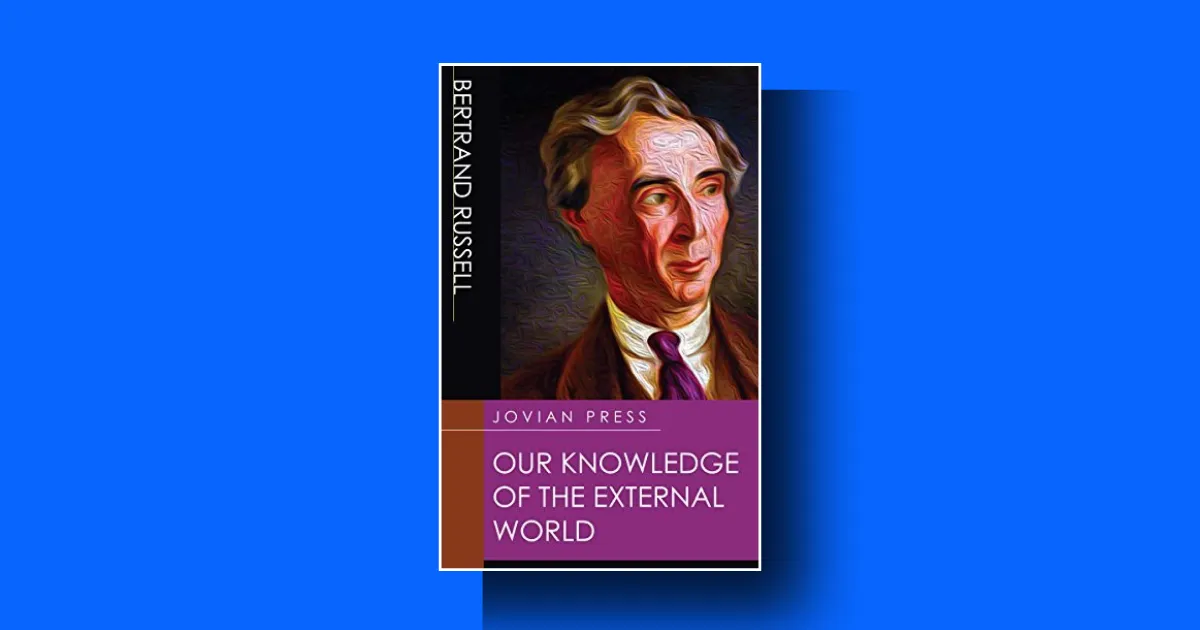
Do you ever stop to wonder whether the table you’re sitting at actually exists when you’re not looking at it? You’re not alone. This question has haunted philosophers for centuries, and in 1914, one of the greatest minds of the twentieth century stood before an audience in Boston to answer it. That man was Bertrand Russell, and those lectures became Our Knowledge of the External World—a book that didn’t just offer answers but fundamentally changed how philosophy asks questions.
Table of Contents
Overview
Our Knowledge of the External World is Bertrand Russell’s attempt to rescue philosophy from vague speculation and turn it into something as rigorous as physics.
Delivered as the Lowell Lectures in Boston during March and April 1914, this book argues that philosophy should adopt the logical-analytic method—breaking down complex problems into their simplest components and rebuilding knowledge from the ground up using logic, not intuition or grand metaphysical systems.
Russell tackles the relationship between our sense-data (what we actually see, hear, and feel) and the physical world of science. His central insight?
Physical objects are logical constructions out of sense-data, not mysterious things-in-themselves. It’s dense, demanding, and occasionally infuriating—but for anyone serious about understanding how we know anything at all, it’s indispensable.
Preferred readers
Our Knowledge of the External World can be best for:
- Philosophy students grappling with epistemology and the problem of perception
- Readers who enjoy clear, rigorous argumentation over poetic obscurity
- Anyone curious about how modern logic transformed philosophy
- Fans of Russell’s lucid, witty prose style
- Those who want to understand the foundations of logical atomism
Not a good read for:
- Casual readers looking for light philosophical entertainment
- Those who prefer continental philosophy’s literary, intuitive approach
- Readers unwilling to engage with technical logic and mathematics
- Anyone expecting definitive answers to life’s big questions—Russell offers methods, not comfort
1. Introduction
Book: Our Knowledge of the External World: As a Field for Scientific Method in Philosophy
Author: Bertrand Russell (1872–1970)
Publication: First published in 1914 by Open Court Publishing Company; reissued as a Routledge Classic in 2009Pages: 245 (first edition)
Series: Lowell Institute Lectures, delivered in Boston, March–April 1914
Bertrand Russell needs little introduction. He was a British philosopher, logician, mathematician, historian, social critic, and recipient of the 1950 Nobel Prize in Literature.
Alongside G.E. Moore and Ludwig Wittgenstein, he was a founding figure in analytic philosophy—the dominant tradition in Anglo-American philosophy today. His collaboration with Alfred North Whitehead on Principia Mathematica (1910–1913) revolutionized logic and mathematics.
Russell published over seventy books and two thousand articles during his lifetime, covering everything from mathematical logic to politics, education, and religion. He was also a passionate anti-war activist, imprisoned for his pacifism during World War I.
Context
Our Knowledge of the External World sits at a crucial turning point in Russell’s intellectual development. Just two years earlier, he had published The Problems of Philosophy (1912), a more accessible introduction to epistemology that defended indirect realism—the view that physical objects cause sense-data, which we then perceive.
But Russell wasn’t satisfied. He wanted to go further, to show that philosophy could achieve the same kind of progress as science.
“Philosophy, from the earliest times, has made greater claims, and achieved fewer results, than any other branch of learning. … I believe that the time has now arrived when this unsatisfactory state of things can be brought to an end.”
Our Knowledge of the External World emerged from a period of intense intellectual ferment. Russell had just finished his monumental work on Principia Mathematica with Whitehead. His pupil Ludwig Wittgenstein was visiting Cambridge, challenging Russell’s ideas.
And the influence of Gottlob Frege—whose work on logic Russell admired deeply—was becoming increasingly apparent.
Purpose
The central thesis of Our Knowledge of the External World is both simple and revolutionary: philosophy should adopt the logical-analytic method used in mathematics and science.
Instead of building grand speculative systems, philosophers should break down complex problems into their simplest components, analyze the logic of our language and knowledge, and rebuild understanding from the ground up using sense-data as the foundation.
Russell’s specific goal is to show that the world of physics can be constructed out of the world of sense—not inferred as something mysterious behind appearances. As he puts it in the preface, the central problem is:
“the problem of the relation between the crude data of sense and the space, time, and matter of mathematical physics.”
This represents a dramatic shift: instead of asking whether physical objects exist behind our perceptions, Russell asks how we can construct physical objects from perceptions using logic. The physical world, he argues, is not something we infer—it’s something we build.
2. Background
To understand why Our Knowledge of the External World matters, you need to know what Russell was reacting against.
The Classical Tradition
By 1914, academic philosophy was still dominated by the classical tradition descending from Kant and Hegel.
Thinkers like F.H. Bradley argued that logic itself proved the world of everyday experience was mere “appearance,” concealing a single, indivisible, timeless “Absolute”. Bradley famously argued that relations—like “left of” or “father of”—were self-contradictory and therefore unreal.
For Bradley, if you really understood logic, you’d see that the everyday world of tables, chairs, and separate people was an illusion.
Russell had had enough. In the first lecture, “Current Tendencies,” he dismisses Bradley’s method as producing “bewilderment rather than conviction”. The problem, Russell argues, is that classical philosophers used logic to deny the obvious facts of experience rather than to clarify them.
Evolutionism and Bergson
Russell also took aim at another fashionable philosophy: evolutionism. Thinkers like Henri Bergson argued that reality was a continuous flow of change that logic could never capture. Intuition, they claimed, was superior to intellect. Russell was scathing:
“Intuition, in fact, is an aspect and development of instinct, and, like all instinct, is admirable in those customary surroundings which have moulded the habits of the animal in question, but totally incompetent as soon as the surroundings are changed in a way which demands some non-habitual mode of action.”
Against both the mystics and the evolutionists, Russell insisted that philosophy must be logical, precise, and accountable to evidence—just like physics.
3. Our Knowledge of the External World Summary
Our Knowledge of the External World consists of eight lectures. Let me walk you through each one, because understanding the architecture of Russell’s argument is essential to appreciating its power.
Lecture 1: Current Tendencies
Russell opens with a bold declaration: philosophy has promised too much and delivered too little. He identifies three competing philosophical schools:
- The Classical Tradition (Kant, Hegel, Bradley)—which uses logic to prove the everyday world is illusion
- Evolutionism (Bergson, James)—which privileges intuition over reason
- Logical Atomism—Russell’s own approach, which applies the methods of mathematical logic to philosophical problems
“The true function of logic is, in my opinion, exactly the opposite of [what classical tradition thinks]. As applied to matters of experience, it is analytic rather than constructive: taken a priori, it shows the possibility of hitherto unsuspected alternatives more often than the impossibility of alternatives which seemed prima facie possible.”
Russell argues that philosophy must become ethically neutral—like physics or chemistry. It shouldn’t try to prove that the world is good or bad, or satisfy our emotional needs. It should simply seek to understand.
“In thought, at any rate, those who forget good and evil and seek only to know the facts are more likely to achieve good than those who view the world through the distorting medium of their own desires.”
Lecture 2: Logic as the Essence of Philosophy
This is the philosophical heart of Our Knowledge of the External World. Russell argues that every genuine philosophical problem, when properly analyzed, turns out to be a problem of logic.
“every philosophical problem, when it is subjected to the necessary analysis and purification, is found either to be not really philosophical at all, or else to be, in the sense in which we are using the word, logical.”
Russell introduces the crucial distinction between atomic facts and molecular propositions. Atomic facts are the simplest truths—like “this is red.” Molecular propositions combine atomic facts with logical connectives—“if this is red, then that is round.” Pure logic deals only with forms, never with particular content.
He also demolishes the traditional subject-predicate logic that had dominated philosophy since Aristotle. The old logic assumed every proposition ascribes a predicate to a subject—“Socrates is mortal.” But Russell shows that many propositions express relations between multiple things—“A is to the left of B.”
This might sound technical, but it’s explosive: if relations are real, then the whole edifice of classical metaphysics—which denied relations to preserve the unity of the Absolute—collapses.
Lecture 3: On Our Knowledge of the External World
This is where Russell directly tackles the problem of perception. He begins by distinguishing hard data (facts of sense and logic, which are certain) from soft data (beliefs that depend on inference, which are doubtful).
“The hardest of hard data are of two sorts: the particular facts of sense, and the general truths of logic.”
Russell then introduces his famous perspective theory. Imagine each mind looking at the world from a unique point of view. What each mind sees is a “private world.” But these private worlds can be correlated with each other through similarity. A physical “thing”—like a table—is not a mysterious entity behind the appearances. It is the system of all its appearances across all perspectives.
“All the aspects of a thing are real, whereas the thing is a merely logical construction.”
This is radical. The table isn’t something behind your visual experience—it is the collection of all possible visual experiences of the table from every angle, by every observer. The physical world, in other words, is a logical construction out of sense-data.
Russell acknowledges that this doesn’t prove the external world exists. But it shows that the hypothesis of an external world is consistent with all our data and simpler than any alternative.
Lecture 4: The World of Physics and the World of Sense
Russell now tackles the apparent gap between what physics describes (atoms, electrons, space-time) and what we actually experience (colors, sounds, textures). His solution? Physics itself must be interpreted as a construction from sense-data.
“In attempting to construct [space, time, and matter] from sense-data and particulars structurally analogous to sense-data, we are … only pushing the procedure of relativity theory one stage further back.”
Russell introduces Whitehead’s method for defining points and instants as logical constructions out of extended sense-data.
A point, on this view, is not an infinitesimal entity—it’s a class of overlapping volumes that all contain the point. Similarly, an instant is a class of overlapping events.
He also introduces the crucial principle of Occam’s Razor:
“Entities are not to be multiplied without necessity. In other words, in dealing with any subject-matter, find out what entities are undeniably involved, and state everything in terms of these entities.”
Lecture 5: The Theory of Continuity
Russell tackles the ancient problem of continuity—how can motion be continuous if space and time are composed of points and instants? He argues that mathematical continuity is perfectly consistent with points and instants, provided there are infinitely many of them.
“In a continuous motion, then, we shall say that at any given instant the moving body occupies a certain position, and at other instants it occupies other positions; the interval between any two instants and between any two positions is always finite, but the continuity of the motion is shown in the fact that, however near together we take the two positions and the two instants, there are an infinite number of positions still nearer together, which are occupied at instants that are also still nearer together.”
He addresses Bergson’s objection that motion is indivisible and cannot be analysed into states. Russell’s response is characteristically sharp: if change exists, there must be different states at different times.
The fact that we perceive motion as continuous doesn’t mean it is continuous in some mystical sense—it just means our senses aren’t infinitely precise.
Lecture 6: The Problem of Infinity Considered Historically
Russell traces the history of the problem of infinity from the Pythagoreans to Kant. The discovery of incommensurables—like the diagonal of a square, which cannot be expressed as a ratio of whole numbers—shattered the Pythagorean belief that everything could be reduced to number.
He then examines Zeno’s famous paradoxes—the racecourse, Achilles and the tortoise, the arrow, and the stadium. Russell argues that Zeno’s arguments are perfectly valid if you assume space and time consist of a finite number of points and instants. The mistake was assuming that infinite collections were impossible.
“We may therefore escape from his paradoxes either by maintaining that, though space and time do consist of points and instants, the number of them in any finite interval is infinite; or by denying that space and time consist of points and instants at all; or lastly, by denying the reality of space and time altogether.”
Russell opts for the first solution, thanks to Cantor’s work on infinite numbers.
Lecture 7: The Positive Theory of Infinity
Russell presents Cantor’s revolutionary theory of infinite numbers. The key insight: infinite numbers behave differently from finite numbers.
“A number is said to be reflexive when it is not increased by adding 1 to it.”
This seems paradoxical—how can adding one not increase a number? But Russell shows that infinite collections can be put into one-to-one correspondence with proper parts of themselves. The even numbers, for example, can be paired one-to-one with all the natural numbers.
This doesn’t mean the whole is not greater than the part in some sense—it means arithmetical equality doesn’t work the same way for infinite collections.
Russell then introduces Frege’s definition of number:
“The number of terms in a given class” is defined as meaning “the class of all classes that are similar to the given class.”
This definition is elegant, precise, and applies equally to finite and infinite numbers. It also avoids the need for mysterious metaphysical entities.
Lecture 8: On the Notion of Cause, with Applications to the Free-Will Problem
Russell tackles causation and free will. He defines a causal law as:
“any general proposition in virtue of which it is possible to infer the existence of one thing or event from the existence of another or of a number of others.”
He argues that the traditional notion of cause—as something that compels its effect—is anthropomorphic nonsense. Causes don’t compel; they simply allow inference.
“Causes, we have seen, do not compel their effects, any more than effects compel their causes. There is a mutual relation, so that either can be inferred from the other.”
On free will, Russell makes a characteristically clear-headed argument: even if human actions are completely determined, that doesn’t mean we lack freedom in any meaningful sense. Freedom is about acting according to our own desires, not about being unpredictable.
“Freedom, in short, in any valuable sense, demands only that our volitions shall be, as they are, the result of our own desires, not of an outside force compelling us to will what we would rather not will.”
4. Our Knowledge of the External World Analysis
Let me be direct: Our Knowledge of the External World is one of the most important works of philosophy published in the twentieth century.
A contemporary reviewer in the International Journal of Ethics called it “the most important contribution that has been made to philosophy for a long time past”. Another said it was “in every sense an epoch-making book”. I agree.
What Makes Our Knowledge of the External World Revolutionary?
1. The Method. Russell doesn’t just say philosophy should be scientific—he shows how. He takes an ancient problem (how do we know the external world?) and breaks it down into logical components. He defines points, instants, things, and numbers as logical constructions out of sense-data. This isn’t abstract theorizing—it’s a practical demonstration of how philosophy can achieve the same precision as mathematics.
2. The Clarity. Russell is one of the finest prose stylists in the history of philosophy. He won the Nobel Prize in Literature for a reason. Unlike many philosophers who deliberately obscure their meaning to hide weaknesses, Russell writes with breathtaking clarity. He anticipates objections and addresses them directly. As one reviewer put it:
“The author maintains the fresh and brilliant yet easy style which always makes his writings a pleasure to read.”
3. The Intellectual Honesty. Russell doesn’t pretend to have all the answers. In the preface, he admits:
“Since my purpose was to illustrate method, I have included much that is tentative and incomplete.”
He doesn’t claim to have proved the external world exists. He simply shows that the hypothesis is consistent with all our data and simpler than alternatives. This is genuine intellectual humility—rare in philosophy then, rare now.
4. The Synthesis. Russell brings together insights from Frege, Cantor, Whitehead, and others to create something genuinely new. He shows that logic, mathematics, and physics are not separate disciplines—they’re all part of the same project of understanding reality.
What I Found Most Compelling
The perspective theory is breathtaking. Russell invites us to imagine the world not as a single thing but as an infinite system of perspectives, each equally real. A table isn’t a mysterious substance—it’s the sum total of all its appearances from every possible angle. This dissolves the ancient problem of appearance versus reality. There’s no appearance and reality—there’s just the system of appearances.
The definition of points and instants is another triumph. Instead of assuming infinitesimal entities that we can never perceive, Russell shows how we can construct points and instants from extended sense-data. This is Occam’s Razor in action: don’t multiply entities beyond necessity.
The treatment of causation and free will is remarkably sane. Russell cuts through centuries of confusion by observing that causes don’t compel—they simply allow inference. And free will isn’t about being unpredictable; it’s about acting according to our own desires.
What I Found Problematic
1. The foundationalism. Russell assumes that knowledge must be built on certain foundations—the “hard data” of sense and logic. But is this really necessary? Later philosophers, including the later Wittgenstein, questioned whether we need foundations at all. Perhaps knowledge is more like a web than a building.
2. The treatment of other minds. Russell admits that the existence of other minds cannot be proved—only inferred by analogy. This is a genuine weakness. If the only thing I can really know is my own sense-data, how can I ever know that anyone else exists? Russell’s answer—that we can’t help believing it—is honest but philosophically unsatisfying.
3. The neglect of value. Russell explicitly excludes ethics and value from philosophy. But is this really possible? Can we understand the world without understanding what matters? Many philosophers, from Aristotle to the existentialists, would say no.
4. The technical demands. This is not an easy book. If you don’t have some background in logic and mathematics, you’ll struggle. Russell does his best to explain, but there’s only so much he can do.
5. Strengths and Weaknesses
Strengths
| Strength | Why It Matters |
|---|---|
| Revolutionary method | Shows how philosophy can achieve scientific precision |
| Crystal-clear prose | Makes complex ideas accessible without dumbing them down |
| Intellectual honesty | Acknowledges limitations and uncertainties |
| Synthesis of logic, math, and philosophy | Demonstrates the unity of knowledge |
| Original solutions | Offers genuinely new answers to ancient problems |
| Historical awareness | Situates the problems in their philosophical context |
Weaknesses
| Weakness | Why It Matters |
|---|---|
| Foundationalist assumptions | May be unnecessary or even harmful |
| Problem of other minds | Remains unsolved and perhaps unsolvable |
| Exclusion of value | May be artificially narrow |
| Technical difficulty | Limits accessibility to general readers |
| Tentative nature | Some arguments feel incomplete |
| Dependence on sense-data | Later philosophers questioned whether sense-data exist at all |
6. Comparison with Similar Works
The Problems of Philosophy (1912) by Bertrand Russell
Russell’s earlier book is more accessible but less ambitious. The Problems of Philosophy introduces many of the same concepts—sense-data, acquaintance, knowledge by description—but doesn’t attempt the radical construction project of Our Knowledge of the External World.
In the later book, Russell constructs the physical world from sense-data; in the earlier, he infers it. This is a crucial difference.
Tractatus Logico-Philosophicus (1921) by Ludwig Wittgenstein
Wittgenstein was Russell’s pupil, and the Tractatus develops many of the ideas in Our Knowledge of the External World—particularly logical atomism and the idea that language mirrors reality.
But Wittgenstein is far more mystical and less concerned with empirical verification. Russell famously disagreed with Wittgenstein’s later philosophy.
Science and Hypothesis (1902) by Henri Poincaré
Poincaré, like Russell, was interested in the foundations of science. But Poincaré was more conventionalist—he argued that many scientific principles are conventions we choose, not truths we discover. Russell rejected this view; for him, logic and mathematics reveal objective truths about the world.
Analysis of Sensations (1886) by Ernst Mach
Mach anticipated many of Russell’s ideas about constructing the world from sensations. But Mach was more radically empiricist—he denied the existence of a self or a physical world independent of sensations.
Russell was more moderate: he thought we could construct a physical world from sense-data without denying its reality.
7. Conclusion
Final Verdict
Our Knowledge of the External World is not a book for everyone. It’s dense, technical, and demands serious intellectual effort. But for those willing to put in the work, it offers something rare: a genuine philosophical breakthrough. Russell doesn’t just ask questions—he provides tools for answering them. He doesn’t just criticize—he builds.
The book has aged remarkably well. Its central insight—that physical objects can be understood as logical constructions from sense-data—anticipates much of twentieth-century philosophy of science.
Its emphasis on clarity and precision remains a model for philosophical writing. And its intellectual honesty—the willingness to admit what we don’t know—is more refreshing than ever.
Who Should Read This Book?
- Philosophy students will find it indispensable for understanding analytic philosophy, logical atomism, and the problem of perception.
- Scientists will appreciate Russell’s respect for empirical evidence and his attempt to ground philosophy in scientific method.
- Anyone interested in epistemology will find Russell’s analysis of knowledge, certainty, and inference invaluable.
- Fans of clear writing will enjoy Russell’s prose, even when the subject matter is difficult.
Who Should Avoid This Book?
- Casual readers looking for light entertainment should look elsewhere.
- Those who dislike technical logic will find much of the book impenetrable.
- Continental philosophers may find Russell’s approach too narrow and reductive.
Final Thought
Russell ends Our Knowledge of the External World with a modest hope:
“The one and only condition, I believe, which is necessary in order to secure for philosophy in the near future an achievement surpassing all that has hitherto been accomplished by philosophers, is the creation of a school of men with scientific training and philosophical interests, unhampered by the traditions of the past.”
More than a century later, that hope remains unfulfilled.
But Our Knowledge of the External World stands as a monument to what philosophy could be—rigorous, honest, and progressive. It’s not a comfortable book, and it won’t give you easy answers.
But if you’re willing to think, really think, about how you know what you know, there’s no better place to start.







