Pay Attention by David Pakman is the rare book about the attention economy written by someone who is paid by it. Pakman runs a political YouTube channel and podcast with more than eight million followers and over three billion video views, and in Pay Attention: How the Algorithms and Media Wars Are Suppressing Truth and Rewiring Your Brain (Harper, September 22, 2026) he turns his own analytics dashboard into evidence.
He shows you the thumbnail tests, the title rewrites, the 99.8 percent revenue crash, and the quiet ways the feed trained him to sound more certain than he felt. The news is grim.
The algorithm doesn’t care if something is true, only whether you keep watching. But the book also hands you a short, workable set of habits for taking your attention back without deleting a single app. I read it cover to cover, checked its biggest claims against the research it leans on, and here is everything it says, what holds up, and what doesn’t.
Table of Contents
Key Takeaways From Pay Attention
Pay Attention argues that the feed is not a mirror of your interests but a machine tuned to your most predictable reactions, and that you can push back with small, deliberate friction. Here are the lessons at a glance:
Attention became a commodity long before smartphones. Pakman traces a straight line from Nielsen’s 1950 Audimeter and the 1955 Zenith Flash-Matic remote to YouTube’s second-by-second retention graph, which he calls “the brutal red line.”
Platforms reward reaction, not truth. Outrage, fear, and certainty are predictable signals, so the system amplifies them. Nobody has to plan this. Incentives do it.
Creators get rewired first. Thumbnails, titles, and topic choice slowly bend toward what performs. Pakman admits the algorithm became his “assignment editor.”
Audience capture is real. Approval turns into instruction, and a complex person shrinks into a predictable character.
The political Right fits the feed better. Not because platforms are biased, he argues, but because short, identity-driven, villain-centered messaging travels faster than policy explanation.
“Independent” media is rarely independent. Every creator leans on advertisers, editorial habits, platforms, and money.
Truth loses on speed. Corrections arrive “like a receipt after the purchase has been completed.”
AI turns distribution into manufacturing. The algorithm that once ranked human content can now generate it endlessly.
You are not the product. Your predicted behavior is. Platforms sell forecasts of what you will do next.
The fix is friction, not exile. Decide what you want before opening an app, wait 24 hours on breaking news, keep a curated “media menu,” and learn to tolerate boredom.
Who Will Love Pay Attention, and Who Will Bounce?
Pay Attention is best for curious general readers who feel worse after scrolling and want to know why, in plain language, from someone who works the machine every day.
You will probably love it if you:
- Watch political YouTube or listen to podcasts and wonder why thumbnails all look like hostage photos.
- Are a creator, marketer, or journalist who has felt the pull of the analytics dashboard.
- Liked Amusing Ourselves to Death but want an update for TikTok and generative AI.
- Want practical habits, not a lecture to throw your phone in a lake.
You might bounce if you:
- Lean conservative. Chapter Six, “Why the Right Is Built for This,” is framed from a progressive point of view and ends with advice for the Left.
- Want footnotes. The book has no endnotes or bibliography, and several studies are cited only in passing.
- Already read Tim Wu, Shoshana Zuboff, or Johann Hari. Much of the history and theory will feel familiar.
- Dislike repetition. Phrases like “brutal red line,” “the hallway,” and “the ghost” come back again and again.
Introduction: What Is Pay Attention by David Pakman About?
Pay Attention is a nonfiction book about how social media algorithms, cable news habits, and now generative AI shape what you see, what you believe, and how you behave.
Title and publication details. The full title is Pay Attention: How the Algorithms and Media Wars Are Suppressing Truth and Rewiring Your Brain. It was published by Harper, an imprint of HarperCollins, on September 22, 2026. The print edition runs 288 pages, according to the retailer listing at Porchlight Books.
On October 1, 2026, Pakman announced on his Substack that the book was “officially a New York Times Bestseller.” He did not name the list or rank in that post, so I can’t confirm which list it appeared on.
Context and author credentials. The book sits in the same shelf as media criticism and tech ethics. David Pakman was born in Buenos Aires in 1984, studied economics and communications at UMass Amherst, and earned an MBA from Bentley University, according to his Wikipedia biography.
He started what became The David Pakman Show in 2005 as a local radio program in Northampton, Massachusetts. His previous book, The Echo Machine: How Right-Wing Extremism Created a Post-Truth America (Beacon Press, March 2025), was also a New York Times bestseller. That background matters.
He is not a sociologist studying creators from outside. He is a creator describing the job from inside.
Purpose and main argument. Pakman states his thesis early: “the most radical act of the 21st century is to reclaim your own attention.” His core claim is that the attention economy is not a conspiracy but a market doing what markets do, and that the product being optimized is your mind.
In the prologue he puts it bluntly: “We are living through the greatest reallocation of human time in history. It is a quiet coup.” The goal of the book is not to make you quit. It is to help you see the machine so that your time online becomes a choice instead of a reflex.
Background
Pakman wrote Pay Attention because, after nearly two decades of making political videos, he realized he was both a participant in and a victim of the system he depends on.
In a Substack post published on launch day, he wrote that platforms are “incredibly good at figuring out what keeps us watching” but that “what keeps our attention isn’t necessarily what’s true.” The timing also matters.
Pay Attention opens with a real event from December 2025: a fake, AI-generated image of Donald Trump using a walker went viral within days of Trump signing an executive order meant to stop US states from regulating artificial intelligence on their own. Both events are documented.
Law firms including Gibson Dunn and Skadden covered the December 2025 order, and Snopes and the AI Incident Database recorded the walker image as AI-generated, with fact-checkers detecting Google’s SynthID watermark.
For Pakman, that week was the whole book in miniature. The fake picture got the debate. The policy that would shape the tools behind it barely registered.
Pay Attention Book Summary
Pay Attention is split into four parts plus a prologue and epilogue. Part I covers history, Part II the human cost, Part III the business of outrage and the way out, and Part IV the AI future. Here is the full argument, chapter by chapter, so you know exactly what is inside.
Prologue and Introduction: Why Does a Fake Photo Open the Book?
The fake Trump walker photo opens the book because it shows that the system worked exactly as designed. “The photo felt real. But it wasn’t, and that was the problem,” Pakman writes. By the time fact-checkers flagged it, the emotional reaction had already happened. He argues the image did not go viral by accident. It spread “precisely because it was destabilizing.”
From there he sets up his frame. In 1985 Neil Postman warned in Amusing Ourselves to Death that we were drifting toward Huxley’s Brave New World, controlled by pleasure and distraction, rather than Orwell’s 1984, controlled by fear. Pakman says Postman was right but incomplete. We ended up with both. We carry surveillance devices voluntarily, and those devices feed each of us a personalized reality designed to keep us scrolling. His phrase for it: “We aren’t sleepwalking into dystopia. We’re scrolling into it.”
He also gives a striking example of the feed reshaping the physical world: “Instagram Face,” a single standardized look of high cheekbones and cat-like eyes that, he says, spread through filters and eventually cosmetic surgery because it performed well. He promises the book is “not a call to go live in the woods.” It is a call to see the machine.
Part I: How Did Attention Become a Currency?
Attention became a currency the moment media companies could measure it, and every new measuring tool pushed content further toward holding eyes rather than informing minds.
Chapter One: How Attention Became a Currency
Chapter One opens with Pakman staring at his YouTube Studio retention graph the morning after posting a carefully researched healthcare video. By 30 seconds he has lost 15 percent of viewers. By one minute, another 20 percent. At 2:14 there is a “cliff,” the exact moment a high-energy news clip ends and the video cuts back to him sitting in a chair. Another 20 percent vanish. Because the video didn’t hit enough “velocity” in its first hour, the algorithm stopped recommending it.
Important topic, dead on arrival.
He contrasts that with Walter Cronkite, who read the CBS Evening News to somewhere between 18 and 30 million people in an era of “assumed attention.” Three networks. No remote. Changing the channel meant getting off the couch. TV executives followed the “Least Objectionable Program” theory, popularized by NBC’s Paul Klein: you didn’t have to love a show, you just had to not hate it enough to switch.
Then the history unfolds in clean stages:
1950s to 1970s, the invention of the audience. Arthur Nielsen’s Audimeter, introduced in 1950, recorded what channel a TV was on and mailed the data back on film cartridges. For the first time, executives had hard numbers. Pakman calls this “the moment when holding attention became more economically important than deserving or earning it.” In 1955 Zenith’s Flash-Matic remote gave viewers an escape button, and networks answered with cold opens, cliffhangers before commercials (the Zeigarnik effect), and conflict.
1970s to 1980s, the theorists. Herbert Simon wrote in 1971 that “a wealth of information creates a poverty of attention.” Postman argued every medium has a bias, and television’s bias is toward image and speed. Jean Baudrillard warned about hyperreality, where representations feel more real than reality.
1980s to 2000s, the 24/7 acceleration. CNN launched in 1980 with 1,440 minutes a day to fill. The 1991 Gulf War made “liveness” addictive. The 1994 O.J. Simpson Bronco chase drew, by Pakman’s count, ninety-five million viewers while “nothing was being said.” Rush Limbaugh went national in 1988 with a formula Pakman summarizes as “Certainty + Enemies + Repetition = Capture.” Fox News and MSNBC arrived in 1996. In 1997 Michael Goldhaber named “the attention economy” in an essay.
2000s to 2010s, attention becomes data. Google’s ad auctions made attention priceable. Facebook’s News Feed (2006) decided what you saw before you asked. YouTube’s “Up Next” sidebar turned a video site into what he calls a behavior-modification engine. The smartphone put the whole thing in your pocket.
2010s to now, the feed takes over. Platforms killed chronological feeds because chronological feeds end and can be boring. TikTok moved from the social graph (who you know) to the interest graph (what you crave).
Two ideas from this chapter stuck with me. The first is the “Filter Fortress.” Pakman writes: “Filter bubbles might put us in different metaphorical rooms, but the Filter Fortress places us on different planets.” The second is his note on podcasts. Because they travel by RSS subscription rather than a central recommendation engine, he calls them “the last sanctuary of the ‘pull’ economy.”
He also cites Cambridge Analytica: data from up to 87 million Facebook users may have been exposed, which led to the record $5 billion FTC penalty against Facebook in July 2019. Both figures match contemporary reporting from CNN and CBS News.
Chapter Two: The Creator Trap
The creator trap is the gap between feeling like your own boss and actually being a tenant on someone else’s land. Pakman opens with a paragraph of pure freedom (no editor, no HR, no expense reports) and then admits it isn’t the whole truth. “You are a digital serf who has been given permission to pick the color of your own crown.”
He describes starting a podcast at 25, filming it in a room corner with bad gear, and the rush of watching a video jump from 500 to 2,000 to 10,000 views. He picked a “rocket ship” over the corporate ladders his MBA classmates climbed.
Then came the 2017 “Adpocalypse,” when big brands found their ads next to extremist videos and YouTube demonetized whole categories of news and politics. “My revenue dropped 99.8 percent overnight,” he writes. Channels earning five or six figures a month fell to around $200. Because he had diversified income, he survived, but it took months to recover even half.
In the same chapter he points to Myanmar, where, he notes, the military used celebrity-style Facebook pages to build audiences and then seed dehumanizing content about the Rohingya. His point: the machine that demonetized a journalist in Los Angeles was equally indifferent to a society on the edge of ethnic violence.
The “unspoken rules” creators learned after 2017 are concrete.
Don’t miss a week of uploads. Stay in your lane. Avoid certain words (early in the pandemic, “coronavirus” in a title hurt reach, so creators wrote “COVID-19” or even “SARS-CoV-2”). Expect monthly revenue swings of 35 percent and the risk of a 40 percent drop from one update.
The chapter then widens to everyone. You check likes on vacation photos. You rewrite captions. You curate LinkedIn. You document your kid’s birthday party as “proof of competence.” Pakman’s sharpest line about the personal cost is that you start to feel “like a cover band of yourself.”
Chapter Three: The Algorithm Is Your Boss
The algorithm becomes your boss through the thumbnail. “The thumbnail is the algorithm’s front door,” Pakman writes, and once you see its effect, not optimizing “starts to feel like malpractice.”
His own test numbers are the most useful data in the book:
- Changing background colors shifted clickthrough rates by 50 percent or more with the same content.
- A skeptical expression of his face “nearly doubled” the clickthrough rate compared with a neutral one.
- Adding or removing text and arrows produced swings of 50 percent, sometimes 100 percent.
- Putting a little-known congressman in a thumbnail flopped. Putting Trump in it worked.
That last finding becomes the chapter’s big idea. Trump, Pakman argues, became “a universal delivery system for attention.” His face could stand in for trade, NATO, court rulings, anything.
Under feed logic, the most clickable part of a story sets the frame, so stories without him began to feel “inert.” Pakman admits that if he couldn’t picture a strong thumbnail for a story about Senate procedure, he might skip the story. “The algorithm wasn’t just my boss; it was my assignment editor.”
He also describes the “1 of 10” ranking in YouTube Studio, which compares a new video to your last ten, and says he has seen successful adults fall into real depression over a “10 of 10.” The chapter’s best line explains the whole book: “A dictator tells you what you can’t say; an algorithm tells you what won’t matter if you do say it.”
Part II: What Does the Attention Economy Do to People?
Part II argues that the system does not force anyone to lie. It teaches people which truths are safest to tell, and over time that lesson rewrites who they are.
Chapter Four: My Life in the Machine
Chapter Four is Pakman’s case study of his own drift, and it starts with titles. He describes swapping “Implications” for “Disaster” and “Update” for “Warning,” then watching the numbers climb. The same video can perform twice as well when “White House Official Answers Questions” becomes a title accusing the press secretary of lying about tariffs. Both are true, he says. One just has friction.
His personal rule is simple and fair: “The title can be emotional, but it has to be honest.” He separates editorializing from fabrication, like claiming someone fainted when they didn’t. Fabrication wins a spike and loses trust, and platforms eventually catch it through drop-off and dislikes.
He explains his “front-loading” technique: put the impact first (“Twenty million people are about to be rocked by a major policy change”) and move context a little later instead of cutting it. He restructured lawmaker interviews to open with his own monologue because guests alone didn’t hold viewers.
Some stories never make it. Regulatory rulings, foreign elections, the philosophy of religion. He moves them to the podcast’s back half or member content, or drops them. “Later,” he writes, is “a graveyard for stories.”
He also notes the surprise exceptions. A segment on hiring discrimination, based on research showing résumés with white-sounding names get about 50 percent more callbacks, drew millions of views. That figure matches the well-known 2004 field experiment by Marianne Bertrand and Sendhil Mullainathan.
The chapter’s quiet confession is the most honest part of the book. He says he hasn’t been forced to choose between survival and integrity “so far,” mostly because the topics he cares about happen to perform well enough.
Chapter Five: Audience Capture Is Real, and It’s Rewriting You
Audience capture is the process by which a person seeking an audience’s approval slowly becomes a prisoner of that audience’s expectations. Pakman opens at the Louvre, watching crowds photograph the Mona Lisa through reflective glass instead of looking at it, and connects that to Susan Sontag and to sociologist Charles Horton Cooley’s “looking glass self.”
The mechanism is a slot machine. You post, you get a variable reward, and your behavior reorganizes around whatever pays out most. “Approval begins as feedback but over time it becomes direction.” The audience prefers a stable character, so the public version of you narrows.
You become “the decisive commentator, the angry critic, the calm explainer, the contrarian thinker.” Eventually, the walls close in so gradually that, in his words, “The walls of the prison feel like the shape of the room.”
He then applies capture to politicians (who learn anger gets clipped), doctors (who learn certainty beats caveats), teachers (who teach more cautiously because any moment could be filmed), academics, and journalists. He gives the audience some credit, too. Public pressure can expose real needs and hold institutions accountable. The danger is when responsiveness becomes dependence.
His defense is a set of questions you can use yourself. “Would I still say this if it did not perform?” Would I cover this if no one asked? Is my tone coming from conviction or from wanting a predictable reaction? He uses a sailing image: a skilled sailor uses the wind, while a drifting boat just goes wherever it blows.
Chapter Six: Why the Right Is Built for This
This is the book’s most argued-over chapter, and its claim is that right-wing messaging fits the feed better because it was built for fast emotional reaction long before social media existed. Pakman calls it “the physics of the feed”: speed plus heat, certainty plus story.
His examples are linguistic. “Death tax” compresses estate tax policy into two words. “Tax relief” frames taxes as a burden. “Pro-life” casts opponents as anti-life. “Border security,” “school choice,” and “woke” all do the same compressing work. The Left, he says, leads with “intersectionality” or “regressive tax structures,” high-friction words that ask the viewer to think. His line: identity is “located in the nervous system, while policy is located in the library.”
He traces this to talk radio and Fox News and adds a historical twist. Because conservatives believed mainstream media shut them out, they treated YouTube and Facebook as “a lifeboat” while progressives treated them as “a side project.” Early adoption then fed machine-learning systems that reward what already works. Moderation became fuel, too. Every flag or suspension proved the “they are silencing us” story, which he calls a “Streisand effect” built into the software. He describes a “martyr’s dividend” and admits experiencing a version himself: when Donald Trump Jr. and Candace Owens targeted him over a tweet, the threats were frightening, but his channels grew faster than almost ever.
His summary: “The Left talks about systems that must be reformed. The Right talks about people who must be stopped.” His fix for progressives is to lead with human stakes (“You should be able to afford a place to live”), keep the nuance but put it second, and treat attention as infrastructure.
He cites FDR selling Social Security as security, not actuarial tables. The closing verdict: the Right “did not win the argument, but they have mostly won the interface.”
There is outside evidence for part of this. A 2021 study in PNAS by Ferenc Huszár and colleagues, using a control group of nearly 2 million Twitter accounts, found that in 6 of 7 countries studied, the mainstream political right got more algorithmic amplification than the mainstream left. That same study, though, found no evidence that extreme groups were amplified more than moderate ones, which complicates the book’s broader claim that the feed always rewards the most extreme voice.
Chapter Seven: The Fake Independence Economy
The fake independence economy is the market for creators who sell “independence” as a brand while still depending on money, platforms, and audiences. Pakman breaks this into four dependencies:
- Advertiser dependence. Leaving big brands often means niche sponsors or ideological nonprofits with their own preferences.
- Editorial dependence. Freedom to choose topics still bends toward what performs. “Editorial independence becomes editorial convenience.”
- Platform dependence. “The algorithm is the editor in chief,” and you can’t schedule a meeting with it.
- Financial dependence. “Until you can afford not to care, you care.”
He describes newer, softer forms of influence: invitations to private briefings, a covered flight, a dinner with networking, peer loyalty inside Discord servers and subreddits. Nothing is demanded, which is why it works. He admits he has been offered “a softened tone there; access to important interviews; expanded sponsorships” and calls all of it “partnership” with invisible strings.
His definition of the real thing is the best sentence in the chapter: “Independence is not the absence of strings but rather knowing who is holding them.” The creators who keep it, he says, usually need less money, less applause, or less certainty.
Part III: Why Does Outrage Beat the Truth Online?
Outrage beats truth because it is faster, simpler, and more predictable, and predictability is what an engagement-driven platform can model and sell.
Chapter Eight: The Business of Controversy
Pakman’s simplest explanation of the feed is in this chapter: “A calm mind closes the app and goes to read a book or cook dinner.” An agitated mind stays. So the system learns to keep you agitated. You pause longer on a post that irritates you. You quote-tweet someone to mock them. The system reads all of that as a reason to show the post to more people, including you.
He believes most online hostility would be about 90 percent less hostile in person, because compression strips away the softening cues of a face-to-face talk. A three-minute conversation becomes a twelve-second clip, and the compression itself creates conflict.
Institutions, he argues, take what creators stumble into and industrialize it. Newsrooms A/B test headlines. Campaigns measure anger in focus groups.
Brands manufacture feuds. His starkest example is Cambodia‘s former prime minister Hun Sen, who used Facebook engagement as proof of legitimacy and posted a video telling opponents they could choose between the legal system and a bat. In June 2023 Meta’s Oversight Board recommended suspending his accounts for six months, a decision confirmed by the board’s own published ruling and coverage from JURIST and Radio Free Asia.
On truth, he uses the Jussie Smollett case from January 2019, where the original story of an attack spread instantly and the later finding that it was staged never traveled as far. “The correction arrives like a receipt after the purchase has been completed.” He also cites the MIT study on false news.
In the original 2018 Science paper by Soroush Vosoughi, Deb Roy, and Sinan Aral, which analyzed about 126,000 Twitter cascades shared by around 3 million people between 2006 and 2017, false news reached 1,500 people about six times faster than the truth and was 70 percent more likely to be retweeted. The researchers found humans, not bots, drove the difference.
He ends with a small but sharp media-literacy lesson: the question mark trick. “President launching massive new war?” carries almost the same emotional pull as the version without the question mark, while letting the writer claim they were only asking.
Chapter Nine: You’re Trapped in the Feed, Here’s How to Fight Back
You are trapped in the feed because it feels like your choice when it is really “a sophisticated autocomplete” built from your most impulsive moments. “You think you’re browsing, but you’re being steered,” Pakman writes.
He describes the feed in behavioral terms. B. F. Skinner’s variable reward schedule, the same pattern behind slot machines. An “outrage treadmill” that works like hedonic adaptation, so you need bigger doses to feel anything. A “Filter Fortress” that is emotional, not only political, which explains why a self-improvement video and a culture-war rant can sit next to each other in your feed. To the system they deliver the same feeling. He compares the feed to a supermarket with 30,000 to 40,000 products owned by a handful of conglomerates: a look of variety, one controlling force.
Then he turns practical. This is the section I’d tell anyone to read twice:
- Decide before you open. “You must decide what you want before you open the gate.” Want election news? Go straight to a trusted source. Want entertainment? Pick the film first.
- Build attention anchors. Hobbies with a learning curve, physical activities, long projects.
- Add friction. Grayscale your phone. Keep it in another room for the first and last hour of the day. Bury addictive apps in folders, or delete them and use the desktop version.
- Keep a curated media menu. A saved list of podcasts, newsletters, and long articles to reach for when the urge to scroll hits. Pakman uses a read-later app that downloads articles for offline reading.
- Tolerate boredom. He calls it “a biological necessity,” the state where your brain reflects and imagines.
His sample day is realistic: thirty pages of a book, two trusted news sites instead of twelve, a couple of chosen newsletters, a podcast you subscribed to on purpose, and then twenty minutes of TikTok with no guilt, because you scheduled it. The goal is to build “a life that is too interesting for the feed to be able to dominate.”
Part IV: What Happens When AI Fills the Feed?
When AI fills the feed, Pakman argues, the attention economy loses its last limit: the fact that humans had to make the content.
Chapter Ten: The AI Content Flood
The AI content flood is the shift from algorithms that distribute content to algorithms that create it. “The librarian has now become the author.” Pakman walks through text generators that can run synthetic astroturf campaigns with thousands of distinct fake accounts, image generators that trigger the same shock as a real news photo, and voice and video clones.
His own test is the most memorable detail. As of mid-2026, he writes, he played a cloned version of his voice for his staff, people who hear him for hours every day, and they couldn’t tell the difference. Video clones of him were “about 60 percent of the way to perfect.”
He describes Google results filling with “SEO-slop,” TikTok story-time videos voiced by AI actors, and YouTube “news” channels posting dozens of synthetic summaries a day. He brings up the “Dead Internet Theory” and the “Liar’s Dividend,” where real evidence can be dismissed as fake. One detail is genuinely depressing: when he told some fellow creators they had shared AI fakes, a few replied, in effect, that if it got them followers, who cares.
His survival kit for this era:
- Intentional precommitment. Protect “the first ten seconds” of opening any app.
- The speed tax. Wait 24 hours before following a major breaking story, sometimes longer, so the facts settle and the “outrage froth” fades.
- The 80/20 centaur. Let AI do the 80 percent “shoveling coal” work, like formatting and summaries, but guard the 20 percent that is judgment, voice, and thesis.
- Algorithmic intuition. Learn the “engagement chill,” the hollow feeling when a headline fits your biases a little too perfectly. Ask “Why am I seeing this now?”
- Rituals. Ten pages before bed, coffee without a screen, a weekly digital Shabbat.
His closing line: “In the age of the algorithm, the most radical act is to be unpredictable.”
Chapter Eleven: You’re Not the User, You’re the Product
Pakman corrects the famous slogan. “You are not the product. You are the raw material from which a prediction is built, and it is the prediction that gets sold.” Platforms build a “behavioral ghost” of you, a model made from typing speed, scroll rhythm, hesitation, and abandoned shopping carts. That ghost doesn’t have moods or second thoughts, which makes it more useful to advertisers than you are.
He explains real-time bidding as a “behavioral futures market.” Advertisers aren’t bidding on “30-year-old male.” They’re bidding on the version of you that is restless at midnight or just got bad news. Calm, reflective users are worth less because they are harder to predict. “In the behavioral market, your free will is volatility.”
He covers microtargeting across the 2016 and 2020 US elections and calls modern war coverage, from Ukraine to what he describes as the 2026 US-Israeli war with Iran, “Wag the Dog 2.0.” The wars are real, but the feed shows you the most activating version of them.
His answer is unpredictability. Take a different route home. Read the article that challenges you. Pick a book no algorithm recommended. Let a notification wait. “The system can model your behavior. Only you can live your life.”
Epilogue: What Happens If We Don’t Pull the Alarm?
The epilogue is an insider’s confession that he is staying in the machine. He says he still checks upload status and records daily, and he refuses the “digital asceticism manifesto” ending. He stayed, he writes, because “this is where the conversation is happening,” and walking away would hand the space to the loudest voices.
He now treats his own viral hits with suspicion. He describes the coming “permanent fog,” where AI content makes meaning itself hard to find, and ends with a mix of warning and invitation: “don’t throw your phone into the lake,” and finally, “Turn off the flow. Find the friction. Wake up.”
Pay Attention Review: Is the Book Any Good?
Pay Attention by David Pakman is an honest, readable, and useful confession that is stronger as testimony than as research. It made me look at every thumbnail differently, and that alone justifies the read.
Does Pakman support his arguments with evidence? Partly. His best evidence is his own: CTR swings of 50 to 100 percent, a 99.8 percent revenue crash, a voice clone his own staff couldn’t detect.
That first-hand material is hard to find anywhere else. When he leans on outside research, though, he mostly names it in passing. The book has no endnotes or bibliography. The MIT false-news study, the hiring-discrimination study, and the smartphone-distraction research are mentioned but not cited.
Some neuroscience claims, such as the prefrontal cortex going “dark” while you scroll, are stated with more confidence than I could verify. The Chapter One figure that viewers of “X” are “40 percent more likely” to stay if shown “Y” reads as an illustration, not a sourced number.
Does it fulfill its purpose? Yes, for its stated goal. Pakman promised to help readers “see the machine,” and the creator’s-eye view does exactly that. As a contribution to the field, it adds an insider account rather than new theory.
The ideas of the attention merchant, behavioral surplus, and the Huxley versus Orwell frame come from Tim Wu, Shoshana Zuboff, and Neil Postman. Postman is credited. Wu and Zuboff, whose terms Pakman uses directly, are not named anywhere in the text, which surprised me in a book about honest sourcing.
Strengths: What Works in Pay Attention?
The confession angle is real. Pakman admits what most creators hide: that he picks stories partly by whether he can picture a thumbnail for them. That candor builds trust.
Concrete numbers from inside the dashboard. Retention cliffs at 2:14, “1 of 10” rankings, 35 percent monthly revenue swings. These details make the abstract feel physical.
The Four Dependencies framework. It gives readers a simple way to judge any “independent” voice, including Pakman himself.
Fairness toward audiences. He doesn’t sneer at viewers. He acknowledges that public pressure can push creators and institutions toward real needs.
Practical habits that cost nothing. The speed tax, the media menu, grayscale, and “decide before you open” are easy to try tonight.
Clear prose. It reads fast, like a long, well-organized monologue.
Weaknesses: Where Does Pay Attention Fall Short?
Repetition and thin editing. “The brutal red line,” the “hallway,” and the “ghost” recur many times. The Introduction says the book is “divided into three parts” and then adds a Part IV. The Part IV opener repeats the Introduction’s Part IV preview almost word for word. There are visible slips, like “now matter how” in Chapter One and a line in the epilogue that refers to “the manuscript,” which reads like an editor’s note left in.
No source notes. For a book warning about unverified claims, this is a real gap.
The polarization claim needs more nuance. In 2023, a large study in Science led by Andrew Guess found that switching Facebook and Instagram users to a chronological feed for three months before the 2020 election did not significantly change their levels of polarization. Pakman’s argument that the feed itself drives division doesn’t engage with that finding.
Partisan framing in Chapter Six. Pakman says he is “not passing value judgment,” but the chapter ends with a strategy memo for the Left. Readers who disagree with him politically will likely tune out, which is a shame, because his points about framing apply to everyone.
Speculative AI scenarios presented as present-day fact. The “Loneliness Pivot” and real-time mood detection are plausible, but the book offers no documented platform examples for them
How Does Pay Attention Compare With Similar Books?
Pay Attention is the most personal and least academic book in its category, closer to a memoir-plus-manual than a study.
Neil Postman, Amusing Ourselves to Death (1985). Pakman’s direct ancestor. Postman diagnosed television. Pakman updates the diagnosis for TikTok and AI.
Tim Wu, The Attention Merchants (2016). Deeper history of advertising and attention. Pakman borrows the “attention merchant” idea without naming Wu.
Shoshana Zuboff, The Age of Surveillance Capitalism (2019). The source of “behavioral surplus” and prediction markets. Far denser, far better sourced. Chapter Eleven of Pay Attention is a friendly summary of her argument.
Max Fisher, The Chaos Machine (2022). A reporter’s investigation of how platforms fueled real-world violence, including Myanmar. More evidence, less personal.
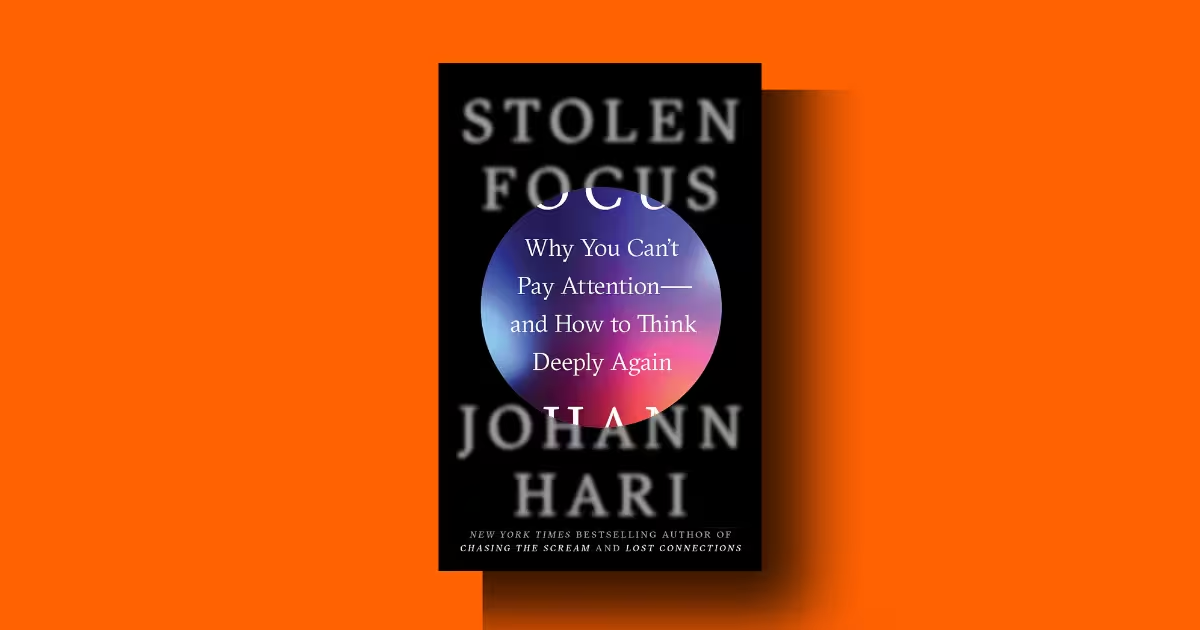
Johann Hari, Stolen Focus (2022). Focused on individual attention and well-being. Pakman’s practical chapters overlap with Hari’s advice.
Chris Hayes, The Sirens’ Call (2025) and Jenny Odell, How to Do Nothing (2019). The publisher lists both as comparable titles. Hayes is more philosophical. Odell is more poetic about resisting productivity culture.
Cory Doctorow’s work on platform decay. Pakman cites Doctorow on how platforms get worse over time.
FAQs About Pay Attention by David Pakman
Is Pay Attention by David Pakman worth reading?
Yes, if you want a plain-language, insider explanation of why your feed feels the way it does and a few habits to change it. Skip it if you want a heavily sourced academic study.
What is audience capture in Pay Attention?
Audience capture is when a creator’s need for approval gradually reshapes their opinions, tone, and identity until they perform the narrow version of themselves their audience rewards.
What is the “speed tax”?
The speed tax is Pakman’s rule of waiting 24 hours, sometimes longer, before following a major breaking news story so the facts can settle and the emotional manipulation fades.
Is Pay Attention politically biased?
Pakman is a progressive commentator, and Chapter Six argues the Right is better suited to the algorithm and offers advice to the Left. Most of the book, though, is about platforms and habits that affect everyone.
How is Pay Attention different from The Echo Machine?
The Echo Machine (2025) focused on right-wing media and post-truth politics. Pay Attention (2026) widens the lens to the whole attention economy, creator incentives, and AI.
How long is Pay Attention?
The hardcover is 288 pages, published by Harper on September 22, 2026.
Conclusion
You should read Pay Attention if you spend more than an hour a day on feeds and want to understand who designed that hour. It is suitable for general readers, not specialists, and it works best for creators, students of media, and anyone who has finished a scrolling session feeling wired and empty. Specialists will find the theory familiar and the sourcing thin.