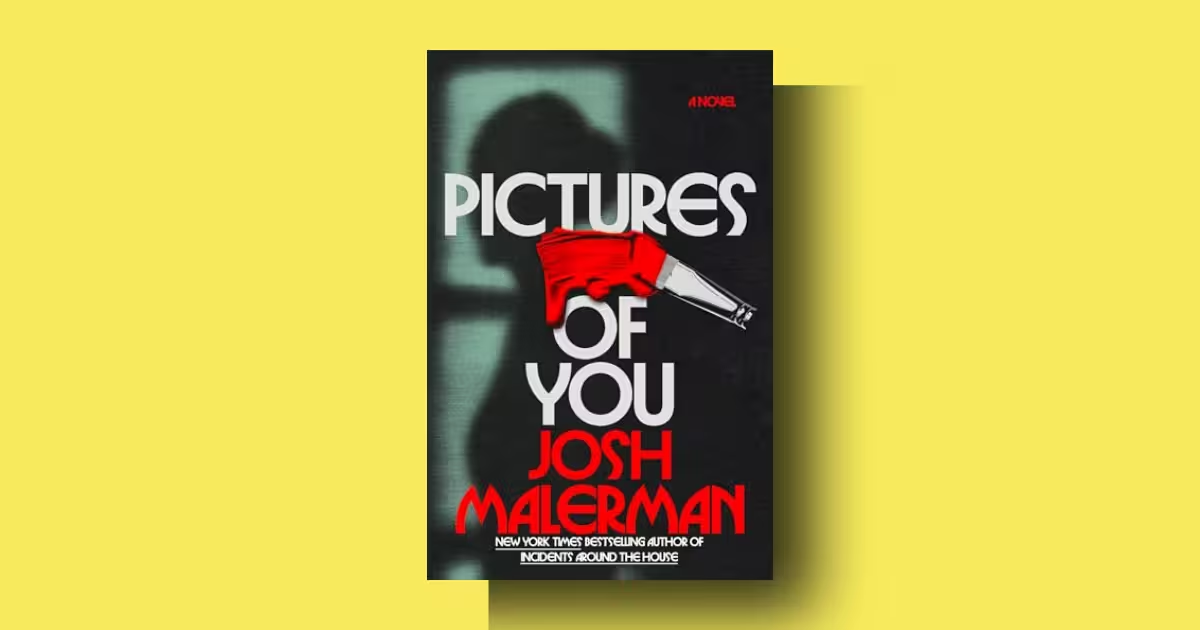

Pictures of You is Josh Malerman’s 2026 psychological horror thriller that asks a genuinely unsettling question: What if someone decided you were their masterpiece? The novel follows Emily Moore, a young woman kidnapped during a romantic getaway to Lake Michigan and forced to serve as the “still life” subject for a delusional artist named Helen Bach.
Malerman, the New York Times bestselling author behind Bird Box and Incidents Around the House, delivers a claustrophobic, single-location nightmare that unfolds over less than 24 hours. The book was released on September 8, 2026, by Del Rey Books, clocking in at 288 pages.
Reader Recommendation: You’ll love Pictures of You if you’re a fan of psychological suspense with a slow-burn, locked-room feel. Think Misery meets Rear Window, hostage horror where the real monster is human obsession. You’ll probably bounce if you need fast-paced action, deep character development, or a sprawling plot.
Several reviewers noted the narrative feels “uneven” and the characterizations “thin,” with one calling it “a slog to get there”. This is a book about ideas, about art, jealousy, and inspiration, and it wears those themes on its sleeve.
Table of Contents
1. Introduction
Title: Pictures of You: A Novel
Author: Josh Malerman
Publication Date: September 8, 2026 (US) / September 10, 2026 (UK)
Publisher: Del Rey (an imprint of Random House)
Pages: 288
Genre: Horror / Psychological Thriller
From the mind that brought us the post-apocalyptic terror of Bird Box and the supernatural dread of Incidents Around the House comes something different, a story grounded entirely in human evil. Malerman has described his approach to horror as writing “straight from the gut,” letting the narrative pull him along.
With Pictures of You, he trades supernatural monsters for something arguably more frightening: a woman so consumed by jealousy and artistic ambition that she’s willing to abduct, imprison, and potentially kill to create her “masterpiece.”
2. Background
The novel’s release comes at a fascinating cultural moment. In 2026, conversations about art, creativity, and authenticity are more charged than ever, particularly with the rise of AI-generated content and debates about what constitutes “real” art. Pictures of You taps directly into these anxieties.
Malerman, who lives in Michigan with his wife, artist-musician Allison Laakko, has long been fascinated by the creative process. The dedication page of Pictures of You is telling: “For my wife, Allison / From whom I’ve witnessed the full arcs of paintings / From sketch to frame / And who laughs every time I say it looks done, each step of the way. / ‘There’s more,’ she says. ‘You’ll see.'”
That intimate understanding of artistic creation, the gap between what the artist sees and what the work actually becomes, is central to the novel’s horror.
Pictures of You was one of the most anticipated horror releases of 2026. Early reviews were mixed but intrigued: Fangoria called it “the Perfect Cursed Coastline Thriller”, while Publishers Weekly was less kind, describing it as a “clumsy thriller” with “minimal action” and “thin” characterizations. Bloody Disgusting praised Malerman’s “clarity of vision” while noting the storytelling felt “a little uneven”.
3. Pictures of You Plot Summary
Part One: The Setup
The novel opens with Emily Moore waking up in a strange bed. She’s hungover, or at least, she thinks she is. The ceiling is pink, the walls are mauve, and the room is far too big to be the hotel room she and her boyfriend Jack checked into the day before.
Emily’s last clear memory is of a magical night out in Wainscott, a small lakeside town on Lake Michigan. She and Jack had been drinking, laughing, and celebrating their six-month relationship. More importantly, Emily had told Jack she might be pregnant, and his reaction had been perfect. He was excited. Giddy, even. He waved at her belly and said, “Ello.”
But now she’s alone. Wearing gloves. In a party dress that isn’t hers.
Beyond the foot of the bed, there’s an easel. And on that easel, an empty picture frame. Through the frame, a woman’s silhouette watches her.
The woman speaks: “Don’t move, Emily.”
She calls Emily “perfect.” She says Emily is “loveless” and “ignorant.” She refers to the scene as her “piece”.
Emily quickly realizes this isn’t a hangover. She’s been drugged, kidnapped, and placed in a room designed to look like a painting. The woman, who we later learn is Helen Bach, is treating Emily as a living still life.
Helen threatens that if Emily leaves the frame, something bad will happen to Jack. And indeed, from somewhere beyond the room, Emily hears a man screaming.
Part Two: Jack’s Search
The narrative shifts to Jack’s perspective. He wakes up in the hotel room, alone, still wearing his shoes. Emily’s phone is on the table beside his. She’s nowhere to be found.
Jack searches the town. He checks the beach, the drugstore, the bars they visited the night before, Mellows, the late-night coffee shop, McMac’s with its bright green awning. He describes Emily to anyone who will listen: “about my height, dark hair, supersmart, funny, great woman.”
Nobody has seen her.
Jack visits the Wainscott Police Station and speaks with Officer Jeff Opal, a young officer who comes from a long line of law enforcement. Opal advises Jack to call Emily’s parents, but Jack hesitates, he’s never met them, and he doesn’t want to scare them unnecessarily.
Desperate, Jack remembers the old man they saw multiple times the night before, a “Crypt Keeper” type carrying a flute. The bartender at Mellows identifies him as Herb Helmsman. Jack drives six miles out of town to Herb’s house on Bogard Road.
At Herb’s property, Jack finds something unsettling: a collection of broken picture frames in the backyard. Then he sees movement inside the house. A woman, Helen Bach, opens the back door and says, “She asked for you…”
Before Jack can react, she raises a flute-like tube to her lips and fires a dart into his chest.
Part Three: The Artist’s Vision
Back in the “studio,” Emily learns more about her captor. Helen is an artist, or believes herself to be one. She’s obsessed with the idea that the entire world is a series of paintings, each moment framed and waiting to be captured. She quotes a critic named Ted Gwynn obsessively, using his theories to justify her actions.
Helen reveals that she and Emily have a history. Years ago, Helen was Emily’s babysitter. Young Emily was a prodigy, she drew constantly, filling hundreds of pages with astonishing work. Helen, jealous of the child’s natural talent, slapped Emily across the face and stole one of her drawings.
That slap, Helen explains, was the moment she “discouraged” Emily from art. And she’s been doing it ever since.
Helen shows Emily the laminated drawing she stole years ago, a colorful, chaotic piece that resembles the very room Emily is now trapped in. Emily realizes the entire studio has been decorated to mirror her childhood artwork.
But there’s more. Helen reveals she saw Emily and Jack on their first date, six months ago, at an Italian restaurant in Chaps. She watched them through the window, raised an empty frame, and “captured” them as a painting. She’s been stalking them ever since.
“Why?” Emily asks.
Helen’s answer is chilling: “Love breeds inspiration. And inspiration breeds art.”
Helen can’t allow Emily to be inspired. If Emily falls in love, if she’s happy, if she creates, she might become the artist she was always meant to be. And Helen can’t stand that.
Part Four: The Triptych
Helen explains her “masterpiece” is a triptych, three paintings that tell a complete story:
- The Babysitter, Helen standing in the hallway of the Moore house, watching young Emily sleep through her bedroom door.
- The Last Great Painting, Emily and Jack dining at Benny Rizzuto’s, framed through the restaurant window.
- The Pregnancy Test, Emily and Jack strapped to chairs, a pregnancy test on the table between them, its result unknown.
Helen has already taken the test. She used Emily’s urine while Emily was unconscious. She knows the result but won’t reveal it.
The old man Herb, who was hiding under Emily’s bed, reveals himself as Helen’s devoted assistant. He worships her. He’s willing to play dead, lie under beds, do whatever it takes to help Helen complete her work.
Emily and Jack are now together in the same room, strapped to chairs, the pregnancy test on the table between them. Helen declares the painting complete.
Part Five: The Hanging
Helen explains that a painting isn’t truly finished until the artist can no longer touch it. She and Herb strip naked, take nails and hammers, and stand facing each other through the empty frame.
“At once,” Helen says. “Just so.”
They drive the nails into each other’s hearts.
Herb falls, drags himself back into the frame, and dies. Helen collapses onto the table, knocking the pregnancy test to the floor.
Emily and Jack are still trapped. But as Helen dies, the pregnancy test lands face-up.
It’s positive.
Part Six: The Rescue
A police officer, Jeff Opal, who had been searching for Jack, enters the building. He’d followed a hunch to the warehouse near Herko Lighthouse. He finds Emily and Jack still strapped to their chairs, surrounded by the dead bodies of Helen and Herb.
But there’s a third person in the building: a teenage boy named Ted. He’s been held captive in another room. And his last name?
Gwynn.
Ted Gwynn is the critic Helen has been quoting throughout the novel. He’s a seventeen-year-old senior at Wainscott High who wrote a term paper about art theory. Helen became obsessed with his ideas, kidnapped him, and has been using his words to justify her actions.
As the four survivors walk past the empty frame, Emily and Ted stop to look back. Emily studies the scene, the dead bodies, the colors, the chaos.
“This painting,” she says. “This painting is good.”
It’s a moment of artistic recognition. Despite everything, the terror, the abduction, the violence, Emily sees the work for what it is. And in that moment, something she thought was lost returns to her.
4. Pictures of You Analysis
4.1. Characters
Emily Moore: The protagonist, Emily is a twenty-something woman who has suppressed her artistic talent after a childhood trauma. Her character arc is the novel’s emotional core, she begins as someone who doesn’t even recognize her own artistic past and ends as someone who reclaims it.
The kidnapping, paradoxically, forces her to confront the art she abandoned. Malerman’s decision to make Emily a former prodigy is crucial; it explains why Helen fixates on her and creates the central tension of the novel. One reviewer noted that “the introspective moments and past reflections worked really well to develop Emily’s character”.
Jack Whitney: Emily’s boyfriend of six months, Jack is relentlessly optimistic, funny, and devoted. He’s the kind of person who makes terrible jokes even in dire situations, the “funeral drummer” bit he and Emily do on their night out is a perfect example of his character.
His search for Emily grounds the novel in a more conventional mystery-thriller structure, though some critics felt his sections lost momentum compared to Emily’s captivity. Jack is, in many ways, the embodiment of everything Helen fears: he brings Emily joy, love, and inspiration.
Helen Bach: Pictures of You‘s antagonist, Helen is a fascinating study in artistic jealousy. She’s a failed artist who can’t tolerate genuine talent in others. Her obsession with Emily spans decades, from the Moore house basement to the streets of Chaps to the beach at Wainscott.
Helen’s motivation is deeply rooted in insecurity: she believes talent should be earned through hard work, not bestowed naturally. Emily’s effortless brilliance is an insult to everything Helen has struggled for. Critics noted that Helen represents “the line separating genius from insanity”.
Herb Helmsman: Helen’s devoted assistant, Herb is a tragic figure, a lonely old man so desperate for connection that he’ll participate in kidnapping and murder just to be near her. He plays dead under Emily’s bed, takes darts to the throat when he disappoints Helen, and ultimately drives a nail into his own heart at her command. His devotion is both pathetic and terrifying.
Ted Gwynn: The seventeen-year-old whose term paper became Helen’s artistic bible.
His kidnapping reveals the true extent of Helen’s delusion, she’s not just obsessed with Emily, she’s obsessed with anyone who can articulate the artistic vision she lacks. His presence in the final scene, walking past the frame with Emily, suggests a symbolic passing of the torch: two artists, one old and one new, recognizing the work for what it is.
Officer Jeff Opal: The young police officer who ultimately rescues the survivors. Opal is the novel’s moral compass, he follows his instincts, doesn’t give up, and genuinely cares about the people he serves. He comes from a long line of law enforcement, which adds weight to his decisions.
4.2. Pictures of You Themes and Symbolism
Artistic Jealousy: The novel’s most prominent theme is the destructive power of envy. Helen can’t stand that Emily was born with talent she had to work for. This jealousy metastasizes into obsession, then violence. The novel asks uncomfortable questions: Is it fair that some people are naturally gifted? What does that mean for those who aren’t? And what happens when jealousy curdles into something darker?
The Frame as Metaphor: The empty picture frame is the novel’s central symbol. Helen believes that framing something, anything, makes it art. She’s both right and wrong. The frame gives context, intention, meaning. But it can’t create substance where there is none. The frame without a canvas is just wood. Helen’s entire artistic philosophy is built on this misunderstanding.
Love vs. Inspiration: Helen’s belief that “love breeds inspiration” is the engine of the plot. She kidnaps Emily specifically to prevent her from falling in love, because love would make Emily happy, and happiness would make her create. It’s a perverse, twisted logic, but it’s consistent. Helen is trying to keep Emily “loveless” and “ignorant” because that’s how she wants her subject to appear in the painting.
Discouragement as Violence: The novel argues that discouraging someone’s creative spirit is a form of violence. When Helen slapped young Emily, she didn’t just hurt her face, she killed something inside her. Emily’s entire adult life has been shaped by that single act. She doesn’t draw, doesn’t paint, doesn’t even like talking about art. The trauma of being told she wasn’t allowed to be good has followed her for two decades.
The Artist’s Voice: Helen quotes Ted Gwynn obsessively, using his theories to justify her actions. But when we finally meet Ted, he’s just a teenager, his “wisdom” is recycled from a term paper. The novel suggests that artistic voice can’t be borrowed or stolen. You have to find it yourself. Helen never does.
The Pregnancy Test: The white oval on the table is the novel’s great question mark. Is Emily pregnant? The test is positive, but Helen’s manipulation of it casts doubt. Even at the end, we don’t know for certain. The test represents uncertainty, potential, the future, everything Helen is trying to freeze in place.
5. Evaluation
My Overall Impression:
Pictures of You is an uneven but compelling addition to Malerman’s bibliography. It’s not as tight as Bird Box or as emotionally resonant as Incidents Around the House, but it’s a bold, strange, and genuinely unsettling exploration of artistic obsession.
The novel’s greatest strength is its premise. The idea of being forced to serve as someone else’s living painting is genuinely nightmarish. Emily’s captivity is claustrophobic, confusing, and terrifying, exactly what you’d want from a hostage horror story. Malerman’s prose has that “persistent feel of discovery” that makes his books compulsively readable.
Strengths:
The Premise: A genuinely original horror concept. Being trapped in someone else’s artistic vision is viscerally frightening.
Atmosphere: The novel is “self-contained to the point of claustrophobia”. The studio feels like a pressure cooker.
Thematic Depth: The exploration of jealousy, creativity, and discouragement gives the novel intellectual weight.
Pacing: At 288 pages, the novel moves quickly. It’s a fast read.
Weaknesses:
Thin Characterization: Several reviewers noted that the characters lack depth. Emily and Jack feel like archetypes rather than fully realized people.
Uneven Narrative: The shifts between Emily’s captivity and Jack’s search create a “bifurcation” that disrupts the momentum. Jack’s sections feel less urgent.
Minimal Action: The novel is mostly interior, Emily thinking, Helen talking, Jack searching. There’s not a lot of physical movement.
Underdeveloped Themes: The ideas about art and creativity are interesting but never fully explored. One reviewer noted the book “could have used a little more room to develop them”.
Comparison with Similar Works:
Misery by Stephen King: Both novels feature a captive creator forced to perform for a deranged fan. Paul Sheldon writes for Annie Wilkes; Emily Moore poses for Helen Bach. The difference is that Emily isn’t a creator anymore, she’s an object.
Rear Window (film): The voyeuristic quality of Helen’s obsession mirrors the way Jimmy Stewart’s character watches his neighbors. Both characters frame their subjects through windows and lenses.
The Yellow Wallpaper by Charlotte Perkins Gilman: Both stories feature women trapped in rooms, their sanity slowly eroding. But where Gilman’s protagonist descends into madness, Emily reclaims her artistic identity.
Vertigo (film): Malerman has cited Hitchcock as an influence. Helen’s obsession with Emily has the same quality as James Stewart’s obsession with Madeleine, a desire to control, to possess, to re-create.
6. Personal Insight: The Relevance of Artistic Jealousy in 2026
The most pressing theme in Pictures of You, artistic jealousy and the fear of being surpassed, feels incredibly timely.
In 2026, the art world is wrestling with questions of authenticity and value. AI-generated art can now produce images in seconds that would take human artists days or weeks. Musicians worry about AI replicating their sound. Writers fear being replaced by language models. There’s a collective anxiety about what happens when the barriers to creation fall away.
But Pictures of You suggests a different kind of anxiety, not the fear of being replaced by machines, but the fear of being outshone by other humans.
Helen Bach can’t stand that Emily was born with talent. She’s spent her entire life working, struggling, trying to find her “voice.” And then she meets a four-year-old who has one naturally. It’s not fair. It’s not right. And Helen decides to do something about it.
This feels relevant to a world where creative success is increasingly visible and competitive. Social media has made it easier than ever to compare ourselves to others. We see the finished products, the paintings, the songs, the books, without seeing the years of struggle behind them. We assume talent is a gift, not a practice.
Malerman’s novel argues that this assumption is dangerous. When we believe talent is innate, we resent those who have it. We tell ourselves we could have been that good if we’d been born differently. We discount the work, the practice, the failures that led to the success.
And sometimes, that resentment curdles into something worse.
Five Lessons from Pictures of You:
1. Jealousy is corrosive. Helen’s envy destroys her, the people around her, and ultimately the very art she’s trying to create. It’s a cautionary tale about what happens when we can’t celebrate others’ success.
2. Talent requires cultivation. Emily had natural ability, but she stopped creating after Helen’s slap. Talent without practice withers. Pictures of You suggests that art isn’t just about what you’re born with, it’s about what you choose to nurture.
3. Discouragement has consequences. Helen’s single slap changed Emily’s entire life. The novel is a reminder that our words and actions can have lasting effects on others, especially young people.
4. Voice can’t be stolen. Helen quotes Ted Gwynn obsessively, but she never finds her own voice. She’s a borrower, not a creator. Pictures of You argues that authentic art comes from within, not from imitation.
5. Art is about questions, not answers. Helen’s obsession with “finishing” her painting misses the point. Great art leaves room for interpretation. The pregnancy test, its result uncertain, is the novel’s symbol of that truth.
7. Pictures of You Quotes
Here are some of the most striking passages from Pictures of You:
“Life is art and art is life,” the woman said. “Ted Gwynn said that.”
“I’m painting my masterpiece,” the woman said. A tear welled in the more visible of the two eyes.
“Love breeds inspiration,” the woman said. “And inspiration…well…that breeds art.”
“Ted Gwynn says good artists borrow. But great artists steal.”
“What could it be called other than macabre?” the woman said. “A loveless woman on a colorful bed…the colors representing her innocence, of course, maybe her ignorance…the woman totally unaware…peaceful in her dress…lounging…at rest…ignorant, yes…ignorant of the fact there was a man under the bed the whole time, his head angled back up at the viewer?”
“I haven’t decided if the subject should know what I know,” the woman said. “Ted Gwynn says paintings can be split up into two categories…there’s the ones where the subjects don’t know what kind of piece they’re in and the ones where they do.”
“This painting,” Emily said. With the confidence of speaking her opinion, with the knowledge to back that up. “This painting is good.”
8. Conclusion
Pictures of You is a strange, unsettling, and ultimately thought-provoking novel. It’s not Malerman’s best work, the characterizations are thin, the pacing is uneven, and the plot occasionally strains credibility. But it’s a novel that sticks with you, primarily because of its central question: What would you do if someone decided you were their masterpiece?
The answer, Malerman suggests, is fight like hell. Emily fights. Jack fights. And in the end, they survive, not because of luck, but because they refuse to be objects. They refuse to be still lifes.
The novel’s final image, Emily and Ted walking past the empty frame, stopping to study the scene, is a powerful one. It suggests that art isn’t just something you look at. It’s something you participate in. Emily is no longer Helen’s subject. She’s become a viewer, a critic, an artist in her own right.
And that, perhaps, is the novel’s real horror. Helen didn’t just try to trap Emily in a painting. She tried to trap her in a story where Emily had no agency, no voice, no future. But stories can be rewritten. Paintings can be reframed. And people, even people who’ve been hurt, even people who’ve been silenced, can find their way back to themselves.
Recommendation: I’d recommend Pictures of You to fans of psychological horror, hostage thrillers, and anyone interested in the dark side of artistic ambition. It’s a quick, compelling read that raises interesting questions about creativity, jealousy, and the cost of obsession.
But if you’re looking for deep character development or fast-paced action, you might want to look elsewhere.