
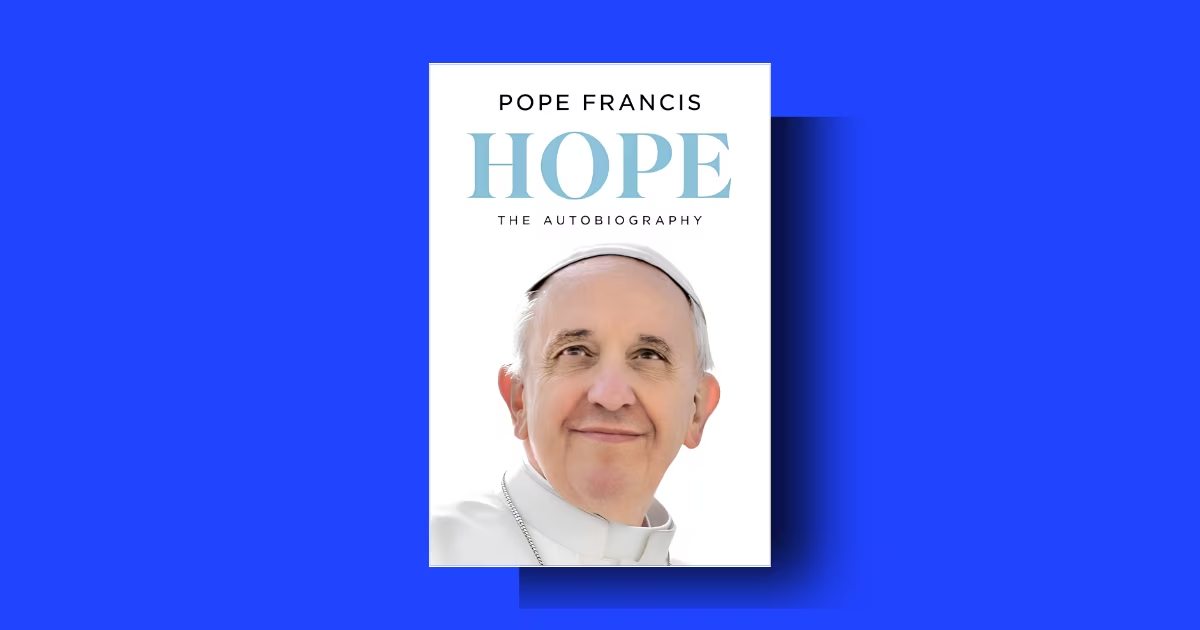

Pope Francis Hope Spera The Autobiography offers an unusually personal look at the life, faith, struggles, and papacy of Jorge Mario Bergoglio. But what does Hope: The Autobiography really reveal about the man behind the white robes, and his understanding of hope?
This review explores the book’s most revealing stories, ideas, and reflections, including what Pope Francis says about his childhood, priesthood, the 2013 conclave, war, faith, and the meaning of hope.
Brief Summary
What is Pope Francis: Hope (Spera), The Autobiography about?
Hope (Spera): The Autobiography is the first memoir published by a sitting pope in history. Written over six years with journalist Carlo Musso and translated from Italian by Richard Dixon, it was published on January 14, 2025, by Random House in the US and simultaneously in over 80 countries.
Hope (Spera) traces Jorge Mario Bergoglio’s life from his Italian immigrant grandparents’ near-miss with the SS Principessa Mafalda disaster in 1927 through his childhood in Buenos Aires, his near-death lung surgery in 1957, his years as a Jesuit provincial during Argentina’s Dirty War, and his election as pope on March 13, 2013.
Who should read Pope Francis: Hope (Spera)?
Read this if you want to understand the man behind the white cassock. Skip it if you’re looking for deep Vatican political intrigue or a full accounting of the abuse crisis. The book is personal, not investigative.
Key takeaway: Pope Francis is a sinner who has been forgiven, and he wants you to know that hope is not optimism. It’s a certainty.
Introduction
Pope Francis: Hope (Spera), The Autobiography is not a book you read for shocking revelations. It’s a book you read to understand how a boy from the Flores barrio of Buenos Aires became the 266th pope of the Catholic Church, and why he cries when he sees photographs of dead children.
Let me be direct with you. I’ve read a lot of papal biographies.
They tend to be either hagiographies written by people who already decided the pope is a saint, or hit pieces written by people who decided the opposite. Hope (Spera) is neither. It’s something rarer: a man telling his own story, in his own words, with all the contradictions and confessions that come with that.
The book was published on January 14, 2025, by Random House in the United States. Pope Francis originally intended it to appear only after his death. He changed his mind because of the 2025 Jubilee of Hope (Spera), which he wanted to celebrate with a legacy rather than a posthumous gift.
I picked up this book expecting a carefully managed Vatican product. What I found was a man who admits, on the page, that he is a sinner. Who confesses to lying to a dying priest. Who tells a joke about himself that ends with a policeman saying, “It’s the pope who is driving him!”.
This is a review for people who want to know whether Hope (Spera) is worth their time. It is. But not for the reasons you might expect.
Book Details: Pope Francis: Hope (Spera), The Autobiography
Title: Hope (Spera): The Autobiography, Italian: Spera: L’autobiografia
Author: Pope Francis (Jorge Mario Bergoglio), with Carlo Musso
Translator: Richard Dixon
Publisher: Random House (US), Viking (Ireland), Mondadori (Italy)
Publication Date: January 14, 2025
Pages: 302
Genre: Memoir, Autobiography, Religion, Spirituality
Available Languages: Published simultaneously in principal languages across 80 countries
About the Author: Pope Francis was born Jorge Mario Bergoglio in Buenos Aires, Argentina, on December 17, 1936. He was ordained a priest in 1969, became archbishop of Buenos Aires in 1998, and was created cardinal in 2001. He was elected pope on March 13, 2013, following the resignation of Benedict XVI.
He is the first Latin American and the first Jesuit to lead the Catholic Church.
Background: The Historical Context Behind Hope (Spera)
The Pope Who Was Almost Never Born
Pope Francis opens Hope (Spera) with a story that sounds like a Hollywood screenplay. In 1927, his grandparents and his father, Mario, bought tickets for the SS Principessa Mafalda, an Italian ocean liner bound for Buenos Aires.
The ship sank off the coast of Brazil on October 25, 1927, killing over 300 people. The Bergoglio family missed that voyage because they couldn’t sell their possessions in time. They exchanged their tickets and sailed two years later on the SS Giulio Cesare instead.
“I don’t know how many times I have found myself thanking Divine Providence,” Francis writes.
This is not just a family anecdote. It’s the foundation of a worldview. The pope who would later preach about migrants, refugees, and the “globalization of indifference” is himself the descendant of people who almost died at sea. His grandmother Rosa sewed the family’s valuables into the lining of her coat and wore it through the Buenos Aires heat, unwilling to let go of everything she had.
The Barrio That Made Him
Francis grew up in Flores, a middle-class neighborhood in Buenos Aires that was a kaleidoscope of Italian, Spanish, Jewish, Syrian, and Lebanese immigrants. He played football with a pelota de trapo, a ball made of rags, because leather balls were too expensive. He went to a state primary school, then a technical school where he studied chemistry. He was not a prodigy. He was, by his own admission, “third or second” in his class, never top.
His father was an accountant.
His mother was a homemaker who loved opera and taught her children to listen to Radio del Estado’s Saturday afternoon broadcasts. “Here is Desdemona, preparing for the night, gripped by a sad foreboding,” she would tell them. “Listen, children: Now he kills her!”.
This is the world that Hope (Spera) reconstructs in its first half. It is not a world of theological abstraction. It’s a world of butcher shops, street carnivals, and a grandmother who taught the future pope to close the edges of empanadas with a fork.
Summary: What Actually Happens in Hope (Spera)
Part One: The Boy from Flores (1936-1957)
The first chapters cover the Bergoglio family’s migration from Piedmont, Italy, to Argentina. His grandfather Giovanni fought in World War I and returned with a lifelong hatred of monarchy and war. His grandmother Rosa lost six children in infancy. His father Mario, the only surviving child, met his mother Regina at a Salesian oratory in 1934. They married in 1935. Jorge Mario was born on December 17, 1936, at 9 p.m., and was baptized on Christmas morning.
Francis describes his childhood with a novelist’s eye for detail. The neighborhood had four “old maids,” the Alonso sisters, who embroidered and prayed constantly. There was a hairdresser named Margot whose sister was a prostitute. There was a widow named Concepcion Minuto, a Sicilian immigrant who walked along railroad tracks while in labor to reach a hospital during the war.
There was “la Porota,” a high-class prostitute who later called the bishop’s palace in Buenos Aires to tell him she was bathing elderly people who had no one else to care for them. “A modern-day Magdalene,” Francis calls her.
The memoir covers his school years, his first job in a sock factory (cleaning floors), his love of football (he was a San Lorenzo fan, a “Cuervo,” and a terrible goalkeeper), and his early interest in girls. He admits to a childhood infatuation with a classmate named Amalia Damonte, to whom he wrote a letter saying they ought to marry, “you or nobody,” and drew a picture of the white house they would buy. She kept the drawing for her entire life.
Part Two: The Call (1953-1969)
On September 21, 1953, Francis had what he describes as a conversion experience. He was seventeen, on his way to meet friends for the first day of spring. He stopped at the church of San José de Flores, where a priest he had never seen before was hearing confessions. “I felt as if someone were calling me,” he writes. “I felt a need to confess.” He entered the confessional. When he came out, he knew he would become a priest.
The priest was Father Carlos Duarte Ibarra, a convert from Corrientes who was dying of leukemia. He became Francis’s spiritual director. When Father Duarte died a year later, Francis wept inconsolably. “It was the first time that I felt despair,” he writes. “I felt totally lost, alone, abandoned.”
In 1957, while studying at the diocesan seminary at Villa Devoto, Francis contracted Asian flu during a global epidemic that killed millions. His condition worsened. The seminary doctor, nicknamed “the Animal,” prescribed only laxatives and aspirin.
A prefect finally intervened and sent him to the Syrian Lebanese Hospital, where a Dominican nun named Cornelia Caraglio saved his life by ordering his antibiotic dose to be doubled. A specialist drained one and a half liters of fluid from his lungs. Francis later underwent surgery to remove the upper lobe of his right lung. He spent weeks under an oxygen tent with a catheter in his lungs. “The pain was terrible,” he recalls.
It was during this convalescence that he decided to join the Society of Jesus. “I enjoyed the seminary, even though I left it,” he writes. “Or rather, they carried me out of the seminary: on a stretcher, on the point of death.”
Part Three: The Jesuit Years (1960-1992)
Francis entered the Jesuit novitiate in Córdoba in March 1958. He describes the austere daily routine: waking at six, meditating, cleaning bathrooms, peeling potatoes, studying Latin and Greek, playing basketball, and teaching catechism to children in a shantytown near the novitiate.
He spent a year in Chile, where he taught at a Jesuit school and learned from the Chilean people. “They made me develop more humanity,” he writes.
He was ordained a priest on December 13, 1969. His mother, who had opposed his decision to enter the seminary, knelt before him at the end of his first Mass and asked for his blessing.
The 1970s brought the Dirty War in Argentina. Francis was appointed provincial superior of the Jesuits in Argentina in 1973, at the age of 36. He describes the terror of those years: priests and nuns disappearing, the military dictatorship’s campaign of torture and murder. He hid people in Jesuit houses. He arranged for a young Uruguayan man to escape to Brazil by dressing him as a priest and giving him an identity document in his own name.
He tried to intervene on behalf of two Jesuit priests, Orlando Yorio and Franz Jalics, who had been arrested by a navy task force. He went to see Admiral Emilio Massera, the head of the navy, and told him: “I want them back, alive.” They eventually were released.
His friend and mentor Esther Ballestrino de Careaga, a Paraguayan Marxist who taught him in the chemistry laboratory, was kidnapped on December 8, 1977, in front of the church of Santa Cruz. She was tortured and thrown alive into the sea from a military plane. Francis had hidden her library of Marxist books in the Colegio Máximo to protect her. Her remains were identified in 2005. Francis arranged for her burial at Santa Cruz.
Part Four: The Bishop of Rome (2013-2025)
The final section covers the 2013 conclave, which Francis describes in detail. He arrived at Santa Marta with a suitcase containing two cassocks. He had already bought a return ticket to Buenos Aires for Saturday, March 23. “No pope will take over during Holy Week,” he thought. He had no expectation of being elected.
During the third ballot, on the afternoon of March 13, he reached 69 votes. When the vote was repeated and his name was read for the 77th time, the cardinals applauded. Cardinal Cláudio Hummes embraced him and said: “Don’t forget the poor.” Those words, Francis writes, “remained with me, I felt them in my flesh.”
He chose the name Francis. When asked by Cardinal Giovanni Battista Re if he accepted, he said: “Accepto.” When asked what he wished to be called, he said: “Vocabar Franciscus.”
He describes his first act as pope: tripping on a step as he walked toward Cardinal Ivan Dias, who was in a wheelchair. He did not fall. He embraced him. He refused the throne. He asked for the blessing of the people before giving his own.
He chose to live at Santa Marta rather than the papal apartment in the Apostolic Palace. “The papal apartment is like an inverted funnel,” he writes. “It is spacious, but the entrance is quite cramped. You squeeze in, drop by drop. And I cannot live without people around me.”
He describes his first papal journey, to Lampedusa, the Mediterranean island that has become a symbol of migrant tragedy. “I too could have been among the outcasts of today,” he writes. “One question is always lodged in my heart: Why them and not me?”
The memoir also covers the COVID-19 pandemic, the wars in Ukraine and Gaza, his meetings with Muslim leaders, his visit to Iraq in 2021, his surgery in 2021, and his ongoing concern about climate change. He includes a chapter on humor and children, and a reflection on artificial intelligence.
The book ends with a chapter called “I Am Just One Step.” “The Church will go on,” he writes. “I am just one step in its history.”
Hope (Spera) Analysis
What Worked for Me
The prose in Hope (Spera) is warm, conversational, and occasionally funny. Richard Dixon’s translation from the Italian captures the pope’s voice: avuncular, self-deprecating, and occasionally sharp. The Guardian called it “a warm, emotionally intelligent” memoir that “fully justifies its bold claim to be the first ever memoir by a living pope”.
The best sections are the ones about his childhood and his family. His grandmother Rosa, who taught him the “Our Father” and the Hail Mary and who sewed money into her coat, is a vivid presence. His father Mario, who wept when he heard about the atomic bombing of Hiroshima, is drawn with affection and respect.
His mother Regina, who opposed his decision to become a priest but later knelt for his blessing, is portrayed with honesty about their disagreements.
The scenes from the Dirty War are harrowing and morally serious. Francis does not present himself as a hero. He admits that he made mistakes as Jesuit provincial. He admits that he sometimes failed to speak up when he should have. He admits that he felt despair when Father Duarte died.
The 2013 conclave narrative is fascinating for anyone interested in Vatican politics. Francis reconstructs the confusion, the “stopgap” votes, the moment when he realized he might actually be elected. His reaction to Cardinal Hummes’s embrace, “Don’t forget the poor,” becomes the thematic center of his papacy.
What Doesn’t Work
Hope (Spera) is not a comprehensive autobiography. It skips over large stretches of Francis’s life. It ignores the Vatican’s resistance to his own commission for protecting minors. It says almost nothing about the ongoing abuse crisis, beyond expressing compassion for survivors. It does not address the rumors and accusations that have dogged Francis since the beginning of his papacy, including the accusation that he was complicit in the kidnapping of two Jesuit priests during the Dirty War.
The Irish Times called it “another triumph of marketing over substance,” criticizing the book for being only 302 pages about an 88-year-old man who has been a major world figure for over a decade. The Church Times noted that it is “not really a full autobiography” but a “vivid memoir” with “editorial idiosyncrasies”.
These criticisms are fair. If you want a comprehensive account of Francis’s papacy, you will need to look elsewhere. If you want to understand the man, Hope (Spera) is a good place to start.
Strengths
Authentic voice. Francis sounds like a real person, not a Vatican press release. He tells jokes. He admits to vanity. He describes his fear of physical pain.
Historical value. The book provides new details about the Bergoglio family’s migration, the 1957 lung surgery, the 2013 conclave, and the Dirty War.
Emotional depth. The sections on his family, especially his grandmother Rosa and his friend Esther, are genuinely moving.
Accessible. The book is written for general readers, not theologians. You do not need a degree in canon law to understand it.
Weaknesses
Selective. It avoids the most controversial aspects of Francis’s papacy.
Repetitive. Some themes, such as the importance of migrants and the evils of war, are repeated multiple times.
Thin on policy. It does not explain how Francis made decisions or why he chose certain reforms over others.
Occasionally sentimental. Some passages veer into the kind of pious storytelling that feels more like a homily than a memoir.
Comparison: Hope (Spera) and Other Papal Memoirs
There is no direct comparison. Hope (Spera) is the first memoir published by a sitting pope. Previous popes wrote encyclicals, letters, and theological works, but not autobiographies. John Paul II wrote a book called Crossing the Threshold of Hope, but it was a collection of interviews with a journalist, not a memoir. Benedict XVI wrote an autobiography called Milestones, but he published it before becoming pope.
The closest comparison is probably the memoirs of world leaders like Nelson Mandela’s Long Walk to Freedom or Barack Obama’s Dreams from My Father. Like those books, Hope (Spera) is not primarily a political document. It is a personal story that uses the author’s life to illuminate larger themes.
What sets Hope (Spera) apart is its religious framework. Francis is not just telling a story about his life. He is telling a story about God’s action in his life. The title is not an accident. The book is about hope, and Francis wants you to understand that hope is not a feeling but a certainty.
Conclusion: Should You Read Pope Francis: Hope (Spera)?
Yes. But read it with the right expectations.
If you are looking for a comprehensive account of Francis’s papacy, or a detailed investigation of the abuse crisis, or a definitive answer to the accusations against him, you will be disappointed. Hope (Spera) does not do those things. It is not that kind of book.
If you want to understand the man, however, hope is indispensable. It shows you where he came from: the immigrant grandparents, the Italian barrio in Buenos Aires, the football fields, the chemistry laboratory, the Jesuit novitiate, the Dirty War, the conclave. It shows you how he thinks: about family, about poverty, about war, about hope. It shows you how he prays: with the spontaneity of a child and the persistence of a widow.
The last chapter is titled “I Am Just One Step.” That is the key to the whole book. Francis does not see himself as the protagonist of his own story. He sees himself as a step in a longer journey. The Church will go on. Hope will go on. He is just one part of it.
Who should read this book:
- Catholics who want to know their pope better
- Anyone interested in the history of migration and the Italian diaspora
- Readers who enjoy memoirs of faith and personal transformation
- Historians interested in the 2013 conclave and the Dirty War
- People who want to understand why Pope Francis talks about migrants, the poor, and the environment
Who should skip it:
- Readers looking for investigative journalism about the Vatican
- Anyone who wants a detailed critique of Francis’s papacy
- People who are not interested in religion or spirituality
Final verdict: Hope (Spera) is a warm, honest, and occasionally frustrating memoir. It is worth your time, especially if you read it as a human story rather than a political document. The pope is a sinner who has been forgiven. He wants you to know that.





