
Did you ever wonder why you feel completely alone in a room full of friends, or why a constantly buzzing smartphone actually makes you feel more isolated from the world?
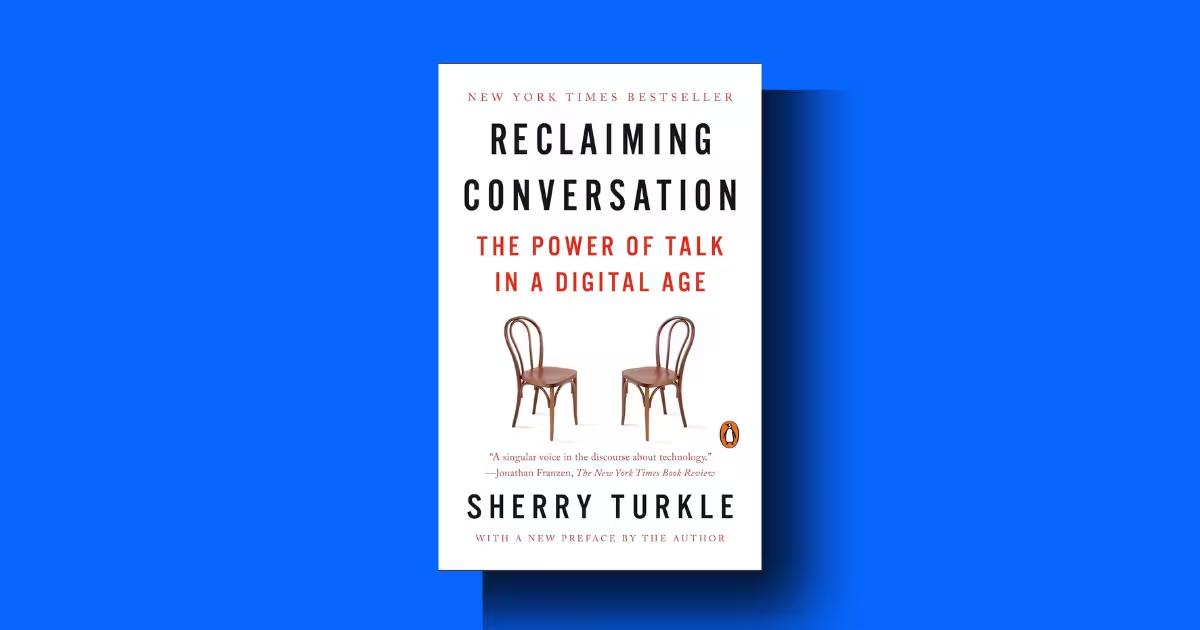
In Reclaiming Conversation: The Power of Talk in a Digital Age, Sherry Turkle argues that our obsession with digital devices is destroying our ability to have meaningful face-to-face conversations. This shift is severely damaging our capacity for empathy, self-reflection, and genuine connection. By intentionally putting our phones away and embracing solitude and direct communication, we can rebuild our relationships and our humanity.
Reclaiming Conversation is best for: parents, educators, managers, and anyone who feels a creeping sense of digital burnout. If you have ever felt ignored by someone staring at a screen, this is for you, and not for hardline tech-utopians who believe every human problem can be solved with a new app, or readers looking for a fast-paced thriller.
Table of Contents
1. Introduction
Title and Author Information: The book is Reclaiming Conversation: The Power of Talk in a Digital Age by Sherry Turkle, published by Penguin Press in 2015.
Context: Reclaiming Conversation is a work of non-fiction focusing on sociology, psychology, and technology. Sherry Turkle is a trained sociologist, teacher, and clinical psychologist who has spent decades studying how children and adults develop within a technological culture.
She has been researching the intersection of computers and human identity since the late 1970s, making her uniquely qualified to discuss how digital life alters human behavior.
When structuring digital publications for probinism.com, understanding the raw mechanics of human connection is the foundation of creating content that actually speaks to people. Turkle provides the psychological framing for why modern audiences behave the way they do.
Purpose: The central purpose of Reclaiming Conversation is that our mediated digital life has caused a “flight from conversation”. We are replacing the messy, demanding, and empathetic nature of face-to-face talk with the controlled, edited efficiencies of text messages and social media. Turkle argues that we must intentionally reclaim conversation to restore our empathy, our creativity, and our sense of self.
2. Background
When personal computers first became mainstream, they were static portals.
You went to a desk, used the machine, and then walked away. By 2015, the landscape had completely shifted. Smartphones created an environment where we are always connected and always distracted. Turkle notes that the average American adult checks their phone every six and a half minutes, and eighty percent of people sleep with their phones.
This constant connection has created a crisis. We are terrified of boredom and terrified of being alone.
This book was written precisely at the moment when the first generation of children who grew up with smartphones was graduating from college, entering the workforce, and showing the world exactly what a lack of face-to-face conversation does to human development.
3. Reclaiming Conversation Summary
I want to give you everything you need to know about this book so you do not even need to read it to understand its full weight. Turkle organizes her thoughts around a concept from the philosopher Henry David Thoreau.
Thoreau famously said he had three chairs in his cabin: one for solitude, two for friendship, and three for society. Turkle uses these chairs to map out how conversation works and how technology is breaking the process.
The Empathy Crisis and The Flight from Conversation
The core problem is that face-to-face conversation is the most humanizing thing we do. It is where we learn to listen and where we develop empathy. But today, we hide from each other.
Turkle shares a terrifying story from the Holbrooke School, a middle school in New York. The dean contacted Turkle because the twelve-year-old students were playing on the playground like eight-year-olds.
They were excluding each other without any emotional awareness. One seventh grader, when asked why she excluded a peer, responded robotically, saying she just didn’t have feelings about it. Because these children spend their time looking at screens, they are not practicing the empathic arts like making eye contact and reading facial expressions.
Turkle points out that in the past twenty years, there has been a 40 percent decline in the markers for empathy among college students. We are trading rich relationships for mere connection. We want to be with each other, but we also want to be elsewhere.
The Rule of Three and The Goldilocks Effect
When college students go out to dinner today, they use something called the “rule of three”. Because everyone wants to check their phones, a person will scan the table to make sure at least three people have their heads up and are maintaining the conversation before they allow themselves to look down at their own screen.
The result is that the conversation remains fragmented and light. No one brings up serious topics because they know they do not have anyone’s undivided attention. Studies even show that simply having a silent phone sitting on a table makes people feel less connected to each other.
We do this because of what Turkle calls the “Goldilocks effect”. We want people not too close, not too far, but just right. Texting allows us to control the distance. We can edit our responses.
We can present the exact version of ourselves we want the world to see. A high school senior told Turkle directly that the problem with real-time conversation is that you cannot control what you are going to say. We are terrified of making mistakes, slipping up, or facing the messy reality of human emotion.
Apologies and Artificial Truces
One of the most damaging things we do with technology is avoid difficult emotional work. People now routinely apologize by sending a text that says “I’m sorry” and hitting send.
Turkle explains that a face-to-face apology is a vital psychological event. You have to see the pain on the other person’s face, and they have to see your genuine remorse. This builds empathy.
A texted apology is what one graduate student called an “artificial truce”. It just hits pause on the argument without actually resolving the underlying feelings.
One Chair: The Loss of Solitude
The first step in having good conversations with others is knowing yourself. That requires solitude. Solitude is not loneliness. It is a state of conscious retreat where you gather yourself. Comedian Louis C.K. summarized this perfectly in a late-night interview Turkle quotes.
He explains that underneath everything in life is a feeling of being alone and empty, and sadness is a poetic part of life. But instead of letting ourselves feel sad or bored, we reach for our phones to push the feeling away. Because we push away the sadness with our phones, we never feel completely happy or completely sad.
We just feel satisfied with our products.
Turkle notes that people now operate under the idea of “I share, therefore I am”. Instead of having a feeling and sitting with it, people feel they need to post or text about the feeling in order to actually experience it.
When we cannot tolerate the “boring bits” of life, we lose our capacity for self-reflection. If we do not know who we are when we are alone, we end up using other people merely as spare parts to support our fragile egos.
Three Chairs: Education and Work
This flight from conversation damages our professional and academic lives. In classrooms, students sit with open laptops. Turkle points out that multitasking degrades the performance of everyone.
It harms the student doing it, and it harms the students sitting around them who can see the screen. In the workplace, young associates turn their desks into “cockpits” by putting on huge headphones and ignoring their colleagues. They avoid making phone calls because they view the human voice as an interruption.
Employers are now actively screening job applicants for the simple ability to hold a conversation. One pharmaceutical executive noted that when she tells new recruits they will have a follow-up conversation instead of trading emails, they look like deer caught in the headlights.
The Fourth Chair: Artificial Intelligence
Finally, Turkle warns about a “fourth chair.” We are starting to talk to machines. We are building robots and virtual assistants that simulate empathy.
Turkle argues that we are arriving at a “robotic moment” not because the robots are ready to be our companions, but because we are so damaged and isolated that we are willing to accept them as companions. If a machine can give us the illusion of being understood, many people now feel that is good enough.
We are redefining words like “caring” and “affective” to apply to machines that have no feelings at all.
The Cure
The good news, according to Turkle, is that we are resilient. Conversation is the talking cure. Just five days at a device-free summer camp increases a child’s ability to read human emotions.
We do not need to throw our phones away, but we must use them with intention. We must create sacred, device-free spaces in our homes, like the kitchen or the dining room, and we must put our phones away when we are walking with our children.
4. Reclaiming Conversation Analysis
Reclaiming Conversation is a poignant, urgent, and vital mirror held up to our modern society. Turkle has written a masterpiece of cultural observation. She captures the exact texture of modern anxiety.
Turkle supports her arguments brilliantly through a mixture of hard statistical data and deeply human, qualitative interviews. When she pairs the statistic that empathy has dropped 40% in college students with the heartbreaking anecdote of a teenager texting during a serious conversation because they cannot handle the emotional weight, the logic is undeniable.
Reclaiming Conversation thoroughly fulfills its stated purpose.
It forces the reader to look at their own habits. She does not just complain about kids these days. She points the finger at adults, noting that parents texting while pushing strollers are teaching their children that they are less important than a screen.
5. Strengths and Weaknesses
Strengths
My most pleasant experience with this book is how recognizable the behaviors are. Turkle’s description of the “rule of three” at dinner parties made me laugh out loud because I have seen it happen, and I have participated in it.
Her inclusion of Louis C.K.’s philosophy on sadness and smartphones is a brilliant touch of pop-culture relevance that grounds her academic research in everyday reality.
She also successfully avoids being purely anti-technology. She states clearly that she is pro-conversation, not anti-tech.
Weaknesses
If there is a negative experience to be had, it is that Reclaiming Conversation can feel slightly repetitive in its middle sections. The examples of people avoiding conflict via text begin to blur together.
Additionally, while she advocates for creating device-free zones, the systemic addiction built into the applications by tech companies (the algorithms designed to keep us scrolling) could be addressed with a bit more aggression.
She relies heavily on personal willpower to fix a problem that is being engineered by billion-dollar corporations.
6. Comparison with Similar Works
When analyzing human connection, it is helpful to look at how different frameworks view our interactions. In books like The 5 Love Languages, we see how people require specific types of attention (like Quality Time or Words of Affirmation) to feel secure.
Turkle’s research shows that digital communication actively destroys our ability to provide Quality Time. You cannot give someone your full presence if you are continuously partially distracted by a phone.
Similarly, if we look at contemporary fiction like This Is How You Lose the Time War, the characters build an incredibly deep, intimate bond through slow, deliberate, written letters. They take time to process their thoughts. Modern texting is the exact opposite. It is fast, reactive, and often lacks the depth of true reflection.
Finally, examining novels like The Vanishing Half, which deals heavily with hidden identities and presenting a specific face to the world, mirrors Turkle’s warnings about the curated selves we present on social media. We edit our lives for public consumption, losing our authentic selves in the process.
7. Conclusion
I highly recommend Reclaiming Conversation to absolutely everyone, but especially to parents, educators, and anyone who feels a sense of vague anxiety when they are separated from their phone.
It is highly suitable for a general audience. Turkle writes clearly and without heavy academic jargon. Reading this will make you want to put your phone in a drawer, walk outside, and have a long, uninterrupted talk with a smart friend.







