
What if the very arguments atheists use to deny God’s existence actually prove that He exists?
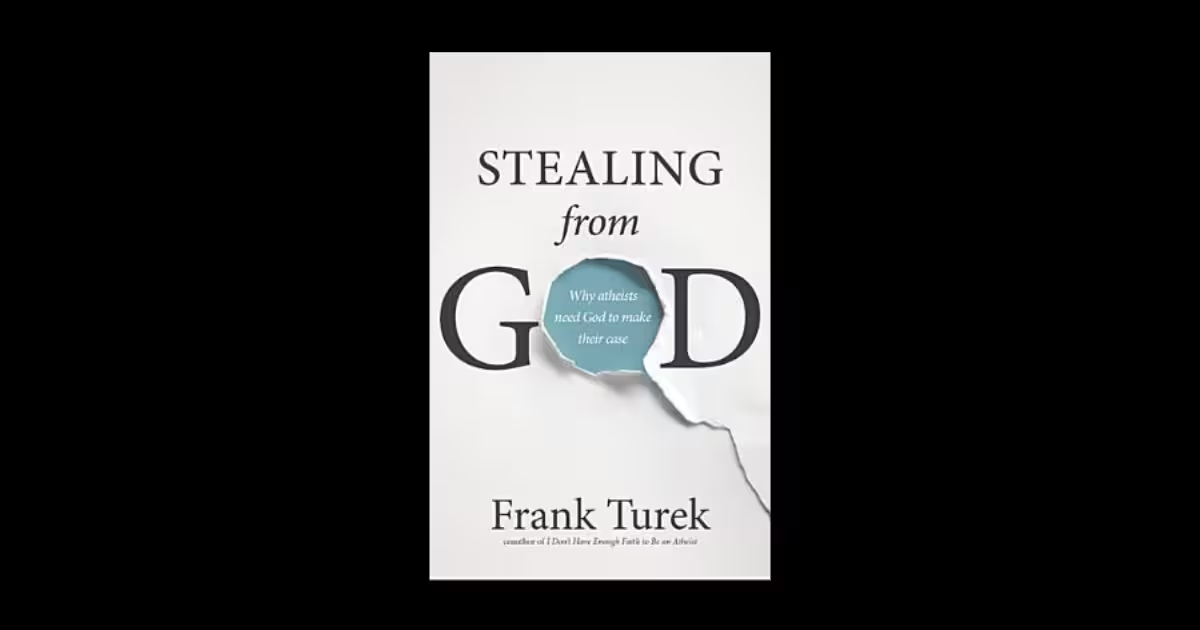
That’s the provocative question at the heart of Frank Turek’s Stealing from God: Why Atheists Need God to Make Their Case. If you’ve ever found yourself in a debate with someone who insists that science, reason, and morality are on the side of atheism, this book will flip that assumption completely on its head.
Table of Contents
Overview
Stealing from God is a Christian apologetics book that makes a bold and counterintuitive claim: atheists cannot make a coherent case for their worldview without borrowing concepts that only make sense if God exists.
Turek argues that when atheists appeal to reason, logic, morality, science, and even the problem of evil, they are effectively “stealing” from a theistic worldview to support their arguments.
Published in 2014 by NavPress, the book is written by Frank Turek, a prominent Christian apologist, author, and president of CrossExamined.org. Turek holds a Doctor of Ministry from Southern Evangelical Seminary and has co-authored the Gold Medallion-winning I Don’t Have Enough Faith to Be an Atheist with Norman Geisler.
The book’s central thesis is encapsulated in the acronym CRIMES, which stands for:
- Causality
- Reason
- Information & Intentionality
- Morality
- Evil
- Science
Each chapter unpacks one of these areas, demonstrating how atheists must rely on these immaterial realities—realities that atheistic materialism cannot explain—to make their case against God.
The Washington Examiner called it “a brilliant and unique contribution to Christian apologetics” and noted that it “fills a bit of a hole in the field of Christian apologetics”.
Reader recommendation
Stealing from God is suggested for:
- Christians who want to understand and articulate the weaknesses in atheistic arguments
- Believers looking for accessible, memorable tools (like the CRIMES acronym) to defend their faith in conversations with skeptics
- Anyone curious about the philosophical and logical foundations of belief and unbelief
- Students and young adults navigating secular college environments where Christianity is often dismissed
Stealing from God is not suggested for:
- Readers seeking a purely academic or neutral philosophical treatise—this book is unapologetically Christian and evangelistic in its tone
- Atheists who are not open to examining the logical consistency of their own worldview
- Those looking for a comprehensive refutation of every possible atheistic argument—Turek focuses on foundational issues rather than exhaustive detail
Introduction
Frank Turek is not your typical ivory-tower academic. He’s a former U.S. Navy Naval Flight Officer who transitioned into Christian apologetics and now speaks at secular college campuses, churches, and conferences around the world. He has debated prominent atheists including Christopher Hitchens and engages regularly with skeptical audiences. This practical, frontline experience gives Stealing from God a grounded, real-world feel rather than a detached philosophical exercise.
The book opens with a deeply personal story: a funeral of a friend named Nancy, whose husband—“Coach”—spoke with remarkable peace after losing his wife to cancer and his son to leukemia years earlier. Coach’s confidence in God, despite unimaginable loss, sets the stage for the book’s central question: Is Christianity true, or is it just wishful thinking?
Turek then pivots to the “new atheists”—Richard Dawkins, Sam Harris, and the late Christopher Hitchens—who have popularized the idea that religion is irrational and that science has rendered God obsolete. Turek’s response is not to retreat but to go on the offensive: he argues that the new atheists’ own arguments are logically self-defeating because they depend on concepts that atheism cannot justify.
“Atheists are using aspects of reality to argue against God that wouldn’t exist if atheism were true. In other words, when atheists give arguments for their atheistic worldview, they are stealing from a theistic worldview to make their case.”
Background: The Rise of the New Atheism
To understand why Stealing from God was written, it helps to know the cultural context. In the early 2000s, a wave of bestselling books by Richard Dawkins (The God Delusion), Christopher Hitchens (god Is Not Great), and Sam Harris (The End of Faith) brought atheism into the mainstream with unprecedented fervor.
These authors didn’t just argue that God doesn’t exist—they argued that religion is dangerous, irrational, and should be ridiculed.
Dawkins famously wrote that belief in God is a “delusion” and that teaching religion to children is “child abuse”. Hitchens declared that “religion poisons everything”. Harris claimed that science can provide a basis for objective morality without God.
Turek saw a gap in the Christian response. While many apologists were defending the faith, few were directly challenging the internal consistency of atheism itself. Stealing from God fills that gap by turning the tables: instead of merely defending Christianity, Turek argues that atheism is intellectually bankrupt on its own terms.
Stealing from God Summary
The book is structured around the CRIMES acronym, with each chapter dedicated to one letter. Here’s a detailed breakdown of each argument.
C – Causality: “No One Created Something Out of Nothing?”
Turek begins with the Cosmological Argument: everything that has a beginning has a cause; the universe had a beginning; therefore, the universe had a cause. He notes that even atheist cosmologists like Stephen Hawking and Alexander Vilenkin agree that the universe had a beginning.
The problem for atheists is that they must explain how something came from nothing. Turek critiques Lawrence Krauss’s book A Universe from Nothing, pointing out that Krauss equivocates on the word “nothing.” Krauss’s “nothing” is actually a quantum vacuum—which is something—and it requires laws of physics that themselves need explanation.
“Nothing can’t create anything because, as Aristotle put it, ‘nothing is what rocks dream about.’ Unless some powerful agent intervenes, the ancient maxim still stands: out of nothing, nothing comes.”
Turek also tackles the “who made God?” objection. He explains that the law of causality applies to things that begin to exist, not to eternal, uncaused beings. God, by definition, is the uncaused first cause.
R – Reason: “Bad Religion or Bad Reason?”
In this chapter, Turek argues that atheism cannot account for the laws of logic. Logic is immaterial, universal, and unchanging—yet atheistic materialism claims that only matter exists.
Turek recounts a debate between Christian apologist Greg Bahnsen and atheist Gordon Stein, where Stein admitted that the laws of logic are not material but couldn’t explain their origin. Turek presses the point: if the laws of logic are merely human conventions, then they are changeable and subjective, making rational communication impossible.
“In order to construct any valid argument for atheism, the atheist has to steal tools from God’s universe because no such tools exist in the world of atheism.”
He also addresses the mind-brain problem. If the mind is merely the brain—as materialists like Francis Crick claim—then our thoughts are determined by physical processes, and we have no reason to trust our reasoning. As atheist J.B.S. Haldane put it: “If my mental processes are determined wholly by the motions of atoms in my brain, I have no reason to suppose that my beliefs are true”.
I – Information & Intentionality: “In Him All Things Hold Together”
This chapter focuses on the origin of biological information. Turek draws on the work of Stephen Meyer (Signature in the Cell, Darwin’s Doubt) to argue that the genetic code is information-rich and requires an intelligent source.
“Human DNA is like a computer program but far, far more advanced than any software ever created.” – Bill Gates
Turek explains that natural laws can produce repetitive patterns (like crystals) but cannot generate the complex, specified information found in DNA. He also discusses “epigenetic information”—information not stored in DNA but necessary for body-plan formation—which further undermines neo-Darwinian explanations.
He then introduces Aristotle’s concept of final causality: the idea that natural objects and processes are directed toward ends or goals. This goal-directedness, Turek argues, points to an external intelligence sustaining the universe moment by moment.
“God is not some distant historical watchmaker who wound things up and isn’t needed anymore. God’s power is present to you right now.”
M – Morality: “Stealing Rights from God”
Perhaps the most emotionally resonant chapter, Turek uses the real-life story of Megan Kanka—a seven-year-old girl raped and murdered by a convicted sex offender—to illustrate the problem of objective morality.
If atheism is true, Turek argues, then morality is merely a matter of opinion. There is no objective standard by which to condemn rape, murder, or genocide. He quotes Richard Dawkins admitting that “it is pretty hard to defend absolutist morals on grounds other than religious ones”.
Turek then critiques Sam Harris’s attempt to ground morality in “human flourishing.” He points out that Harris confuses epistemology (how we know right from wrong) with ontology (what makes something right or wrong). Even if science can tell us what promotes flourishing, it cannot tell us why we ought to flourish.
“You can know what a book says while denying there’s an author. But there would be no book to know unless there was an author. Likewise, atheists can know objective morality while denying God exists, but there would be no objective morality unless God exists.”
He also addresses the Euthyphro dilemma, arguing that God’s nature is the standard of goodness—neither arbitrary nor subject to an external standard.
E – Evil: “Does Evil Disprove Atheism?”
The problem of evil is often considered the atheist’s strongest argument. Turek turns it on its head: if evil exists, then good exists; if good exists, then God exists.
“The shadows prove the sunshine. There can be sunshine without shadows, but there can’t be shadows without sunshine.”
Turek explains that evil is not a “thing” but a privation or lack of good. It only makes sense against the backdrop of an objective standard of goodness, which requires God. He also addresses the apparent cruelty of God in the Old Testament, using the acronym STOP (Situation, Type, Object, Prescription) to help readers interpret difficult passages in context.
He acknowledges that we don’t have complete answers for every instance of suffering but argues that God can bring good out of evil—a point illustrated by the powerful testimony of a pastor born from rape.
S – Science: “Science Doesn’t Say Anything, Scientists Do”
In the final chapter, Turek argues that science itself depends on philosophical assumptions that atheism cannot justify. Scientists must presuppose the uniformity of nature, the reliability of their senses, the laws of logic, and the reality of the external world—none of which can be proven scientifically.
“We wouldn’t be able to do science reliably if atheism were true.”
Turek critiques the “scientism” of thinkers like Peter Atkins, who claimed that science can explain everything. Turek points out that this claim is itself not scientific but philosophical—and self-defeating.
He also defends intelligent design as a legitimate scientific inference, noting that ID theorists predicted the functionality of “junk DNA” long before it was confirmed.
Stealing from God Analysis
Stealing from God is a thought-provoking and accessible work that succeeds in its primary goal: exposing the logical inconsistencies in atheistic arguments. Turek writes with clarity and passion, drawing on real-world debates, personal stories, and philosophical heavyweights like Aristotle and Aquinas.
What I appreciate most is Turek’s refusal to let atheists off the hook. He doesn’t just defend Christianity; he goes on the offensive, showing that atheism is not merely unproven but unlivable and self-defeating. The CRIMES acronym is a brilliant mnemonic that makes complex ideas memorable and easy to deploy in conversation.
That said, the book is not without its limitations. Turek’s tone can at times feel combative, and some readers may find his dismissal of certain atheistic arguments too swift. For example, his treatment of the multiverse hypothesis is brief, and he doesn’t engage deeply with the most sophisticated versions of atheistic philosophy (e.g., those of Thomas Nagel or Daniel Dennett).
Moreover, the book is clearly written for a Christian audience. While Turek claims that atheists will benefit from reading it, the evangelistic thrust may alienate skeptical readers who are not already open to theistic conclusions.
Nevertheless, as a work of popular apologetics, Stealing from God is highly effective. It equips believers with tools to engage skeptics thoughtfully and challenges atheists to examine the foundations of their own worldview.
Strengths and Weaknesses
Strengths
Memorable Framework: The CRIMES acronym is one of the most effective pedagogical tools I’ve encountered in apologetics. It’s easy to remember and covers the major areas of contention.
Engaging Writing Style: Turek writes in a conversational, accessible tone. He uses stories, dialogues, and real-world examples to illustrate abstract concepts.
Strong Philosophical Grounding: Turek draws on Aristotle, Aquinas, and contemporary philosophers to build his case. He doesn’t just assert; he argues.
Practical Application: The book provides concrete tools for defending the faith in conversations with skeptics, making it valuable for laypeople and students.
Timely and Relevant: In an era of rising secularism and aggressive new atheism, Stealing from God offers a timely counter-narrative.
Weaknesses
Tone: Some readers may find Turek’s tone overly confrontational or dismissive of atheist intelligence. While he respects individual atheists, his rhetoric can feel sharp.
Lack of Engagement with Nuanced Atheism: The book primarily targets popular atheists like Dawkins and Hitchens. It doesn’t engage deeply with academic atheist philosophers who might offer more sophisticated defenses.
Brief Treatment of Some Topics: Chapters like the one on science could have been expanded. The intelligent design debate, in particular, deserves more thorough treatment.
Evangelical Bias: The book is unapologetically Christian and assumes the truth of the Bible. Skeptical readers may feel that Turek is preaching rather than arguing.
Comparison with Similar Works
Stealing from God fits within the broader genre of Christian apologetics, alongside works like:
Mere Christianity by C.S. Lewis, a classic defense of Christian faith, but less focused on refuting atheism specifically.
The God Delusion by Richard Dawkins, the atheist counterpart; Turek’s book is a direct response to Dawkins’ arguments.
I Don’t Have Enough Faith to Be an Atheist by Geisler and Turek, Turek’s earlier collaboration with Norman Geisler, which covers similar ground but in a more systematic, twelve-step format.
The Last Superstition by Edward Feser, a more philosophically dense critique of new atheism, drawing on Aristotelian-Thomistic philosophy.
What sets Stealing from God apart is its focus on the internal contradictions of atheism rather than merely presenting evidence for God. It’s less a comprehensive case for Christianity and more a demolition of the logical foundations of unbelief.
Conclusion
Should you read this book?
Yes, especially if you are:
- A Christian looking to understand and articulate the weaknesses in atheistic arguments
- A student or young adult navigating secular environments where your faith is challenged
- A skeptic who is genuinely open to examining the logical consistency of your worldview
- Anyone interested in the intersection of philosophy, science, and religion
Stealing from God is not a neutral or academic treatise—it is a passionate, polemical, and persuasive work of Christian apologetics. It won’t convince every atheist, but it will give believers the tools to engage thoughtfully and confidently.
As Turek writes in the conclusion:
“If you don’t find the evidence for Christian theism persuasive, keep looking for more evidence. But after seeing all the conceptual and logical CRIMES in atheism, which will not be overturned by more evidence, I hope you’re at least convinced that, whatever is true, it’s not atheism.”
In a world where atheism is often presented as the default rational position, Stealing from God is a much-needed corrective. It reminds us that every worldview rests on assumptions, and that theism—particularly Christianity—offers a far more coherent foundation for reason, morality, and science than atheism ever could.







