
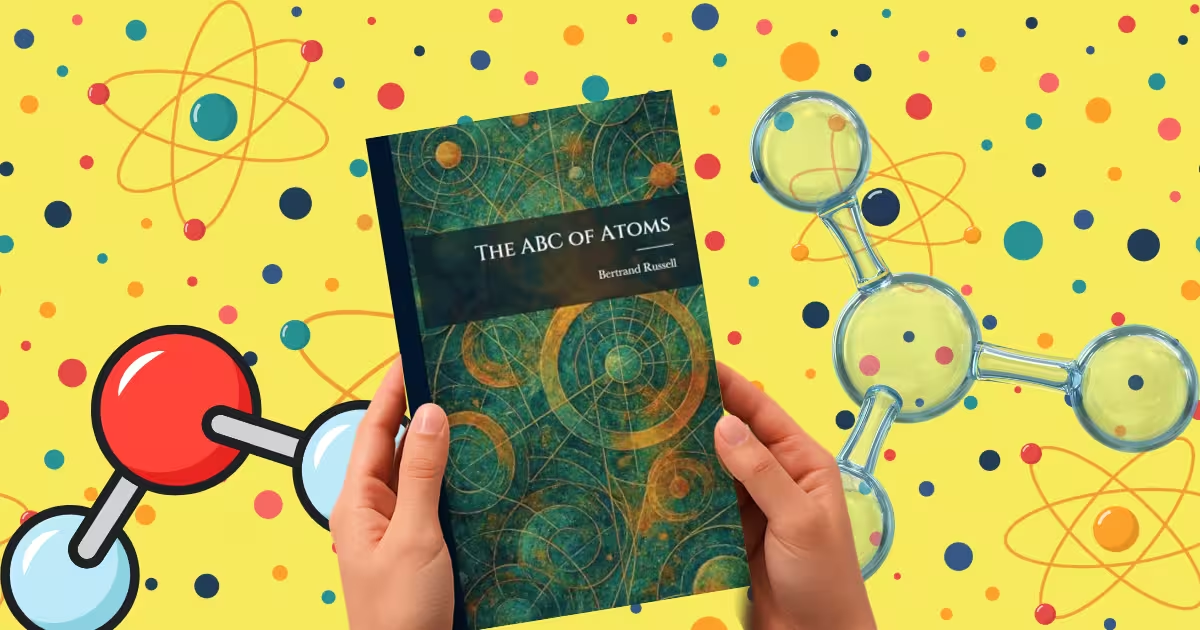
Why would anyone in 2026 sit down with a hundred-year-old physics book built on an atomic model that scientists abandoned within three years of its publication? I asked myself the same question before I opened The ABC of Atoms, and I finished it convinced that Bertrand Russell had written one of the strangest and most quietly important books of his career, a book that got the atom wrong and the future terrifyingly right.
Overview
The ABC of Atoms (1923) is Bertrand Russell’s plain-English guide to the atom exactly as physicists understood it in the early 1920s: a miniature solar system of electrons circling a nucleus, governed by Niels Bohr’s new quantum rules.
Russell was not a physicist. He was a mathematician and philosopher already famous for Principia Mathematica, Mysticism and Logic, and The Analysis of Mind, and he wrote this book the way he wrote almost everything, in clean, unhurried sentences aimed at readers who had never opened a physics textbook.
That alone would make the book a curiosity. What makes it worth reading now is a single paragraph in Chapter I, where Russell predicts, twenty-two years before Hiroshima, that the new physics of the atom would probably end up “making more deadly explosives and projectiles than any yet invented.”
He was not guessing wildly. He was reasoning from the same wartime research he had just finished describing.
That sentence, more than any equation in the appendix, is why this small science book still matters.
Preferred Readers
The ABC of Atoms is best for:
- Readers who want to understand the “old quantum theory,” the Bohr model of the atom, before quantum mechanics replaced it
- Fans of Bertrand Russell who only know his philosophy or his politics and have never read his science writing
- Anyone curious how physicists in the 1920s already sensed that nuclear weapons were coming
- People who enjoy short, plain-English popular science with almost no jargon
- Readers who like tracing how “settled” science quietly becomes history
Not for:
- Anyone who wants a current, textbook-accurate account of atomic structure (this is a time capsule, not a manual)
- Readers hoping to avoid equations entirely (the appendix works through Bohr’s math, though the main chapters do not)
- People expecting Russell’s usual wit, politics, or provocation on every page (this book stays close to the science)
- Absolute beginners with zero chemistry background, since a few chapters assume familiarity with terms like “atomic weight” and “spectroscope”
Table of Contents
Introduction
The ABC of Atoms is a short work of popular science, first published in 1923 by E. P. Dutton & Company in New York, running to roughly 170 pages across thirteen chapters and a mathematical appendix.
The book was written by Bertrand Arthur William Russell (1872 to 1970), then fifty-one years old and already one of the most recognized minds in Britain.
The title page lists his prior works as Mysticism and Logic and The Analysis of Mind, and Russell had also co-written Principia Mathematica with Alfred North Whitehead a decade earlier.
He would not receive the Nobel Prize in Literature until 1950, but by the early 1920s he had already built a career on making difficult ideas legible to ordinary readers, whether the subject was logic, ethics, or, in this case, physics he had not personally researched.
Context
Russell was trained as a mathematician at Cambridge before turning to philosophy, and he had a long-standing interest in the philosophy of physical science, going back at least to Our Knowledge of the External World (1914).
The ABC of Atoms was his first attempt at explaining frontier experimental physics for a general audience, and he would follow it two years later with a companion volume, The ABC of Relativity (1925), applying the same method to Einstein instead of Bohr.
The ABC of Atoms arrived at a genuinely electric moment in physics. X-rays had been discovered by Röntgen in 1895, radioactivity by Becquerel in 1896, and the electron by J. J. Thomson in 1897.
Those three discoveries had unlocked roughly three decades of experimental work by the time Russell sat down to write.
In 1922, the year before this book appeared, Niels Bohr won the Nobel Prize in Physics for the very atomic model Russell spends most of the book explaining, and at the same ceremony Albert Einstein collected his delayed 1921 Prize, awarded not for relativity but for the photoelectric effect.
Weeks before Russell finished his manuscript, researchers at Bohr’s own institute in Copenhagen confirmed a new, 72nd element, which Bohr named hafnium after his home city.
Russell mentions the discovery in Chapter II as news barely a few months old, which gives a real sense of how close to the research frontier this little book was standing.
Purpose
Russell states his purpose directly in the opening chapter: to explain, in language free of mathematics and technical jargon, what was known about the structure of atoms and how that knowledge had been obtained, while being honest about how much remained unknown.
He adds, almost as an aside, that important new discoveries might overturn the picture at any moment. That single admission turned out to be the most accurate sentence in the entire book.
Within two to three years of publication, Werner Heisenberg and Erwin Schrödinger would replace the sharp, planet-like electron orbits Russell describes with a completely different mathematical picture, and within nine years James Chadwick’s discovery of the neutron would quietly retire the nuclear model this book presents as settled science.
Background
To follow The ABC of Atoms, it helps to know what physicists call the “old quantum theory,” the body of ideas that dominated atomic physics from roughly 1913 until 1925. Max Planck had introduced the idea that energy comes in discrete packets, or quanta, in 1900, while studying the radiation given off by heated bodies.
Thirteen years later, in 1913, a young Danish physicist named Niels Bohr, working under Ernest Rutherford, applied Planck’s quantum idea to the hydrogen atom and explained, for the first time, why atoms emit light only at certain sharp, specific frequencies rather than a smooth spread of colour.
Arnold Sommerfeld then extended Bohr’s circular orbits into ellipses to account for finer details in the spectrum.
This Bohr-Sommerfeld framework is what Russell is teaching throughout most of the book, and it is also exactly what quantum mechanics would replace only a couple of years after publication.
TThe ABC of Atoms was also written in the long shadow of the First World War. Russell notes, more than once, that a surprising amount of the research on atomic structure had been carried out during the war years, a detail he found both remarkable and worrying.
And because James Chadwick would not discover the neutron until 1932, the nuclear model Russell describes has to squeeze both hydrogen nuclei and electrons into the nucleus itself to make the arithmetic of atomic weight and atomic number come out right. It was the best available theory in 1923.
It was also, as later chapters of this review will show, one of the book’s clearest blind spots.
The ABC of Atoms Summary
Chapter I: Introductory
Russell opens with a joke about an Irishman’s definition of a net, “a number of holes tied together with pieces of string,” to describe how solid matter is mostly empty space.
From there he builds the whole book’s central image: an atom is a miniature solar system, with a nucleus for a sun and electrons for planets.
A gram of hydrogen, he explains, contains roughly a million million times a million million atoms, and the electron weighs so little that it takes about 1,850 of them to balance the weight of a single hydrogen atom. A hydrogen atom itself measures about a hundred-millionth of a centimetre across.
Russell compares the physicists’ skill at drawing huge conclusions from tiny clues to Sherlock Holmes, and he notes, almost in passing, that a great deal of this research had gone on during the war.
Then comes the line this whole review is built around: he predicts that atomic research will probably end up “making more deadly explosives and projectiles than any yet invented.”
He closes the chapter by describing the strange, jumpy behaviour of electrons, comparing an electron’s motion to a flea that “crawls for a while, and then hops,” a plain image for what physicists would later call quantum discontinuity.
Chapter II: The Periodic Law
Eighty-eight chemical elements were confirmed by early 1923, the most recent addition being hafnium, discovered at Bohr’s institute in Copenhagen that January.
Russell walks through Dmitri Mendeleev’s periodic law, first proposed around 1870, which arranges elements by atomic weight and groups them into seven repeating periods, ending each period with an unreactive “inert gas” such as helium, neon, or argon.
He explains why atomic number (an element’s position in the sequence) matters more than atomic weight (its actual mass), and introduces isotopes, elements that are chemically identical but differ slightly in weight, a puzzle that F. W. Aston’s mass spectrograph work had only recently helped solve.
Chapter III: Electrons and Nuclei
Here Russell lays out the solar-system model in detail, noting that what holds an atom together is electricity, not gravity. He is characteristically blunt about what electricity actually is: not a substance like paint, he says, but simply a name for how certain things behave.
He calculates that in its smallest orbit, a hydrogen electron travels at about one hundred and thirty-fourth the speed of light, covering roughly 2,200 kilometres every second and completing about seven thousand million orbits in a single millionth of a second. “The modern man is supposed to have a passion for rapid motion,” he writes, “but nature far surpasses him in this respect.”
The chapter introduces the idea that electrons in heavier atoms sit in successive rings around the nucleus, with the outermost ring controlling an element’s chemistry.
Chapter IV: The Hydrogen Spectrum
This chapter explains the spectroscope, the instrument that splits light into its component colours the way a prism splits sunlight into a rainbow.
Every element produces its own signature pattern of bright or dark lines, called a spectrum, and those patterns let astronomers work out the chemical make-up of stars they will never visit.
Russell credits Niels Bohr, still working under Rutherford in 1913, with the theory that finally explained why each element’s spectrum looks the way it does.
Chapter V: Possible States of the Hydrogen Atom
Russell describes Bohr’s central idea: an atom emits light only when an electron jumps from a farther orbit to a nearer one, and it absorbs light when an electron is pushed the other way, into a larger orbit. Each spectral line, in this picture, corresponds to one specific jump, and the brightness of a line reflects how common that particular jump is.
This same mechanism, Russell notes, explains fluorescence.
Chapter VI: The Theory of Quanta
This chapter traces Max Planck’s original 1900 quantum hypothesis, developed to explain the radiation given off by hot bodies, and shows how Bohr adapted it to the atom thirteen years later.
Russell introduces Planck’s constant and the more abstract, generalized version of the quantum principle developed by Sommerfeld, built around a technical quantity called “action.”
He keeps the mathematics to a minimum here, saving the full derivation for the appendix.
Chapter VII: Refinements of the Hydrogen Spectrum
Sommerfeld’s contribution takes centre stage: allowing electrons to travel in ellipses rather than perfect circles, which explains three delicate phenomena that circular orbits alone cannot: the Zeeman effect (how a strong magnetic field alters spectral lines), the Stark effect (the equivalent effect from a strong electric field), and “fine structure,” the discovery that a single spectral line, examined closely enough, is actually a tight cluster of several almost identical lines.
Chapter VIII: Rings of Electrons
Once an atom has more than one electron, the mathematics stops being solvable in full. Even helium, with only two electrons, already resists a complete calculation.
Russell describes how physicists came to abandon the early assumption that electrons in one ring all share a single plane, noting Bohr’s suggestion that the eight outer electrons of an inert gas might sit roughly at the corners of a cube.
He is candid that even this picture is likely too simple, and that the arrangement of electrons in complex atoms was, in 1923, still substantially guesswork.
Chapter IX: X-Rays
Wilhelm Röntgen discovered X-rays in 1895, and about a decade later Charles Barkla showed they are transverse waves, like light, just at a vastly higher frequency.
Russell explains why X-rays make such good skeleton photographs: a material’s ability to block X-rays rises roughly with the fourth power of its atomic number, so calcium, the main component of bone, stops X-rays about 160,000 times more effectively than hydrogen, and lead is about 45 million times more effective.
That is also why a bullet lodged in the body, or a swallowed object, shows up so clearly on an X-ray plate.
He then describes the K, L, and M line families of X-ray spectra and how they progress with almost mechanical regularity as atomic number increases, regardless of how differently elements behave chemically.
Chapter X: Radio-Activity
This is The ABC of Atoms‘ most narratively vivid chapter. Henri Becquerel stumbled onto radioactivity by accident, when a photographic plate stored with a piece of uranium in a dark drawer turned out to be exposed anyway.
Marie and Pierre Curie then noticed that pitchblende, the ore uranium is extracted from, was more radioactive than pure uranium itself, a clue that led them to isolate radium.
Russell introduces the concept of half-life, the time it takes for half of a radioactive sample to decay, giving uranium’s half-life as 4,500 million years and radium’s as 1,580 years, figures strikingly close to the modern accepted values of roughly 4.47 billion years and 1,600 years.
He explains the three kinds of radioactive emission: alpha rays (helium nuclei), beta rays (electrons), and gamma rays (light-like waves at extremely high frequency), and describes how one element transmutes into another during decay, something medieval alchemists spent centuries failing to achieve on purpose.
The chapter closes on one of Russell’s most memorable images: a universe that resembles “a clock running down, with no mechanism for winding it up again.”
Chapter XI: The Structure of Nuclei
Russell turns to Ernest Rutherford’s experiments bombarding nitrogen atoms with alpha particles, which knocked loose hydrogen nuclei and offered the first artificial evidence that atoms other than radioactive ones could be broken apart.
Because most atomic weights are close to whole-number multiples of hydrogen’s weight, Russell concludes that nuclei are built from a packed combination of helium nuclei, hydrogen nuclei, and electrons.
He describes the nucleus of Radium C, with a radius of about three million-millionths of a centimetre, as containing 58 helium nuclei, 2 hydrogen nuclei, and 131 electrons, all crushed into a space so tight that he calls the overcrowding “something fearful,” adding dryly that it is no wonder these particles move so fast once radioactivity sets them free.
Chapter XII: The New Physics and the Wave Theory of Light
Russell introduces “action,” a technical quantity combining energy and time, as more fundamental to the new physics than energy alone.
He then walks straight into one of the book’s most honest moments: the apparent contradiction between light’s proven wave behaviour, demonstrated through interference and diffraction, and the quantum theory’s insistence that light also travels in discrete packets.
Quoting the physicist James Jeans, he describes an experiment in which diffraction patterns held their shape even when the light was reduced to roughly one quantum per 10,000 cubic centimetres, a result that should have been impossible if light truly travelled as separate particles.
Russell admits plainly that reconciling these two pictures was, in 1923, simply beyond anyone’s reach.
Chapter XIII: The New Physics and Relativity
The final chapter connects the quantum theory to Einstein’s relativity through the shared concept of “action,” leaning on the astronomer Arthur Eddington for some of the more speculative connections, including a playful suggestion tying the size of an electron to the overall curvature of the universe.
Russell ends The ABC of Atoms, and the whole argument, without a firm answer.
He raises the question of whether the universe is fundamentally “rational,” meaning suited to human habits of thought, or “irrational,” and then states plainly that he does not intend to answer it.
It is a deliberately open, agnostic close, and a very characteristic one for a philosopher who spent his career more comfortable identifying good questions than manufacturing false certainty.
Appendix: Bohr’s Theory of the Hydrogen Spectrum
For readers who want the mathematics behind everything the main chapters describe in words, Russell works through Bohr’s original derivation step by step, using nothing beyond elementary dynamics, and arrives at the same formula for hydrogen’s spectral lines that had already been confirmed by observation.
He calls the numerical agreement between theory and experiment “perhaps the most sensational evidence in favour of Bohr’s theory when it was first published,” and it is easy to see why: a page of algebra, done from first principles, reproduces a pattern of light that had puzzled physicists for decades.
The ABC of Atoms Analysis
Evaluation of Content
Russell supports almost every claim in The ABC of Atoms by naming the specific person and experiment behind it: Rutherford’s bombardment work, Bohr’s 1913 theory, Sommerfeld’s refinements, Aston’s isotope research, the Curies’ radium, Eddington’s relativity commentary.
That habit of attribution is one of the book’s quiet strengths, and it is also what makes the book unusually easy to fact-check a century later.
Judged against its own stated purpose, to explain atomic structure in plain language without mathematics, the book succeeds almost completely for the main text and mostly succeeds in the appendix, where Russell’s idea of “simple” mathematics will still challenge readers with no algebra background.
What Russell Got Right
Several of the book’s specific numbers hold up remarkably well. His figures for uranium’s half-life (4,500 million years, against a modern value of roughly 4.47 billion) and radium’s half-life (1,580 years, against a modern value of roughly 1,600) are close enough to be genuinely impressive for 1923 measurement techniques. His explanation of why X-rays photograph bones so clearly, tied to atomic number, is still exactly correct today.
He also grasped something more conceptually important: that the periodic table’s true organizing principle is atomic number, not atomic weight, and that the sudden, discontinuous “jumps” inside atoms represented a genuinely new category of physical law rather than classical mechanics wearing a disguise.
But the passage that matters most is the one about weapons. Russell’s 1923 warning that atomic research would likely produce explosives “more deadly… than any yet invented” arrived twenty-two years before the bombs fell on Hiroshima and Nagasaki.
It was not an isolated aside either. Russell spent much of his later life acting on that same worry, co-signing the Russell-Einstein Manifesto in 1955, serving as the first president of the Campaign for Nuclear Disarmament from 1957 to 1958, and spending a week in prison in 1961 for an anti-nuclear demonstration outside Britain’s Ministry of Defence.
The physicist-turned-philosopher who wrote this quiet little science book in 1923 became one of the loudest voices arguing against the weapon it had predicted.
What Russell Got Wrong
The ABC of Atoms‘ central weakness is also its most interesting feature in hindsight: the atomic model itself.
Because James Chadwick would not discover the neutron until 1932, Russell has to describe atomic nuclei as containing both hydrogen nuclei and stray electrons crammed together, an arithmetic patch that made the numbers work but that turned out to be simply false.
The neutron, not embedded electrons, supplies the missing nuclear mass, and Chadwick’s discovery quietly retired the entire picture Russell spends Chapter XI defending.
The larger model fares no better.
The sharp, planet-like electron orbits that anchor almost every chapter, Bohr’s circles and Sommerfeld’s ellipses alike, were replaced within two to three years of this book’s publication by Werner Heisenberg’s matrix mechanics (1925) and Erwin Schrödinger’s wave mechanics (1926), where electrons are described by probability clouds rather than fixed paths.
Russell’s count of eighty-eight or eighty-nine known elements also looks modest next to the 118 recognized today, most of them created artificially in laboratories that did not exist in 1923. None of this is really a criticism of Russell as a writer.
It is simply what happens to any book that tries to describe the very edge of a fast-moving science, and Russell said as much himself, on the very first page.
Strengths and Weaknesses
Strengths
The analogies still work a century later: the Irishman’s net, the family locked in a perpetual quarrel inside the nucleus, the flickering cinema standing in for quantum jumps, uranium’s ninety-two electrons compared to “the Grand Turk” and his consorts
The ABC of Atoms is short, well under 200 pages, yet manages to cover the entire old quantum picture of the atom from first principles to relativity
Russell is unusually honest about uncertainty throughout, repeatedly flagging speculation as speculation rather than presenting the Bohr model as settled fact
Read today, it functions almost like a laboratory notebook from the exact week before an entire scientific field changed underneath it
Weaknesses
The physics is, in the specifics, simply outdated, and the book cannot substitute for a modern textbook or a contemporary popular-science title on the same subject
The appendix’s mathematics, however elementary Russell insists it is, will still stop many general readers who came looking for a jargon-free read
A handful of chapters assume a reader already comfortable with terms like “atomic weight” and “spectroscope,” so total beginners may occasionally feel lost
Russell’s usual wit and political voice rarely surface here; readers coming from his philosophy or his essays looking for personality may find long stretches drier than expected
Comparison with Similar Works
Russell revisited this same project two years later in The ABC of Relativity (1925), applying the identical plain-English method to Einstein instead of Bohr, and the two books read almost like a matched pair.
That companion volume is not yet covered on this site, but it belongs on the shelf right next to this one.
His own later book, The Impact of Science on Society (1953), returns to the same anxiety about scientific power outrunning human wisdom, except written thirty years later, after the bomb Russell had only predicted in 1923 had already been used twice.
Bertrand Russell’s Fact and Fiction (1961) shows the same clear-headed, skeptical voice applied to culture broadly rather than to physics specifically, and is a useful next step for readers who want more of Russell’s personality than The ABC of Atoms offers.
Bill Bryson’s A Short History of Nearly Everything (2003) covers much of the same Rutherford-Bohr-electron history for a modern audience, with eighty extra years of hindsight that Russell simply did not have available to him.
H. G. Wells’s The Fate of Man (1939) offers a similar case of a scientifically literate writer sensing catastrophe years ahead of it arriving, published sixteen years after Russell’s book and prefiguring the Second World War the way Russell’s book prefigured the bomb.
Readers who want the fuller list of essential philosophy, including Russell’s other major works, may also want the Top 20 Philosophy Books roundup, and everything else on Russell already reviewed on this site is collected under the Bertrand Russell tag.
Conclusion: Should You Read The ABC of Atoms?
Yes, with the right expectations. The ABC of Atoms is not the book to hand someone who wants an accurate modern account of atomic physics, and it should not be judged as one.
It is, instead, a remarkably clear window into how the smartest people alive in 1923 understood the smallest building blocks of matter, written by a philosopher who had no formal training in the subject and who managed, almost as an afterthought, to predict the defining weapon of the twentieth century before a single gram of uranium had ever been enriched for that purpose.
I would recommend it to students of the history of science, to Russell readers who have only encountered his philosophy or his politics, and to anyone who wants to understand exactly how much of what we call “settled science” is really just the best available answer at a given moment.
I would not recommend it as anyone’s only book on atomic physics, or on Bertrand Russell.
Read alongside his later, angrier warnings about science and society, this short, careful, occasionally wrong little book reads less like an outdated textbook and more like the opening chapter of a much longer and more personal argument Russell would spend the rest of his life making.







