
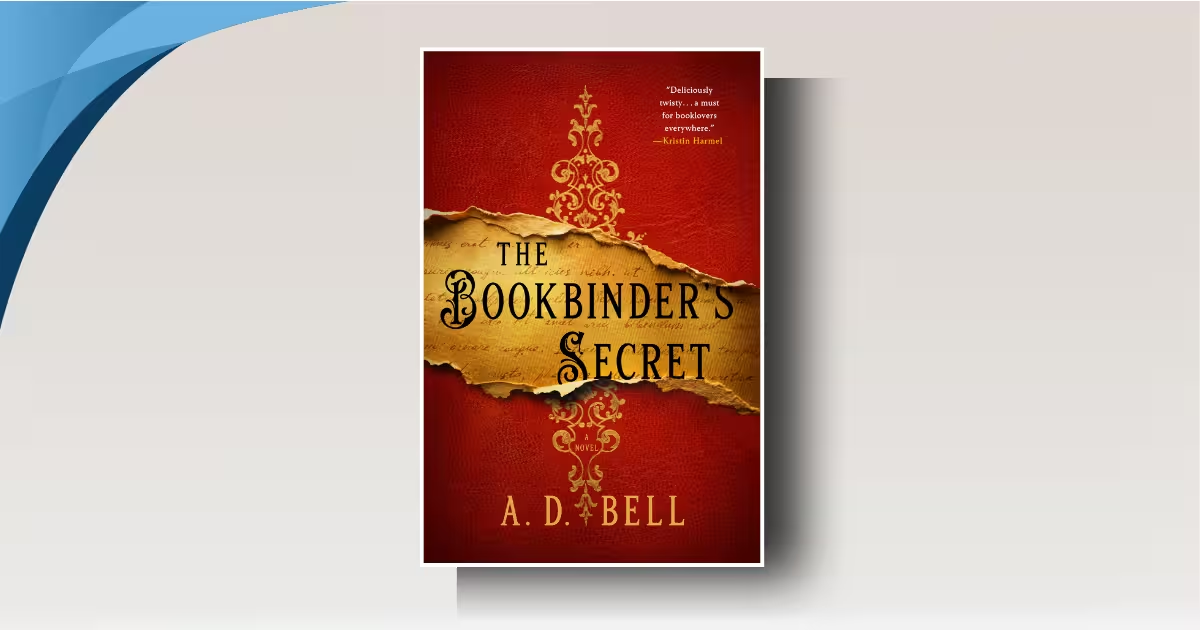
Have you ever felt the whisper of a secret hidden in plain sight—tucked between the pages of an old book? The Bookbinder’s Secret by A.D. Bell isn’t just a historical mystery; it’s an immersive journey into the hidden world of books and the dangerous truths they can hold.
A young female bookbinder in Edwardian England uncovers a series of coded love letters concealed inside cheap romance novels, plunging her into a dangerous mystery involving theft, violence, and a decades-old scandal that someone is desperate to keep buried.
*The Bookbinder’s Secret is best for lovers of historical fiction, bibliomysteries, and strong female protagonists; readers who enjoy atmospheric settings and slow-burn suspense. But not for those seeking fast-paced action or lighthearted romance; readers uncomfortable with themes of familial neglect and financial despair.
Table of Contents
1. Introduction
The Bookbinder’s Secret is a 2026 historical mystery novel by A.D. Bell, published by HQ (HarperCollins). Set in 1901, the story pulls readers into the secretive, tactile world of bookbinding through the eyes of a young apprentice whose discovery of a hidden letter in a burned novel unravels a decades-old scandal.
2. Background
The novel is steeped in the world of Edwardian bookbinding—a time when the trade was highly gendered, and women like the real-life Sarah Prideaux were breaking into the field. The Guild of Women Binders, referenced in the story, was founded in 1898, offering a rare professional avenue for women.
This historical context grounds Lilian’s struggle for recognition and economic independence, mirroring real social constraints of the era.
3. Summary of the Book
The Bookbinder’s Secret follows Lilian Delaney, a 25-year-old bookbinder apprenticed to the aging but kind Mr. Caxton in Oxford. Living above her father’s struggling bookshop, Lilian’s world is one of leather, glue, and quiet ambition. Her life shifts when a prominent collector, Dr. Ashburn, commissions her to rebind a botanical book.
During the visit, he gives her a badly burned novel—A Song for a Knave by Abel Bell—that he considers worthless.
Back in Oxford, Lilian discovers a fragment of a letter hidden beneath the book’s endpaper: “I wish you had not killed him.” Intrigued, she carefully dismantles the binding and finds more pages—a desperate love letter from a woman signing as “Your Queen” to her “Knave.” The letter hints at a hidden pregnancy, family violence, and a murder.
Lilian’s curiosity pulls her into a deepening mystery. She learns the book came from a London bookseller, Edmund Grieves, who warns her the books are “dangerous.”
After being attacked by a man in a bowler hat who steals the letter, Lilian connects with Grieves’ assistant, Charlie Cutter, who helps her locate two more Abel Bell novels: He Sings His Devotion and Orpheus in the Tower.
Each contains additional hidden pages—a fragmented confession from the “Queen,” revealing her identity as the daughter of a powerful lord, her love for William Heathfield, her forced engagement, her pregnancy, and her father’s violent threats.
Meanwhile, Lilian’s personal life frays. Her father is hiding a £2,000 debt and plans to sell their home. Her childhood love, Harry, reenters her life, but she’s drawn to the charming Charlie. The bowler-hatted man invades her home, threatening her unless she hands over all the books. Lilian realizes a wealthy, anonymous collector is hunting these novels to destroy the scandalous truth they contain.
In the climax, Lilian pieces together the story: the “Queen” was Lady Helena Penrose, daughter of Lord Silas Penrose. After her father beat William and threatened to kill him, Helena was forced to marry Lord Beauchamp while carrying William’s child.
The final hidden pages suggest Lord Penrose may have killed Beauchamp—or arranged his death—to protect the family line, with William wrongfully blamed. The confession was hidden in cheap novels, bound by a binder with the initials FFG, to await discovery.
Lilian confronts the truth that the collector is likely a Penrose descendant, trying to erase the past. She decides to protect the story, hiding the pages and refusing to surrender the books. The novel ends with her taking control of her future—professionally, by accepting Mr. Caxton’s offer to inherit his bindery, and personally, by choosing honesty with Harry.
4. The Bookbinder’s Secret analysis
4.1. The Bookbinder’s Secret Characters
Lilian Delaney is a compelling protagonist—book-smart, observant, and resilient, yet flawed in her single-minded obsession. Her development from a “dog with a bone” apprentice to a woman making bold moral choices is the heart of the story.
As she reflects: “Books will outlast us all and I was content to be but a footnote in their lives” (Page 40). Her relationships—with her emotionally distant father, mentor-like Mr. Caxton, steady Harry, and roguish Charlie—reveal her conflicts between duty, passion, and ambition.
Mr. Caxton serves as Lilian’s professional and ethical anchor. His gentle humor (“You have bound the book upside down, Miss Delaney” – Page 12) masks deep wisdom. He represents the old world of craftsmanship, contrasting with the exploitative Frank Karslake of the Guild of Women Binders, who runs a “factory line of bindings” (Page 90) devoid of artistry.
The “Queen” (Helena) and William Heathfield are vividly rendered through the hidden pages. Helena’s voice is achingly real: “I am glad he is gone. This story is the truth… It will set us both free” (Page 34). Their tragic love story underscores themes of female powerlessness and the violence of patriarchal control.
4.2. The Bookbinder’s Secret Themes and Symbolism
Books as Keepers of Truth: The novel’s central symbol is the book itself—a vessel for hidden histories. As Lilian notes, “A book is a many-layered thing and we see but a fraction of its depth” (Page 41). The cheap Abel Bell novels become safes for a dangerous truth, contrasting with the ornate, expensive bindings that often house less meaningful content.
Female Agency in a Male-Dominated World: Lilian’s fight for professional recognition mirrors Helena’s struggle for personal autonomy. Both are constrained by fathers and societal expectations. The Guild of Women Binders, while progressive, is shown to exploit women’s labor, highlighting the complexity of female advancement.
The Weight of Debt: Financial peril haunts both Lilian and her father. Debt is literal but also metaphorical—the debt of the past, the secrets owed to the dead. Lilian’s father confesses, “It’s my mess” (Page 131), symbolizing a generation’s failure to adapt.
Destruction vs. Preservation: The burned book represents attempts to erase history; Lilian’s restoration work is an act of resistance. The bowler-hatted man wants to destroy the books, but Lilian decides they must be preserved: “You can’t have them. I won’t let them go”.
5. Evaluation
The Bookbinder’s Secret is a richly textured and intelligent novel that lingers like the scent of old paper and leather. It is both a love letter to bookmaking and a gripping mystery about who gets to control the narrative of the past.
Strengths
- Atmospheric Detail: Descriptions of bookbinding are tactile and immersive. You can feel the “raised bands of dark blue morocco” (Page 11) and smell the “earthy, sometimes sweet scent of calf’s leather” (Page 16).
- Complex Protagonist: Lilian is neither purely heroic nor naive. Her moral compromises—lying to her father, stealing a book—make her relatable.
- Pacing: The slow unraveling of the mystery mirrors the careful work of book restoration, building suspense organically.
Weaknesses
- Underdeveloped Romance: The love triangle between Lilian, Harry, and Charlie feels secondary and slightly rushed, particularly the entanglement with Charlie.
- Predictable Villain: The anonymous collector’s identity, while thematically fitting, lacks a surprising reveal.
Impact
The novel resonated deeply with its portrayal of a woman using her specialized knowledge to uncover injustice. It’s a powerful reminder that history is often hidden in the margins.
Comparison with Similar Works:
Fans of Jessie Burton’s The Miniaturist (for historical female craftsmanship) or M.L. Rio’s If We Were Villains (for academic atmosphere and hidden secrets) will find much to enjoy. Its bibliocentric mystery also calls to mind Carlos Ruiz Zafón’s The Shadow of the Wind, though it is more intimate in scope.
6. Personal Insight with Contemporary Relevance:
One of the novel’s most pressing themes is the weaponization of historical erasure. In an age where book bans and historical revisionism are rising globally (see PEN America’s 2023 report on school book bans), Lilian’s fight to preserve a censored story feels urgently contemporary.
The novel argues that preserving uncomfortable truths is an act of moral courage. Just as individuals today work to archive suppressed histories—from marginalized voices to contested events—Lilian understands that to destroy a book is to attempt to kill a truth. In a digital age, the physicality of the book as an artifact of evidence becomes even more potent.
The lesson is clear: those who control the narrative control power, and resistance often begins with a single person refusing to let a story be burned.
7. The Bookbinder’s Secret quotes
- “What danger could lie within a book?” (Page 1)
- “Books endure, my father would say. They endure, as we do not.” (Page 13)
- “Doubt has no place here. You cannot be tentative when gluing leather to board, it must be a firm, confident motion, as must life.” (Page 19)
- “I was a small part of this book’s story, and the stories of every book I’d worked on, and that gave me an invisible immortality.” (Page 40)
- “Books are a poor substitute for love, my dear… Books don’t break your heart… Of course they do.” (Page 68)
8. Conclusion
The Bookbinder’s Secret is a masterful blend of historical detail and suspenseful mystery. It celebrates the beauty of books as objects while never losing sight of the human stories they carry. A.D. Bell has crafted a novel that is as much about the preservation of truth as it is about the art of binding it.
Recommendation: Highly recommended for readers who savor slow-burn historical fiction, appreciate richly researched settings, and enjoy watching a clever protagonist piece together a puzzle from the past. It’s a novel that will particularly satisfy those who believe that stories—and the books that hold them—are things worth fighting for.
Final Reflection: This book is significant because it understands that obsession—with books, with the past, with truth—is not a flaw but a form of devotion.
In preserving Helena’s secret, Lilian ultimately discovers her own voice and agency, proving that sometimes the most powerful stories are the ones we choose to save.







