
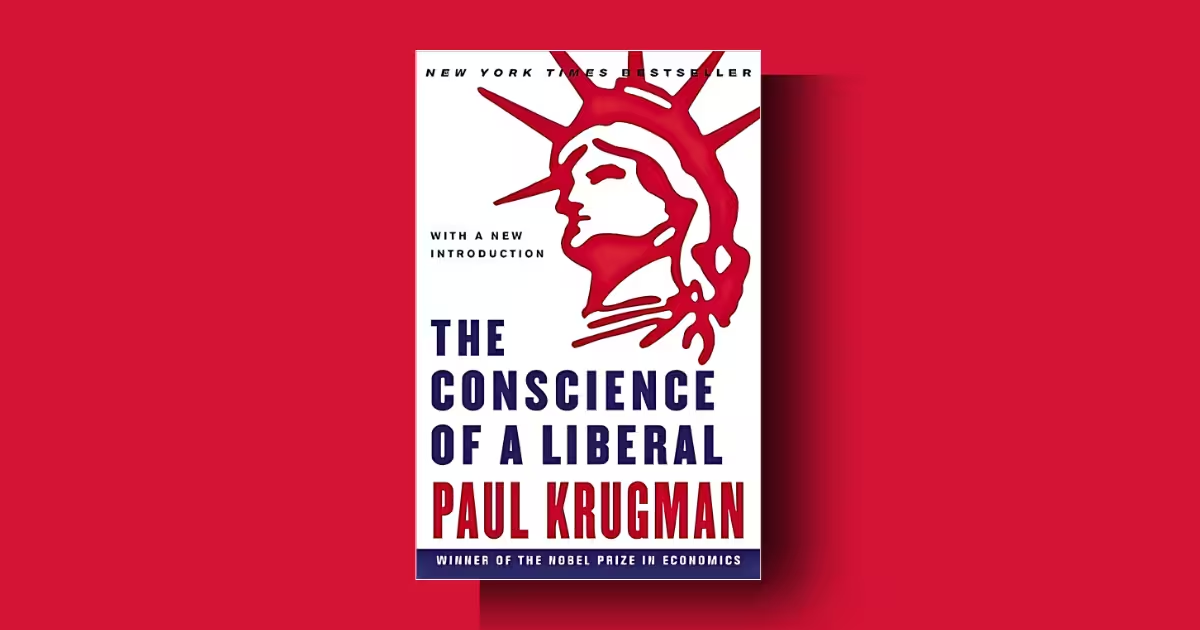
Do you ever wonder why the American Dream feels increasingly out of reach for so many people, even as the country grows richer than ever? The Conscience of a Liberal will show you how a deliberate political movement systematically dismantled the middle-class society your parents and grandparents took for granted, and why it’s not too late to build it back.
1. Overview
Paul Krugman’s The Conscience of a Liberal is a 2007 sweeping political and economic history of the United States from the Gilded Age to the George W. Bush era.
The Nobel Prize-winning economist and New York Times columnist argues that the middle-class America of the postwar years wasn’t a natural evolution of the free market; it was deliberately created by the policies of Franklin D. Roosevelt and the New Deal.
And it was just as deliberately torn down by a radical movement that took over the Republican Party starting in the 1970s.
The book’s title deliberately echoes Barry Goldwater’s 1960 manifesto The Conscience of a Conservative, flipping the script to offer a progressive vision for America’s future.
Krugman documents two parallel arcs in American history: an economic arc from high inequality to relative equality and back again, and a political arc from extreme polarization to bipartisanship and back again.
What you’ll learn from this book:
- Why income inequality today matches the levels of the 1920s
- How the “Great Compression” of the 1940s created America’s middle class almost overnight
- Why race has been the single most important factor in the success of movement conservatism
- How a network of think tanks, foundations, and media organizations (the “vast right-wing conspiracy”) took control of the Republican Party
- What a “new New Deal” would look like and why universal health care must be its centerpiece
Reader recommendation: If you’ve ever felt frustrated by the direction of American politics, confused about why so many people vote against their own economic interests, or simply want to understand how we got from the postwar prosperity to today’s inequality, this book will give you the answers.
It’s written for general readers, not academics, and Krugman’s accessible style makes complex economic and political history digestible.
But if you’re a movement conservative looking for validation, you’ll bounce off this book hard, Krugman pulls no punches in his critique.
Table of Contents
2. Introduction
Title: The Conscience of a Liberal
Author: Paul Krugman
Publication: W. W. Norton & Company, October 1, 2007
Pages: 296
Awards: New York Times bestseller, reaching #24 on the list in November 2007
Context
The Conscience of a Liberal is a work of political economy and American political history. Paul Krugman is a Nobel laureate in Economics (2008), a professor at Princeton University, and a longtime op-ed columnist for the New York Times. He’s one of the most widely read economists in the world, known for his ability to explain complex economic ideas in plain English.
The book was published at a pivotal moment in American politics. George W. Bush had just won re-election in 2004, and movement conservatives seemed ascendant. Many commentators were declaring the death of liberalism and the birth of a permanent Republican majority.
Krugman wrote this book to challenge that narrative and offer a roadmap for progressives to reclaim the country’s future.
Purpose
The book’s central thesis is that America’s postwar middle-class society was not the natural product of economic development but a political creation, and it can be recreated through political action.
Krugman argues that the New Deal policies of the 1930s and 1940s, progressive taxation, strong unions, Social Security, and wage controls during World War II, dramatically compressed income inequality and created a broad middle class.
But starting in the 1970s, a radical movement known as “movement conservatism” took over the Republican Party and systematically dismantled these institutions, leading to the return of Gilded Age levels of inequality.
3. Background
To understand Krugman’s argument, you need to understand what he calls the “Long Gilded Age”, the period from the end of Reconstruction in the 1870s to the Great Depression.
This was an era of extreme economic inequality, where a tiny elite controlled vast wealth while most Americans lived in grinding poverty. As Krugman points out, in the 1920s the richest 1 percent of Americans received about 24 percent of all income, comparable to today’s levels.
What’s remarkable is that this inequality persisted even as the Progressive Era brought some reforms (the income tax, the Food and Drug Administration). The rich remained rich, and the poor remained poor. Krugman uses this to make a crucial point: middle-class societies don’t emerge automatically as an economy matures. They have to be created through political action.
The Great Depression changed everything. It discredited the old elite and its ideology, creating the political space for Franklin D. Roosevelt’s New Deal.
FDR’s policies, raising taxes on the wealthy, strengthening unions, creating Social Security and unemployment insurance, didn’t just provide a safety net.
They actually reduced the after-tax incomes of the wealthiest Americans by nearly 50 percent in absolute terms between the 1920s and the 1950s. Meanwhile, the income of the median American family almost doubled.
4. The Conscience of a Liberal Summary: What I Learned
The Great Compression: How America Became Middle-Class
The most surprising thing I learned from this book is that the creation of America’s middle class happened almost overnight. Krugman draws on the work of economic historians Claudia Goldin and Robert Margo, who dubbed this transformation the “Great Compression”.
During World War II, the government imposed wage controls that deliberately compressed wages, raising the pay of low-wage workers while limiting increases for the highly paid. You might expect that once the controls were lifted, inequality would spring back. But it didn’t. The relatively equal income distribution persisted for more than thirty years.
Why? Because the New Deal had created institutions and norms that sustained equality: powerful unions, progressive taxation, Social Security, and a political consensus that extreme inequality was unacceptable. As Krugman writes, the postwar era was “a golden age of economic equality” that corresponded to a “golden age of political bipartisanship”.
I found it fascinating that even Dwight Eisenhower, the Republican president, accepted the New Deal as permanent. In a 1954 letter to his brother, Eisenhower wrote: “Should any political party attempt to abolish social security, unemployment insurance, and eliminate labor laws and farm programs, you would not hear of that party again in our political history”.
He dismissed those who wanted to roll back the New Deal as a “tiny splinter group” whose “number is negligible and they are stupid”.
The Rise of Movement Conservatism
So how did that “tiny splinter group” take over the Republican Party? Krugman traces the movement back to the founding of the National Review in 1955 by William F. Buckley. Early issues of the magazine defended the right of Southern whites to disenfranchise blacks and praised Generalissimo Francisco Franco, who overthrew Spain’s democratically elected government, as “an authentic national hero”.
But movement conservatism remained a fringe movement until Ronald Reagan showed how to win elections. Reagan’s genius was to take the elitist economic agenda of the conservative movement and dress it in populist rhetoric.
He appealed to white backlash against the civil rights movement, played on fears of communism, and used “welfare queen” stories to tap into racial resentment without ever saying anything overtly racist.
Krugman argues that race is at the heart of the story. The legacy of slavery and the backlash against civil rights are the main reasons the United States is the only advanced country where a major political party wants to roll back the welfare state. As Lyndon Johnson predicted after signing the Civil Rights Act in 1964: “I think we’ve just delivered the South to the Republican Party for the rest of my life, and yours”.
The Vast Right-Wing Conspiracy
One of the most eye-opening sections of the book is Krugman’s description of the institutional infrastructure of movement conservatism. He argues that there really is a “vast right-wing conspiracy”, an interlocking network of think tanks, foundations, media organizations, and lobbying groups that reward loyalists and punish dissenters.
The American Enterprise Institute expanded dramatically in 1971 with corporate money.
The Heritage Foundation was created in 1973 with cash from Joseph Coors and Richard Mellon Scaife. The Cato Institute relied heavily on funds from the Koch family foundations. These think tanks produce a steady stream of studies that support conservative positions, providing “intellectual” cover for policies that benefit the wealthy.
What’s remarkable is how this system enforces loyalty.
Bruce Bartlett, a conservative economist who worked in the Reagan administration, was fired from his think tank position after writing a book critical of George W. Bush. Rick Santorum, a hard-line conservative who lost his Senate seat in 2006, immediately landed a job at a conservative think tank.
Lincoln Chafee, a moderate Republican who lost the same year, had to settle for a one-year teaching appointment.
The Great Divergence: How Inequality Returned
Krugman documents the return of inequality since the 1970s with devastating clarity. The top 1 percent of Americans now receive about the same share of national income as they did in the 1920s. The top 0.01 percent is seven times richer than they were in 1973.
But here’s the crucial point: this wasn’t the result of impersonal market forces like technology and globalization. It was the result of deliberate political choices.
Krugman marshals several pieces of evidence:
- The timing doesn’t work. The rightward shift of the Republican Party began in the mid-1970s, before inequality started rising.
- The rise in inequality is concentrated at the very top, among CEOs and other highly compensated executives, not among the broadly educated.
- The U.S. experience is unique among advanced countries. Canada, France, Germany, and Japan haven’t seen the same surge in inequality.
The collapse of unions is a key part of the story. In 1960, the U.S. and Canada had essentially equal rates of unionization, around 30 percent. By 1999, U.S. unionization had fallen to 13 percent, while Canadian unionization was unchanged. The difference was politics: America’s political climate turned favorable to union-busting, while Canada’s didn’t.
The New Politics of Equality
Despite the grim picture, Krugman is optimistic. He argues that movement conservatism’s moment has passed. The Iraq War debacle has discredited Republicans on national security. America is becoming less white, reducing the effectiveness of racial appeals. And the public is increasingly aware that the economy isn’t working for most people.
Krugman calls for a “new New Deal” centered on universal health care. Every other advanced country already guarantees health care to its citizens. The United States spends twice as much per person on health care as Canada, France, or Germany, but leaves 45 million people uninsured. A universal system would be cheaper, better, and more just.
Beyond health care, Krugman advocates for:
- Restoring progressive taxation (letting the Bush tax cuts expire, closing loopholes)
- Strengthening unions through the Employee Free Choice Act
- Raising the minimum wage
- Expanding the social safety net
5. The Conscience of a Liberal Analysis
The Conscience of a Liberal is a compelling, provocative, and urgently necessary book. Krugman’s ability to distill complex economic history into accessible prose is remarkable. He writes with the clarity of a teacher who actually wants to be understood, not the obscurity of an academic showing off.
What I appreciated most is Krugman’s honesty about his own evolution.
He admits that he began working on the book believing that rising inequality caused political polarization, that impersonal economic forces enriched the elite, who then used their wealth to buy political influence. But the evidence convinced him that causation runs the other way: political change drove economic change.
The rightward shift of the Republican Party enabled the rise in inequality, not the other way around.
This is a genuinely important insight. It means inequality is not inevitable. It can be reversed through political action.
However, I have some reservations. Krugman’s partisan framing can sometimes be overwhelming. Every problem is laid at the feet of movement conservatives, and every solution comes from liberals. There’s little acknowledgment that Democrats have their own failings or that some conservative critiques of government programs have merit.
I also found the book’s treatment of the Clinton years somewhat unsatisfying. Krugman criticizes Clinton for not having a well-defined agenda and for mishandling health care reform, but he doesn’t fully grapple with the deeper reasons why Democrats have struggled to articulate a coherent vision.
This is partly addressed in the final chapter, but I wanted more.
6. Strengths and Weaknesses
Strengths
Exceptional use of data. Krugman backs up every argument with hard numbers. The tables showing the concentration of income among the top 1 percent, the decline in union membership, and the rise in CEO pay are devastating.
Clarifies a confusing era. The book does an excellent job of making sense of the last fifty years of American political history in a way that elections and editorial pages often fail to do.
Accessible to general readers. Despite being written by a Nobel laureate economist, the book doesn’t require any background in economics.
Honest about race. Krugman doesn’t shy away from the uncomfortable truth that racial resentment has been central to the success of movement conservatism.
Offers hope. This isn’t a cynical book. Krugman argues persuasively that movement conservatism has reached its high-water mark and that a progressive resurgence is possible.
Weaknesses
Partisan to a fault. Critics have described the book as a “preachy, underdeveloped diatribe” and “crude propaganda for a ‘soak-the-rich’ policy”. While I think these criticisms are overblown, Krugman’s one-sidedness can be grating.
Thin on economic theory. Given that Krugman is an economist, some readers were disappointed that the book contains almost no economic theory. This is a political history, not an economics textbook.
Underestimates Democratic failures. Krugman criticizes Clinton but doesn’t fully grapple with why Democrats have so often failed to articulate a compelling alternative vision.
Dated in places. The book was published in 2007 and doesn’t address the Obama presidency, the rise of Trump, or the COVID-19 pandemic. The core analysis remains relevant, but some of the policy prescriptions need updating.
7. Comparison with Similar Works
If you’re interested in the themes of The Conscience of a Liberal, here are other books worth reading:
Thomas Frank, What’s the Matter with Kansas? (2004), like Krugman, Frank explores why working-class voters support conservative politicians who don’t serve their economic interests. Frank emphasizes cultural issues and the “trick” of distracting voters from economics. Krugman is more systematic and data-driven.
Joseph Stiglitz, The Price of Inequality (2012), another Nobel Prize-winning economist makes the case that inequality is not just unfair but economically inefficient and politically destructive. Stiglitz is more focused on the mechanics of how the wealthy rig the system.
Jacob Hacker and Paul Pierson, Winner-Take-All Politics (2010), this book makes a similar argument to Krugman’s but with more focus on the specific policy changes (tax cuts, financial deregulation, union-busting) that drove inequality.
Noam Chomsky, Requiem for the American Dream (2017), Chomsky offers a more radical critique of inequality and the concentration of wealth and power.
Robert Frank, Richistan (2007), a journalistic account of the lives of the new super-rich that complements Krugman’s economic analysis.
8. Conclusion
Who Should Read This Book?
The Conscience of a Liberal is essential reading for:
- Anyone who wants to understand how America went from the postwar middle-class society to today’s Gilded Age inequality
- Progressives looking for a coherent intellectual framework and policy agenda
- Students of American political history
- Anyone frustrated with the state of American politics who wants to understand how we got here
- Voters who want to make informed decisions about economic policy
Who Should Skip It?
- Movement conservatives looking for a fair-minded treatment of their ideology; this book is not that
- Readers who want a neutral, “both sides” analysis of American politics
- Anyone looking for deep economic theory
The Conscience of a Liberal is an important, thought-provoking, and ultimately hopeful book. Krugman makes a powerful case that the middle-class America of the postwar years wasn’t an accident, it was a political achievement. And if it was achieved once, it can be achieved again.
The book’s subtitle could have been “How We Got Here and How We Get Back.” Krugman provides both a diagnosis and a prescription.
The diagnosis is damning: a radical movement used race, fear, and money to dismantle the institutions that created the American middle class.
But the prescription is optimistic: universal health care, progressive taxation, strong unions, and a revived commitment to the idea that government can be a force for good.
I came away from this book with a clearer understanding of American politics and a renewed sense that change is possible.
As Krugman writes in his final chapter, “Liberals want to restore the middle-class society I grew up in; those who call themselves conservative want to take us back to the Gilded Age.” The choice is ours.







