
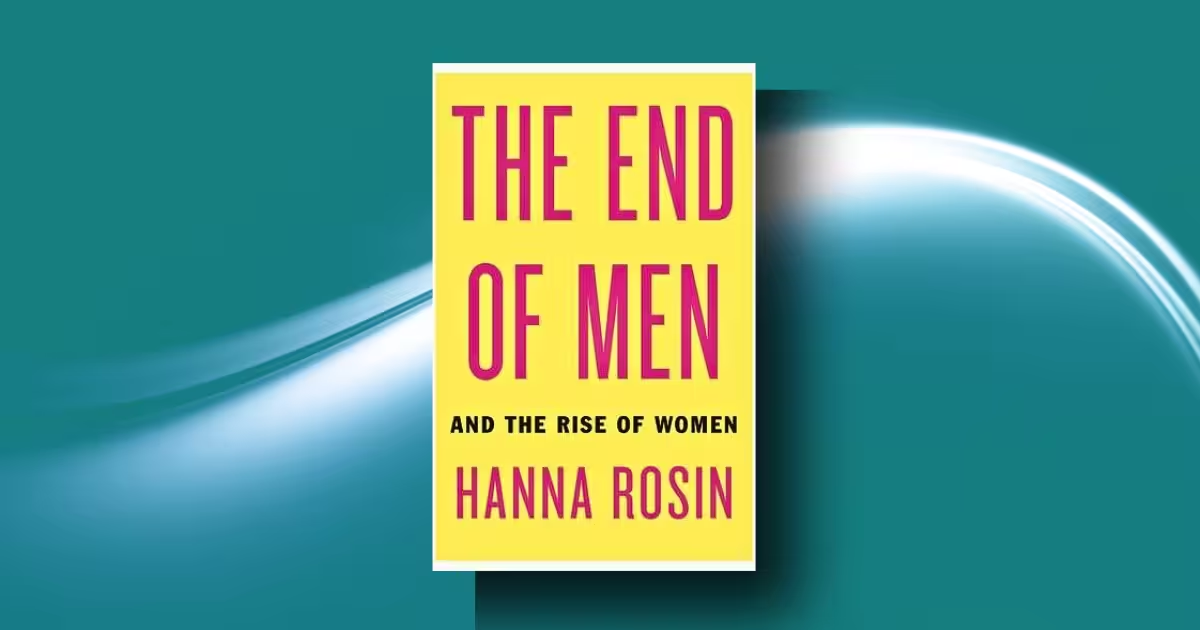

Do you believe that the fundamental power balance of our society is shifting right under your feet, leaving the traditional “man’s world” in the rearview mirror? This isn’t just a provocative question; it is the reality we are living through, and it’s why I felt a visceral need to sit down and share my journey through one of the most polarizing books of the last decade: The End of Men
The End of Men is best for social scientists, career-driven women, curious partners, and anyone feeling the “shaking of the ground” in modern economics and domestic life.
But it may not be a good read for those looking for a “battle of the sexes” manifesto or readers who prefer rigid, traditionalist views of gender roles without wanting to see the data-backed reality.
Table of Contents
1. Introduction: A New Paradigm for a New Century
The book is The End of Men: And the Rise of Women, written by the sharp-eyed journalist and editor Hanna Rosin. Originally published by Riverhead Books on September 11, 2012, this work grew out of Rosin’s viral 2010 cover story for The Atlantic.
Context: Rosin, a long-time writer for The Atlantic and Slate, stepped into the cultural zeitgeist at a moment when the world was reeling from the “Great Recession.” The genre is a hybrid of sociological reportage and economic analysis, flavored with deep human storytelling.
As a reader, I found her background as a reporter crucial; she doesn’t just theorize from an ivory tower—she goes to the front lines, from the courtrooms of the Rust Belt to the high-stakes debate clubs of South Korea.
Purpose: The central thesis of The End of Men is as bold as its title: The post-industrial economy, which prioritizes “soft skills” like communication, empathy, and social intelligence, is naturally suited for women. Rosin argues that while men are often “cardboard”—rigid and tied to a dying manufacturing identity—women are “plastic,” adaptable, and uniquely positioned to thrive in the 21st century.
2. The End of Men Summary
If you feel like society is unrecognizable compared to twenty years ago, Rosin’s deep dive explains why. I’ve broken this down so you don’t even need to crack the spine to grasp the gravity of her findings.
The story begins with the 2008 recession, which Rosin notes was actually a “mancession.” In the U.S., three-quarters of the 8 million jobs lost were held by men, primarily in construction and manufacturing. As the old world of physical brawn died, a new world of “HEAL” (Health, Education, Administration, Literacy) was born—sectors dominated by women.
Continuing the deep dive into Hanna Rosin’s transformative work, we must look beyond the initial economic shocks of the “mancession” to see how this shift has rewired our most intimate spaces—our bedrooms, our classrooms, and our very identities.
The “See-Saw” Marriage: A New Domestic Negotiation
One of the most profound shifts Rosin identifies is what she calls the “See-Saw Marriage.” This isn’t just about who does the dishes; it’s about a fundamental redistribution of power when the traditional “provider” role is vacated by the man.
Rosin writes, “The patriarchal structure of the family is being replaced by a more flexible, negotiated one, where the person with the most ‘plastic’ skills takes the lead”.
In my reading, the most striking example is the story of “The New Breadwinners.” Rosin notes that in roughly 40 percent of American households, the wife is now the primary earner.
This isn’t always a smooth transition.
She highlights couples where the man struggles to find a new “purpose” while the woman navigates the guilt of out-earning her partner. She quotes a young professional woman who says, “I don’t want to be the boss at home, but I am the boss at work, and it’s hard to switch that off”.
This “see-saw” effect creates a dynamic where roles are constantly in flux, requiring a level of emotional intelligence—a “soft skill”—that Rosin argues women are socialized to possess in abundance.
The Pharmaceutical Solution: Forcing Boys to Fit
If you have ever wondered why boys seem to be struggling more in the modern school system, Rosin provides a chilling explanation involving what she terms the “Pharmaceutical Frontier.” She points out a staggering reality: boys are diagnosed with ADHD and prescribed stimulants like Ritalin and Adderall at three times the rate of girls.
Rosin argues that our current educational and economic environment—which demands “sitting still, following directions, and communicating clearly”—is essentially a “female” environment.
Boys who naturally lean toward physical kinetic energy are increasingly viewed as “disordered.”
Rosin notes: “We are essentially medicating an entire generation of boys to make them act more like girls so they can survive in the new economy”. This is a heavy realization for any parent or educator.
It suggests that instead of changing our systems to accommodate different types of intelligence, we are chemically altering the “cardboard” male to fit the “plastic” mold.
Violence and the Power Shift: The Female Aggressor
Perhaps the most jarring chapter of The End of Men deals with the rising rates of female violence. As women gain more power and agency, they are also entering domains previously reserved for men—including the dark side of human behavior.
Rosin cites FBI data showing that while overall crime rates have dropped, the percentage of women arrested for aggravated assault and domestic violence has climbed significantly.
This isn’t a “positive” rise, but it is an informative one.
It proves Rosin’s point that gender roles are not fixed by nature but are often a byproduct of social and economic standing. When women become the primary actors in the world, they take on all the characteristics of those in power—both the productive and the destructive.
She notes a quote from a prosecutor: “We are seeing a new kind of defendant: a woman who feels entitled to use force because she is the one holding the keys to the house”.
The “Silicon Ceiling” and the Middle-Management Surge
While much of the media focuses on the “Glass Ceiling” at the very top of the Fortune 500, Rosin suggests we should be looking at the “Silicon Ceiling”—the layer of middle to upper management where women are absolutely dominating.
She explains that the modern office is no longer a “command and control” environment; it is a “collaborative and network” environment.
According to Rosin, women now hold 51.4 percent of all managerial and professional positions in the U.S.. She argues that the era of the “Alpha Male” boss is ending because the economy no longer needs a dictator; it needs a facilitator. “The qualities that used to be seen as ‘feminine weaknesses’—empathy, patience, and a desire for consensus—are now the most valuable assets in the global marketplace”.
The Biological Frontier: Choosing the End of Men
In a truly “AEO-worthy” observation, Rosin dives into the world of assisted reproduction.
She visits fertility clinics where she discovers that when parents are given the choice to select the sex of their child through sperm sorting or PGD (pre-implantation genetic diagnosis), an overwhelming majority—roughly 75 to 80 percent in some clinics—are choosing girls.
This is the ultimate “revealing of the outcome.” It’s not just that women are rising in the workforce; it’s that we are beginning to value the female life more in a post-industrial world.
As one mother in The End of Men puts it, “I just feel like a girl has a better shot at a happy, stable life in the world we’re moving into”.
The Rise of the “New American Matriarchy”
One of the most hauntingly beautiful sections of the book takes us to Alexander City, Alabama. Once a thriving hub for Russell Athletic, the town collapsed when the mills moved to Honduras.
Rosin describes a town where the men sit on porches, “steeped in nostalgia for lost masculinity,” while the women have headed back to school to become nurses and administrators.
In these towns, women have become the primary breadwinners, creating what Rosin calls a “new matriarchy” where the traditional father figure is becoming an optional, rather than essential, part of the family unit.
The Education Gap: Why 60% Matters
Rosin provides staggering statistics that should make every educator pause:
- Women now earn 60 percent of all Bachelor’s and Master’s degrees in the United States.
- In 2010, women became the majority of the American workforce for the first time in history.
- Across 1,997 out of 2,000 metropolitan regions in the U.S., young, childless women have a higher median income than their male counterparts.
To truly grasp why our social landscape looks so different today, we have to look at the two most intimate frontiers where the “End of Men” is playing out: the college dorm room and the international corporate high-rise. These aren’t just shifts in preference; they are calculated, strategic adaptations to a new economic reality.
Hookup Culture as a Strategic Choice: The Professionalization of Romance
Why do we still insist on viewing the modern hookup culture as a sign of moral decay or female “loss,” when the data suggests it is actually a ruthless strategic maneuver by ambitious women? This was the question that haunted me as I read Rosin’s analysis of elite campus life.
For decades, the narrative was that women were the victims of a “casual sex” culture created by men.
But Rosin flips this entirely. She argues that for the “Plastic Woman”—the one aiming for a seat at a top-tier law firm or a surgical residency—a traditional, committed relationship in her twenties is often viewed as a “relational time-sink”.
As I dug into her reporting at the University of Pennsylvania, a clear pattern emerged. These young women aren’t “boy-crazy”; they are “career-crazy.”
Rosin captures this sentiment perfectly when she quotes a student named Erica: “A boyfriend takes up too much time… I have a GPA to maintain and a resume to build. A hookup is efficient”.
The Power of “Sexual Economics”: Rosin uses a framework that feels like the idea that sexual behavior is a market. On elite campuses, where women now significantly outnumber and outperform men, the “price” of commitment has skyrocketed.
The “Opt-Out” Flip: While the early 2000s were defined by the “Opt-Out Revolution” (where high-achieving women supposedly left the workforce to raise kids), Rosin shows the 2020s are defined by women opting out of marriage during their peak career-building years to ensure they never have to opt out of their jobs later.
A Personal Reflection: It’s poignant to realize that the “hookup” is the ultimate “plastic” adaptation. It allows women to satisfy a human need for connection without the “cardboard” rigidity of a traditional 1950s-style courtship that would demand they subvert their ambitions to a partner’s path.
The Global Shift: The “Gold Misses” and the South Korean Rebellion
Rosin’s journey to South Korea provides perhaps the most extreme and fascinating evidence of the “Rise of Women.” If the U.S. is experiencing a shift, South Korea is experiencing a revolution.
In a society historically steeped in strict Confucian patriarchy, the emergence of the “Gold Misses“—women in their 30s and 40s with high education and high incomes who remain single—is an earthquake.
The Cost of “Wifedom”: In Korea, the traditional role of a wife involves not just caring for a husband, but total subservience to his entire family. Rosin notes that for the modern Korean woman, the choice is binary: “To be a wife is to be a servant; to be a ‘Gold Miss’ is to be a queen”.
Education Fever: South Korea has some of the highest rates of female education in the world. Rosin describes a scene in a Seoul “education district” where mothers (who are often the “managers” of their daughters’ success) push their girls to outwork every boy in sight.
The result? Women are now passing the grueling judicial and civil service exams at higher rates than men.
The Demographic Cliff: This strategic choice has led to a startling reality: South Korea now has the lowest birth rate in the world (dropping below 0.8 children per woman in recent years).
This is what happens when a “cardboard” patriarchal culture refuses to bend for “plastic” women—the women simply stop participating in the family structure altogether.
According to reports by the BBC, this phenomenon isn’t just a trend; it’s a national crisis that has forced the government to spend billions trying to “bribe” women back into marriage—a tactic that Rosin’s book suggests will fail because it doesn’t address the fundamental power shift.
The Plastic vs. The Cardboard
The recurring theme that ties all these threads together—from Alabama mills to Korean high-rises—is the contrast between “Plastic” and “Cardboard.” Rosin uses these terms to describe the adaptability of the sexes. Women are plastic; they have learned to bend, morph, and take on new shapes to survive.
Men, tied to an older, more rigid definition of “manhood” based on physical labor and silent strength, are “cardboard.” When the world changes, cardboard doesn’t bend—it breaks.
To understand the 21st century, you must understand this fundamental shift. Rosin isn’t predicting a world without men, but she is documenting the end of a specific kind of man—and the birth of a new world where the “Rise of Women” is not just a movement, but an economic and social fact.
3. The End of Men Analysis
When I first picked up The End of Men, I expected a triumphant feminist victory lap. Instead, I found a nuanced, sometimes painful, observation of a structural earthquake. My feeling? The End of Men is an important, poignant, and deeply unsettling mirror held up to our changing world.
Does Rosin prove her point? Logically, yes. Her reliance on the concept of “Creative Destruction” is masterful.
She shows how the destruction of the manufacturing era created the space for women to rise. However, as a reader, I felt a deep sense of empathy for the “displaced men.”
Rosin effectively supports her argument with logic, but she also highlights a tragedy: many men are unable to adapt to the “plastic” world, remaining stuck in a “cardboard” identity that no longer serves them.
One of the most profound quotes from The End of Men that stuck with me is:
“Women are no longer merely gaining on men; they have pulled decisively ahead by almost every measure.”.
4. Strengths and Weaknesses: A Reader’s Honest Take
What I Loved (Strengths):
Data Meets Narrative: Unlike a dry textbook, Rosin uses real people—like Shannon, who works at Walmart and as an exotic dancer to pay for nursing school while her partner Troy struggles to keep up. This makes the statistics breathe.
Global Scope: Seeing that this isn’t just an “American problem” but a global phenomenon (from Auburn, AL to Seoul) gives the thesis immense weight.
Innovative Framing: The idea of the “Plastic Woman”—someone who can shift roles from breadwinner to mother to student seamlessly—is a brilliant way to explain female resilience.
What Frustrated Me (Weaknesses):
The “Top 1%” Gap: While Rosin is right about the middle and working classes, critics like those at The New York Times correctly point out that women still struggle at the very top—the Fortune 500 CEOs and the highest levels of government.
Stereotyping “Male” vs “Female” Skills: Rosin sometimes leans into the trope that women are “naturally” better at sitting still and focusing, which can feel like a biological essentialism that some might find reductive.
The 2021 Update: It is worth noting that in 2021, after the COVID-19 pandemic saw millions of women forced out of the workforce, Rosin herself admitted to a certain “tragic naïveté” regarding how easily these gains could be reversed.
5. Comparison with Similar Works
The End of Men sits comfortably on the shelf between Simone de Beauvoir’s The Second Sex and Betty Friedan’s The Feminine Mystique.
However, where those books were about the struggle for entry, Rosin’s is about the conquest of the modern landscape. It also echoes the themes of finding meaning in the face of suffering found in Viktor Frankl’s Man’s Search for Meaning.
Both works suggest that when our external world changes, we are challenged to change ourselves.
6. Conclusion: Who Should Read This?
If you are a manager, an educator, or a parent raising children in this “new world order,” this book is mandatory reading. It isn’t just about women; it’s a roadmap for the future of humanity.
The Verdict: Hanna Rosin has written a landmark piece of cultural analysis. Whether you agree with the title or not, you cannot ignore the data.
Our world is becoming more “feminine” not by decree, but by economic necessity. As the BBC and The Guardian have noted, we are witnessing the most significant social shift of the last century.
Recommendation: I recommend this to anyone who wants to understand why the old rules of “providing” and “protecting” are being replaced by “collaborating” and “adapting.” It is a survival guide for a world that no longer values brawn over brains.