
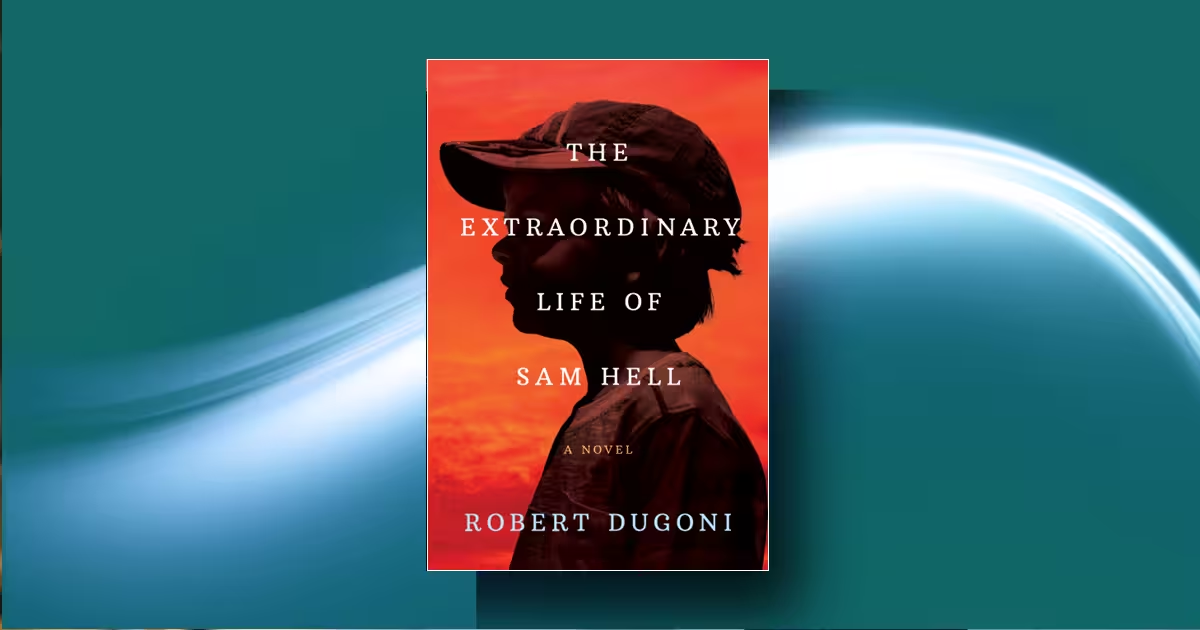

Did you ever wonder whether the cruelest things said to you as a child could become the very source of your greatest compassion as an adult? The Extraordinary Life of Sam Hell by Robert Dugoni turns that terrifying possibility into one of the most quietly luminous novels of the decade.
A boy born with crimson eyes in a world that mistakes the extraordinary for the damned learns, over five decades and a lifetime of scars, that God’s will and human cruelty are two entirely separate things — and that the friends who stay are the ones worth living for.
The Extraordinary Life of Sam Hell is best for readers who love deeply humane coming-of-age fiction with spiritual texture, fans of John Irving’s sprawling emotional novels, anyone who has ever felt categorically excluded, and book clubs hungry for something genuinely moving.
Not for thriller readers expecting Dugoni’s trademark Tracy Crosswhite pace; those put off by Catholic iconography woven into narrative; or anyone who finds multi-decade bildungsromans too leisurely.
Table of Contents
1. Introduction
The Extraordinary Life of Sam Hell is a standalone literary novel by Robert Dugoni, published on 24 April 2018 by Lake Union Publishing.
The book is narrated in first person by Samuel James Hill — Sam Hell — whose entire life is shaped by a rare condition called ocular albinism, which gives his irises a deep, unsettling red.
Dugoni, best known for the Tracy Crosswhite detective series, which has sold more than eleven million copies worldwide, departs here entirely from genre crime fiction to produce what critics and readers have consistently called his masterpiece.
The Extraordinary Life of Sam Hell is a Newsweek Staff Pick for Favourite Books of the Year — and All Time, a Suspense Magazine Crimson Scribe Award Winner, and a Goodreads Choice Award Semifinalist in Historical Fiction.
Accordingly, Sam Hell is not a mystery. It is a life — one rendered with such precision and warmth that by the time you reach the epilogue, you feel you have grown up alongside its protagonist, borrowed his grief, and quietly inherited his mother’s faith.
2. Background
The Extraordinary Life of Sam Hell is rooted in autobiography, at least in spirit. In the Acknowledgements, Dugoni explains that on 24 June 1973, his mother gave birth to her tenth child, Michael Sean Dugoni, who was born with Down syndrome.
Doctors advised his parents to institutionalise the boy; his mother threw them out of the hospital room. That maternal ferocity — the refusal to accept the world’s verdict on a child — became the emotional DNA of Madeline Hill, Sam’s mother.
A brief newspaper article completed the picture: a young boy in Australia had been denied admittance to Catholic school because he was born with ocular albinism, and his classmates called him “the devil boy.” Dugoni had his novel.
The Extraordinary Life of Sam Hell is set across roughly four decades, from 1957 to the late 1990s, in Burlingame, California, a peninsula suburb south of San Francisco.
The period backdrop is vivid: the conservative Catholic community of the 1960s, the earthquake of 1989 (the Loma Prieta earthquake, which kills Sam’s partner Eva), the AIDS decade, and finally the humanitarian missions of the 1990s.
Dugoni knows this terrain instinctively, and the texture of small-town Catholic America — the weekly Masses, the school envelopes, the lunch-box rituals, the rectory confrontations — gives the novel the particular weight of a place and time faithfully remembered.
3. The Extraordinary Life of Sam Hell Summary
The Frame: A Man Pausing at the Edge
The Extraordinary Life of Sam Hell opens in 1989 with Sam Hill, thirty-two, sitting in a doctor’s office preparing for a vasectomy at the insistence of his live-in partner Eva, an airline pilot who has decided she does not want children.
The procedure triggers a flood of memories, and the bells of Our Lady of Mercy — auditory hallucination or divine signal — cause him to pause, fully clothed, on the examination table.
He cannot go through with it. In this moment of suspended decision, the past rushes in, and the novel’s dual-timeline structure is established: Sam’s childhood and adolescence play out in intercut flashbacks, while his adult story advances in 1989.
Part One: A Stain on the Carpet — Birth and the Battle of OLM
Born on 15 March 1957, Sam enters the world five weeks premature. When he finally opens his eyes in the delivery room, the nurses recoil and the doctor freezes.
His father, Maxwell Hill — a pharmacist of quiet wit and immense practicality — looks down at his newborn son and whispers what will become Samuel’s name: “What the Sam Hell?” His mother, Madeline, an Irish-Catholic woman of formidable faith and theatrical temperament (she once played Elizabeth in Pride and Prejudice at college), immediately frames the boy’s red irises as God’s will and extraordinary blessing.
They are diagnosed as ocular albinism — a rare genetic condition producing no melanin in the iris, causing it to appear red-pink by the blood vessels behind it. His vision is affected modestly over time, but his social life is devastated from the start.
Madeline fights to enrol Sam at Our Lady of Mercy Catholic school, which has denied his admission on the grounds that his appearance will “disrupt” the other children.
Principal Sister Beatrice, a woman with prominent incisors, thick-framed glasses, and a silver flask hidden in her habit, tells Madeline point-blank that Sam is known among the children as “the Devil Boy.”
Madeline goes to a television news reporter — an old college friend — and within twenty-four hours, the story is on the local news. Father Brogan, the pastor, calls the Hills to dinner and the school reopens its gates. Sam is enrolled.
His first days at OLM are a study in solitude. He lies to his parents at the dinner table each night, inventing friends named Dillon and Barry, telling tales of kickball glory, while in reality he eats alone on the bleachers and develops the fine art of eating a Hostess Twinkie so slowly that lunch consumes the entire period.
Part One Continued: Ernie Cantwell and David Bateman
In the second week of school, a new student arrives: Ernie Cantwell, the only Black child in all of Burlingame, recently relocated from Detroit, where his father had worked in car manufacturing and is now building something in the garage (Cantwell Computers, as it will become).
Ernie sits beside Sam on the bleachers, notices his eye condition with direct but unoffended curiosity, and asks if he wants to go play. Before they can do so, a rubber ball hits Sam flush in the face — hurled deliberately by David Bateman, a large, held-back student who announces he’s given Sam “a red face to go with his red eyes.”
When Bateman attacks Ernie, calling him a “darkie” and a word far worse, Sam leaps onto Bateman’s back in a grip that does not let go until Sister Beatrice drags him away by the ear. The incident ends in the rectory, with Father Brogan expelling Bateman after Patrick O’Reilly and Tommy Leftkowitz — guilty consciences, both — confess everything.
Sam lies throughout and says he had a bike accident. Father Brogan knows he is lying, calls it the mark of a man, and gives Sam an Irish blessing card. He also discovers, for the first time, that Sister Beatrice keeps a flask.
The aftermath of Bateman’s expulsion inaugurates what Sam and Ernie will later call the “AB” years — After Bateman. Sam and Ernie become inseparable.
Sam, quietly aware that Ernie is struggling to read (letters transpose themselves), engineers a competitive reading challenge that gets Ernie through the yellow and red packets without anyone losing face. His father, upon hearing Sam describe a hypothetical friend with a learning difficulty, tells him the Tom Sawyer story of the fence: you make the task desirable, and the person does it willingly.
It works. Mrs. Cantwell brings a chocolate cake to the Hill house and has no idea why.
Part Two and Three: The Mick — Middle School and the Arrival of Michaela Kennedy
Mickie Kennedy arrives at OLM in the second semester of sixth grade: short hair, a skirt that keeps rising above regulation, not remotely interested in jumping rope, and completely willing to say what no one else will say.
When Sister Beatrice substitutes for the class and Mickie says, out loud, “I think it was hilarious” — referring to the catastrophic all-school Mass at which Sam deliberately said “vaginal” instead of “virginal” in a Pauline reading, echoing Ernie’s deliberate ringing of the altar bells to scatter Valerie Johnson’s prank — she earns two consecutive detentions and drags Sister Beatrice into open warfare.
Crucially, before any of this, Mickie had seconded Sam’s nomination for lector to ensure he got the role, not from kindness but from contempt for Valerie Johnson. Later, when I asked her why, she said: “You’re a brain; you should be the lector. Better you than that airhead.”
The three misfits are now complete: the boy with red eyes, the Black athlete, and the girl who breaks every rule. They will form the spine of Sam’s entire adult life.
In eighth grade, Sam graduates from OLM.
He finds in his desk a Bible inscribed by Sister Beatrice — a gift that confounds him — and at the graduation dance, Mickie pulls him onto the floor to the Rolling Stones and later to Rod Stewart, and holds him in a slow dance so close that Sam, for the first time, realises he loves her.
Part Four: High School, Donna Ashby, and the Limits of Naivety
At Saint Joseph’s all-boys Catholic high school, Sam acquires the nickname “Hell” — a gift from teammates who cheer “Give him Hell!” when his red-eyed defensive intensity rattles opponents.
He quits the basketball team voluntarily, deflecting so that Ernie can get scouted, and starts writing sports for both the school paper and the county Times, eventually earning $2,500 in journalism scholarships.
He also begins working at his father’s pharmacy, where a senior girl named Donna Ashby arrives, calls him “polite and cute,” and proceeds to use him as what Mickie tartly calls “her personal vibrator” — sex in the Falcon, always behind the baseball backstop, never in public, never acknowledged.
When Sam asks Donna to the movies or to dinner, she has reasons. When he discovers she was also sleeping with Leo Tomaro (a none-too-bright former football player) on the very night she told Sam her parents were in Tahoe, he leaves her kitchen without the gift he brought and drives home in silence.
Mickie had warned him. She was right.
Sam’s senior year brings more institutional discrimination: the school trustees choose Ernie as class valedictorian — not because he earned it academically, but because they want their first Black valedictorian to look progressive. Ernie turns the honour down. Neither boy is ever officially apologised to. Sam says at the dinner table, in a line that stops his mother cold: “I’m the one who has to live this life.”
It is the first time he wrests the narrative from her hands.
Ernie commits to Stanford on the phone. A few days later, a thin envelope arrives from the same admissions office for Sam. His mother insists he open it: THIS IS TO ADVISE THAT YOUR APPLICATION HAS BEEN ACCEPTED. For one night, everything is extraordinary. Then his father has a stroke.
Part Five: None of Us Are Getting Out of Here Alive — Adulthood and the Earthquake
The stroke happens on graduation night. Sam defers Stanford for a year, hires a pharmacist named Frank, restructures his father’s store, trains his mother to run it, and finally gets to Stanford a year late — rooming with Ernie, writing for the Stanford Daily, eventually becoming an ophthalmologist (inspired directly by his childhood doctor, the mild, dusty-spectacled, spearmint-chewing Dr. Pridemore).
He buys his father’s building when it comes time, and opens Burlingame Ophthalmology and Vision Center above the pharmacy with Mickie Kennedy as his business partner — Mickie, who has been expelled from the Catholic girls’ school for engineering her own expulsion, graduated from the public school, gone to UC Davis, come home to medical school, and become a doctor of her own.
Back in 1989 — the novel’s present — Sam’s relationship with Eva crumbles. He calls her Boston hotel room and a man answers. That same week, a mother named Trina Crouch arrives at his office with a daughter named Daniela Bateman. Sam’s blood goes cold.
David Bateman is back, now a uniformed police officer. Daniela’s retina is detaching — the result, Sam suspects, of a blow to the head her father administered and everyone is calling a “bike accident.” Sam confronts Bateman at a bar.
Bateman ambushes Sam in a church parking lot that same night, handcuffs him, beats the backs of his legs with a billy club, and threatens him into silence.
Yet Sam does not go silent. With Mickie, the emergency room doctor Pat LeBaron, and a domestic violence investigator named Merilee Montoya, he builds a case. He donates the surgery to correct Daniela’s retina. He arranges for Trina and Daniela to leave for Tucson. He files for a restraining order.
Then, on the morning the hearing is finally set, David Bateman goes to Trina’s hotel and shoots her dead before shooting himself.
The Loma Prieta earthquake also kills Eva — her car is crushed under a collapsed freeway overpass on the day she was flying home from Boston. Sam is the one who identifies her body at the makeshift morgue, sparing her parents.
He attends her funeral as “just a friend.” And he tells no one that there was a second body in her car.
Part Six and Seven: The Long Penance, Fernando, and the Return of Mickie
Trina Crouch’s death devastates Sam into post-traumatic stress disorder.
He surrenders his practice to Mickie — who refuses to buy him out or buy his house, saying “both will be here when you come back” — and spends nearly a decade working for Orbis, a medical NGO operating a flying hospital that restores sight in clinics across Africa, India, Costa Rica, and Asia.
He works not from faith but from guilt: this is his purgatory.
In Costa Rica, he examines thirty orphaned children and is directed at the end of the day to a six-year-old boy named Fernando. Fernando has ocular albinism.
His classmates call him el hijo del Diablo — the son of the devil. When Sam sits down across from the boy, he removes his brown contact lenses — the lenses he has worn since he was eighteen, since his father’s stroke, since he decided to stop believing — and drops them down the drain.
He tells Fernando: “Tus ojos son extraordinarios. Very special.” He tells the boy that he has searched the world and found no one else so blessed. Fernando lunges from the stool and wraps his arms around Sam’s neck.
Sam calls Mickie that night, full of the story of Fernando, and hears a subdued note in her voice: “You need to come home, Sam. You need to see your mother.”
Madeline Hill has been diagnosed with aggressive breast cancer that has already metastasised. She chose not to tell Sam or Mickie. She chose not to have treatment.
She is dying. Sam rushes home and refuses to leave her side. He takes his parents on a final trip — aboard the Orbis DC-10, converted to carry hospital beds — to Lourdes, France, where his mother is dipped in the spring waters, attends Mass, goes to confession, and emerges from the baths walking unaided, radiant, with a fixed gaze that Sam follows but cannot quite see.
She hands him her rosary as they meet in the grotto.
Then she collapses.
She dies in her own bed, beside her husband, within days of returning. His father follows her six weeks later. Sam buries them side by side at the Catholic cemetery.
The Ending: Mickie, Fernando, and the Return of Faith
Months after his parents’ deaths, Sam asks Mickie to marry him. She says she cannot. She leaves for a medical conference in Mexico and goes silent. Sam, alone, prays his mother’s rosary for the first time since his father’s stroke — praying, he realises, not from faith but from desperate need.
When Mickie returns, she tells him the full truth: she had a hysterectomy years earlier and cannot have biological children. She feared that if she told him and they married, she would be denying him something irreplaceable. But she also tells him that she and his mother — together, secretly, conspiring across the years — have been processing the paperwork to adopt Fernando. The adoption is nearly complete.
All that is needed is Sam’s personal interview, a formality. The orphanage’s caretaker, the woman who was in the room the day Sam met Fernando, has already written a letter of reference.
His mother, in her final months, signed a document stating that Sam and Mickie were married — the only lie, as Mickie puts it, she ever heard the woman tell.
Sam gets down on one knee and produces his mother’s diamond wedding ring, reset in a circle of tiny red rubies.
The epilogue finds Sam, Mickie, Fernando, and the pit bulls Douglas and Blue on Cortez Avenue, climbing the red-tile steps of Our Lady of Mercy to enrol Sam’s son in first grade.
The principal, Patricia Branick, has been expecting them: Madeline Hill came to see her before she entered the hospital. She paid Fernando’s tuition — all eight years at today’s prices. Sam and Mickie don’t need to argue.
As they climb the stairs, the statue of the Blessed Mother comes into view — first her veil, then her face, then her blue-and-white robes. Sam pauses. He recognises her, finally, for the first time: she is the same statue he saw at the grotto in Lourdes. His mother had told him all his life that the Blessed Mother was watching over him.
He had never known, until this moment, what that statue looked like.
The Extraordinary Life of Sam Hell closes with Sam sitting on his couch, hearing the OLM bells ring the six o’clock hour, and reaching into the bowl on the end table where he keeps his mother’s rosary. He begins as she taught him.
For I am my mother’s son.
4. The Extraordinary Life of Sam Hell Analysis
4.1. Characters
Samuel James Hill (Sam Hell) is among the most fully realised protagonists in recent American literary fiction. He is not a hero in any conventional sense — he is cautious, frequently passive, prone to lying by omission and self-sabotage in love. His instinct, born from childhood, is to protect others from his pain rather than claim his own.
He invents friends at the dinner table so his parents won’t grieve.
He covers for Ernie with manufactured bets. He identifies Eva’s body so her father won’t have to, then goes home and cries alone. What makes him extraordinary — and the word is not incidental — is precisely this: he knows exactly what the world thinks of his red eyes, and he chooses, again and again, not to be made smaller by it.
The contact lenses he puts in at eighteen, after his father’s stroke, represent a failure of nerve he only recovers in Costa Rica when Fernando’s eyes look back at him.
Madeline Hill is The Extraordinary Life of Sam Hell‘s true north. She is ferociously present — staging a media intervention against a Catholic school, spilling cream in her husband’s lap after he suggests Sam might be happier at public school, weeping in silence on the living-room couch when she discovers Sam has no real friends, engineering the adoption of Fernando from her deathbed.
She is not without complexity: her faith can function as an emotional fortress, a way of closing down uncertainty rather than sitting within it.
But her love for her son is the structuring principle of his entire life, and when she hands him her rosary in the Lourdes grotto moments before she collapses, the gesture is both completely earned and almost unbearably moving.
Ernie Cantwell is the most straightforwardly good character in the novel, and Dugoni wisely refuses to make him a saint. He rings the altar bells on purpose to save Sam’s lector reading and lies about it with an expression of innocent confusion.
He turns down the valedictorian honour with the same decisiveness he brings to everything. He invests Sam’s money in Cantwell Computers and calls from Santiago de Cuba to tell him he’s rich.
He remains, across fifty years, what he was on day one on the bleachers: the friend who sits down without being asked.
Michaela Kennedy (Mickie) is The Extraordinary Life of Sam Hell‘s most complicated and arguably most interesting figure. Her sexuality has been weaponised against her since high school, where boys spread rumours that no one contradicts, and where Michael Lark drunkenly gropes her at the prom.
She is Dugoni’s portrait of what happens when a child grows up in a loveless, alcoholic household and learns to mistake the physical act of intimacy for the feeling of being loved.
Her ferocity is a cover. The scene in which she finally tells Sam why she cannot have children — standing in his kitchen, having returned from Costa Rica, where she has already moved the adoption forward — is one of the most quietly devastating in The Extraordinary Life of Sam Hell.
David Bateman begins as a schoolyard bully and ends as a psychopath in uniform. Dugoni is careful not to make him simply evil: his father hits him in public, at the rectory, with a hand described as the size of a baseball mitt, and David howls “don’t hit me again” with the inflection of a child who has heard those words directed at him.
The system that produced his violence — his father’s violence, a military school, the Marines — is indicated throughout, but Dugoni does not let it excuse him. David Bateman could have chosen differently.
He did not. His murder of Trina Crouch is the novel’s darkest moment, and it is the right decision to include it. Sam has spent the book believing that confronting bullies leads to justice. This ending, in which justice does not arrive, is where the novel grows into genuine moral seriousness.
Sister Beatrice is given a redemption of sorts — she appears, dying, in the room two doors down from Madeline’s hospital room, having sought Sam out to apologise — that some readers may find too neat.
Yet Dugoni has been careful to give her a backstory (she was bullied as a child for a lisp and buck teeth, and became an alcoholic at sixteen) without using it as an alibi. Sam’s forgiveness is not absolution; it is release.
He tells her there is nothing to forgive. The reader, who has watched her call him “Devil Boy” in the hallway, may feel differently, and that tension is the right texture for the scene.
4.2. The Extraordinary Life of Sam Hell Themes and Symbolism
The Red Eyes as Sign. The novel’s central metaphor is Madeline’s claim, from birth, that Sam’s eyes are not a defect but an extraordinary gift.
The Extraordinary Life of Sam Hell tests this claim relentlessly. It costs Sam the valedictorian. It gets him beaten up behind a cinder-block bathroom. It makes Donna Ashby choose him as a convenient secret.
Yet by the end, Sam removes his contact lenses in a clinic in Costa Rica not from faith but from shame — shame at having covered the very thing his mother called extraordinary.
Fernando’s eyes answer the question The Extraordinary Life of Sam Hell has been asking: yes, these eyes are a gift, because without them Sam would never have recognised the boy across the room.
Faith as the Central Argument. Sam empties his “prayer piggy bank” repeatedly as a child, asking God to change his eye colour, and is repeatedly refused.
His father’s stroke becomes the breaking point: if God will not heal a good man, Sam is done with God’s will as an explanation. He spends a decade in secular penance, not prayer.
The Lourdes trip is not a conversion in the traditional sense — it is a recognition. The warmth he feels in the baths, which the Italian volunteer identifies as the Spirito Santo, is described in terms of his mother’s embrace.
The Extraordinary Life of Sam Hell ultimately presents faith not as propositional theology but as love: his mother’s love, which persists after her death through rosary beads, wedding rings, and paid school tuition.
The Bells of OLM. Sam hears them three times in moments of crisis: when he almost gets a vasectomy, when he is praying Mickie home, and when Mickie steps out of the taxi.
In the Catholic tradition, church bells mark transitions — Mass, deaths, celebrations.
In The Extraordinary Life of Sam Hell, they mark Sam’s own turning points, the moments when he stops and starts looking back at his own life. His father tells him in the shade of an oak tree that “there comes a day in every man’s life when he stops looking forward and starts looking back.”
The bells are the signal that day has arrived.
Outsiders as Chosen Family. Sam, Ernie, and Mickie are each excluded from the dominant order — the red-eyed boy, the Black child in a white suburb, the girl with the bad reputation.
Dugoni’s argument is that the excluded see more clearly than the included: Ernie recognises the fraud of the valedictorian honour instantly; Mickie sees Donna for what she is before Sam does; Sam sees Fernando across a waiting room because he has lived that child’s experience.
The community of misfits is not a consolation prize. It is the real inheritance.
The Mother as Mediator. In the novel’s theological structure, Madeline Hill occupies a position analogous to the Blessed Mother: an intercessor whose prayers continue to operate after her death.
The final revelation — that she paid Fernando’s tuition, that she co-signed the adoption paperwork, that she had planned the final gift from her hospital room — positions her not as a character who has died but as a presence that endures.
The statue at Lourdes and the statue at OLM are the same woman. Sam has been climbing her steps his whole life.
5. The Extraordinary Life of Sam Hell Evaluation
The Extraordinary Life of Sam Hell is Dugoni’s most assured and deeply felt work — a novel in the tradition of John Irving’s The World According to Garp, shaped by the same sprawling warmth and the same conviction that a life, fully rendered, can carry the weight of argument. It earns every tear it extracts.
5.1. Strengths
The mother-son relationship at the novel’s centre is drawn with exceptional precision.
Madeline Hill is neither a saint nor a caricature; she is a woman whose faith has made her brave in the world and occasionally blind to the particular ache of being her son.
Dugoni knows exactly when to let her be funny (the cream in the coffee, the media intervention, the theatrical retelling of Sam’s birth) and when to let her be human (weeping silently on the couch when she discovers Sam has no friends).
The novel’s pacing across decades is managed with considerable skill. The dual-timeline structure — 1989 framing chapters intercut with childhood and adolescence — means that reader and narrator are always moving toward and away from each other, and the convergence in the final sections lands with real force.
Ernie’s friendship, in particular, accumulates genuine weight: every sacrifice he makes for Sam is repaid in kind across the decades, without either character ever making the accounting explicit.
5.2. Weaknesses
The Extraordinary Life of Sam Hell is genuinely episodic in structure — Dugoni acknowledges this in the Acknowledgements — and some sections feel disproportionate.
The Donna Ashby plotline, while useful as a study of Sam’s self-diminishment in love, runs longer than it needs to and returns in the epilogue (the newspaper article about Judge Donna Ashby Gage resigning in disgrace) in a way that feels more like closure-for-closure’s-sake than anything emotionally necessary.
Furthermore, the decade Sam spends with Orbis is relatively compressed and deliberately schematic, functioning as penance more than dramatised experience.
Readers who have been emotionally invested in Sam’s relationships may feel the novel loses some of its intimacy in Part Seven. The Costa Rica scenes are affecting — Fernando is a genuinely luminous presence — but the transition from the earthquake’s aftermath to Sam’s decade of global travel is summarised rather than shown.
Sister Beatrice’s hospital-bed reconciliation is the one moment where the novel is too gentle with itself. The woman called Sam “Devil Boy” in the hallway. The question of whether she deserves the forgiveness she receives might have been explored with a fraction more complexity.
5.3. Comparison with Similar Works
The obvious comparison is John Irving, specifically The World According to Garp and A Prayer for Owen Meany — both novels concerned with the long shadow of maternal love, the peculiarity of faith, and the violence of the ordinary world.
Sam Hell lacks Irving’s maximalist excess and dark comedy, but it has something Irving occasionally doesn’t: genuine warmth without sentimentality.
Closer in tone is Pat Conroy’s The Great Santini or The Prince of Tides, with their Catholic families under pressure, their brutal masculinity and tender women, their sense that the damage of childhood is the material you spend your adult life turning into meaning.
Readers who loved Marcus Zusak’s The Book Thief — its first-person narration of a mid-century life shaped by violence and illuminated by love — will find a similar emotional register here.
6. Personal Insight: Ocular Albinism and the Right to Be Seen
Reading Sam Hell, what strikes me most is not the bullying itself but the institutional scaffolding around it. Sister Beatrice does not invent her cruelty in a vacuum: the school first denied Sam’s application, the parish board deferred to a bully’s mother, the valedictorian honour went to the Black athlete because it made the school look progressive.
The discrimination against difference — whether it is the colour of one’s eyes or one’s skin — rarely announces itself as hatred. It announces itself as administrative policy, community standards, the best interests of the other children.
This remains urgently true. As of March 2024, the UN Expert on Albinism warned that “quality education is still unattainable for most persons with albinism,” citing bullying, pervasive stigma, and a lack of reasonable accommodation as common barriers.
Globally, according to the United Nations, while numbers vary, it is estimated that in North America and Europe, 1 in every 17,000 to 20,000 people has some form of albinism. The condition is much more prevalent in sub-Saharan Africa, with estimates of 1 in 1,400 people being affected in Tanzania and prevalence as high as 1 in 1,000 reported for select populations in Zimbabwe and for other specific ethnic groups in Southern Africa.
In some countries, people with albinism face discrimination, poverty, stigma, and violence, including killings. More than 80% of individuals with albinism have reported experiences of bullying or discrimination in school.
Sam Hell’s story is fiction, but it is not fantasy. The child called “Devil Boy” in a playground in 1963 California has countless counterparts in 2026 — in sub-Saharan Africa, where the myths around albinism sustain violence against people whose body parts are believed to carry magical properties; in schools across Europe and North America, where visible difference still triggers ridicule.
What Dugoni’s The Extraordinary Life of Sam Hell offers is not a solution but a disposition: the conviction that the person who is different is often the one most equipped to see what others cannot. Sam becomes an ophthalmologist, restoring sight for a living. The metaphor is exact. He was the one all along who could see most clearly.
Five lessons The Extraordinary Life of Sam Hell teaches that remain as contemporary as ever:
First: Maternal advocacy matters. Madeline Hill going to that television camera is the single act that changes Sam’s trajectory. Every institution that discriminates requires someone willing to make it publicly uncomfortable.
Second: True friendship is unconditional and specific — not symbolic. Ernie does not befriend Sam as an act of solidarity. He befriends him because Sam takes the longest time eating a Twinkie he has ever seen.
Third: Self-acceptance cannot be handed to another person. Sam receives his mother’s conviction that he is extraordinary, his father’s practical wisdom, Mickie’s fierce love — and still hides behind brown contact lenses for fourteen years. The decision to drop them down the drain in Costa Rica is his alone.
Fourth: Institutional cruelty outlives its perpetrators. David Bateman was made, at least partially, by a father whose hand was described as “as big as a baseball mitt.” Breaking that cycle requires something more than good intentions.
Fifth: Faith, in Dugoni’s telling, is not a theological position but a practice of returning — returning to the beads, returning to the people you love, returning to the house with the cedar shakes where the porch light is always on.
7. The Extraordinary Life of Sam Hell Quotes
The foreword’s opening line is the novel in a sentence:
“My mother called it ‘God’s will.’ At those moments in my life when things did not go as I had hoped or planned, and there were many, she would say, ‘It’s God’s will, Samuel.'”
Sam’s mother’s response to the hospital staff who want to examine his eyes — simple, absolute, and entirely hers:
“‘Not rare, Doctor,’ my mother corrected. ‘Extraordinary.'”
After Sam’s father corrects him in the early pages:
“There comes a day in every man’s life when he stops looking forward and starts looking back.”
Sam in the bathroom mirror, first grade, the morning he must walk into OLM:
“‘Devil Boy,’ I said, despite my mother’s admonition not to listen to a word Sister Beatrice had said. How could I not? I’d been standing right there when she’d said it.”
Mickie, to Sam, one of the most honest things she ever says:
“You use your eyes as an excuse for not believing you could do better and for not standing up for yourself and telling women they’re not good enough for you.”
And the line in Costa Rica, which undoes the novel’s long resistance to faith:
“I am never again going to hide the color of my eyes or be ashamed of them. And I want you to promise me that you will also never be ashamed.”
The passage that closes The Extraordinary Life of Sam Hell‘s thematic argument — Sam’s father’s gift, finally understood:
“He was offering me the gift of perspective… We realize it is in those quiet moments that each of us has the ability to make our lives extraordinary.”
8. Conclusion
The Extraordinary Life of Sam Hell is a rare novel: one that justifies its own title. It earns the word “extraordinary” not by manufacturing spectacle but by rendering fifty years of an ordinary Catholic Californian life with enough precision, honesty, and warmth that the ordinary becomes the very thing it was always secretly claiming to be. Madeline Hill was right. She was almost always right.
The Extraordinary Life of Sam Hell is for anyone who has ever felt that the world was built for everyone except them — and the novel that insists that is precisely the point. The misfits see more clearly. The red-eyed boy becomes the ophthalmologist. The son of the devil becomes the one who restores sight.
Robert Dugoni will be remembered for the Tracy Crosswhite series. He should be remembered for this.
Recommended for: readers of John Irving, Pat Conroy, Marcus Zusak; anyone who loved A Man Called Ove, The Kite Runner, or The Help for their emotional range and moral seriousness; book clubs seeking a multi-decade story of faith, friendship, and the cost of difference.


