
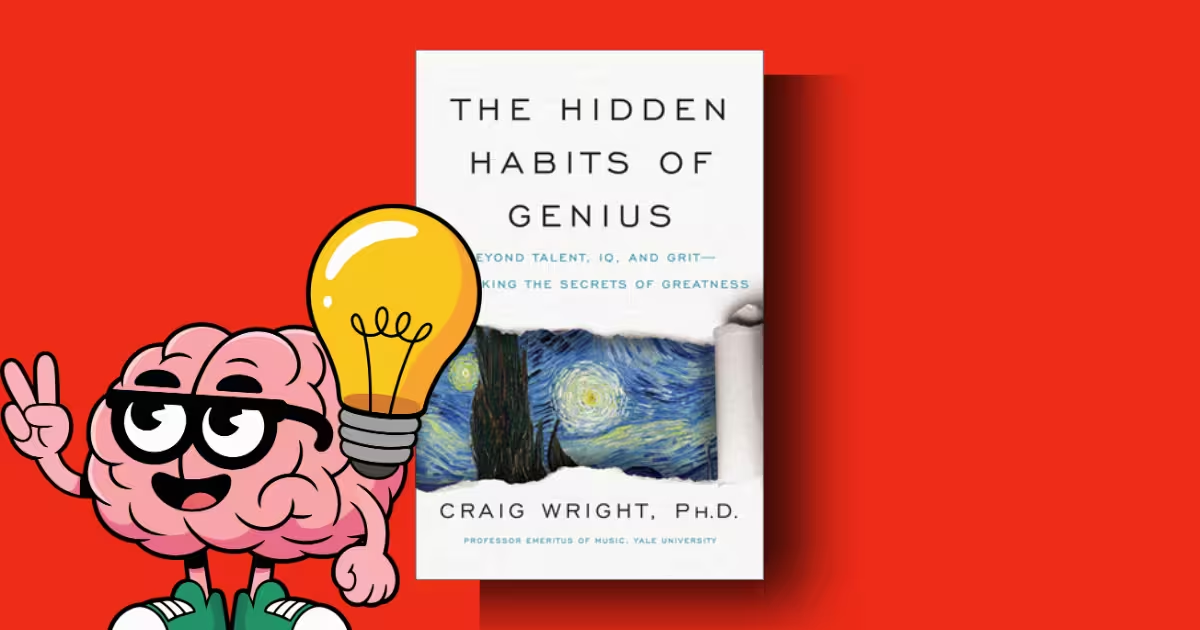
Why do obsessive, often unlikable people change the world while well-adjusted overachievers fade into obscurity? Craig Wright’s The Hidden Habits of Genius forces you to confront that uncomfortable question head-on.
Table of Contents
Overview
Craig Wright, a Yale professor who spent decades studying history’s most transformative figures, argues that genius isn’t about IQ, talent, or even grit. It’s a perfect storm of fourteen distinct habits, ranging from childlike imagination and insatiable curiosity to creative maladjustment and obsession.
Wright draws from the lives of over a hundred geniuses, from Leonardo da Vinci and Marie Curie to Steve Jobs and Elon Musk, to show that geniuses don’t just work harder; they see what others can’t, rebel against convention, and often destroy personal relationships in the process.
The Hidden Habits of Genius won’t make you a genius, but it will fundamentally change how you think about education, parenting, creativity, and success.
Reader recommendations for The Hidden Habits of Genius
The Hidden Habits of Genius is perfect for:
- Parents who want to understand how to nurture (or not stifle) creativity in their children
- College students and young professionals questioning the value of standardized tests and elite education
- Anyone fascinated by the messy, often disturbing personal lives of history’s great minds
- Leaders and entrepreneurs who want to understand the psychology behind breakthrough innovation
- Readers who enjoyed Malcolm Gladwell’s Outliers or Angela Duckworth’s Grit but want a more critical perspective
The Hidden Habits of Genius is suggested for:
- Readers looking for a straightforward self-help book with practical step-by-step instructions
- Those who prefer their heroes uncomplicated and morally upright
- Anyone seeking a quick, inspirational read; this book forces you to sit with uncomfortable truths
- Readers already deeply familiar with genius studies; some content may feel like familiar territory
Introduction
Book: The Hidden Habits of Genius: Beyond Talent, IQ, and Grit—Unlocking the Secrets of Greatness
Author: Craig Wright, Ph.D.
Publication Date: October 6, 2020
Craig Wright is the Henry L. and Lucy G. Moses Professor Emeritus of Music at Yale University. He holds a Bachelor of Music from the Eastman School of Music and an M.A. and Ph.D. in musicology from Harvard. At Yale, he created and taught the wildly popular undergraduate course “Exploring the Nature of Genius,” which attracted hundreds of students annually.
He’s also a Guggenheim Fellow and a member of the American Academy of Arts and Sciences. Wright’s background isn’t psychology or neuroscience, it’s music history. That outsider perspective, he argues, actually helps him see patterns that specialists might miss.
Context of The Hidden Habits of Genius
The Hidden Habits of Genius emerges from Wright’s decades of teaching at Yale and his observation of exceptionally gifted individuals across multiple disciplines.
As he writes in the introduction: “I have spent my career surrounded by people who are exceptionally gifted at one thing or another—math, chess, classical music, creative writing, and other fields of endeavor”.
Yet he found himself “not especially gifted at anything”. That admission of mediocrity—from a Yale professor, no less- is what makes this book so disarmingly honest. Wright isn’t selling you a fantasy that you can become Einstein. He’s showing you what Einstein actually was.
Purpose of The Hidden Habits of Genius
The Hidden Habits of Genius argues that genius is neither a divine gift nor simply the product of 10,000 hours of practice. Instead, it’s “an explosive and seemingly random event arising from a combination of many personal phenotypes, among them intelligence, resilience, curiosity, visionary thinking, and more than a dash of obsessive behavior”.
Wright defines a genius as “a person of extraordinary mental powers whose original works or insights change society in some significant way for good or for ill across cultures and across time”.
The Hidden Habits of Genius’s purpose isn’t to make you a genius; he’s upfront about that, but to force you to think about how you lead your life, raise your children, and approach creativity.
Background
The word “genius” has meant radically different things across history. In ancient Greece, it was a daemon or mania, a creative fury that consumed an inspired poet. The Romans believed everyone had a genius, a guardian spirit. In the Middle Ages, genius was rebranded by the Catholic Church as divine inspiration, and the creators of the great Gothic cathedrals remained mostly nameless.
With the Renaissance, transformative thinkers regained a face and a name. Leonardo, Michelangelo, and Shakespeare were dubbed ill divino, the divine ones. By the eighteenth-century Enlightenment, genius became wholly immanent: it came with birth and rested within the individual.
The nineteenth-century Romantics gave us the tortured, eccentric genius, Beethoven, the mad scientist Frankenstein, the deformed Quasimodo.
Today, the term has been so overused that it’s nearly meaningless. Kim Kardashian is called a “business genius.” Kanye West is “a jerk who is also a genius”. Donald Trump declared himself “an extremely stable genius”. Wright argues that our “longing for genius” reveals a profound human desire to understand the unknown, but we’ve cheapened the term by applying it to mere celebrities.
The Hidden Habits of Genius Summary
Wright organizes the book around fourteen key habits of genius. Let me walk you through what I found most striking.
1. Work Ethic (and Why 10,000 Hours Isn’t Enough)
Wright dismantles the popular “10,000-hour rule” popularized by Malcolm Gladwell. The rule comes from psychologist Anders Ericsson’s study of Berlin violinists, which claimed that elite performance is simply the result of deliberate practice. But Wright points out two fatal flaws. First, the Berlin psychologists never tested students for natural musical ability, they compared the talented to the truly gifted. Second, and more important, “practice may make the old perfect, but it does not produce innovation”.
Wright shares his own painful story. He practiced piano for approximately 18,000 hours by age twenty-two, attending the prestigious Eastman School of Music. He had huge hands, long thin fingers, and the best training. But he never became a concert pianist. “I lacked only one thing: a great gift for music”.
The conclusion? “Genius is the product of both nature and nurture”. Wright quotes Olympic figure skater Nathan Chen, who estimated that success is about 80 percent nature and 20 percent nurture. As Chen put it, “no matter how hard you train in your sport, without the genetic capacity it will be nearly impossible to be the best”.
2. IQ and Standardized Tests Are Overrated
Wright is scathing about IQ tests, the SAT, and the GRE. He points out that Thomas Edison, Albert Einstein, Steve Jobs, and Winston Churchill were all mediocre students. Charles Darwin’s academic record was so poor that his father predicted he would be “a disgrace to his family”. Picasso couldn’t remember the sequence of letters in the alphabet.
Wright cites a famous “genius test” conducted at Stanford by Lewis Terman, which tracked 1,500 children with IQs over 135 from the 1920s into the 1990s. The result? “A cohort of 1,500 youngsters with IQs over 135 ultimately failed to produce a single genius”. As a Terman associate later admitted: “There wasn’t a Nobel laureate. There wasn’t a Pulitzer Prize. We didn’t have a Picasso”.
Wright advocates for what he calls the “Many Traits Quotient” (MQ), a broader measure that includes curiosity, resilience, passion, self-confidence, and the ability to work hard. He quotes a saying attributed to Einstein: “Everybody is a genius. But if you judge a fish by its ability to climb a tree, it will live its whole life believing that it is stupid”.
3. Genius and Gender: The Game Is Rigged
This chapter is perhaps the most devastating in The Hidden Habits of Genius. Wright reports a survey he conducted of over four thousand adults, asking them to name a dozen geniuses. Even among a strong female majority of respondents, the first woman emerged on average in eighth place.
Wright documents centuries of systematic exclusion. Women couldn’t attend university until 1678 (Elena Piscopia at the University of Padua). They couldn’t vote in the UK until 1918 and the US until 1920. They were barred from art academies and music conservatories.
But the most disturbing finding is that women themselves hold the same biases. A 2013 Harvard study found that 75 percent of men held stereotypes about women’s place, but so did 80 percent of women. Wright cites an experiment where identical CVs were submitted under male and female names; the male applicant was deemed more hireable and worthy of a higher salary, and the bias was held equally by women and men.
Wright concludes: “If you were running a business, let’s call it the Human Potential Company, and nine out of every twenty geniuses working for you were kept underemployed, how smart would that be?”
4. Avoid the Prodigy Bubble
Wright distinguishes sharply between prodigies and geniuses. “Prodigies merely mimic,” he writes. “Geniuses create”. Most prodigies, like the twelve-year-old composer Jay Greenberg or the child chess prodigies featured on TV shows, never become transformative creators.
Mozart is the exception, not the rule. Wright notes that most geniuses, like Einstein, were late bloomers. Martha Graham didn’t dance until age twenty. T.S. Eliot took up poetry at twenty. Freud only came to psychoanalysis at forty.
Wright warns against the “prodigy bubble”, the suffocating environment of unmitigated positive reinforcement, strict rules, and helicopter parents. He advises parents to “work to develop independence of thought and action and the capacity to deal with failure”.
5. Imagine the World as Does a Child
This chapter explores what evolutionary biologists call neoteny, the retention of juvenile traits into adulthood. Wright argues that geniuses maintain a childlike imagination and sense of wonder.
Mary Shelley wrote Frankenstein at eighteen, drawing on a “wakeful dream”. Albert Einstein credited his breakthroughs to “pictorial thinking” and “free play with ideas”. He said: “Imagination is more important than knowledge. Knowledge is limited. Imagination encircles the world”.
Pablo Picasso put it succinctly: “Every child is an artist. The problem is to remain an artist as we grow up”. Wright observes that Walt Disney, Mozart, and even the notoriously crude Robin Williams all retained a childlike quality that fueled their creativity.
6. Develop a Lust for Learning
Wright profiles Queen Elizabeth I, who set three hours of reading daily as her standard and declared: “I suppose few (that be no professors) have read more”. Leonardo da Vinci, who had no formal education, filled thirteen thousand pages of notes with questions about everything from hydraulics to ice skating.
Benjamin Franklin, Nikola Tesla, and Elon Musk were all voracious readers. Musk’s brother said it was “not unusual for him to read ten hours a day”. Musk himself recalled: “I ran out of books at the school library… So then, I started to read the Encyclopaedia Britannica”.
Wright quotes Isaac Asimov: “Self-education is, I firmly believe, the only kind of education there is”. The point isn’t to drop out of school, though many geniuses did, but to become a lifelong learning addict.
7. Find Your Missing Piece
Passion is essential, but it’s not always obvious. Vincent van Gogh tried being a gallery dealer, teacher, bookseller, and street minister before turning to art at age twenty-nine. Grandma Moses didn’t take up painting until seventy-six.
Marie Curie’s passion nearly killed her. She spent years stirring eight tons of pitchblende in a leaky shed, suffering radiation burns, to isolate a single gram of radium. She called those years in the miserable shed “the best and happiest years of our life”. The Latin root of “passion” is passio, meaning “pain”.
Wright quotes Shel Silverstein’s children’s book The Missing Piece: the happiness resided in the looking, not in the accomplishment. The genius is driven by an itch they can’t scratch, a “divine discontent” that won’t let them rest.
8. Leverage Your Difference
This chapter tackles the uncomfortable relationship between genius and mental illness. Wright acknowledges that “at least a third” of the geniuses he studied were seriously affected by mood disorders. Van Gogh, Woolf, Beethoven, Newton, and Kusama all struggled with mental illness.
But Wright argues that “disability is a difference, not a deficit”. Chuck Close’s face blindness forced him to develop a unique method of portraiture. Beethoven’s deafness may have heightened his abilities as a composer. Yayoi Kusama says: “By translating hallucinations and fear of hallucinations into paintings, I have been trying to cure my disease”.
Wright quotes Martin Luther King, Jr.: “Human salvation lies in the hands of the creatively maladjusted”. He poses a provocative question: would we want to eliminate autism or ADD if it meant losing the genius that sometimes accompanies it?
9. Be the Fox
Drawing on the ancient Greek parable, Wright contrasts the fox (who knows many small things) with the hedgehog (who knows one big thing). Geniuses, he argues, are foxes. They roam widely, combining disparate ideas.
Steve Jobs said: “Creativity is just connecting things”. He credited his calligraphy course for the fonts on the first Macintosh computers. Lady Gaga, who studied art history and dramatic writing before dropping out, integrates music, fashion, and performance art.
Wright cites research showing that Nobel Prize-winning scientists are nearly three times as likely to engage in a fine arts activity as their less distinguished colleagues. Einstein said that had he not become a physicist, he would have been a musician. Mozart was deeply interested in mathematics.
The lesson: don’t specialize too early. “To create a new and improved world, better call Mr. Fox”.
10. Think Opposite
Wright shows how oppositional thinking drives breakthroughs. Christopher Columbus sailed west to reach the east. Edward Jenner injected people with pox to inoculate them against smallpox. Jeff Bezos brought goods to the customer instead of the customer to the goods.
James Watson and Francis Crick discovered the structure of DNA by understanding the palindrome, molecules that go forward and backward. Elon Musk’s SpaceX succeeded by showing that rocket boosters could go round-trip into space and back down safely.
In art, Leonardo da Vinci’s Mona Lisa reversed the traditional dynamic: instead of the artist telling us something, the painting engages in a dialogue with the viewer. Shakespeare’s greatest oxymoron, “To be or not to be”, captures the power of oppositional thinking.
11. Get Lucky
Wright acknowledges that luck plays a role, but he insists that “luck favors the prepared mind”. Alexander Fleming’s discovery of penicillin wasn’t pure accident, he had been training for thirty years. Louis Pasteur said: “In the observational sciences, luck favors only the prepared mind”.
Wright notes that geniuses almost never come from extreme wealth or extreme poverty. They come from the middle class: Shakespeare’s father was a glove maker; Newton’s was a farmer; Curie’s was a schoolteacher.
He also observes that geniuses tend to move to cities or university towns. “Geniuses don’t stay home; they move to where circumstances are more favorable”. Silicon Valley, Belle Époque Paris, and Renaissance Florence all attracted the best minds because they offered critical mass, competition, and freedom.
12. Move Fast and Break Things
This is the darkest chapter. Wright documents the destructive, often abusive behavior of many geniuses. Steve Jobs was “an arrogant asshole” who regularly humiliated employees and family. Thomas Edison electrocuted an elephant to discredit his rival Nikola Tesla. Pablo Picasso terrorized the women in his life, physically assaulting them and pitting them against each other.
Wright asks: “Can we hate the artist but love the art?” He notes that biographers are all too willing to excuse destructive behavior. A week after Mozart’s death, a Viennese newspaper wrote that Mozart had “that indifference to family circumstances which so often attaches to great minds”.
Wright doesn’t offer easy answers. But he forces readers to confront the uncomfortable truth: “The standard for genius is based on accomplishment, not character”.
13. Now Relax
Wright emphasizes the importance of relaxation and sleep for creative insight. REM sleep, he explains, is when the brain makes free associations across disparate memories. Paul McCartney’s “Yesterday” came to him in a dream. Dmitri Mendeleev dreamed the structure of the periodic table.
Wright notes that 72 percent of Americans get their best ideas in the shower. The reason: a time lag of about twenty minutes exists after we awaken before our mind fully returns to its wakeful state.
He advises: keep pen and paper by the bed. Take walks. Daydream. Don’t reach for your smartphone first thing in the morning.
14. Time to Concentrate!
The final chapter balances the previous one. Relaxation is necessary, but so is intense concentration. Leonardo da Vinci would stand for hours in front of a painting, “examining and criticizing the figures to himself”. Einstein could work with a baby on one knee and a pad on the other.
Wright profiles Stephen Hawking, who was diagnosed with ALS at twenty-one and given two to three years to live. His disability forced him to focus: “Keeping the mind active was the key to my survival”. Hawking learned to do complex physics entirely in his head, without writing anything down.
Wright’s advice: create a daily routine, establish a “fourth wall” of concentration, and get to work. “We need successful people to make the world function well today. We need geniuses to ensure that it will function better tomorrow”.
The Hidden Habits of Genius Analysis
This is an important book, but it’s also a deeply unsettling one. Wright doesn’t sugarcoat the fact that many geniuses were terrible human beings. Picasso was abusive. Jobs was cruel. Edison was clueless. Newton was paranoid. The Hidden Habits of Genius forces you to ask: is the world better off because of these people? Yes. But would you want to live with one? Probably not.
Wright’s strength is his breadth. He draws from music, art, science, literature, business, and politics. He’s not a psychologist, which actually works in his favor, he’s not locked into any single theoretical framework. He’s a storyteller, and he tells compelling stories.
But The Hidden Habits of Genius has weaknesses. As one reviewer noted, “it covers familiar territory without offering fresh insight”. If you’ve read widely on genius, creativity, and productivity, much of this will feel like a greatest hits compilation. The “14 habits” framework feels somewhat arbitrary; could there have been 12 or 16?
Another reviewer pointed out that Wright “points to only the most widely recognized geniuses: Einstein, Mozart, Van Gogh (and then, puzzlingly, a small batch of present day billionaires), and then from this small set of data points tries to extrapolate just as many ‘habits’ that anyone could apply”. The sample is small and unrepresentative.
I also found Wright’s treatment of gender frustrating. The chapter on gender bias is excellent, but his analysis of why women have been excluded feels incomplete.
He documents the bias but doesn’t fully reckon with the fact that his own definition of genius, impact on the greatest number of people over the longest period of time, is itself a male-centric construct. Virginia Woolf made this point in A Room of One’s Own nearly a century ago.
That said, Wright’s honesty is refreshing. He admits his own mediocrity as a pianist. He admits that the book won’t make you a genius. He admits that many geniuses are deeply flawed. In an era of relentless self-help positivity, that honesty feels like a breath of fresh air.
Strengths and Weaknesses
Strengths
Compelling anecdotes. Wright is a master storyteller. The Hidden Habits of Genius is packed with memorable details: Newton sticking a needle in his eye, Tesla reading Goethe while surrounded by electrical bolts, Curie carrying radium in her pockets.
Intellectual honesty. Wright doesn’t pretend that genius is achievable for everyone. He acknowledges the role of genetics, luck, and obsession.
Broad scope. The Hidden Habits of Genius covers figures from multiple disciplines and time periods, giving readers a panoramic view of genius.
Provocative questions. Wright forces readers to confront uncomfortable truths about education, parenting, and the dark side of creativity.
Weaknesses
Familiar territory. As one reviewer put it, “it adds little to what has already been written about the subject”. Readers of Gladwell, Ericsson, and Simonton won’t find much that’s new.
Weak methodology. Wright draws conclusions from a small, unrepresentative sample of geniuses. He doesn’t systematically test his hypotheses.
Self-help pretense. Despite Wright’s disclaimer, the book is marketed as a self-help book. Some readers will be frustrated by the lack of practical takeaways.
Inconsistent focus. The Hidden Habits of Genius sometimes reads like a collection of loosely connected essays rather than a unified argument.
Comparison with Similar Works
Outliers by Malcolm Gladwell: Gladwell popularized the 10,000-hour rule and the importance of opportunity. Wright pushes back hard, arguing that natural gifts matter more than Gladwell acknowledges.
Grit by Angela Duckworth: Duckworth emphasizes perseverance. Wright acknowledges its importance but argues that obsession, not grit, is what drives geniuses.
Originals by Adam Grant: Grant explores how nonconformists drive change. Wright covers similar ground but with a darker, more critical lens.
Genius Explained by Michael J.A. Howe: Howe takes a more scientific approach to genius. Wright is more anecdotal and accessible.
Conclusion
The Hidden Habits of Genius won’t make you a genius. Wright is upfront about that. But it will change how you think about genius, and about yourself.
What I took away from this book is that genius is messy. It’s not about acing the SAT or getting into an Ivy League school. It’s about seeing what others can’t see, obsessing over problems that others ignore, and having the resilience to keep going when everyone tells you you’re wrong. It’s also about accepting that many geniuses were deeply flawed human beings, and that we benefit from their contributions despite their flaws.
Wright’s final observation is haunting. At the beginning of his Yale course, three-quarters of students say they want to be geniuses. By the end, only a quarter still do. They’ve learned that genius comes with a price: obsession, isolation, and often, cruelty.
As Wright writes: “If you work for a genius, you may be berated or abused, or you may lose your job. If someone close to you is a genius, you may find that his or her work or passion always comes first”.
Is that a price worth paying? Wright doesn’t answer that question. He leaves it for you to decide.
I recommend The Hidden Habits of Genius to parents, educators, college students, and anyone who’s ever wondered why some people change the world while others just get good grades. It’s not a comfortable read, but it’s an important one.







