
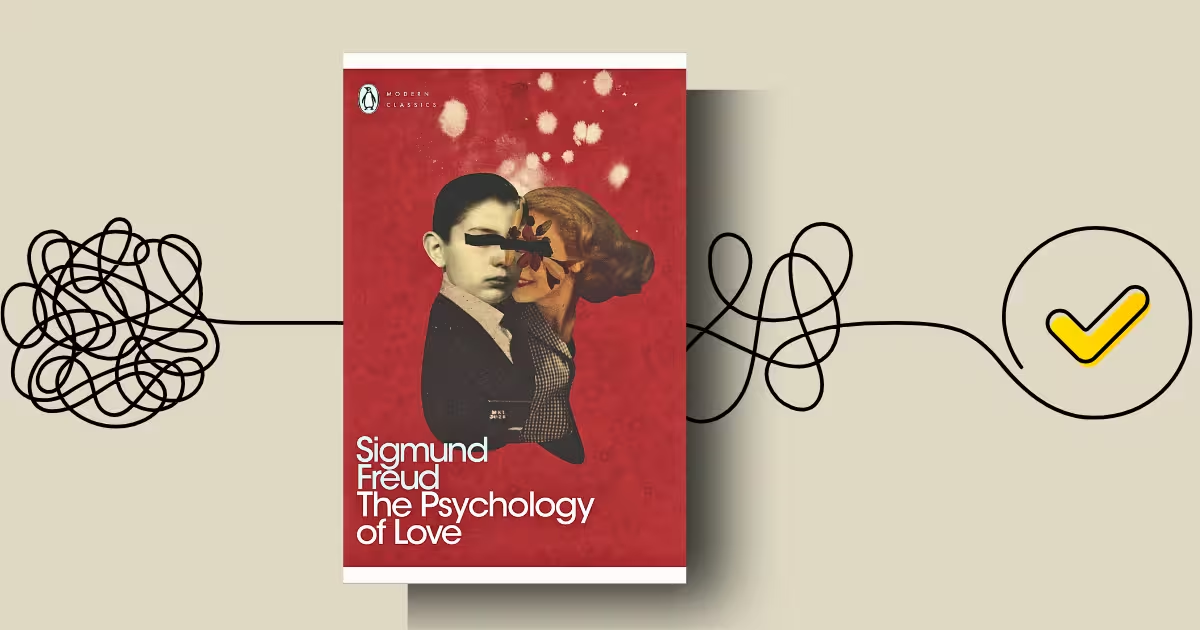
Do you ever catch yourself repeating the same painful patterns in relationships, wondering why you’re drawn to people who are unavailable, or why genuine intimacy feels somehow threatening? According to Sigmund Freud, the answers lie buried in your childhood, and they’re far stranger than you might imagine. The Psychology of Love isn’t just a dusty collection of century-old theories; it’s a confrontation with the uncomfortable truth that our erotic lives are shaped by forces we barely understand.
This collection of Freud’s most provocative writings on love, sexuality, and desire forces us to ask: how much of who we love is actually a choice?
Overview
What It Is: A compilation of Sigmund Freud’s key papers on love and sexuality, translated by Shaun Whiteside with an introduction by Jeri Johnson, published by Penguin Classics in 2006. The volume brings together eight of Freud’s most influential works, including the famous “Dora” case study, Three Essays on Sexual Theory, and later papers like “On Female Sexuality.”
The Core Argument: Freud argues that human love is fundamentally rooted in infantile sexuality. The way we love as adults, our object choices, our fantasies, our fears and inhibitions, is a repetition and transformation of our earliest, often unconscious, desires for our parents. As the introduction puts it, “knowing has everything to do with sex”.
There is no sexuality without fantasy, and these fantasies are shaped in the crucible of childhood.
What You’ll Walk Away With: A framework for understanding why you might be drawn to “the wrong type,” why intimacy can feel threatening, and how your earliest relationships set the template for your erotic life. You’ll also gain insight into Freud’s controversial theories on the Oedipus complex, penis envy, and the nature of perversion.
Reader suggestion
The Psychology of Love is suggested to:
- Students of psychology, psychoanalysis, or the history of ideas who want to engage with Freud’s foundational texts.
- Readers interested in the intersection of sexuality, fantasy, and human behavior.
- Those who appreciate intellectual history and are willing to grapple with dense, often unsettling ideas.
- Anyone curious about the origins of modern concepts like the “Oedipus complex” or “penis envy.”
I do not suggest The Psychology of Love to:
- Readers looking for practical relationship advice or a “how-to” guide for love.
- Those who prefer contemporary, evidence-based psychology and are easily frustrated by outdated or unscientific claims.
- Anyone seeking a comforting or affirming view of human nature, Freud is relentlessly unsentimental.
Table of Contents
Introduction
The Psychology of Love is a collection of writings by Sigmund Freud (1856–1939), the founder of psychoanalysis. This Penguin Classics edition, published in 2006, features translations by Shaun Whiteside and an introduction by Jeri Johnson, with Adam Phillips as the general editor. The book brings together Freud’s main contributions to the psychology of love, including his famous case study of “Dora”.
Freud’s credentials are formidable, if controversial. Born in Moravia, he spent most of his life in Vienna before fleeing the Nazis to London in 1938. He began his career in anatomy and physiology before turning to psychology, eventually creating psychoanalysis, a method of treating neurotic patients through talking that evolved into a comprehensive theory of the mind. His ideas have “shaped not only many specialist disciplines, but also the whole intellectual climate of the twentieth century”.
Context
The book is about the psychosexual foundations of human love. Freud’s central claim is that “sexuality is always psychosexuality—that there is no sexuality without fantasy, conscious or unconscious”. This collection examines the nature of desire, transgression, fantasy, and erotic taboo.
Purpose
The book’s primary thesis is that our adult love lives are determined by our infantile sexual experiences and fantasies. As Freud puts it in Three Essays on Sexual Theory, “the discovery of the object is in fact a rediscovery”. We are forever seeking to recreate the intense, ambivalent relationships of our childhood.
Background: The Development of Freud’s Ideas
To understand The Psychology of Love, it helps to know a bit about the intellectual context. Freud’s theories emerged in the late 19th and early 20th centuries, a time when Victorian morality was beginning to crack.
The Seduction Theory and Its Abandonment
Initially, Freud believed that his hysterical patients had been sexually abused as children. In 1896, he presented this “seduction theory” to the Viennese Society for Psychiatry and Neurology, claiming that “these sexual traumas must have occurred in early childhood… and their content must consist of an actual irritation of the genitals”. He was met with ridicule; Richard von Krafft-Ebing dismissed it as “a scientific fairy tale”.
By 1897, Freud had abandoned this theory, concluding that his patients’ “memories” were often fantasies. This led to a crucial insight: “If hysterical subjects trace back their symptoms to traumas that are fictitious, then the new fact which emerges is precisely that they create such scenes in phantasy”. This shift paved the way for his theory of infantile sexuality.
The Oedipus Complex
In a letter to his friend Wilhelm Fliess in 1897, Freud wrote:
“I have found, in my own case too, [the phenomenon of] being in love with my mother and jealous of my father, and I now consider it a universal event in early childhood… If this is so, we can understand the gripping power of Oedipus Rex… the Greek legend seizes upon a compulsion which everyone recognizes because he senses its existence within himself.”
This became the cornerstone of his theory: the Oedipus complex, the child’s unconscious desire for the parent of the opposite sex and rivalry with the parent of the same sex.
The Psychology of Love Summary
Reading The Psychology of Love is like having a brilliant, unsettling conversation with a man who refuses to let you cling to comfortable illusions. Here’s what I took away from each major section.
1. Fragment of an Analysis of Hysteria (Dora)
This is the centerpiece of the collection, the famous case study of an eighteen-year-old girl Freud calls “Dora” (actually Ida Bauer). Dora’s father brought her to Freud after she threatened suicide and had a fainting fit.
The clinical picture is a tangled web of love, desire, and betrayal. Dora’s father is having an affair with Frau K., the wife of a family friend, Herr K. Meanwhile, Herr K. has made sexual advances toward Dora. Dora is furious with her father, believing she has been “handed over to Herr K. as a price for his tolerating the relations between Dora’s father and his wife”.
Dora’s Symptoms: She suffers from nervous coughing, loss of voice, migraines, mood swings, and a taedium vitae (weariness of life). Freud interprets these symptoms as expressions of her unconscious sexual desires.
The Kiss in the Shop: Dora recounts an earlier incident when she was fourteen: Herr K. pulled her to him and pressed a kiss on her lips. Instead of feeling sexual excitement, Dora felt “violent revulsion” and disgust. Freud interprets this as a hysterical reaction, a displacement of sensation from the genitals to the throat.
The First Dream: Dora dreams of a house on fire, her father waking her, and her mother wanting to save a jewelry box. Freud interprets the dream as expressing Dora’s unconscious desire to flee Herr K.’s advances and return to her father’s protection. The “jewelry box” is a symbol for the female genitals.
The Second Dream: Dora dreams of wandering in a strange town, receiving a letter that her father has died, and being unable to find the station. Freud interprets this as expressing her unconscious love for Herr K. and her fantasy of having a child with him.
Why Dora Walked Out: After eleven weeks, Dora abruptly ended the treatment. Freud later admitted he had failed to recognize the significance of her “homosexual (gynaecophilic) feelings of love for Frau K.”—”the strongest of the unconscious currents in her mental life”.
My Take: The Dora case is both fascinating and deeply problematic. Freud is brilliant at uncovering hidden meanings, but he’s also dogmatic and, at times, dismissive of Dora’s perspective. He assumes her symptoms are expressions of sexual desire, but he fails to see how she might be a victim of the adults around her.
As the BBC notes, “Dora, a vulnerable teenager, was badly let down by Freud”.
2. Three Essays on Sexual Theory (1905)
This is Freud’s foundational text on sexuality, divided into three parts.
Essay I: The Sexual Deviations: Freud examines “perversions”, deviations in sexual object and goal. He argues that “the sexual drive is probably at first independent of its object”. In other words, we aren’t born with a predetermined sexual orientation. Instead, the sexual drive is “polymorphously perverse” in childhood—capable of finding satisfaction through any number of objects and activities.
Key points:
Inversion (Homosexuality): Freud argues that “all people are capable of same-sex object-choices” and that “the independence of the object-choice from the sex of the object… seems to be the original basis”.
Fetishism: The substitution of a body part or object for the sexual object.
Sadism and Masochism: The inclination to cause or receive pain in a sexual context.
Essay II: Infantile Sexuality: This is where Freud makes his most radical claim: children are sexual beings. He argues that “the seeds of sexual impulses are already present in new-born babies”.
Key concepts:
Auto-eroticism: The child’s sexual drive is initially directed toward its own body, not others.
Erogenous Zones: The mouth, anus, and genitals are sources of sexual pleasure.
Thumb-sucking: Freud uses this as a model for infantile sexuality, arguing that it is “a form of sexual expression”.
The Latency Period: From about age five to puberty, sexual impulses are repressed, and “mental forces… such as disgust, the feeling of shame, the aesthetic and moral requirements of the ideal” are constructed.
Polymorphous Perversity: The child’s sexual drive is capable of finding satisfaction through any number of objects and activities.
Essay III: The Transformations of Puberty: Freud describes how the diffuse, auto-erotic sexuality of childhood becomes organized under the “primacy of the genital zones”. The goal is now reproduction, and the object is another person.
Key concepts:
The Libido: “A quantitatively changeable force enabling us to measure processes and transformations within the realm of sexual excitement”.
Object-choice: The process of finding a sexual object.
The Barrier Against Incest: The cultural prohibition on choosing one’s parents as sexual objects, which forces the adolescent to seek objects outside the family.
My Take: Three Essays is a revolutionary work that challenges everything we thought we knew about childhood and sexuality. Freud’s insistence that children are sexual beings was shocking in 1905 and remains controversial today. But his emphasis on the formative power of childhood experience has had an enduring influence.
3. On the Sexual Theories of Children (1908)
Freud explores how children develop theories about sex, often in the face of adult evasion and misinformation.
The Stork Theory: Children are told that the stork brings babies, but they often respond with “energetic doubt”. This creates a “psychical conflict” between what adults say and what the child suspects.
The Castration Complex: The boy assumes everyone has a penis. When he sees a girl’s genitals, he concludes she has been castrated. This leads to “penis-envy” in girls and “castration anxiety” in boys.
The Cloacal Theory of Birth: Children often believe babies are born through the anus, like feces. This theory is “the most natural and the only one that the child would consider likely”.
The Sadistic View of Coitus: If children witness parental intercourse, they often interpret it as an act of violence.
My Take: This essay is a testament to Freud’s genius as an observer of children. He captures the way children try to make sense of a world that adults refuse to explain honestly.
4. Contributions to the Psychology of Erotic Life (1910–1918)
This section contains three papers on specific aspects of love.
I. Concerning a Particular Type of Object-choice in Men: Freud describes a type of man who can only love women who are already in a relationship or who have a “bad sexual reputation”. He traces this to an unconscious desire for the mother and a need to “rescue” the beloved.
II. Concerning the Most Universal Debasement in the Erotic Life: Freud argues that civilized men often suffer from “psychical impotence” because they split love into two currents: the “affectionate” and the “sensual”. They can only feel full sexual desire for a “debased” object, not for the woman they respect.
III. The Virginity Taboo: Freud examines the widespread custom among primitive peoples of having someone other than the husband deflower the bride. He argues this is a defense against the woman’s “archaic reaction of hostility” to the man who first possesses her.
My Take: These essays are uncomfortable reading. Freud’s claims about male sexuality are often misogynistic, but they also contain genuine insights. The idea that we might split love and desire, or that we might seek out partners who remind us of our parents, is still relevant.
5. “A Child is Being Beaten” (1919)
Freud analyzes a common childhood fantasy: “a child is being beaten”. He traces it through three phases:
- “The father is beating the child” (sadistic, the child is a rival).
- “I am being beaten by my father” (masochistic, unconscious, based on guilt and love for the father).
- “A child is being beaten” (the child is a spectator, the father is replaced by a teacher).
Freud argues that this fantasy is a “residue” of the Oedipus complex.
My Take: This essay is a masterclass in psychoanalytic interpretation, showing how a seemingly simple fantasy can have a complex developmental history.
6. On Female Sexuality (1931)
In this late essay, Freud admits that he had neglected the study of female sexuality and that his “model child” was “definitely a boy”.
The Pre-Oedipal Phase: Freud argues that the girl’s first love object is her mother, and this attachment lasts much longer than previously thought, sometimes until the fourth or fifth year.
The Turn to the Father: The girl turns away from her mother because of disappointment (the mother didn’t give her a penis) and the influence of the castration complex.
Penis Envy: The girl’s realization that she lacks a penis leads to envy of the boy and a desire to be male.
My Take: This essay is an attempt to correct a glaring gap in Freud’s theory, but it remains deeply problematic. The concept of “penis envy” has been justly criticized as phallocentric and misogynistic.
The Psychology of Love Analysis
Reading The Psychology of Love is an experience of intellectual vertigo. Freud’s insights are often brilliant, but his conclusions are frequently infuriating. He forces you to confront uncomfortable truths about human nature, but he also reveals his own biases and blind spots.
What Works
The Interpretive Power: Freud’s method of uncovering hidden meanings in symptoms, dreams, and fantasies is genuinely illuminating. He shows how seemingly trivial details can reveal deep-seated conflicts.
The Emphasis on Childhood: Freud’s insistence that our adult lives are shaped by our earliest experiences is a lasting contribution. He made us take childhood seriously.
The Courage to Be Unpopular: Freud was willing to challenge the moral certainties of his time. He insisted that sexuality is a fundamental part of human nature, not something to be denied or repressed.
What Doesn’t Work
The Phallocentrism: Freud’s theory is built around the male experience. Women are defined by their “lack” (of a penis), and female sexuality is seen as a deviation from the male norm. As one Goodreads reviewer put it, “I never rolled my eyes so badly” at the concept of “penis envy”.
The Lack of Empirical Evidence: Freud’s theories are based on clinical observation, not controlled experiments. As another reviewer notes, “most of them don’t have any scientific base”. His claims are often unfalsifiable.
The Dogmatism: Freud was often unwilling to entertain alternative interpretations. In the Dora case, he assumes that her symptoms are expressions of sexual desire, but he fails to see how she might be a victim of abuse.
The Misogyny: Freud’s views on women are deeply problematic. He sees women as “castrated” men, and he assumes that their natural destiny is to be passive and submissive.
Strengths and Weaknesses
Strengths
Groundbreaking insights: Freud’s theories on infantile sexuality, the Oedipus complex, and the role of fantasy in desire have had a profound impact on Western culture.
Rigorous analysis: Freud’s interpretive method is meticulous and often brilliant.
Intellectual courage: Freud was willing to challenge the moral certainties of his time.
Weaknesses
Phallocentrism and misogyny: Freud’s theories are built around the male experience and often denigrate women.
Lack of empirical evidence: His claims are often unfalsifiable and based on clinical observation, not controlled experiments.
Dogmatism: Freud was often unwilling to entertain alternative interpretations.
Outdated language and concepts: The book uses terms like “perversion” and “degeneracy” that are no longer acceptable.
Comparison with Similar Works
Compared to contemporary works on love and sexuality, The Psychology of Love feels dated and often offensive. However, it’s important to read it in its historical context.
Compared to The Interpretation of Dreams: The Psychology of Love applies the interpretive methods of dream analysis to the study of love and sexuality.
Compared to the work of Carl Jung: Jung broke with Freud over the centrality of sexuality, arguing for a more spiritual view of human nature.
Compared to contemporary psychology: Modern psychology has largely rejected Freud’s specific claims, but it has absorbed his broader emphasis on the importance of childhood and the unconscious.
Conclusion
I must admit, The Psychology of Love is not an easy read. It’s dense, unsettling, and often infuriating. But it’s also a work of immense intellectual ambition and insight.
Who Should Read It: Students of psychology, intellectual history, or anyone who wants to understand the origins of modern ideas about love and sexuality. It’s also essential reading for anyone who wants to engage critically with Freud’s legacy.
Who Should Avoid It: Readers looking for practical relationship advice or a comforting view of human nature. It’s also not for those who are easily offended by outdated and misogynistic language.
Final Verdict: The Psychology of Love is a flawed but essential work. It forces us to confront the uncomfortable truth that our erotic lives are shaped by forces we barely understand.
Love, for Freud, is never simple; it’s always entangled with desire, fantasy, and the ghosts of our past.







